Finding the best health insurance for expats isn’t just a box to tick—it’s about securing a plan designed for a global lifestyle. Why? Because your standard, home-country policy likely offers zero coverage the moment you step on foreign soil.
A proper expat medical insurance plan gives you worldwide access to care, covers emergency medical evacuations, and works with a network of hospitals that bill the insurer directly. It’s your financial and physical safety net, rolled into one.
Why Your Standard Health Plan Is Not Enough Abroad

Moving to a new country is an incredible adventure, but relying on your domestic health insurance is a huge gamble. Most of these plans are geographically locked, meaning their coverage simply evaporates at your home country’s border. This leaves you completely exposed to the full, often staggering, cost of medical care abroad.
Think of your home insurance plan like a key that only unlocks doors in your specific city. The second you drive to the next town over, that key is useless. In the same way, your local health plan won’t open the doors to hospitals or clinics in your new host country. You’ll be on the hook, out-of-pocket, for everything from a simple check-up to a life-threatening emergency.
The True Cost of Inadequate Coverage
Without the right protection, a sudden illness or accident can quickly spiral into a financial nightmare. Healthcare costs in many popular expat hubs, from Singapore to the United States, are among the highest in the world. Even a seemingly minor incident could saddle you with bills totaling tens of thousands of dollars.
An expat medical insurance plan acts as a universal key, granting you access to quality healthcare facilities worldwide. It’s designed specifically for the challenges of living abroad, providing a safety net that domestic plans simply cannot offer.
This is where understanding your options becomes absolutely critical. And as we dig into why your standard plan falls short, it’s also vital to grasp the key differences between travel insurance and health insurance. A travel policy is for short-term vacation mishaps; it completely lacks the comprehensive, long-term coverage you need when you’re actually living overseas.
The Pillars of Expat Medical Protection
The best expat medical insurance is built on a few core benefits tailored specifically to the needs of a global citizen. These pillars ensure you’re protected, no matter where your journey takes you.
- Worldwide Coverage: This is the non-negotiable foundation. It ensures you have access to medical care in your new country and often globally (though some plans exclude high-cost countries like the USA to keep premiums down).
- Emergency Medical Evacuation: If you suffer a serious injury or fall ill in a place with inadequate medical facilities, this benefit covers the cost of transporting you to the nearest top-tier hospital. It can literally be a lifesaver.
- Direct-Billing Networks: This feature is a game-changer. It allows the hospital to bill your insurance company directly, saving you from having to pay massive sums upfront and then fight for reimbursement later.
In the end, specialized expat medical insurance isn’t just another policy. It’s peace of mind. It’s the assurance that your health and your finances are secure, freeing you up to fully embrace your adventure abroad.
Decoding the Different Types of Expat Medical Plans
Diving into the world of expat medical insurance can feel like learning a new language. With so many terms and options floating around, it’s easy to get lost. The key is to realize these plans aren’t one-size-fits-all; they exist on a spectrum designed for every kind of life abroad, from the solo digital nomad to a family putting down roots.
At its heart, expat medical insurance isn’t a single product. It’s a whole category of plans built for people living long-term in another country. The biggest point of confusion? Mistaking it for travel insurance. Getting this distinction right from the start is absolutely critical.
Travel insurance is your short-term safety net for vacation mishaps. Expat health insurance is your primary, long-term health plan for your new life abroad, covering everything from routine check-ups to major medical emergencies.
The Spectrum of Coverage: Good, Better, Best
To make sense of the options, let’s break them down into three main categories. Think of it as a “good, better, best” framework, where each level is built for a different need and budget.
- Essential (Good): This is your catastrophic coverage, plain and simple. These plans are laser-focused on inpatient care—that means the costs you rack up when you’re actually admitted to a hospital. They’re designed to shield you from the financially crushing blow of a major surgery or a serious accident. For a young, healthy expat on a tight budget, it’s a solid baseline.
- Standard (Better): This tier brings outpatient services into the picture. It covers everything from the Essential plan plus things like visits to your family doctor, specialist consultations, and diagnostic tests like X-rays or blood work. This is a much more balanced approach for anyone who wants coverage for day-to-day health needs without paying for every possible benefit.
- Comprehensive (Best): This is the full-service, all-inclusive option. It wraps up inpatient and outpatient care and then adds a whole suite of wellness and preventative benefits. We’re talking dental and vision, maternity care, mental health support, and annual health screenings. This is easily the best health insurance for expats with families or anyone who simply wants complete peace of mind.
Why This Market is Growing
It’s no surprise that the demand for these specialized plans is exploding. The global expat insurance market was valued at around USD 331 million in 2024 and is projected to climb to USD 355 million by 2025. What’s driving this? More than 87 million skilled professionals are living and working abroad, and they all need robust health coverage that their old domestic plans just can’t provide. You can dig into more insights on this expanding market at intelmarketresearch.com.
Tying It All Together
So, which plan is right for you? It comes down to your personal situation. Are you just looking for a financial shield against a worst-case scenario, or do you need a plan that supports your family’s routine medical care? Answering that question will point you directly to the right tier of coverage.
Knowing the difference between plan types is the first big step. But understanding how these plans actually deliver care through their networks of doctors and hospitals is just as crucial. For a deeper look into how these provider networks function on a global scale, check out our guide on understanding international health networks for expats. This piece will help you pick a plan that not only fits your budget but also gives you access to the best care wherever you call home.
The Must-Have Features in Every Expat Health Policy
When you’re trying to figure out which expat medical insurance plan is right for you, it’s easy to get lost in the details. But if you cut through the noise, a few core features are what really separate a solid, dependable plan from one that might let you down. Knowing what these non-negotiables are is the key to protecting your health and your wallet while living abroad.
Think of it like inspecting a car before a long road trip. You wouldn’t just check the paint job; you’d get under the hood to look at the engine, check the tires, and make sure the brakes are solid. It’s the same deal here. You need to look past the shiny brochure and examine the real engine of the policy.
Defining Your Area of Coverage
One of the first and most important decisions you’ll make is your area of coverage. This simply determines the geographical regions where your policy will actually work. Most insurers boil this down to two main options: “Worldwide” and “Worldwide excluding the USA.”
Here’s a tip that can save you a bundle: choosing a “Worldwide excluding the USA” plan can slash your premium, sometimes by as much as 30-50%. Why the huge difference? Healthcare in the United States is notoriously expensive, and including it in your plan drives up the price for everyone. If you don’t plan on spending much, if any, time there, excluding it is one of the smartest moves you can make.
You’ll find that plans generally fall into a few tiers, from the essentials to the all-inclusive options.
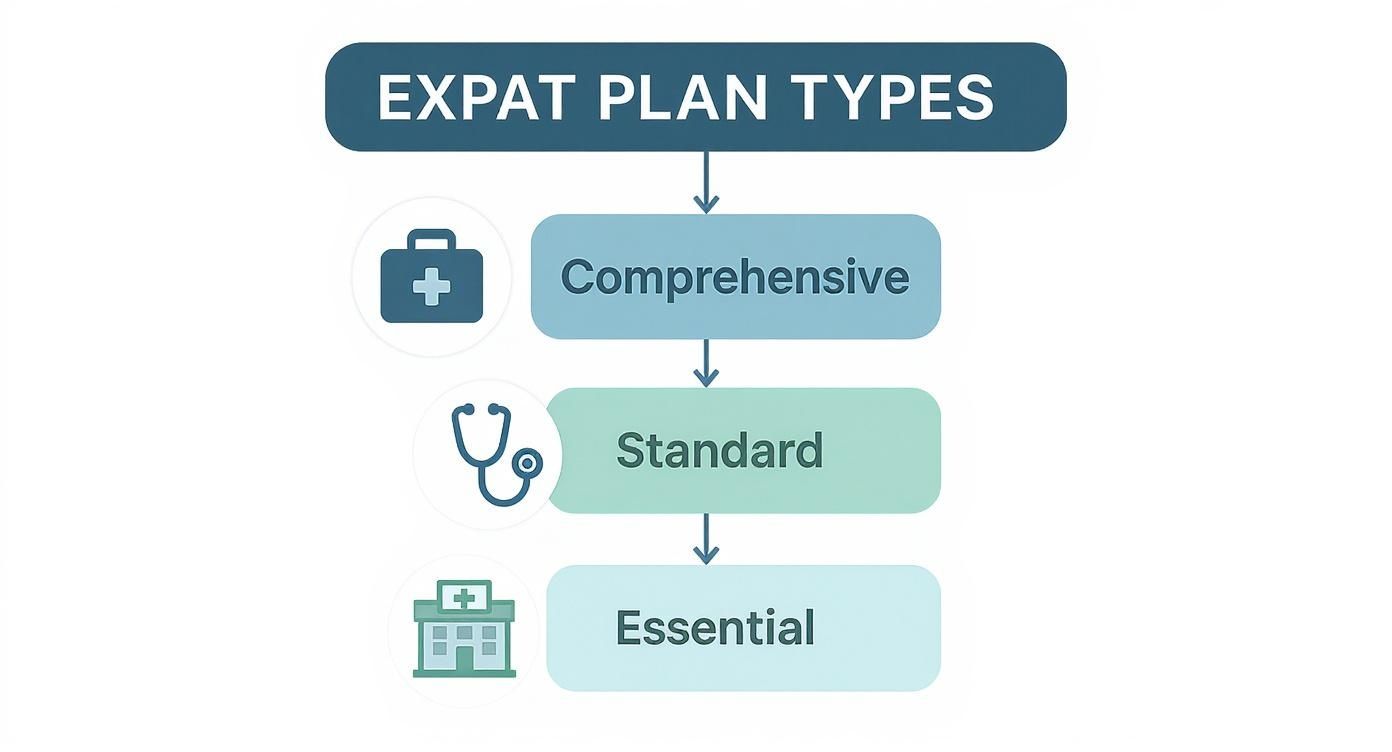
As you can see, essential plans have your back for major hospital stays, but the comprehensive policies add those extra layers like outpatient care and wellness benefits for a complete health safety net.
The Power of a Strong Direct-Billing Network
Picture this: you’re hospitalized in a foreign country. On top of the stress of being sick, you’re handed a bill for thousands of dollars that you have to pay upfront before you can even be discharged. A robust direct-billing hospital network is designed to prevent exactly that nightmare.
This feature means the hospital sends the bill straight to your insurance company. You just show your insurance card, and the money side of things gets handled behind the scenes. It’s the difference between a smooth, stress-free process and a logistical headache involving huge out-of-pocket payments and a long wait for reimbursement.
When you’re comparing plans, don’t just ask if there’s a direct-billing network. Ask for the list of in-network hospitals in your specific city or country. After all, access to care is only useful if it’s right where you live.
Understanding Medical Evacuation and Repatriation
For many expats, especially those living in more remote spots or in countries with developing healthcare, medical evacuation and repatriation coverage are absolute lifelines. The terms are often used together, but they cover two different, critical situations.
- Medical Evacuation: This pays to get you to the nearest top-notch medical facility if the local hospitals can’t handle your condition. It could be an ambulance ride to a better hospital in a nearby city or even a chartered medical flight to a different country.
- Repatriation: This covers the cost of getting you back to your home country for treatment. This is usually an option when your condition is stable enough for a longer journey, allowing you to recover near family.
These services can be unbelievably expensive out-of-pocket. An emergency medical flight can easily top $100,000. Having this coverage means that in a worst-case scenario, you can focus on your health, not the staggering cost of getting to the right hospital. For a deeper dive, check out our guide on how emergency air evacuation insurance works.
Let’s break these crucial features down side-by-side to see why they’re so important for every expat.
Critical Feature Comparison for Expat Insurance Plans
This table compares essential features across different tiers of expat health insurance to help you identify must-have components for your specific needs.
| Feature | What It Means | Why It Matters for Expats | Consideration Level |
|---|---|---|---|
| Area of Coverage | The specific countries or regions where your health plan provides coverage. Typically “Worldwide” or “Worldwide excluding the USA.” | Directly impacts your premium costs. Excluding high-cost countries like the USA can save you 30-50% if you don’t need coverage there. | Essential |
| Direct-Billing Network | A network of hospitals and clinics where the insurer pays the medical bills directly, so you don’t have to pay out-of-pocket first. | Avoids massive upfront payments and the hassle of filing for reimbursement. It provides financial peace of mind during a medical emergency. | Essential |
| Medical Evacuation | Covers the cost of transporting you to the nearest suitable medical facility if local care is inadequate. | A true lifeline in remote areas or countries with underdeveloped healthcare. An emergency flight can cost over $100,000 without this coverage. | Essential |
| Repatriation of Remains | Covers the cost of transporting your remains back to your home country in the event of death. | Provides financial and logistical relief to your family during an incredibly difficult time, handling complex international arrangements. | Highly Recommended |
| Outpatient Coverage | Covers medical care that doesn’t require a hospital stay, like doctor’s visits, specialist consultations, and diagnostic tests. | Crucial for managing day-to-day health, chronic conditions, and getting preventive care without dipping into your savings. | Highly Recommended |
| Pre-existing Conditions | Coverage for health issues you had before the policy started. | If you have a known condition, this is non-negotiable. Without it, you could be on the hook for all related treatment costs. | Must-Have (if applicable) |
Focusing on these key features ensures your policy is built on a strong foundation. They provide the practical, real-world protection that defines the best expat medical insurance, giving you security no matter where your journey takes you.
How Your Destination Shapes Your Insurance Needs
Picking the right expat medical insurance for your life abroad isn’t like grabbing a generic plan off the shelf. It’s more like choosing the right gear for a specific expedition. A policy that works perfectly for the well-paved roads of Western Europe will leave you dangerously exposed on the rugged terrain of a developing nation.
Where you’re going is, without a doubt, one of the biggest factors in your insurance decision. Every country has its own unique mix of healthcare quality, costs, and legal hoops to jump through. A one-size-fits-all plan simply doesn’t cut it. Ignoring these local details can mean ending up with a policy that gets your visa denied or, worse, fails you when you actually need medical care.
Legal and Visa Mandates
For a lot of expats, the insurance conversation begins with a very practical question: what does the law demand? More and more countries are making proof of health insurance a non-negotiable part of the visa or residency process. They need to know you won’t become a drain on their public healthcare system.
This creates a pretty clear split between different kinds of expat destinations.
- Countries with Strict Requirements: Places like Germany, the UAE, and France have firm rules. You won’t get your visa approved unless you show up with a policy that meets their specific minimums. In Dubai, for instance, every single resident—expats included—is required by law to have health insurance.
- Countries with Fewer Requirements: On the flip side, many spots popular with digital nomads in Southeast Asia or Latin America have more laid-back entry rules. This gives you more freedom, but it also puts all the responsibility on your shoulders to make sure you’re properly covered without any government nudging.
Don’t underestimate this step. Failing to meet a country’s mandatory insurance rules isn’t a small hiccup—it can lead to a denied visa, deportation, or hefty fines. Always start by researching the specific legal requirements for your destination before you even start comparing plans.
The Quality and Cost of Local Healthcare
Beyond what the law says, the day-to-day reality of a country’s healthcare system has to guide your choice. The quality of care, how easy it is to access, and what it costs can be wildly different from one capital city to the next. You have to be honest about the local infrastructure.
Let’s look at two completely different scenarios:
- High-Cost, High-Quality Private Care: If you’re moving to a place like Singapore or Hong Kong, you’ll have access to some of the best doctors and hospitals in the world. But that world-class quality comes with a world-class price tag. A single night in a private hospital can easily run into the thousands. Here, a comprehensive plan with a high coverage limit isn’t a luxury; it’s essential protection against financially devastating bills.
- Developing or Overburdened Public Systems: In many other countries, the public healthcare system might be underfunded, understaffed, and plagued by long wait times. Expats in these locations almost exclusively turn to private clinics and hospitals. For you, the most important feature of an insurance plan is a strong network of these private facilities to make sure you can get timely, quality care when you need it.
Ultimately, your policy has to be a direct answer to your environment. In a country with amazing but expensive healthcare, high coverage limits are your priority. In a place where the public system is struggling, your focus has to be on ensuring access to a solid private network. This is how you turn a generic policy into the best health insurance for your new life abroad.
Comparing Top Providers in the Expat Insurance Market
Once you’ve figured out what you absolutely need in a policy, the next question is, where do you get it? The world of expat medical insurance is dominated by a handful of major players, and each one has its own personality and approach. The goal isn’t to find the one “best” provider, but to find the one that’s the best fit for you.
This isn’t an exhaustive list, but let’s look at the heavyweights: Cigna Global, William Russell, and Now Health International. Understanding what makes each of them tick gives you a solid starting point for your research, helping you zero in on the right choice before you start chasing down quotes.
Cigna Global: A Leader in Customization
For many seasoned expats, Cigna Global is the first name that comes to mind—and for good reason. Their biggest strength is how modular their plans are. Think of it like building your perfect plan from a menu of high-quality options.
You start with a core inpatient plan (Silver, Gold, or Platinum) and then bolt on the extras you need. These optional modules include things like:
- Outpatient services
- Medical evacuation
- Health and wellness checks
- Vision and dental coverage
This pick-and-choose style is fantastic for expats who know exactly what they want and don’t want to pay a dime for benefits they’ll never touch. Add in their massive direct-billing network and rock-solid financial reputation, and you’ve got a reliable choice for global citizens who demand both flexibility and security.
William Russell: A Focus on Service and Simplicity
While Cigna is all about customization, William Russell has carved out its niche with exceptional customer service and refreshingly straightforward plans. You’ll often hear expats praise them for their responsive support teams and policies that are actually easy to understand—a huge plus when you’re dealing with a stressful medical issue in a foreign country.
Their plans are less modular, but they’re designed to be comprehensive right out of the box. This often appeals to families and professionals who value simplicity and dependable support more than granular control. William Russell offers clear tiers that bundle benefits logically, taking a lot of the guesswork out of the whole process.
Now Health International: Modern and Tech-Forward
Now Health International is built for the modern expat, with a serious emphasis on digital convenience. Their online portals and mobile apps are slick and designed for painless claims submission and policy management. For tech-savvy digital nomads and busy professionals, this is a game-changer.
Their whole philosophy is about making the insurance experience as frictionless as possible. They’re also known for having particularly strong networks in Asia and the Middle East, making them a top contender if you’re relocating to those regions. Their plans are often priced very competitively, striking a great balance between solid coverage and modern ease of use.
By 2025, the international health insurance market has become dominated by a few key providers known for financial stability. For instance, Cigna Global, founded in 1982, remains a leading insurer with an A rating from A.M. Best, signaling strong financial health. Other prominent companies include William Russell and Now Health International (rated A+ by A.M. Best), which provide tailored options to meet diverse expat needs.
Beyond the providers themselves, it’s also helpful to know about the other players in the market, like acceptance agencies. You can learn more by Understanding insurance acceptance agencies to get a fuller picture of how everything fits together.
Ultimately, choosing between these top-tier companies really boils down to what you prioritize. Do you value customization, customer service, or digital convenience? Answering that simple question will almost certainly point you toward the right provider for your life abroad.
For a much more detailed comparison, check out our guide on the best global health insurance providers. It dives even deeper to help you make a decision you can feel confident about.
A Simple Framework for Making Your Final Decision

Alright, we’ve covered a lot of ground. Now, how do you turn all this information into a confident decision? It’s not as daunting as it seems if you follow a clear, step-by-step process.
This framework is your personal roadmap. We’ll walk through it together, moving from a quick self-assessment to your final policy choice, making sure you land on the best health insurance for your specific expat journey.
The first step has nothing to do with insurance companies. It’s about looking inward. Before you even glance at a policy, you need a crystal-clear picture of your own health profile and lifestyle. Are you managing any chronic conditions? Or are you just looking for a safety net for major emergencies?
From there, think about your travel style. Will you be setting up shop in one country, or is your life a series of cross-border adventures? Your answers here will point you toward either a localized plan or a broader worldwide one.
Step 1: Assess Your Personal Profile
Let’s start by creating a simple health inventory. This isn’t just about ticking boxes for pre-existing conditions; it’s about being real about what you and your family might need down the road. After all, a young family’s needs are worlds apart from a solo digital nomad’s.
- Your Health Needs: Jot down any ongoing medical conditions, prescriptions you rely on, or potential future needs like maternity care. Be honest and thorough—no one else needs to see this.
- Your Lifestyle: What do you do for fun? An avid skier or scuba diver should probably look for a plan with solid sports injury coverage.
- Your Dependents: If you’re moving with family, your checklist expands. You’ll need to think about pediatric care, dental options, and what it costs to cover multiple people under one umbrella.
Step 2: Define Your Budget and Priorities
Next up, let’s talk money. While it’s tempting to grab the cheapest option and call it a day, remember that insurance is about value, not just price. Figure out what you can comfortably afford each month, but just as importantly, decide on your non-negotiables.
Is having emergency medical evacuation your absolute top priority? Or is it more important to have access to a wide network for simple outpatient visits?
A policy with a higher deductible can significantly lower your monthly premium, but it means you’ll pay more out-of-pocket before coverage kicks in. Find the right balance between what you pay now and what you could comfortably pay during a medical event.
Step 3: Compare Quotes and Scrutinize the Details
With your needs and budget mapped out, it’s time to gather some quotes. But when you get them, you have to look beyond the big number on the front page. The real story is always in the fine print.
This is where you dig into the policy documents. Pay close attention to exclusions, coverage limits, and the actual process for making a claim. Don’t be shy about asking direct questions: “What is the direct-billing network like in my specific city?” or “How exactly are pre-existing conditions handled under this plan?”
Getting proactive now helps you avoid nasty surprises later. Follow these steps, and you can confidently pick a policy that offers genuine peace of mind for your life abroad.
Got Questions About Expat Medical Insurance? We’ve Got Answers.
Stepping into the world of international medical coverage can feel like learning a new language. You’ve probably got a dozen questions swimming around, and getting straight answers is the only way to move forward with confidence.
Let’s cut through the noise. Most of the confusion boils down to a few key areas: understanding what makes one policy different from another and figuring out how your own health history plays into the equation. Here are the most common questions we hear every day.
What’s the Real Difference Between Expat Medical and Travel Insurance?
Think of it this way: expat medical insurance is your new primary health plan for your life abroad. It’s built for the long haul—typically for anyone living outside their home country for a year or more. It covers you for everything from routine doctor’s visits and specialist appointments to emergencies, just like your plan back home would.
Travel insurance, on the other hand, is a short-term safety net. It’s designed for a specific trip, like a two-week vacation, and really only kicks in for emergencies. It won’t cover your annual check-up or manage an ongoing condition. Mistaking one for the other is a common—and potentially very expensive—blunder.
How Do Insurers Handle Pre-Existing Conditions?
This is a huge one, and the answer varies a lot between insurance providers. The most important rule? Be completely honest on your application. Hiding a condition is a surefire way to get a claim denied when you need it most.
When you disclose a pre-existing condition, you’ll usually run into one of these three outcomes:
- Exclusion: The insurer offers you a policy but states it will not cover any costs related to that specific condition.
- Waiting Period: Some plans will agree to cover the condition, but only after you’ve been on the policy for a set amount of time, often up to 24 months.
- Coverage with a Higher Premium: Better-tier plans might cover your condition right from the start but will charge you more each month to balance out the higher risk.
Will My Expat Plan Cover Me in My Home Country?
Most international medical plans do offer some coverage for when you pop back home for a visit. This is usually limited to a specific timeframe, like 30 to 90 days per year.
It’s critical to know that this home country coverage is almost always for emergencies or acute care only. It’s not meant for planned check-ups or routine treatments. If you plan on spending a good chunk of time back home, you need to read this clause in your policy very, very carefully.
How Does Making a Claim Work When I’m Living Abroad?
The simplest way is to use a provider’s “direct billing” network. You visit a hospital or clinic in the network, show your insurance card, and they bill the insurance company directly. No fuss, no upfront payments.
If you go outside that network, you’ll probably have to pay for the services yourself. You’ll then need to submit the receipts and medical reports to your insurer to get reimbursed. The good news is that most modern insurers have made this process pretty painless, letting you submit everything through an online portal or a mobile app.
Trying to piece all this together on your own can be overwhelming. That’s where an expert guide makes all the difference. The team at Expat Global Medical has been helping people just like you find the right protection since 1992. Let us give you a free quote and some personalized advice to find a plan that secures your health and your finances, wherever you decide to call home.