Thinking your health plan from back home has you covered for a new life abroad is an easy mistake to make, but it’s a risky one. The truth is, that plan was built for your home country’s healthcare system and is fundamentally unprepared for the realities of long-term international living as an expat.
Relying on it overseas is like expecting your local bank card to work at every ATM in another country without racking up huge fees—or worse, not working at all when you need it most. True peace of mind comes from a specialized expat medical insurance plan designed for a global lifestyle.
Why Your Home Health Plan Isn’t Expat Medical Insurance
Moving to a new country is an incredible adventure, but it also means you’re stepping into a completely different healthcare landscape. The insurance you counted on back home just wasn’t designed for the unique challenges of getting medical care as an expat. This disconnect can leave you financially exposed right when you need support the most.
Think of your domestic plan as a key cut for a very specific lock. It works perfectly within its own system—its network of doctors, hospitals, and billing codes. But when you move abroad, you’re suddenly faced with a whole new set of locks. Your old key won’t fit, leaving you to pay steep out-of-pocket costs for the care a proper expat plan would cover.
The Gaps in Domestic Coverage
The limitations of a home-based plan become painfully obvious once you look at the fine print. These policies are geographically restricted and often fail to cover even the most basic needs once you’re living in another country. A dedicated expat medical insurance plan is built to solve these problems.
Here are the key shortfalls of relying on a domestic plan:
- Restricted Provider Networks: Domestic plans are built on contracts with a specific list of local doctors and hospitals. Abroad, those networks are meaningless. Any care you get is considered “out-of-network,” which usually means it’s not covered at all by your old plan.
- Complex Claims Processing: Imagine trying to submit a claim from another country, in a different language, and using a different currency. Most domestic insurers just aren’t set up to handle that, leading to frustrating delays and outright denials.
- Lack of Emergency Support: Critical services like medical evacuation—transporting you to a better-equipped hospital or even back home—are almost never included in standard domestic plans, yet they are an essential feature of any good expat medical insurance policy.
A true expat medical insurance plan is designed from the ground up to fill these gaps. It provides the financial security and peace of mind you need to confidently manage your health, no matter where you are in the world. This is specialized coverage built for a global lifestyle.
To get a sense of how different these two types of plans really are, let’s break it down.
Domestic vs. Expat Health Insurance At a Glance
The table below offers a quick snapshot of the fundamental differences between the insurance you have at home and the coverage you need as an expat.
| Feature | Typical Domestic Health Insurance | Expat Medical Insurance |
|---|---|---|
| Geographic Coverage | Limited to a single country or region. | Global or multi-country coverage. |
| Provider Network | Restricted to in-network doctors and hospitals at home. | Extensive international network of providers. |
| Medical Evacuation | Rarely included; an expensive add-on if available. | Standard benefit in most comprehensive plans. |
| Claims Processing | Designed for a single currency and language. | Equipped to handle multi-currency, multi-language claims. |
| Plan Design | Built for long-term residency in one country. | Designed for a mobile, global lifestyle. |
As you can see, they are two completely different tools for two very different jobs. One is for staying put, the other is for living globally.
The growing number of people living and working abroad has fueled the need for this kind of specialized insurance. In fact, the global expatriate health insurance market was estimated at USD 17.6 billion in 2024 and is expected to keep growing. This trend shows just how many expats are realizing they need proper coverage.
For a deeper dive into why your specific home plan falls short, check out our guide on why U.S. health insurance doesn’t work abroad.
So, What Are Your International Coverage Options, Really?
Trying to pick the right health insurance for living abroad can feel a bit like learning a new language. You’re hit with a bunch of new terms and plan types, and each one seems built for a slightly different situation. Getting a handle on these options is the first, and most important, step to making a choice you feel good about—one that protects both your health and your wallet.
Think of it like this: you wouldn’t use a hammer to tighten a screw. The right tool depends on the job. The same logic applies here. Are you moving to Portugal for five years, or are you backpacking through Southeast Asia for three months? Your answer completely changes which type of plan makes sense, but for long-term living, the answer is always expat medical insurance.
This infographic breaks down the core differences between the insurance you’re used to back home and the specialized coverage you need for a global lifestyle.
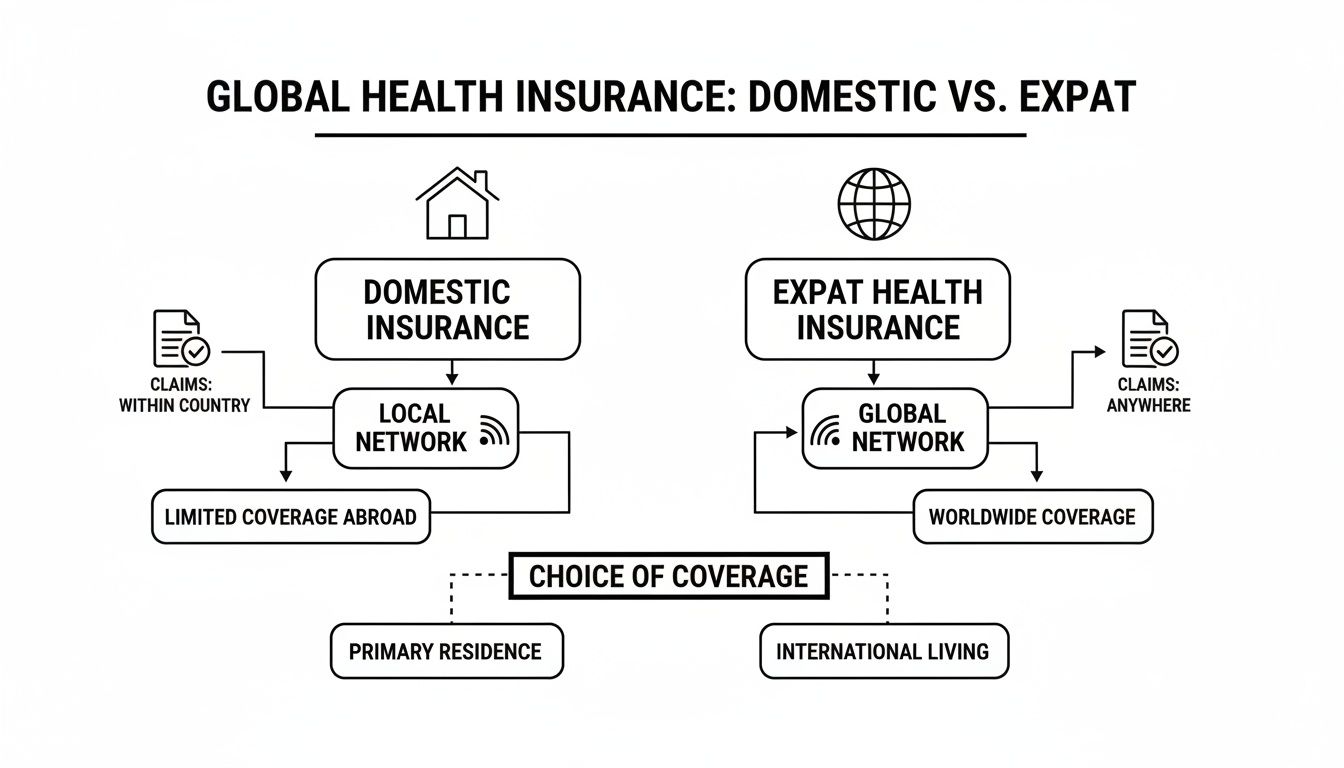
As you can see, while both types of plans deal with networks and claims, expat insurance is built from the ground up to work on a global scale. Domestic plans, on the other hand, are pretty much stuck within a single country’s borders.
Expat Medical Insurance: The Long-Term Solution
Expat medical insurance is the absolute cornerstone of healthcare for anyone living outside their home country for a year or more. It’s designed to work just like your primary health plan back home, but with a crucial difference: it has a global reach. These plans offer thorough, comprehensive coverage for a whole host of medical needs.
We’re talking about everything from emergency hospital stays and major surgeries to routine doctor visits, annual wellness checks, and prescription drugs. Because it’s built for residents, not tourists, it gives you the continuous, reliable coverage you need to actually manage your health long-term.
For instance, if you’re a retiree moving to Spain and need regular check-ups for a chronic condition, an expat medical plan is really your only viable option. Similarly, a family relocating to Singapore for a multi-year work assignment would depend on this kind of plan for everything from their kids’ check-ups to any unexpected illnesses.
Other Key Coverage Types You’ll See
While expat medical insurance is the go-to for long-term residents, it helps to understand how it stacks up against other common types of international coverage. Each one serves a very specific purpose.
- Travel Insurance: This is your short-term safety net, designed for tourists on trips that usually last less than 90 days. Its focus is squarely on emergencies only—think a sudden accident or illness. It also covers trip-related headaches like cancellations or lost luggage, but it is completely unsuitable for routine or preventive care. It’s simply not enough for anyone actually living abroad.
- Local National Plans: In some countries, once you have residency, you might be able to sign up for a local health plan, either public or private. While these are often more affordable, they are strictly limited to that one country. This can be a huge drawback if you travel a lot or want the freedom to get care somewhere else.
- Medical Evacuation Insurance: This is highly specialized coverage that you can buy on its own or find included within a top-tier expat plan. Its one and only job is to cover the massive cost of getting you to the nearest adequate medical facility—or even back home—in a serious emergency. For anyone living or traveling in remote areas, this is a non-negotiable layer of protection.
Picking the right type of plan is a critical decision. You can dive deeper into what to look for by reading our guide on international medical insurance for expats. It will help you pinpoint the specific features that line up with your personal needs and travel habits.
Ultimately, your lifestyle dictates your insurance needs. A vacationer’s travel plan won’t cut it for an expat’s life, and a local plan can feel incredibly restrictive for a true global citizen. By understanding these key distinctions, you can find coverage that gives you genuine peace of mind, no matter where your journey takes you.
What Makes a Great Expat Medical Insurance Plan?

Not all health insurance for living abroad is created equal. Beyond the glossy brochures and headline benefits, the real value of a plan is buried in the details. A truly solid expat medical plan is like a well-built house—it has a strong foundation and is designed to protect you from any storm.
Understanding the core components is the key to picking a policy that offers genuine security, not just the illusion of it. It’s about knowing what to look for so you don’t fall into the common trap of being underinsured right when you need protection the most.
Defining Your Geographic Footprint
One of the first and most critical decisions you’ll make is defining your area of coverage. Think of it as drawing the boundaries on your healthcare map—it determines where in the world your insurance is valid.
Most expat medical insurance providers boil it down to two main options:
- Worldwide Coverage: This is the full-access pass, offering protection in nearly every country. It’s the go-to choice for frequent travelers or anyone who might need care in different regions.
- Worldwide Excluding the USA: It’s no secret that healthcare in the United States is expensive. Excluding it from a policy can significantly lower your premium, making this a practical choice if you don’t plan on traveling to or needing treatment in the US.
Choosing the right area is a balancing act between cost and freedom. Opting for a plan that excludes the US can be a smart way to save money, but only if you’re certain you won’t need care there, even during a short trip home.
Core Coverage: Inpatient and Outpatient Care
The engine of any great expat health plan is how well it covers both inpatient and outpatient services. These terms might sound like insurance jargon, but they really just cover the full spectrum of medical care you might need.
Inpatient care is any treatment that requires you to be formally admitted to a hospital. Think surgeries, major illnesses, or serious accidents. This is your safety net for the big stuff.
Outpatient care, on the other hand, covers everything else where you don’t need to stay overnight. This includes routine doctor’s visits, seeing a specialist, getting diagnostic tests, or picking up prescription medications. A truly comprehensive expat medical insurance plan covers both seamlessly, protecting you from a common cold to a critical emergency. You can learn more about how these benefits provide crucial protection in our article on why expats need an international major medical plan.
Non-Negotiable Benefits for Global Living
Beyond the basics, a few benefits are simply non-negotiable for anyone living a global lifestyle. These features are designed to address the unique risks and challenges that come with being far from home.
A plan without strong mental health support and emergency medical evacuation isn’t truly built for an expat. These aren’t luxury add-ons; they are essential components of modern, responsible coverage.
Here’s why they matter so much in an expat medical insurance plan:
- Mental Health Support: Moving abroad is a huge life change that can be incredibly stressful. Access to mental healthcare is vital. Look for plans that cover therapy, counseling, and psychiatric care to ensure you have support for your overall well-being.
- Emergency Medical Evacuation: If you get seriously ill or injured somewhere without adequate medical facilities, this benefit covers the cost of transporting you to the nearest capable hospital. It’s a lifeline that can literally be worth hundreds of thousands of dollars in a crisis.
The last few years have really hammered home the importance of this kind of complete protection. In fact, 67% of surveyed expatriates now rate extensive medical coverage as a top concern, a huge jump from just 42% before the pandemic.
How to Choose an Expat Medical Insurance Plan Without Overspending

Finding the perfect expat medical insurance feels like hitting a sweet spot—securing robust protection for your health without draining your bank account. The goal is to get exactly what you need without paying for a bunch of features you’ll never touch. This isn’t about just picking a plan; it’s about strategically building your own coverage.
By understanding the key levers that control your premium, you can make informed trade-offs. It’s a balancing act, for sure, but with the right framework, you can confidently choose a plan that delivers both security and real value. Let’s break down what actually drives your costs and create a clear action plan.
Demystifying Your Premium Costs
The price you pay for an expat medical plan isn’t pulled out of thin air; it’s a calculated figure based on several personal and policy-specific factors. Getting a handle on these elements is the first step to managing your costs effectively.
The most significant drivers of your premium include:
- Your Age: Premiums almost always increase with age, reflecting the higher likelihood of needing medical care later in life.
- Area of Coverage: A plan that includes the USA will always be more expensive than one that excludes it. This is the single biggest cost-saving decision you can make.
- Deductible Level: A deductible is what you pay out-of-pocket before your insurance kicks in. Choosing a higher deductible will lower your monthly premium.
- Level of Benefits: Plans with higher annual limits, lower co-pays, and more extensive benefits (like dental and vision) will naturally cost more.
Think of these as dials you can turn. Turning up the deductible dial lowers your premium, while expanding your coverage to include the US turns the cost dial way, way up.
The USA Coverage Factor: A Critical Decision
Deciding whether to include the United States in your coverage is a huge deal with major financial implications. Healthcare in the U.S. can be 4 to 5 times more expensive than in many European or Asian countries. We’re talking typical hospital stays costing between USD 30,000 and 50,000 without insurance. These staggering figures are exactly why international health coverage is so critical for expats—it shields you from massive financial risk. You can explore more data on global healthcare costs to see why this choice matters so much.
For example, a healthy 40-year-old expat might see quotes for a “Worldwide excluding USA” plan hovering around $300 per month. The exact same plan with “Worldwide including USA” coverage could easily jump to $600 per month or more. That’s double the cost for a single benefit.
For expats who don’t plan on visiting the US or have separate, short-term travel insurance for brief trips home, excluding the US is the most effective way to make a plan affordable.
Your Step-by-Step Guide to Smart Shopping
Now that you understand the cost factors, it’s time for the practical steps of finding your ideal expat medical insurance plan. This process is all about careful comparison and paying close attention to the details that truly matter.
- Gather Multiple Quotes: Don’t just settle on the first provider you find. Get quotes from at least three different international carriers or work with a specialized broker to see a range of options. This gives you a clear baseline for what a fair price looks like.
- Compare Plans Side-by-Side: Fire up a simple spreadsheet to compare the key features of each plan. Your columns should include things like the monthly premium, annual deductible, co-pay amounts, annual coverage limit, and specific benefits like evacuation and mental health support. A visual comparison makes it much easier to spot the best value.
- Read the Fine Print Carefully: This is where you uncover the crucial details that slick marketing brochures often gloss over. Look specifically for clauses related to:
- Pre-existing Conditions: How does the policy handle them? Is there a waiting period before they’re covered, or are they excluded entirely?
- Waiting Periods: Many plans have waiting periods for specific benefits like maternity care or major dental work. Make sure you know what they are.
- Exclusions: Every policy has a list of what it won’t cover. Read this section twice to avoid any nasty surprises down the road.
By following this structured approach, you shift from being a passive buyer to an empowered one. You’ll be ready to find a plan that not only fits your budget but also gives you the comprehensive protection you need for a secure and healthy life abroad.
Using Your Expat Medical Insurance in a New Country

Having a great insurance policy is one thing; knowing how to actually use it when you need it is a whole different ball game. This is the moment your expat medical insurance transforms from a document in a folder to a real, practical tool. With a bit of know-how, you can confidently handle the healthcare system in your new home and get the most out of your coverage.
The heart of your plan is its provider network. Think of it as a global web of hospitals, clinics, and doctors who have a working relationship with your insurer. Sticking to this network is the secret to a smooth, cost-effective experience and ensures you’re getting care from trusted professionals.
Finding In-Network Doctors and Hospitals
Long before you ever feel sick, one of your first tasks should be to get familiar with your insurer’s provider directory. Most global insurance companies have online portals or mobile apps that make this surprisingly simple.
For instance, this is what a standard provider search tool looks like.
These tools let you filter by location, specialty, and even language, making it easy to track down a qualified English-speaking doctor in your new city. Taking a few minutes to bookmark your local in-network options before you need them will save you a world of stress when you’re not feeling your best.
Direct Billing vs Pay and Claim
Figuring out how you’ll actually pay for medical services is critical. International insurers typically use two main models for handling payments, and understanding the difference will help you manage your finances without any surprises.
Direct Billing (Cashless Service): This is the ideal scenario. The hospital or clinic sends the bill straight to your insurance company. You just show your insurance card, pay any required deductible or co-pay, and walk away. This is the most common method for inpatient hospital stays within your provider network.
Pay-and-Claim Reimbursement: For many routine outpatient visits or if you end up seeing an out-of-network provider, you’ll probably have to pay for the services upfront. You then submit the detailed receipts and medical reports to your insurer, and they pay you back.
While direct billing is obviously more convenient, the pay-and-claim model is a standard part of using expat medical insurance. The key to getting your money back quickly is diligent paperwork.
Mastering the Claims Process
Filing a claim shouldn’t give you a headache. A smooth reimbursement really just comes down to providing complete and accurate documentation right from the get-go. To sidestep common delays or denials, just follow these simple steps.
- Get Detailed Invoices: Make sure every bill you get clearly itemizes the services and their costs. Vague descriptions like “medical services” are a red flag and a common reason for claims to get kicked back.
- Keep All Medical Reports: Hold onto every doctor’s note, lab result, or prescription related to your visit. These documents give your claim the context it needs to get approved.
- Submit Claims Promptly: Don’t let the paperwork pile up. Most insurers have a time limit for submissions (often 90-180 days), so file them as soon as you can through your provider’s online portal.
- Double-Check All Forms: Before you hit submit, give your claim form one last look. Check for any typos in your policy number, name, or the date of service. Tiny mistakes can cause major delays.
Of course, navigating care can be much simpler in countries with highly organized healthcare systems. Places like Germany, Switzerland, and the Netherlands consistently rank among the world’s best, and expats there often benefit from digital processes and a high number of English-speaking doctors. For more on top-tier medical destinations, you can explore this guide on countries with the best healthcare for expats.
Meeting Visa and Residency Insurance Requirements
For anyone planning a new life overseas, expat medical insurance is often more than just a smart move—it’s a non-negotiable legal requirement. Getting this wrong doesn’t just put your health at risk; it can bring your entire relocation to a grinding halt before you even pack a single box.
Many countries simply won’t issue a visa or residency permit without definitive proof that you have adequate medical coverage. It’s their way of making sure new residents won’t become a financial burden on the local public healthcare system if they get sick or injured.
Why Your Policy Is Part of Your Paperwork
Immigration authorities have specific, often very strict, criteria for what an acceptable insurance plan looks like. A basic travel policy or your domestic plan from back home will almost certainly be rejected. They need to see a comprehensive expat medical insurance plan designed for long-term residents.
For instance, when figuring out the process for securing a UAE residence visa, you’ll find that specific health insurance is a mandatory part of the application. This is a common hurdle worldwide, especially in popular expat destinations.
Think of it this way: governments see mandatory insurance as a crucial gatekeeping measure. Your policy is proof that you are financially prepared to handle medical needs on your own, which protects public resources and ensures you can get care without any bureaucratic nightmares.
This isn’t a niche requirement anymore; it’s becoming the standard. Government regulations increasingly mandate health insurance as a prerequisite for residency visas. This is especially true in Middle Eastern countries like the UAE and Saudi Arabia, where they set minimum coverage thresholds. In Dubai, for example, every expatriate must have at least USD 135,000 in annual coverage.
Common Requirements and Country Examples
While the exact rules change from one country to the next, immigration officials are typically looking for a few key things in your insurance policy. The best thing you can do is research your destination’s rules early on to avoid any last-minute surprises or a rejected application.
Here are some of the most common requirements you’ll likely run into:
- Minimum Coverage Amount: Many countries, particularly those in the Schengen Area, require policies that cover at least €30,000 (or its local equivalent) in medical expenses.
- Medical Evacuation and Repatriation: The plan must explicitly state that it covers the cost of emergency medical transport to a proper facility or, if necessary, back to your home country. This is a big one.
- Zero Deductible: Some visa applications demand that the insurance plan has a zero deductible, which means the insurer pays from the very first dollar of a claim. No out-of-pocket costs for you.
- Proof of Payment: You’ll often need to show a receipt or certificate proving the policy has been paid in full for your entire intended stay, or at the very least, for the first year.
Failing to meet these precise standards can completely derail your plans. The best advice? Always, always verify the latest requirements directly with your destination country’s embassy or consulate website. They are the ultimate source of truth.
Got Questions About Expat Insurance? We’ve Got Answers.
Stepping into the world of expat medical insurance can feel like learning a new language. Let’s clear up some of the most common points of confusion so you can move forward with total confidence.
Can I Just Squeak By with Travel Insurance Instead of Expat Insurance?
This is probably the most common—and most dangerous—misconception out there. In short, no. Trying to use travel insurance for long-term living is like using a band-aid for a broken arm. It’s simply not what it was designed for.
Travel insurance is for short trips, usually under 90 days, and is built to cover emergencies only. Think sudden accidents or unexpected illnesses. It completely ignores routine stuff like doctor visits, preventative care, annual check-ups, and almost always excludes pre-existing conditions. If you’re actually living abroad, not just visiting, a proper expat medical insurance plan is the only real solution. It’s built for the long haul, covering everything from emergencies to your day-to-day health management.
What’s the Single Biggest Mistake People Make When Buying a Plan?
Hands down, the most frequent and costly error is skimping on the area of coverage to shave a few dollars off the premium. It’s a classic penny-wise, pound-foolish situation. For example, an American expat in Spain buys a ‘Worldwide excluding USA’ plan. Six months later, they fly home for the holidays, have an unexpected health crisis, and are shocked to find they have zero coverage.
Another huge pitfall is not being upfront about pre-existing conditions on your application. It might seem like a clever way to get a lower rate, but it’s a gamble that can backfire spectacularly. If the insurer finds out, they can deny your claims or even cancel your policy right when you’re most vulnerable. When it comes to insurance, honesty isn’t just the best policy—it is the policy.
How Do I Handle My Prescription Medications Abroad?
Getting this right just takes a bit of planning. First, make sure your expat medical insurance plan actually has solid prescription drug coverage. Then, you’ll need to do a little homework. Is your specific medication available in your new country? Is it legal? You might find it under a completely different brand name.
Here are a few practical steps to make it seamless:
- Get a doctor’s note. Always carry one that lists the generic name of your medication, not just the brand name.
- Bring an initial supply. Pack enough to last you for the first month or two. This buys you precious time to get your feet on the ground and find a local doctor.
- Find a local physician quickly. Your top priority should be establishing a relationship with a local doctor who can take over writing your prescriptions. This ensures you never have a gap in your care.
A little prep work here goes a long way. It’s a crucial part of making your expat medical insurance work for you, ensuring your health is never a source of stress in your new home.
Ready to secure your peace of mind? The team at Expat Global Medical has been helping expats, retirees, and global nomads find the right protection since 1992. Get a free, no-obligation quote and personalized advice to build a plan that truly fits your global lifestyle. Find your ideal expat health plan with Expat Global Medical today.