Think of medical evacuation insurance as your ultimate safety net while living abroad. It is a specialized plan designed to cover the staggering cost of moving you from a location with inadequate medical facilities to a hospital that can handle your emergency. It’s less like your everyday expat health insurance and more like having a private, global emergency service on speed dial.
What Is Medical Evacuation Insurance for Expats?
Imagine this: you’re an expat living your life abroad when a sudden, serious medical emergency strikes. The local clinic is overwhelmed, lacks the right specialists, or their equipment is decades old. This is the exact moment medical evacuation insurance proves its worth. It’s specifically built to fill a critical gap that standard expat health insurance policies often leave open, giving you genuine peace of mind as you navigate life in a new country.
This type of insurance has one primary job: to manage and pay for your emergency transport when the local healthcare system just isn’t good enough. It’s not a health plan that covers doctor’s visits or hospital stays. Its sole purpose is to get you from Point A (where you can’t get proper care) to Point B (a medical facility that can save your life). The price tag for these transfers, especially if you need an air ambulance, can easily hit $100,000 or more.
Before we dive deeper, here’s a quick overview to frame the conversation.
Medical Evacuation Insurance at a Glance
This table breaks down the essentials of medical evacuation coverage for the expat community.
| Component | Description | Key Benefit for Expats |
|---|---|---|
| Core Purpose | A specialized insurance plan covering the cost of emergency medical transportation to a better-equipped hospital. | Ensures access to high-quality care, regardless of your host country’s medical infrastructure. |
| Primary Benefits | Pays for air ambulance, medical escorts, and logistical coordination during a critical medical event. | Protects against catastrophic financial costs (often $100,000+) not typically covered by standard expat health insurance. |
| Ideal Users | Expats, long-term international residents, digital nomads, and employers with staff in remote or medically underserved areas. | Provides a vital lifeline for anyone living in a country where the standard of medical care is uncertain or inadequate. |
This snapshot shows why medevac isn’t just an add-on; for many expats, it’s an absolute necessity for a secure life abroad.
The Core Function of Medevac Coverage
At its heart, medical evacuation coverage is a powerful logistics and financial shield. When a qualifying medical emergency strikes, your insurance provider steps in to coordinate and pay for your transport. And let’s be clear, this is far more than just booking a flight; it’s a complex, high-stakes operation managed by seasoned experts who understand the challenges expats face.
Here’s what that team handles for you:
- Medical Assessment: A dedicated team of doctors consults with your local physician to confirm that an evacuation is truly necessary for your condition.
- Transportation Logistics: They figure out the best way to move you, whether it’s on a commercial flight with a medical professional by your side or in a private, fully-equipped air ambulance that functions like a flying ICU.
- Hospital Coordination: The provider doesn’t just drop you off. They make sure the receiving hospital is expecting you, with a bed secured and a medical team ready to take over your care.
- Financial Guarantees: The insurer deals directly with the transport companies, handling all the payments. This removes an enormous financial weight off your shoulders at a moment when you need to focus on one thing: getting better.
For an expat, this service is invaluable. You could be in a country where you don’t speak the language or have any idea how the healthcare system works. Having a dedicated team of experts manage your entire emergency transfer is a benefit that goes far beyond just the money.
This kind of plan is built from the ground up for the realities of living abroad. Whether you’re in a remote village or a major city with inconsistent care, it guarantees that your access to world-class treatment isn’t dictated by your new address. It’s your direct link to the care you need, right when you need it most.
How an Emergency Medical Evacuation Unfolds
Picture this: you’re an expat in a foreign country, a serious medical crisis hits, and everything feels chaotic. This is the exact moment when having medical evacuation insurance shifts from a “nice-to-have” to a lifeline. You’re not left alone to figure out a complex, unfamiliar system. Instead, a team of seasoned professionals takes over, and it all starts with one simple phone call from you.
That call connects you to a 24/7 global assistance hotline. This isn’t your average call center. You’re immediately linked with a dedicated team of medical and logistical experts who take charge. From that moment on, they are your coordinators, your advocates, and your lifeline, working behind the scenes to get you to the care you desperately need.
The Initial Coordination and Assessment
First things first, the assistance team launches a rapid, expert-led assessment. They get in touch with the local hospital or clinic where you are and speak directly with the attending physicians. This isn’t just a friendly check-in; it’s a critical, doctor-to-doctor consultation to get an unvarnished view of your condition and what the local facility can realistically provide.
This medical consult is the linchpin. It confirms whether the local hospital has the right staff, equipment, and expertise to treat you. If the team determines the local standard of care isn’t adequate for your specific needs, they officially declare the medical evacuation a necessity. That’s when the real action begins.
The entire process is a high-stakes, coordinated effort. This flowchart breaks down the key stages, from that first emergency call to your safe arrival at a hospital that can properly care for you.
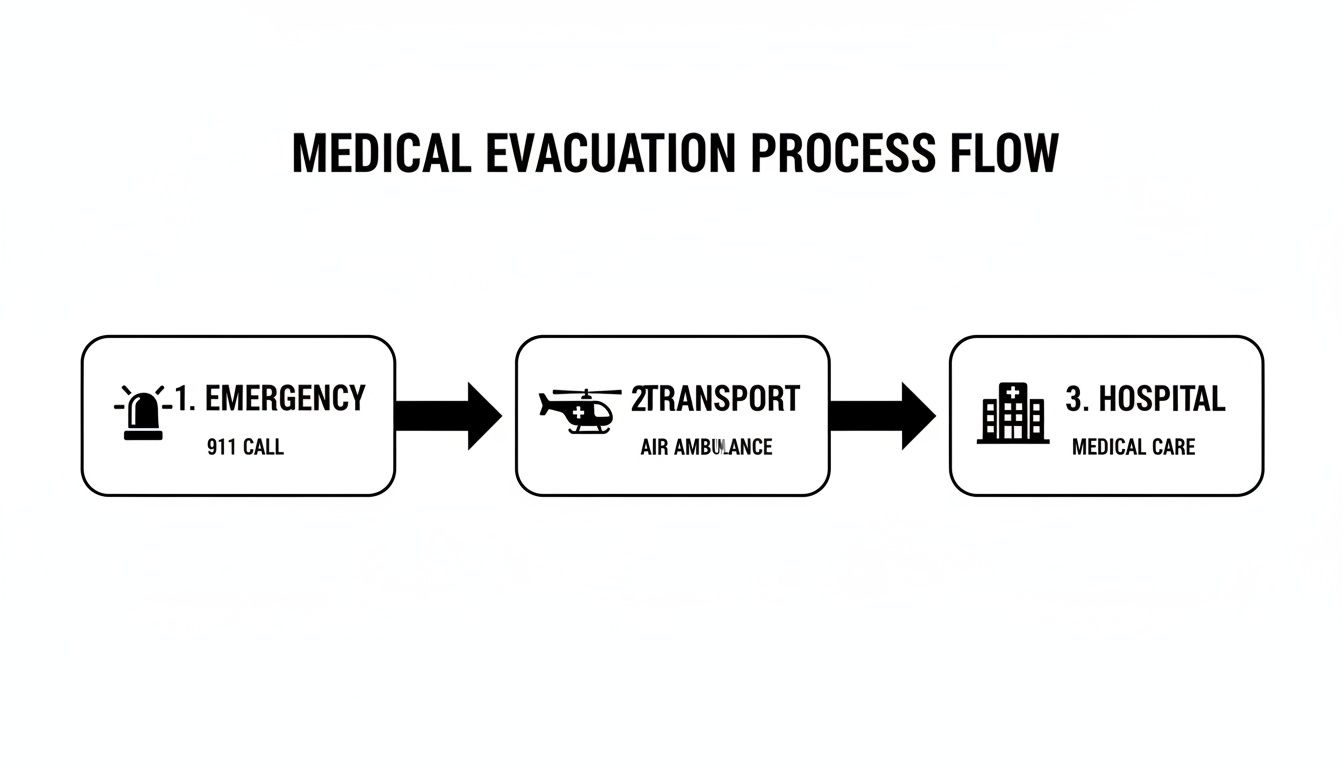
As you can see, what might seem like a simple flight is actually a multi-step operation managed by a team of specialists dedicated to your well-being.
Arranging the Complex Logistics
Once the “go” decision is made, the logistics team jumps into action. Their job is to manage every single detail of your transport, ensuring a safe and seamless journey to a better-equipped hospital. This is far more complex than just booking a ticket.
Here’s a glimpse of what that team orchestrates:
- Choosing the Right Transport: Based on your medical needs, they decide on the best way to move you. For stable patients, it might be a commercial flight with a medical escort. For critical cases, it’s a private, fully-equipped air ambulance—essentially a flying ICU.
- Assembling the Medical Crew: They arrange for the right medical professionals—be it doctors, critical care nurses, or paramedics—to accompany you the entire way, monitoring your condition and providing constant care.
- Coordinating Ground Support: The team organizes ground ambulances at both the departure and arrival points for a smooth “bed-to-bed” transfer. This minimizes any gaps in your medical supervision.
- Navigating Red Tape: They handle all the mind-numbing paperwork, from flight plans and landing permits to customs and immigration clearances, which can be a massive roadblock in an emergency.
This intricate coordination is one of the biggest benefits of having medevac insurance. For expats in remote areas where this coverage is most critical, being able to send a distress signal is the first step. For anyone venturing off the beaten path, this New Zealand Safety Beacon Guide comparing EPIRBs and PLBs is a fantastic resource for understanding how emergency communication devices work.
Arrival and Handover of Care
The support doesn’t stop once the plane is in the air. While you’re in transit, the assistance team is in constant contact with the receiving hospital. They make sure a bed is waiting for you and that the medical staff is fully briefed on your condition, ready for your arrival. When you land, everything is prepared for a smooth admission and a seamless handover of care.
The demand for these critical services is exploding. The global medical evacuation services market, valued around $150 million in 2025, is expected to more than double to over $350 million by 2033, growing at a compound annual growth rate (CAGR) of 8.5%. This shows just how vital these services have become for the global expat community.
Ultimately, the entire process is designed to lift the immense burden off you and your family. It allows you to focus on the only thing that matters: your recovery. By exploring the different travel medical air evacuation options available, you can truly appreciate the incredible level of support these plans provide when you need it most.
Decoding Your Policy: What Is Actually Covered?
Let’s be honest, insurance policies can feel like they’re written in a different language. The marketing brochures paint a great picture, but the real value is buried in the fine print. To make a smart choice for your life abroad, you need to get past the sales pitch and understand exactly what a provider will—and won’t—do for you in a crisis.

A solid medevac plan is much more than just an expensive flight. It’s a complete emergency management service, a safety net designed to handle everything from the moment the call is made to your safe arrival at a hospital that can properly care for you. Let’s break down what you should find in any plan designed for expats.
Standard Inclusions in Most Medevac Plans
While the details can vary, any reputable plan for expats and long-term residents will be built on a few core, non-negotiable benefits.
- Emergency Medical Transportation: This is the heart of the policy. It pays for moving you from a place where you can’t get adequate care to the nearest medical facility that can. This could be a medically staffed commercial flight or, in critical situations, a private air ambulance.
- Medical Escort and Monitoring: You won’t be flying alone. The policy covers the cost of trained medical professionals—doctors, nurses, or paramedics—to accompany you, providing continuous care and keeping an eye on your condition every step of the way.
- Repatriation of Mortal Remains: It’s a tough topic, but this is a vital benefit for any expat. In the tragic event of a death abroad, the policy handles the considerable expense and complex logistics of returning the deceased’s remains to their home country.
These core services mean that if the worst happens, the logistical nightmare and financial strain fall on the experts, not on you or your family back home.
Typical Inclusions vs Common Exclusions in Medevac Policies
To get a clearer picture, it helps to see what’s typically covered side-by-side with what’s often left out or requires special add-ons.
| Typically Included | Often Excluded or Requires Rider |
|---|---|
| Medically necessary air ambulance transport | Pre-existing conditions without a waiver |
| Medical escort and in-flight care | Injuries from high-risk sports (e.g., mountaineering) |
| Transport to the nearest appropriate medical facility | Evacuation from war zones or politically unstable areas |
| Coordination of all medical and travel logistics | Acts of terrorism or civil unrest |
| Repatriation of mortal remains to home country | Self-inflicted injuries or substance abuse |
| 24/7 emergency assistance hotline | Non-emergency or elective medical transport |
This table gives you a quick snapshot, but always remember the golden rule: read your specific policy document. The details in that contract are what truly matter.
Common Exclusions That Can Catch You Off Guard
Knowing what isn’t covered is just as important. Exclusions are the specific scenarios your policy won’t pay for, and overlooking them can lead to a denied claim and a financially devastating situation.
One of the biggest tripwires for expats is pre-existing conditions. Many plans have a “look-back” period and won’t cover an emergency tied to a health issue you had before your coverage started. You must declare your medical history honestly and know the rules. For a deeper look at this, a helpful resource is this guide on understanding how medical conditions impact travel insurance coverage.
Other common things that policies won’t cover include:
- High-Risk Activities: If you get injured skydiving, rock climbing, or playing professional sports, you’re likely out of luck unless you’ve bought a special adventure sports rider.
- Politically Unstable Regions: Most insurers will not evacuate you from a country with a “Do Not Travel” advisory due to war, terrorism, or widespread civil unrest.
- Self-Inflicted Injuries: Emergencies that result from drug or alcohol abuse, illegal activities, or intentionally hurting yourself are almost never covered.
Reading the exclusions section of your policy document isn’t just a suggestion—it’s essential. This is where you’ll find the true boundaries of your coverage. Never assume something is covered without verifying it in the policy language.
By carefully reviewing both what’s included and what’s excluded, you arm yourself with the knowledge to pick a plan that genuinely fits your expat lifestyle, travel habits, and health needs.
Medevac vs. Expat Health Insurance: What’s the Difference?
It’s a common, and frankly risky, assumption that your expat health insurance plan automatically has you covered for every possible emergency. While these plans are absolutely essential for life abroad, they play a very different role than medical evacuation insurance. For any expat who wants to be truly protected, understanding this distinction is a game-changer.
Think of it like this: your expat health insurance is your day-to-day healthcare partner. Its job is to cover the costs of actual medical treatments—things like doctor visits, prescriptions, necessary surgeries, and hospital stays. It’s designed to pay the medical bills you rack up at a healthcare facility.
Medical evacuation insurance, on the other hand, is purely a crisis transportation service. It has one single, vital function: to get you from a place with inadequate medical care to a hospital that can properly treat your serious condition. It doesn’t pay for the surgery you need; it pays for the air ambulance to get you to the surgeon who can perform it.
Why Your Expat Health Plan Probably Isn’t Enough
Many expats are shocked to discover their comprehensive health plan has surprisingly limited, or even zero, coverage for emergency evacuations. Even if a medevac benefit is included, it often comes with major strings attached that can leave you dangerously exposed.
For instance, a common clause will only cover transport to the “nearest adequate medical facility.” That might sound reasonable, but “adequate” doesn’t mean “best.” It also doesn’t mean a hospital where you speak the language or have a support network of family and friends nearby. As an expat, you get very little say in where you end up.
A standalone medical evacuation policy is the gold standard for expats. It gives you control and a dedicated team of logistical experts focused solely on your transport. This ensures you get to a top-tier hospital, often one of your choosing or even one back in your home country.
This separation of duties is precisely why savvy expats layer their coverage. Your health insurance handles the treatment bills, while your medevac policy handles the emergency transport to get you there. This dual-coverage strategy creates a robust safety net with no gaps.
The Growing Need for This Specialized Coverage
Relying on a basic health plan for a serious evacuation is a gamble, especially as expats venture to more remote locations. The demand for specialized emergency transport is surging, which tells you that global citizens are waking up to this reality.
The broader medical travel insurance market, where evacuation services are a huge component, was valued at USD 30.59 billion in 2024. Projections show it more than doubling to USD 63.98 billion by 2030, a trend fueled by rising international medical costs and the increasing mobility of the global workforce. As you can discover more insights about this growing market, it’s clear that standalone coverage is becoming a necessity, not a nice-to-have.
Here’s the simplest way to remember their distinct roles:
- Expat Health Insurance: Is all about paying for medical treatment once you are at a hospital.
- Medical Evacuation Insurance: Is all about paying for emergency transportation to get you to that hospital.
Ultimately, while both are vital for life abroad, they protect you from different kinds of financial ruin. Your health plan shields you from six-figure medical bills for treatment. Your medevac insurance shields you from the equally catastrophic cost of a $200,000 air ambulance flight. Having both is the smartest way to protect yourself as an expat.
Understanding the True Cost of an Evacuation
The term “medical evacuation” can feel a bit abstract, almost like something out of a movie. That is, until you see the bill. Without the right insurance, an emergency air ambulance flight isn’t just a major expense—it’s the kind of cost that can financially ruin an expat family for years. A single international transport can easily blow past $100,000, and in more complicated situations, it’s not unheard of for costs to exceed $200,000.

These six-figure price tags aren’t just pulled out of thin air. They represent the incredible logistics and specialized resources needed to safely move someone who is critically ill or injured across borders. When you start to grasp these numbers, the value of a solid medical evacuation insurance plan snaps into focus.
There’s a reason this market is growing so quickly. The global travel medical insurance sector, which is closely linked with evacuation services, was valued at $5.24 billion in 2024. It’s projected to nearly double, hitting $10.21 billion by 2034. This boom is fueled by a simple truth: as more people live and work abroad, the harsh reality of soaring medical costs becomes impossible to ignore. The full analysis of this market growth really drives home how essential this coverage has become.
Deconstructing the Bill: What Are You Paying For?
So, where does all that money actually go? An air ambulance bill is a complex puzzle of high-stakes expenses that stack up incredibly fast. It’s a whole lot more than just a plane ticket and some fuel.
Here’s a look at what drives the cost:
- Aircraft and Flight Crew: Chartering a medically equipped jet, plus paying the pilots and flight coordinators, makes up the biggest chunk of the bill.
- Medical Personnel: You’re not just getting a flight; you’re getting a dedicated medical team. This often includes a critical care doctor, nurse, or paramedic providing constant, in-flight care.
- Specialized Medical Equipment: The aircraft essentially becomes a flying ICU, stocked with everything from ventilators and cardiac monitors to other life-support systems.
- Ground Transportation: The service is “bed-to-bed,” which means ambulances are needed at both the departure and arrival points to ensure a seamless transfer.
- Logistical Fees: Think landing permits, international flight clearances, and various airport fees. These behind-the-scenes costs add up significantly.
When you break it down like this, it’s easier to see why a flight from a remote corner of Southeast Asia back to the United States can carry such a staggering price tag.
From Catastrophic Costs to Affordable Premiums
Here’s the good news: protecting yourself from this financial disaster doesn’t cost a fortune. A robust medical evacuation insurance plan transforms that terrifying six-figure possibility into a predictable, manageable annual premium. The actual cost of your policy will depend on a few key things.
Your age, the geographical regions you need coverage for, and your total policy limit ($1 million is a common and highly recommended amount) all play a role in the final premium. For example, a younger expat based in Europe will typically pay less than an older retiree living in a more remote location.
At the end of the day, medical evacuation insurance is a financial shield built on a very simple premise: you pay a small, manageable amount each year to completely eliminate the risk of a life-altering, six-figure bill. It’s a straightforward investment in your health, your safety, and your financial peace of mind as an expat.
How to Choose the Right Medevac Plan
Picking the right medical evacuation insurance isn’t about chasing the lowest premium. It’s about finding a rock-solid partner for a crisis that you hope never comes. For an expat, this decision is a cornerstone of a secure life abroad.
A great plan is your ultimate safety net, but its strength is in the details you check before you sign up. Think of it like this: you wouldn’t use a regular wrench on delicate electronics. You need the right tool for the job. Your medevac plan has to be just as precisely matched to your life, your host country, and your potential risks.
Start With Your Personal Needs and Location
The first step is a gut check on your own circumstances. Where you live and how you live drastically change the kind of coverage you’ll need. An expat in a remote village with spotty medical care has entirely different needs than someone living in a major European city.
Get started by asking yourself a few tough questions:
- How good is the local healthcare, really? Be honest. Can the nearby hospitals in your host country handle a true emergency like a stroke, heart attack, or major accident?
- Just how remote am I? Think about how long it would take to get to a top-tier hospital by ground. If the answer is hours—or even days—then air ambulance access is non-negotiable.
- What are my own health factors? Do you have any pre-existing conditions? Are you at an age where certain medical events become more likely?
- What am I doing for fun? If your new expat life includes adventure sports like scuba diving, rock climbing, or skiing, you’ll need a plan or a special rider that doesn’t exclude those activities.
Answering these questions helps you build a personal risk profile. This profile becomes your compass, guiding you toward a plan that doesn’t have dangerous gaps in coverage.
Check Out the Provider’s Network and Assistance Quality
A medevac policy is only as good as the team that actually gets you out. You’re not just buying a piece of paper; you’re buying access to a world-class emergency response crew. The quality of their 24/7 assistance service is everything.
Look for providers with a proven global network of air ambulances, dedicated medical teams, and strong hospital partnerships. A provider’s real value is in their ability to cut through red tape in foreign countries, coordinate with local doctors, and manage the mind-boggling logistics of an international evacuation.
When you’re comparing plans, don’t just stare at the price tag. Dig into the provider’s reputation. Hunt down reviews and testimonials from other expats, and pay close attention to stories about how they handled real emergencies. That’s your best window into their actual performance.
Get Into the Weeds: Policy Limits and Key Benefits
Finally, it’s time to read the fine print. This is where the true value of a policy is hidden. A high coverage limit, like $1 million or more, is absolutely critical to cover the staggering costs of an international air ambulance.
Beyond that big number, make sure you verify these key benefits:
- Hospital of Choice: Does the plan only fly you to the “nearest adequate facility,” or do you get a “hospital of choice” or “return to home country” option? For most expats, getting back to a familiar healthcare system near family and friends is priceless.
- Pre-existing Condition Coverage: You need to know the rules here. Look for any waiting periods or specific exclusions that could affect you.
- Adventure Sports Coverage: If you’re an adrenaline junkie, make sure your policy explicitly covers your activities, even if it means adding an extra rider.
By methodically walking through these areas—your personal needs, the provider’s real-world capabilities, and the policy’s specific benefits—you can choose a medical evacuation plan with confidence. You’ll have genuine security, no matter where your expat journey leads.
Your Questions, Answered
When it comes to something as important as medical evacuation insurance, it’s natural to have questions. Getting the details right is crucial, especially when you’re an expat and this is your ultimate safety net. We’ve gathered some of the most common questions we hear to help clear things up and give you the confidence to choose the right coverage.
Does Medical Evacuation Insurance Cover Pre-Existing Conditions?
This is a big one, and the answer really depends on the specific policy. Many standard plans come with a “look-back” period, meaning they might not cover any condition you received treatment for or had symptoms of during that time.
However, some of the more premium plans—the kind designed for long-term expats—do offer options to cover stable, well-managed conditions. The most important thing here is full disclosure. Be completely honest on your application and read the fine print on how the policy defines a pre-existing condition. You don’t want any surprises when you need help the most.
Can I Choose Which Hospital I Am Evacuated To?
This is a major difference between a basic plan and a truly comprehensive one. A standard policy will typically get you to the “nearest adequate medical facility.” While that meets a minimum standard of care, it might not be where you’d ideally want to be treated.
This is why we strongly recommend more robust plans for expats, which often include a “hospital of choice” or “return to home country” benefit. This feature gives you an incredible amount of control, letting you decide to be treated at a world-class facility or fly back to a familiar healthcare system close to your family.
The ability to choose your destination hospital is one of the most powerful benefits a medevac policy can offer. It transforms the service from a simple transport to a truly personalized lifeline that gets you to the best possible place for your specific recovery needs.
Is Medevac Necessary If My Host Country Has Good Hospitals?
Absolutely. Even if you’re living as an expat in a country known for its excellent healthcare, you could find yourself in a remote area, hours away from a top-tier hospital. A medical evacuation can bridge that gap and get you to a center of excellence fast.
On top of that, your specific emergency might call for highly specialized care that’s only available in another country or back home. Medical evacuation insurance ensures you get to the best facility for your unique situation, not just the one that happens to be closest.
What Is the Difference Between Medical Evacuation and Medical Repatriation?
These two terms often go hand-in-hand, but they refer to two very different stages of care. Think of it this way:
- Medical Evacuation: This is the emergency flight. It’s the immediate transport from a place with inadequate medical care to a better-equipped hospital where your condition can be stabilized.
- Medical Repatriation: This is the journey home. It’s the process of getting you back to your home country for ongoing treatment or recovery after you’ve been stabilized.
Most high-quality medical evacuation plans for expats will bundle repatriation in as a core benefit, but it’s always smart to double-check your policy documents to be sure.
Protecting your health and finances while living abroad requires a specialized approach. At Expat Global Medical, we help you build a safety net that covers every angle, from comprehensive health plans to critical emergency evacuation services. Get a free quote today and ensure you have the right protection in place, no matter where your journey takes you.