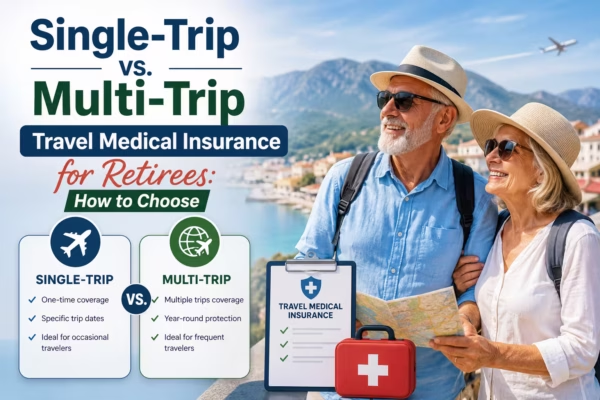
For anyone living overseas long-term, asking “is travel insurance worth it?” is often the wrong question. It’s like asking if a spare tire is a good substitute for a car engine. Sure, it’s essential for a short-term emergency, but it’s dangerously inadequate for the long haul.
The real dilemma isn’t about if you need protection, but choosing between temporary travel coverage and the comprehensive security of long-term expat medical insurance.
The Expat Insurance Dilemma

The moment you transition from tourist to resident, your insurance needs shift dramatically. The simple safety net that covers a two-week vacation just isn’t built to support a new life in another country. This critical misunderstanding leaves many expats dangerously exposed to huge financial and medical risks.
The solution comes down to understanding the distinct roles of two very different products: temporary travel insurance and essential international medical insurance.
The Right Tool for the Right Job
Let’s break it down with an analogy.
Think of travel insurance as the rental car for your weekend getaway. It’s perfect for a specific, short journey. It covers unexpected bumps in the road, like a flat tire (a cancelled flight) or a minor fender-bender (a sudden illness). Its job is to get you through the trip and back home safely.
International medical insurance, on the other hand, is the car you own for your daily life. It’s built for the long haul—covering everything from routine maintenance (doctor check-ups) to major engine overhauls (hospital stays). It’s your primary vehicle for navigating healthcare in your new home country.
Relying on travel insurance for long-term residency is like trying to use a spare tire to drive across the country. It’s a temporary fix that will inevitably fail when you need it most, leaving you stranded with massive bills and no reliable support.
This distinction is everything. Using the wrong tool for the job can actually void your policy. For instance, most travel insurance plans require you to have a “home country” you plan to return to. If you establish residency elsewhere, your coverage could be invalidated overnight.
To help you see the difference clearly, here’s a quick side-by-side comparison.
Travel Insurance vs Expat Medical Insurance At a Glance
| Feature | Standard Travel Insurance | International (Expat) Medical Insurance |
|---|---|---|
| Primary Purpose | Covers financial losses and medical emergencies during short-term trips. | Provides comprehensive, long-term health coverage for people living abroad. |
| Coverage Scope | Trip cancellations, lost luggage, flight delays, and emergency medical care only. | Routine doctor visits, specialist care, hospitalization, preventative care, and emergencies. |
| Best For | Tourists, vacationers, and short business trips (days or weeks). | Expats, digital nomads, retirees, and anyone living abroad for 6+ months. |
| Policy Duration | Per-trip or a multi-trip annual plan for short, frequent travel. | Annual, renewable policy designed for ongoing, primary health needs. |
As the table shows, these products are designed for completely different scenarios. One protects your vacation, while the other protects your health and life abroad.
So, How Do You Choose?
First, you need to define your status. Are you just visiting, or are you building a life abroad?
- For short trips away from your new home base: Travel insurance is absolutely worth it. If you’re an expat in Spain taking a one-week trip to Italy, a travel policy will cover flight cancellations or lost luggage—risks your expat health plan won’t touch.
- For your day-to-day life abroad: You need a proper international medical insurance plan. This is non-negotiable. It provides comprehensive medical coverage for emergencies, specialist visits, routine care, and sometimes even pre-existing conditions.
Getting this right is the most important step you can take to protect your health and finances while living overseas. Now, let’s dig deeper into when each type of policy is a smart investment.
What Standard Travel Insurance Actually Covers
To figure out if travel insurance is really worth it, you have to look under the hood and see what you’re actually buying. The best way to think about a standard policy is like roadside assistance for your journey. It’s there to rescue you from specific, sudden breakdowns—not to handle your car’s routine oil changes.
That distinction is everything. A policy is built for unexpected emergencies that disrupt a trip with a start and end date. This makes it a fantastic tool for short-term travel but the wrong solution for long-term living abroad. Its real value comes from protecting you against four classic travel nightmares.
Trip Cancellation and Interruption
This is the feature most people immediately think of. If you have to cancel your trip before it even starts for a covered reason—like a sudden illness, a death in the family, or getting laid off—this coverage pays you back for non-refundable costs like flights and hotels. This is a travel-specific benefit not found in an expat medical plan.
Trip interruption is the other side of that coin. It kicks in if you have to cut your trip short for one of those same covered reasons, helping to pay for a last-minute flight home and reimbursing you for the unused parts of your trip. It protects your financial investment when life gets in the way.
Emergency Medical and Dental Care
For anyone traveling abroad, this is often the most critical piece of the puzzle. Your health plan from back home might offer little to no coverage once you cross international borders. Travel insurance steps in to cover emergency medical and dental costs that pop up during your trip.
I have to stress the word “emergency.” This coverage is for an unexpected broken leg from a hiking accident, not for a routine check-up or a planned dental cleaning. The goal of the policy is to get you stabilized and treat the immediate crisis, not to manage your ongoing health needs.
Travel insurance is a short-term safety net, not a long-term healthcare plan. Its medical benefits are triggered by sudden, unforeseen events during your trip, with the expectation that you will return home for any follow-up or routine care.
Understanding this one concept can save you from a world of expensive misunderstandings. For a deeper dive into what’s included, check out our complete guide to international travel insurance coverage explained.
Medical Evacuation and Repatriation
What if you have a serious medical emergency somewhere remote, far from a capable hospital? This is where medical evacuation coverage can be an absolute financial lifesaver. It covers the staggering cost of transporting you to the nearest adequate medical facility. Expat medical plans also offer this, but it’s a key feature of travel policies.
In the worst-case scenario, it can also cover repatriation—transporting your remains back to your home country. These costs can easily climb into the tens or even hundreds of thousands of dollars, making this benefit alone a compelling reason to get a policy.
Baggage and Personal Belongings
This part of the policy reimburses you if your luggage gets lost, stolen, or damaged on your trip. It usually includes baggage delay coverage, too, which gives you a budget to buy essentials like clothes and toiletries if the airline sends your bags on a detour for a while. This is another purely travel-related benefit that your expat medical insurance will not cover.
There are, of course, limits—typically a per-item cap and an overall maximum payout—but this coverage offers genuine peace of mind. And more travelers are catching on; the global travel insurance market is expected to grow from USD 22.1 billion in 2025 to a massive USD 50.1 billion by 2033. It’s clear people are seeing it less as a luxury and more as a necessity.
When Travel Insurance Is a Smart Buy for Expats
Even if you’ve got a rock-solid expat medical plan, the question “is travel insurance worth it?” still pops up. The answer is almost always a resounding yes. Your long-term medical insurance is for your life abroad, but a good travel policy is what protects your actual journeys. It’s designed to fill critical gaps that your medical coverage just wasn’t built to handle.
Here’s an easy way to think about it: your international medical insurance is like your home insurance—it covers your primary residence and day-to-day well-being. Travel insurance, on the other hand, is like the specialized coverage you get when you rent a U-Haul for a weekend move. They serve completely different purposes, and you’d never use one to do the job of the other.
There are a few high-stakes situations where buying a separate travel insurance policy isn’t just a good idea; it’s an essential move to protect your wallet and your sanity.
Protecting Vacations Outside Your Host Country
This is the most common—and crucial—scenario for expats. Let’s say you’re an American living in Spain. Your expat medical plan gives you excellent medical coverage within Spain and maybe even across the EU. But what happens when you book that dream week-long trip to Morocco? Or a getaway to Egypt?
Sure, your health plan will cover a true medical emergency, but it offers zero protection for all the other travel-specific headaches that can derail a trip. This is where travel insurance shines.
A simple travel policy for that one-week trip would cover:
- Trip Cancellation: If you get a nasty flu right before your flight to Marrakech and have to cancel, you’ll be reimbursed for those non-refundable flights and hotel bookings.
- Lost Luggage: The airline loses your bag on the way to Cairo? Travel insurance will reimburse you for new clothes and essentials so you can get on with your trip.
- Major Delays: A storm cancels your connecting flight, leaving you stuck overnight? The policy can cover the cost of a hotel room and meals.
Without travel insurance, every single one of those problems comes straight out of your own pocket.
Fulfilling Mandatory Visa Requirements
This one is non-negotiable. Many countries have strict insurance requirements for visa applications, and your standard expat medical plan often won’t cut it. The most famous example is Europe’s Schengen Area.
To get a Schengen visa, you have to show proof of travel medical insurance that meets very specific criteria:
- Minimum coverage of €30,000 (about $32,000).
- Coverage for emergency medical costs, hospitalization, and medical repatriation.
- It must be valid across all Schengen member states for your entire stay.
A standard travel insurance policy is built to meet these requirements perfectly. Trying to use your primary expat health plan could get your visa application flat-out rejected, stopping your plans before they even start.
Safeguarding Your Financial Investment
Sometimes, the best reason to get travel insurance has less to do with medical emergencies and more to do with cold, hard cash. This is especially true for expensive, pre-planned trips like a guided safari, a multi-day tour, or a cruise where you’ve paid thousands of dollars upfront.
A simple travel insurance policy acts as a financial backstop. For a small premium—often just 4-8% of your total trip cost—you’re protecting a much larger investment from being completely lost due to an unforeseen event.
The demand for this kind of protection is exploding because the value is so obvious. The trip cancellation insurance market was valued at USD 26.54 billion in 2024 and is projected to hit USD 58.40 billion by 2030. Travelers who skip it can face cancellation penalties of 50-75% of their trip cost, whereas a policy can reimburse up to 100% for covered reasons.
As you map out your future travels, it’s smart to research the best countries for digital nomads that fit your lifestyle and your insurance strategy. For expats and long-term travelers, the logic is clear: travel insurance isn’t a replacement for your health plan, but an essential partner that secures your journeys.
Why Expats Need More Than Just Travel Insurance
For anyone living abroad long-term, there’s a moment when the whole idea of “travel” just doesn’t fit anymore. You’re not on a trip; you’re building a life. This is the exact point where relying on travel insurance becomes like using a band-aid for a broken leg—it’s the wrong tool for the job, and frankly, it’s dangerously inadequate.
Standard travel insurance is built for one thing: protecting temporary journeys with a clear start and end date. It works on the assumption that you have a permanent home to return to for any serious or ongoing care. Once you set up residency in a new country, you break that fundamental rule, and the entire safety net can collapse underneath you.
The Critical Gaps in Travel Insurance for Expats
The reasons travel insurance fails as a long-term solution aren’t buried in the fine print; they’re part of its basic design. Getting your head around these limitations is the first step to making sure you’re properly protected as an expat.
The most obvious problem is short coverage periods. Most travel policies have a hard cap on trip duration, often just 30, 60, or 90 days. The second you stay past that limit, your policy is worthless. Any medical emergency after that cutoff is 100% on you to pay, which could be financially crippling.
Travel insurance is a lifeline for tourists but a liability for residents. It’s built for temporary emergencies, not the ongoing, comprehensive healthcare needs that are a normal part of life. Relying on it long-term is a gamble you cannot afford to lose.
On top of that, travel insurance specifically excludes routine and preventative care. Need your annual physical, a dental cleaning, or a check-in with a specialist for a chronic condition? A travel policy offers zero coverage for that. It’s only for sudden, unforeseen emergencies—the broken leg from a scooter accident, not the months of physical therapy that come after.
This brings us to another huge gap: pre-existing conditions. The vast majority of standard travel policies will not cover flare-ups or treatments related to any medical issue you had before your trip began. For expats, this is a non-starter, since managing ongoing health is just a part of life.
The “Home Country” Clause That Can Void Your Policy
Perhaps the most critical failure point for expats is the “return to home country” requirement. Travel insurance is designed to stabilize you after an emergency and, if needed, fly you back home for more treatment.
But what if you don’t have a “home country” you plan on returning to? What if your new country is your home? In that case, the insurer can deny your claim or even cancel your policy. In their eyes, you’re no longer a traveler; you’re an uninsured resident.
The Real Solution: International Medical Insurance
This is where International Medical Insurance comes in—not as a better alternative, but as the only appropriate solution for expats. It’s not “travel” insurance at all; it’s a proper healthcare plan, designed from the ground up for a global lifestyle.
Think of it as the kind of health coverage you’d have back home, but built to be portable worldwide. These plans are specifically structured to support long-term residency abroad.
Here’s what sets it apart:
- Annual and Renewable Policies: These aren’t per-trip plans. They are annual policies you can renew each year, giving you continuous, stable coverage for as long as you live abroad.
- Comprehensive Medical Coverage: This is its greatest strength. It covers the full spectrum of healthcare, from emergency hospital stays to routine doctor visits, specialist consultations, wellness checks, and often dental and vision.
- Coverage for Pre-Existing Conditions: While rules vary between plans, many international health policies are designed to cover pre-existing conditions, sometimes after a waiting period. This offers a level of security travel insurance can never provide.
- Global Portability: These plans move with you. Whether you relocate from Spain to Thailand or just travel a lot from your new home base, your coverage follows you, ensuring access to quality healthcare wherever you are.
Coverage Gaps Where Travel Insurance Fails Expats
When you compare them side-by-side, it becomes crystal clear why a travel policy just doesn’t work for someone living abroad. It’s simply not designed for the realities of expat life.
| Expat Healthcare Need | Covered by Travel Insurance? | Covered by Expat Medical Insurance? |
|---|---|---|
| Routine check-ups & physicals | No | Yes |
| Managing a pre-existing condition | No | Yes (often available) |
| Specialist consultations | No | Yes |
| Maternity & newborn care | No | Yes (usually an option) |
| Long-term prescriptions | No | Yes |
| Mental health support | Rarely | Yes (widely available) |
| Dental & vision care | No | Yes (optional add-on) |
| Emergency evacuation | Yes (but to home country) | Yes (to nearest suitable facility) |
The table really says it all. For the day-to-day, year-to-year healthcare that defines normal life, travel insurance leaves you completely exposed.
Making the switch from a travel mindset to a resident mindset is crucial. Instead of asking if travel insurance is worth it for your life abroad, the better question is how to secure a real health plan. You can explore a wide range of options and see how a dedicated plan provides the necessary security by reviewing our detailed guide on international medical insurance for expats. This type of coverage isn’t just a smart buy; it’s an essential foundation for a safe and healthy life abroad.
Choosing Your Coverage: A Simple Framework
Trying to figure out expat insurance can feel like sorting through a puzzle with way too many pieces. You’ve got single-trip plans, multi-trip policies, and full-blown international medical insurance all vying for your attention. The trick isn’t finding a one-size-fits-all answer—it’s building a solution that actually fits your life abroad.
To cut through the noise, let’s break it down into a few straightforward questions. Answering them honestly will light up the right path forward, making sure you invest in coverage that genuinely has your back. This framework takes the guesswork out of the equation, helping you decide if travel insurance is enough or if you need to step up to a comprehensive expat medical plan.
Start with Your Time Horizon
The first—and most important—question is all about time: How long are you staying abroad? This single factor is the main fork in the road between needing temporary travel insurance and a more permanent health plan.
- Short-Term (Less than 6 months): If you’re on a long vacation or a short work gig with a clear end date, a solid travel insurance policy is usually all you need. Its primary job is to handle emergencies and get you home if things go sideways.
- Long-Term (6+ months or indefinitely): The moment your stay drifts past the six-month mark or becomes open-ended, you’ve graduated from traveler to resident. This is the non-negotiable point where you need to switch over to an international medical insurance plan for your day-to-day medical needs.
Define Your Healthcare Needs
Next up, think about the kind of medical care you expect to need. This helps you choose between a basic emergency safety net and a more comprehensive plan. Just ask yourself: Do I need coverage for just emergencies, or also for routine care and pre-existing conditions?
Your answer points you in one of two directions. If all you want is a backstop for unexpected accidents, an emergency-only or medical evacuation plan might do the trick. But if you need to manage a chronic condition, get annual check-ups, or see specialists, only a true expat medical plan is going to cut it.
A “major medical” travel plan is not the same as a health insurance policy. Don’t make that mistake. The first is for stabilizing you during a trip crisis; the second is for managing your overall health for the long haul.
This decision tree gives you a visual for how to think through the core questions that take you from tourist to a fully covered expat.
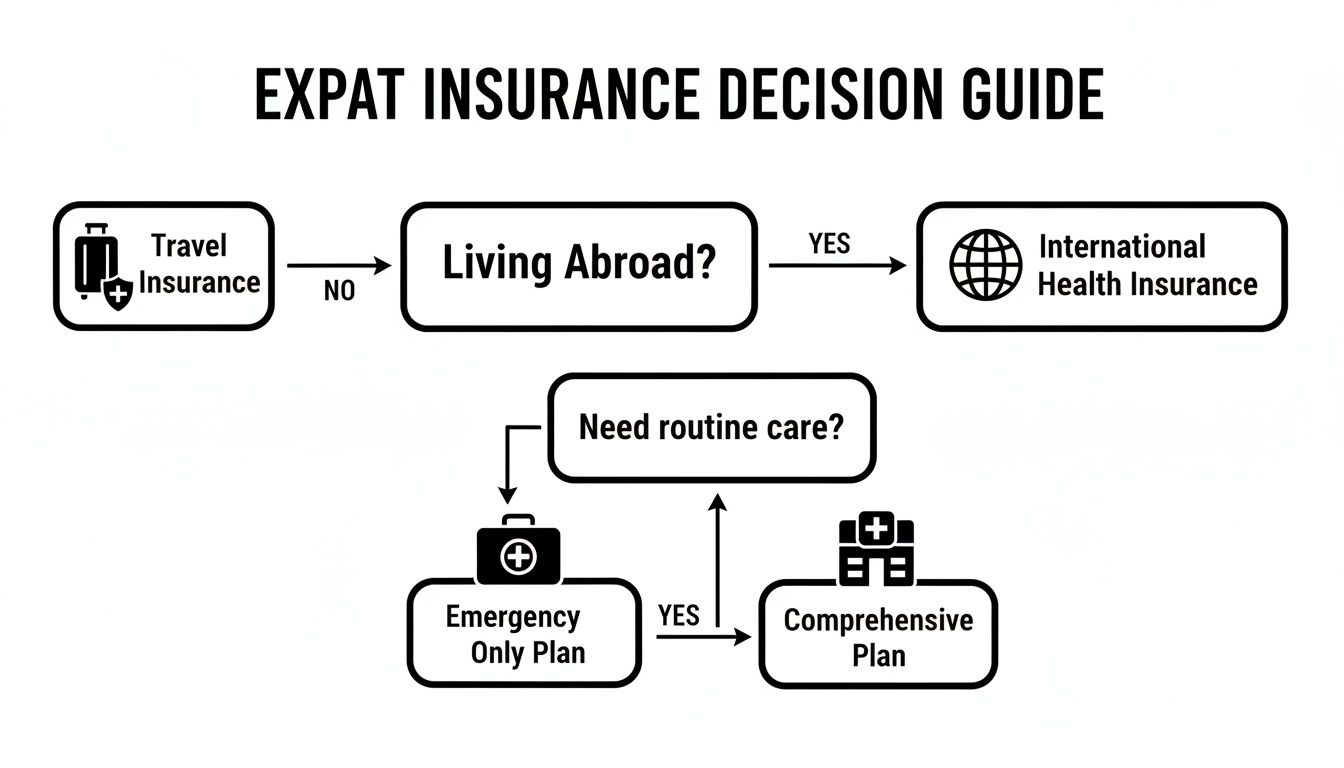
As you can see, the path splits based on two critical questions: are you actually living abroad, and do you need routine medical care? Answering those two questions will lead you straight to the right type of insurance.
Factor in Legal and Visa Requirements
Finally, you have to play by the rules of your new home country. Many nations have very specific, non-negotiable insurance requirements for anyone applying for residency or a long-term visa. This is not the place to try and cut corners.
You have to ask: What are the official visa and residency requirements for my destination country? Some places, like Spain, demand proof of a comprehensive health plan with a zero deductible as a condition of your visa. A standard travel policy won’t even come close to meeting these tough standards and will get your application rejected flat out.
Always start by researching the immigration rules of your host country. Often, this will make the decision for you, instantly narrowing your options to only the plans that are legally compliant. By combining these three steps—your timeline, your health needs, and your legal duties—you can confidently build the right insurance strategy for your new life abroad.
What Your Expat Medical Insurance Probably Doesn’t Cover
Knowing what your policy covers is only half the battle. The real test comes when you understand what it doesn’t cover. Buried in the fine print of both travel and expat medical policies are exclusions that can get your claim denied right when you need the cash most. Getting familiar with these common traps is the key to making sure your insurance is actually worth the paper it’s written on.
The big one? Pre-existing medical conditions. While many expat medical plans offer coverage, it often comes with a waiting period or higher premiums. You have to be completely honest on your application—hiding a condition is a surefire way to get your entire policy voided.
High-Risk Fun and Risky Places
Another landmine is coverage for anything adventurous. While some plans are built for adrenaline junkies, your average policy will likely leave you high and dry if you get hurt doing something they consider high-risk.
Think things like:
- Scuba diving past a certain depth
- Mountaineering or high-altitude trekking
- Bungee jumping or skydiving
- Racing in competitive sports
Always dig into the policy details. You might need to buy a special “adventure sports” add-on to make sure you’re covered for more than just lounging by the pool.
It’s not a suggestion, it’s a responsibility: read your policy’s exclusion list before you buy. The insurer’s job is just to follow the contract you signed. A simple misunderstanding on your part could leave you with a massive, uncovered bill.
Heading to a country with a “Level 4 Do Not Travel” warning from the government? Your insurance will probably be useless there. Insurers see these trips as knowingly walking into danger, so they won’t cover anything related to civil unrest, war, or political chaos in those regions.
A Few Other Surprising Gaps
Beyond the obvious, a few other exclusions tend to catch people off guard. For example, your furry friends are rarely covered by your personal medical insurance. If you’re bringing a pet, you’ll need to look into things like pet transportation costs and see if you can get separate coverage for them.
Also, don’t assume medical evacuation is a given. It’s a very specific benefit with its own set of rules. We break down exactly what it does—and doesn’t—include in our guide on what medical evacuation insurance is. The bottom line is this: read your documents, ask the dumb questions, and buy the add-ons you need. It’s the only way to fill the gaps and live abroad with real peace of mind.
Your Top Questions About Expat Insurance Answered
When you’re sorting out life abroad, insurance questions always pop up. It’s a confusing landscape, for sure. So, let’s cut through the noise and get you some straight, clear answers to the most common questions we get from expats and long-term travelers.
Can I Just Use My Travel Insurance Instead of Expat Medical Insurance for My Visa?
That’s a hard no. Think of it this way: travel insurance is for tourists, not residents. Most countries that require health insurance for a residency visa have very specific rules about what that plan must cover, and a travel policy won’t even come close.
Visa officials are looking for proof that you have a real, comprehensive health plan in place that covers routine care, not just emergencies. Trying to submit a travel policy for a residency visa is almost a guaranteed rejection.
Is My Credit Card’s Travel Insurance Good Enough?
Not even for a second. That “free” insurance that comes with your credit card is a nice little perk for a weekend trip, but it’s completely useless for an expat. These plans are designed for super short trips—usually 15 to 30 days at most—and come with rock-bottom coverage limits.
Credit card perks are a bonus, not a plan. Relying on them for your life abroad is a massive financial gamble and offers zero meaningful protection.
Trying to use credit card insurance as your main coverage while living overseas is a recipe for disaster, leaving you exposed to potentially life-altering medical bills.
What Happens If My Trip Lasts Longer Than My Policy’s Maximum Duration?
The second you overstay your policy’s trip limit, your coverage evaporates. It’s not flexible; it’s a hard stop. This is a critical risk of relying on travel insurance for long-term stays.
This means any medical emergency, flight cancellation, or lost bag that happens after that cutoff date is on you. You will be 100% on the hook for every single dollar, which could easily spiral into catastrophic costs for things like hospital stays or an emergency flight home.
I Already Have Expat Medical Insurance. Do I Still Need Travel Insurance?
Yes, and this is where a lot of people get confused. Having both is actually the smartest way to protect yourself. They cover completely different things and are designed to work together, not replace each other.
Here’s the simple breakdown:
- Your Expat Medical Plan is for your actual health. It covers your doctor’s appointments, prescriptions, and any hospital care you need in your new country of residence.
- Your Travel Insurance is for your travels. It protects you from things like trip cancellations, lost luggage, or major flight delays when you take short vacations away from your new home base.
One policy protects your health and well-being abroad; the other protects the money you invest in your trips. With both in your back pocket, you’ve built a rock-solid safety net for every part of your international life.
Ready to build the right insurance strategy for your life abroad? The team at Expat Global Medical specializes in helping expats find comprehensive international medical plans that fit their budget and destination. Get your free quote and start your journey with true peace of mind.