When you’re planning a new life abroad, it’s easy to get swept up in the excitement. But here’s a hard truth many people overlook: your domestic health plan isn’t coming with you. This is where expat medical insurance steps in. It’s not just a nice-to-have; it’s the foundation for your financial security and well-being in a new country.
Think of it as a passport for your health. Without it, you can’t truly cross borders with confidence.
Why Your Health Needs a Passport, Too
Moving to a new country is a massive undertaking. Just as you’d spend time and care on big decisions like choosing an international removal company, getting your health coverage right is a non-negotiable part of the process.
Your standard health insurance from back home is built for a specific, local network of doctors and hospitals. The moment you move abroad, it becomes practically useless. Trying to use it is like trying to pay for groceries with a foreign currency the shop doesn’t accept—it just won’t work.
The Big Difference: It’s Not Travel Insurance
A common mistake is thinking travel insurance will do the job. It won’t. These two types of insurance are designed for completely different scenarios, and confusing them can be a costly error.
Travel insurance is for tourists. It’s a short-term safety net for vacation mishaps—think a broken leg on a ski trip or a lost suitcase. The goal is to patch you up and, if it’s serious, get you back home for proper medical care. It was never built for the realities of actually living somewhere new.
Expat medical insurance, on the other hand, is your primary medical plan. This is long-term, comprehensive coverage designed for someone setting up a new life. It covers everything from routine check-ups and prescriptions to major surgeries and chronic condition management.
To help clear up the confusion, here’s a quick look at how these plans stack up.
Expat Insurance vs Other Coverage Types
This table breaks down the fundamental differences between expat medical plans, the insurance you have back home, and short-term travel policies.
| Coverage Type | Best For | Key Limitation for Expats |
|---|---|---|
| Expat Medical Insurance | Expats, digital nomads, and anyone living abroad for 6+ months. | Higher premium than travel insurance (but offers far more value). |
| Domestic Health Insurance | Residents living in their home country. | Coverage is geographically restricted and won’t work abroad. |
| Short-Term Travel Insurance | Tourists on short trips, vacations, or business travel. | Only covers emergencies; no routine care or long-term needs. |
Understanding this distinction is crucial. Getting it wrong can leave you dangerously exposed. More and more people are realizing this, which is why the global market for this kind of coverage was valued at USD 38.8 billion in 2024. That number speaks volumes about the real need for plans that can handle the unique challenges of expat life. You can read more about the expanding global insurance market on ipmiglobal.com.
Navigating the World’s Healthcare Systems
Every country’s healthcare system is its own unique maze. Some have fantastic public healthcare, but you might not qualify as a new resident, or you could face long waiting lists. Others are dominated by private care, where the costs can be staggering if you’re paying out-of-pocket.
A good expat medical insurance plan is your universal key. It unlocks access to high-quality private doctors and hospitals around the world, letting you bypass the complexities and uncertainties of unfamiliar public systems. More importantly, it shields you from medical bills that could otherwise be financially devastating. That protection is what allows you to build a successful and secure life abroad.
Building Your Expat Medical Insurance Plan
Think of putting together your expat medical insurance plan less like buying an off-the-shelf product and more like building a custom toolkit. You start with a solid foundation of essential coverage and then add the specific tools—or benefits—that you’ll actually need for your new life abroad.
This modular approach is what makes expat medical insurance so powerful. It ensures you’re not paying for coverage that doesn’t make sense for your situation, creating a personalized safety net that fits you perfectly. It’s also a key reason why expat medical plans are in a completely different league from your standard domestic plan or a simple travel insurance policy.
This diagram nails the hierarchy. For anyone truly living abroad, expat insurance sits at the very top, offering a fundamentally different kind of protection than plans designed for life back home or for short holidays.
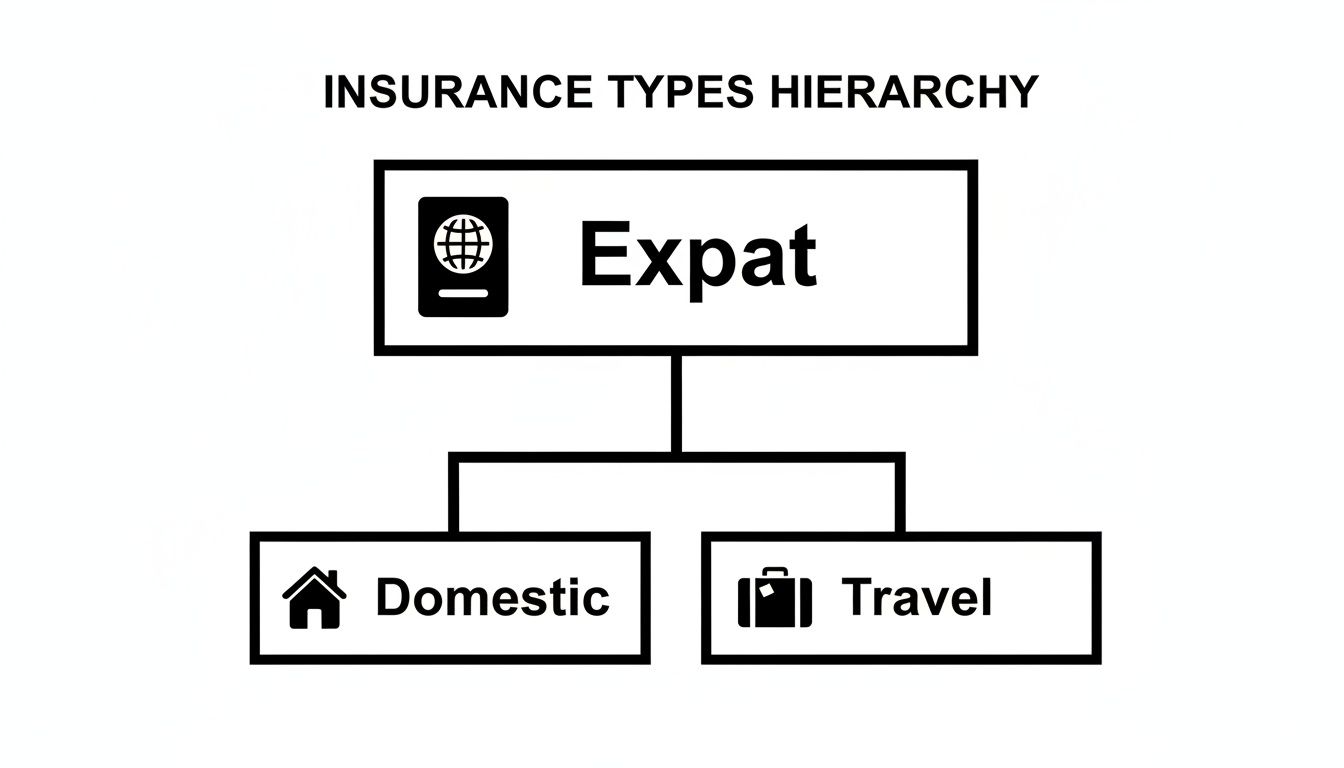
As you can see, domestic and travel plans have their place, but they’re built for limited purposes. Only a dedicated expat medical plan is designed to handle the comprehensive, long-term health needs that come with living in another country.
The Foundation of Your Coverage
Every solid plan starts with the essentials. In the insurance world, we call these the core benefits, and they typically break down into two main buckets: inpatient and outpatient care. Getting your head around the difference is the first step to building a plan that works for you.
Inpatient Care is the absolute cornerstone of your policy. This is what kicks in for any medical treatment that requires you to be formally admitted to a hospital. Think of it as your protection against the big, scary medical events—the ones that can lead to overwhelming and unexpected bills.
- Hospital Stays: This covers your room, meals, and the nursing care you receive.
- Surgeries: It pays for the surgeon’s fees, the anesthesiologist, and the use of the operating room.
- Intensive Care: For critical situations where you need specialized, around-the-clock monitoring.
- In-Hospital Diagnostics: This includes things like MRIs, CT scans, and lab work done while you’re admitted.
Outpatient Care, on the other hand, covers all the medical services that don’t require a hospital stay. This is your day-to-day healthcare management. While it’s often sold as an optional add-on, it’s a vital piece of the puzzle for most expats.
- Doctor Visits: For consultations with general practitioners or specialists.
- Prescription Drugs: Medications you need to pick up from the pharmacy.
- Preventative Care: Think annual check-ups, important vaccinations, and health screenings.
- Minor Procedures: Services you’d get in a clinic, like having stitches put in.
Adding Specialized Modules to Your Plan
Once your core benefits are locked in, you can start adding specialized modules to match your personal health needs and lifestyle. This is where the real customization happens. An expat moving to Singapore for a high-powered corporate job will likely need different add-ons than a retiree settling down in the quiet hills of Portugal.
Some of the most common add-on modules include:
- Dental and Vision: Routine dental check-ups, cleanings, fillings, and new glasses or contacts are almost never covered by a core plan. If you know you’ll need these, adding this module is a no-brainer.
- Maternity Care: If you’re planning on growing your family while abroad, this is absolutely essential. It covers prenatal appointments, the costs of delivery, and postnatal care. Just be aware that most insurers impose a waiting period (usually 10-12 months) before these benefits become active, so you need to plan ahead.
- Medical Evacuation: This is a critically important add-on, especially if you’re living somewhere with questionable or limited medical facilities. It covers the high cost of transporting you to the nearest top-tier medical center if the local care isn’t up to snuff. We dive deep into this topic in our guide on what medical evacuation insurance covers.
Addressing Pre-Existing Conditions
One of the most crucial parts of building your plan is figuring out how it will handle pre-existing conditions—basically, any health issue you had before the policy started. Insurers generally have two ways of approaching this, and it’s vital that you are 100% honest on your application to make sure your coverage is secure.
Medical Underwriting: This is the most common approach. You provide your full medical history, and the insurer analyzes it. They might then decide to cover your condition as is, cover it but for a higher premium, or exclude it from the policy altogether. The big advantage here is that you know exactly where you stand from day one.
Moratorium Underwriting: With this option, you don’t disclose your conditions upfront. Instead, the insurer automatically puts a temporary hold (a moratorium) on covering any condition you’ve had symptoms or treatment for in the recent past (usually 2-5 years). They might agree to cover it down the road, but only if you remain completely symptom-free for a continuous period (like 24 consecutive months) after your policy begins.
Choosing the right structure and modules for your expat medical insurance means your plan will be a perfect fit, giving you robust protection and, most importantly, peace of mind on your global journey.
Finding the Right Plan for Your Expat Lifestyle
Not all expat journeys are cut from the same cloth, so your medical insurance shouldn’t be a one-size-fits-all product, either. The real trick is to match your coverage to your lifestyle, your destination, and how long you plan to be away. Grabbing a generic plan is a recipe for disaster—you could end up with critical gaps in your coverage or find yourself paying for benefits you’ll never actually use.
Picking the right expat medical insurance comes down to aligning the policy’s structure with the reality of your life on the ground. An executive on a two-year assignment in Singapore has completely different needs than a freelancer hopping across Southeast Asia or a retiree putting down roots in Spain. Let’s break down which type of plan makes sense for your adventure.
Plans for the Permanent Relocator
If you’re planning to live abroad long-term—or maybe even forever—a comprehensive global medical plan isn’t a luxury; it’s essential. This is the kind of policy built for maximum stability, designed to act as your primary health insurance for years. These plans are robust, often loaded with extensive benefits for both hospital stays and regular doctor visits, management of chronic conditions, and even preventative health screenings.
This need for durable, long-term coverage is a growing trend. Research shows that roughly 35 percent of all expatriates are now open to staying in their host countries indefinitely. This shift away from temporary assignments highlights why a basic travel or short-term plan just doesn’t cut it anymore. You can read more about how the modern expat is changing and what it means for insurance.
Think of these long-term plans as being built for a life, not just a trip. They give you the peace of mind that comes from knowing you have consistent, reliable medical access, no matter what health challenges pop up down the road.
Flexible Coverage for Digital Nomads
The digital nomad lifestyle is all about freedom and movement, often zigzagging across multiple countries in a single year. For this crowd, the number one priority is seamless, worldwide coverage that isn’t chained to a single location. Flexibility is the name of the game.
Plans designed with digital nomads in mind typically offer a few key things:
- A Massive Geographic Footprint: Coverage that spans multiple continents without forcing you to update your policy every time you get a new stamp in your passport.
- Both Emergency and Routine Care: You get access to emergency services for the unexpected stuff and day-to-day care like doctor visits, wherever you happen to be.
- Painless Claims: Easy-to-use apps and online portals make it simple to submit claims and find network providers while you’re on the move.
This setup ensures you’re protected whether you’re working from a cafe in Lisbon, a co-working space in Bali, or an apartment in Mexico City. The entire focus is on portable, hassle-free healthcare.
Regional Plans for Retirees and Settlers
Let’s be honest: not every expat needs coverage that blankets the entire globe. For retirees settling in a specific part of the world, like the Iberian Peninsula or Southeast Asia, a regional plan can be a brilliant and cost-effective choice. These policies provide comprehensive coverage but limit it to a defined geographical area, such as “Europe” or “ASEAN countries.”
By narrowing the coverage area, insurers can often offer these plans at a much more attractive price point compared to a full worldwide policy. It’s the perfect solution if you plan to live in one country and maybe travel to neighboring nations, but have zero intention of ever needing medical care in high-cost places like the United States.
It’s a practical way to get the high-quality private medical access you need without paying a premium for global coverage you won’t use. To see how different plans stack up, our overseas health insurance comparison tool can help clarify which options are the best fit for your destination and budget. By really thinking through your lifestyle—whether you’re a permanent settler, a constant traveler, or a regional resident—you can land on a plan that truly works for you.
Breaking Down the Cost of Your Global Coverage
Figuring out the price tag on expat medical insurance can feel like trying to solve a complex puzzle. But the final cost isn’t random; it’s calculated based on a few key factors you can actually control. Once you understand these levers, you can make a smart, budget-conscious decision without giving up the coverage you desperately need.

Think of it like building a custom car. The base model has a set price, but that sticker shock changes dramatically depending on the engine you choose, the features you add, and even where you plan to drive it. Your insurance premium works in much the same way.
The Core Pricing Factors
Three main elements drive the cost of your premium more than anything else. Insurers use these to figure out their potential risk and, ultimately, how much you’ll pay.
- Your Age and Health: This one is pretty straightforward. Younger, healthier people typically get lower premiums because, statistically, they’re less likely to need extensive medical care. As you get older, premiums naturally increase to reflect the higher probability of needing medical services.
- Your Level of Benefits: Just like we talked about building your plan with different modules, the number of benefits you select directly impacts the price. A basic inpatient-only plan will be far more affordable than a comprehensive one that includes outpatient care, dental, vision, and maternity.
Your Geographic Area of Coverage
Where you need coverage is one of the biggest financial levers you can pull. Insurance providers offer different geographic zones, and your choice here can dramatically alter your premium.
The most significant pricing distinction is whether you include the United States in your plan. Healthcare costs in the U.S. are the highest in the world, often by a huge margin. Because of this, insurers have no choice but to price policies that include the USA much, much higher.
For this reason, a “Worldwide excluding USA” plan is one of the most popular and cost-effective options for expats. Simply deselecting this one country can reduce your annual premium by as much as 30-50%.
This is a critical decision. If you have no ties to the U.S., excluding it is an easy way to save a bundle. But if you’re an American expat who wants the option to get treatment back home, you’ll need to factor that higher cost into your budget.
Balancing Premiums and Out-of-Pocket Costs
Beyond those core factors, you have direct control over your monthly premium through two important tools: deductibles and co-payments. This is all about the trade-off between what you pay each month versus what you pay when you actually need care.
A deductible is the amount you pay out-of-pocket for medical care before your insurance starts covering the bills. For example, with a $1,000 deductible, you pay the first $1,000 of your covered medical expenses for the year.
A co-payment (or co-insurance) is a percentage of the bill you pay for a covered service after your deductible has been met. A common split is 80/20, where the insurer pays 80% and you pay 20% of the remaining cost.
Here’s how the trade-off works:
- Higher Deductible = Lower Monthly Premium: If you’re willing to take on more of the initial cost yourself, the insurer rewards you with a lower monthly payment.
- Lower Deductible = Higher Monthly Premium: If you’d rather have lower out-of-pocket costs when you need care, you’ll pay a higher premium for that peace of mind.
Choosing a higher deductible is a great strategy if you’re generally healthy and want to keep your fixed monthly costs down, while still having solid protection against a major medical event.
To give you a clearer picture, here are a few ballpark estimates. Remember, these are just illustrations—your actual quote will depend on your specific details.
Sample Annual Premium Estimates for Expat Health Insurance
| Expat Profile | Coverage Area | Deductible Level | Estimated Annual Premium (USD) |
|---|---|---|---|
| 30-year-old Digital Nomad | Worldwide excl. USA | $2,500 | $1,800 – $2,500 |
| 45-year-old Expat Family (2 adults, 2 kids) | Europe Only | $1,000 | $7,000 – $9,500 |
| 65-year-old Retiree Couple | Worldwide incl. USA | $5,000 | $15,000 – $22,000 |
| 35-year-old Single Professional | Worldwide excl. USA & SE Asia | $500 | $3,500 – $5,000 |
As you can see, the interplay between age, coverage area, and your deductible creates a wide range of potential costs. The key is finding that sweet spot that aligns with your health needs and your wallet.
For a more detailed breakdown, our complete guide to understanding international health insurance costs offers additional examples to help you find the right balance for your financial situation.
Choosing a Provider That Works for You
A glossy policy document is one thing, but the true test of your expat medical insurance comes the moment you actually need to use it. The best coverage on paper means nothing without a strong, responsive team behind it. Think of it this way: you’re not just buying a plan; you’re choosing a service partner who will have your back during a stressful medical event.
Picking the right provider means looking past the list of benefits. You need to dig into the practical, real-world support they offer, like their network of doctors, how they handle billing, and the quality of their customer service when you need it most.
The Power of a Strong Provider Network
Imagine this: you have a medical emergency in your new country, only to find out your insurance isn’t accepted at the best local hospital. A provider’s network—their collection of partner hospitals, clinics, and doctors—is the absolute backbone of your coverage. A big, well-respected network means you can get quality care without a fight.
Before you ever sign on the dotted line, you have to verify that your preferred local facilities are in-network. Most top-tier insurers have online tools that let you search their network by city. Take a few minutes to look for reputable hospitals and English-speaking doctors near where you’ll be living. It’s a simple step that can save you a world of trouble later.
Keep in mind, healthcare quality varies wildly from one country to another. For example, a 2023 survey found Taiwan, South Korea, and Qatar offered some of the best healthcare for expatriates. This just highlights why having a plan with a solid network in your specific location is a game-changer. You can find more insights on these global healthcare rankings for expats on Statista.
Direct Billing vs. Reimbursement Claims
Understanding how your medical bills get paid is one of the most practical things you need to know. The difference between direct billing and reimbursement can have a massive impact on your bank account and your stress levels.
- Direct Billing (Cashless Service): This is the gold standard. With direct billing, the hospital bills your insurance company directly. You show your insurance card, pay your deductible (if you have one), and that’s it. The provider handles the rest.
- Reimbursement: This is the old-school way. You have to pay the entire medical bill upfront with your own money. Then, you submit a mountain of receipts and paperwork to your insurer and wait for them to pay you back.
For something major like a hospital stay or surgery, the difference is night and day. A direct billing setup means you aren’t stuck paying thousands of dollars out of pocket, which can be a huge financial burden for anyone.
When you’re comparing providers, always ask about their direct billing network. An insurer with extensive direct billing partnerships makes getting care smoother and a whole lot less stressful on your finances.
The Importance of 24/7 Multilingual Support
A medical emergency couldn’t care less about business hours or language barriers. When you’re in a foreign country and a crisis hits at 2 AM, the last thing you want to hear is an automated message or a support agent who doesn’t speak your language.
This is where 24/7 multilingual assistance becomes a non-negotiable feature. The best providers offer round-the-clock support hotlines staffed by real people who can:
- Help you find the nearest in-network hospital.
- Arrange a medical evacuation if it’s necessary.
- Provide translation services to help you communicate with doctors.
- Answer urgent questions about what your policy covers.
This support system is your lifeline in a crisis. It turns your insurance policy from a piece of paper into an active, responsive service that delivers genuine peace of mind, no matter where you are or what time it is.
Making Your Final Decision with Confidence
Choosing your expat medical insurance is a big move, and it’s completely normal to feel a little bit of pressure when it’s time to make the final call. You’ve learned about coverage, costs, and networks, but pulling all that information together to pick the one perfect plan can feel like a heavy lift.
The good news? You don’t have to make this decision on your own.
This is where working with a specialist broker really shines. A good broker is your advocate, helping you cut through the marketing noise and get to what matters. They’re already experts in the global insurance market and can quickly line up top-tier plans from leading insurers like Cigna, GeoBlue, and IMG for a side-by-side comparison.
But a broker’s job is about more than just finding the cheapest price. They make sure the policy you choose actually fits your personal health needs, your budget, and—crucially—any specific visa requirements for your new home country. This kind of expert guidance helps you sidestep costly mistakes and land a plan that truly has your back.
Asking the Right Questions Before You Commit
Whether you decide to work with a broker or go straight to an insurer, you need to show up prepared with the right questions. Getting solid answers on a few key points will give you the confidence to sign on the dotted line. Think of it as your final checklist before securing your peace of mind.
Here are the non-negotiables to ask about:
- Policy Renewal: What does the renewal process look like each year? Will my premium go up automatically just because I’m a year older, and if so, by how much?
- Portability: If I move to a different country down the road, can this policy come with me? How does changing my country of residence impact my coverage and my premium?
- Claims Process: Can you walk me through the exact steps for filing a claim, both for a routine doctor’s visit and a real emergency? What’s the typical turnaround time for getting reimbursed?
- Emergency Support: If I have a medical emergency in the middle of the night, who do I call? What kind of support can they actually provide in that moment?
- Cancellation Terms: What are the rules if I need to cancel my policy before the year is up?
Getting straightforward, no-fluff answers to these questions is essential. A transparent provider or broker will be more than happy to give you detailed responses, confirming that you’re making a smart, well-informed choice for your health and safety abroad.
Ultimately, you’re looking for a plan that feels less like a transaction and more like a partnership. By leaning on expert advice and asking sharp questions, you turn a complex decision into a confident investment in your new global life. You’re not just buying an insurance policy; you’re securing a support system that will be there for you, no matter where your adventure takes you.
Got Questions About Expat Insurance? We’ve Got Answers.
Stepping into the world of global medical coverage can feel a bit like learning a new language. Let’s clear up some of the most common questions expats have when sorting out their health insurance.
If My New Country Has Public Healthcare, Do I Still Need Private Insurance?
Yes, it’s a very good idea. Even in countries with excellent public healthcare, you’ll often run into long wait times for specialists or find that certain treatments aren’t covered at all.
Think of an expat medical insurance plan as your fast-track pass. It gets you immediate access to private doctors and hospitals for quicker, more personalized care. More importantly, it covers things that public systems almost never do, like medical evacuation back home.
What’s the Real Difference Between Travel and Expat Insurance?
This is a big one, and mixing them up can be a costly mistake. Travel insurance is for tourists. It’s a short-term fix for emergencies on a trip—like a sudden illness or a canceled flight. Its main job is to patch you up and get you home.
Expat medical insurance, on the other hand, is your primary, long-term health plan for living abroad. It’s designed to cover everything from your annual check-up and prescriptions to serious, ongoing treatments. It’s not just for emergencies; it’s for your everyday health.
To put it simply: travel insurance is for visiting, while expat insurance is for living. Treating a long-term stay like a short trip can leave you dangerously exposed when it comes to your day-to-day medical needs.
Will I Be Denied Coverage for a Pre-Existing Condition?
It really depends on the insurance provider and your specific health history. When you apply, the insurer will take a close look at your medical records.
Here are the usual outcomes:
- They might exclude coverage for that specific condition, but cover everything else.
- They could offer you a policy but charge a higher premium to account for the risk.
- Some plans use a moratorium, where they’ll agree to cover the condition after a waiting period (often 24 months) as long as you haven’t had symptoms or needed treatment for it.
The absolute golden rule here is to be 100% honest on your application. Hiding a pre-existing condition can void your entire policy right when you need it most, leaving you to foot the bill. Full transparency ensures there are no nasty surprises down the road.
Trying to figure all this out on your own can be overwhelming. The team at Expat Global Medical lives and breathes this stuff. We specialize in matching expats with the right plan for their unique situation, so you can have total peace of mind, no matter where you decide to call home.