Most digital nomad visas really boil down to a few key things: can you prove you have a steady remote income, is your background clean, and most importantly, do you have comprehensive expat medical insurance? If you can tick these boxes, you’re showing your host country that you can stand on your own two feet without taking local jobs or becoming a burden on their public healthcare system.
Your Roadmap to a Digital Nomad Visa
So, you’re ready to get your digital nomad visa. You’re in the right place. The explosion of remote work has swung open doors all over the globe, letting people like us live and work from pretty much anywhere. Countries have caught on, too, creating special visas to draw in location-independent workers who boost local economies.
This guide is here to cut through the confusion. We’ll break down the entire application process, explaining what these visas are all about and why they’ve become a game-changer for today’s global workforce. We’ll also flag the common tripwires—especially the ones related to insurance—so you can step right over them.
Forging the Keys to Your Application
Think of the application process less like a bureaucratic maze and more like a series of gates. Each gate needs a specific key, and this article is going to show you how to forge every single one—from proving your income to locking in the right medical insurance. These common digital nomad visa requirements aren’t just random hoops to jump through; they’re how a country makes sure you’ll be a responsible guest.
A digital nomad visa is your legal foundation for living and working abroad. Having the right insurance isn’t just a requirement—it’s your safety net for the journey ahead, protecting both you and your host country from unexpected financial burdens.
Preparing for the Journey
You’ll quickly learn that a successful application is all about solid preparation. As you start laying out your plans, remember that the visa is just one piece of the puzzle. For a complete look at the whole relocation process, our step-by-step guide for future expats is a great place to start.
This journey is about more than just paperwork. It’s about building a secure and legal framework for your new life abroad, with proper health coverage at its core. Let’s get to it.
The Four Pillars of Your Visa Application
Navigating the world of digital nomad visas can feel overwhelming, but once you get the hang of it, you’ll see a pattern. Nearly every application you fill out will rest on four core pillars. These aren’t just random bureaucratic hoops to jump through; they’re a country’s way of making sure you’ll be a great temporary resident.
Think of it like this: a government is asking you four simple questions. Can you support yourself financially? Are you taking a job from a local? Are you a safe person to have in our community? And crucially, can you handle a medical crisis without relying on our public system? Nail these four, and you’re golden.

Pillar 1: Proof of Sufficient Income
First up, money. Governments need to know, without a doubt, that you can afford to live in their country. They want to see that you have a steady, reliable income that allows you to pay for rent, food, and fun without ever needing to seek local employment or government help. This is why every digital nomad visa comes with a minimum income threshold.
This magic number can swing wildly from place to place. For a country like Brazil, you might only need to show around $1,500 per month. On the flip side, a place like Iceland will want to see proof of over $7,700 per month. The amount is almost always tied to the local cost of living, and you’ll usually have to back it up with a few months of bank statements, tax returns, or a stack of client invoices.
Pillar 2: Evidence of Remote Work
Next, you have to prove you’re actually a remote worker. This is the whole point of a “nomad” visa, after all. The government needs to see that your income comes from clients or an employer located outside their country.
This is a huge deal for them. It’s their assurance that you won’t be hopping into the local job market and competing with their citizens for work. You can usually satisfy this with one of these documents:
- An employment contract from a foreign company that clearly states your role is remote.
- Signed contracts or letters of intent from your clients if you’re a freelancer.
- Official registration documents for your business, proving it’s based outside their country.
This whole scene is still pretty new. The digital nomad visa boom really took off after 2020—in fact, a staggering 91% of all nomad visas were launched since then. With around 64 countries now vying for remote talent, governments see nomads as a great way to boost the economy. You can get a deeper dive into this global trend by checking out this great report on the digital nomad boom.
Pillar 3: A Clean Criminal Record
The third pillar is all about safety and trust. Countries are opening their doors to you, and they want to be sure they’re welcoming responsible, law-abiding people into their communities. That’s why a clean criminal record check is a non-negotiable part of almost every long-term visa application.
You’ll need to get an official background check from your home country. If you’ve lived anywhere else for an extended period (usually six months or more), you might need one from that country, too. This piece of paper is your proof that you’re a good citizen who won’t cause any trouble.
Pillar 4: Comprehensive Expat Medical Insurance
Finally, we get to the pillar that trips up more people than any other: health insurance. Let me be clear—this isn’t a suggestion. It’s an absolute, non-negotiable requirement designed to protect both you and the country you’re moving to.
Immigration officials see an uninsured foreigner as a massive financial risk. If you have a medical emergency and can’t pay for it, the burden could fall on their public healthcare system. It’s a risk no government is willing to take.
This is exactly why your standard travel insurance policy won’t cut it and will lead to an automatic rejection. Travel insurance is for short trips—think lost luggage or a twisted ankle on a two-week vacation. It simply doesn’t have the deep, comprehensive medical coverage that visa officials are trained to look for.
What you absolutely must have is a proper expat medical insurance plan. These policies are built from the ground up for people living abroad long-term. They offer the kind of robust coverage consulates demand, including:
- Hospital stays and outpatient doctor visits
- Emergency medical evacuation if you need to be flown to a better hospital
- Coverage that meets the country’s minimum requirement, which is often €30,000 or more
Submitting proof of a solid expat medical plan sends a powerful message. It shows you’re a prepared, responsible applicant who won’t be a liability. It is one of the single most critical documents for strengthening your visa application and proving you’re the kind of nomad they want to welcome.
Why Expat Medical Insurance Is Your Most Crucial Document

Of all the paperwork you’ll pull together for your digital nomad visa, there’s one document that trips up more applicants than any other: your health insurance policy. It’s easy to treat this as just another box to check, grabbing the cheapest or quickest option you can find. But that’s a huge mistake that often leads to instant visa denial.
Immigration officials don’t see your health coverage as a mere formality. They see it as a direct measure of your preparedness and financial stability.
Submitting the wrong kind of insurance is like showing up to a corporate job interview in flip-flops—it tells them you don’t grasp the seriousness of the situation. Consulates see thousands of applications, and they can spot a flimsy travel insurance policy from a mile away. They are specifically trained to look for robust, long-term coverage because an underinsured foreigner is a potential drain on their country’s public health system.
This isn’t just about satisfying a rule. It’s about providing a guarantee. Your insurance certificate is your promise to the host country that you can handle anything from a stomach bug to a serious accident without costing their taxpayers a dime.
The Critical Difference: Travel Insurance vs. Expat Medical Insurance
One of the most common pitfalls for hopeful nomads is confusing short-term travel insurance with long-term expat medical insurance. They are two completely different products built for entirely different scenarios. Submitting one when the other is required is a fast track to a visa denial.
Think of it like this: travel insurance is a first-aid kit. It’s perfect for a two-week vacation, covering emergencies like a lost bag, a canceled flight, or a sprained ankle. It’s designed to patch you up and get you home.
Expat medical insurance, on the other hand, is like having your family doctor, a team of specialists, and a full hospital on call wherever you land. It’s a comprehensive healthcare system in your back pocket, designed for someone who is living abroad, not just visiting.
Submitting a travel insurance policy for a long-stay visa is one of the top reasons for immediate rejection. Visa officers are looking for proof of sustained, comprehensive health coverage that mirrors a domestic plan, not temporary trip protection.
This distinction is everything, because digital nomad visa requirements are built around the idea that you’ll be a temporary resident. Because of that, countries mandate specific coverage levels that basic travel insurance just can’t provide.
What Visa Officials Are Really Looking For
When an immigration officer picks up your insurance documents, they have a mental checklist. They are hunting for specific, non-negotiable details that prove your policy is solid enough for a long-term stay. Anything less will raise an immediate red flag.
Here’s a breakdown of what they typically need to see:
- Minimum Coverage Amount: Most countries, especially in the Schengen Area, demand a minimum of €30,000 (or the local equivalent) in medical coverage. Some destinations require even more.
- Emergency Medical Evacuation: This is a deal-breaker. They need absolute certainty that if you have a serious accident in a remote area, your insurance will cover the massive cost of getting you to a proper medical facility.
- Repatriation of Remains: It’s a grim thought, but this is a standard requirement. It ensures that in a worst-case scenario, the costs of returning your remains to your home country are fully covered.
- Zero Deductible: Many visas specify that the policy must have a €0 deductible. This guarantees that you won’t be blocked from receiving care because you can’t afford the initial out-of-pocket payment.
- Validity in the Host Country: The policy document must explicitly state that it provides full coverage in the specific country (and often the entire region, like the Schengen zone) for the entire visa duration.
These tough requirements are exactly why a specialized plan is non-negotiable. To tick all these boxes, you need a policy built from the ground up for the nomad lifestyle. Exploring options for digital nomad health insurance is the best way to see what a compliant, protective plan actually includes. These policies are designed to satisfy even the strictest visa requirements right out of the gate.
More Than a Document: A Personal Safety Net
Forget the visa application for a moment. Your expat medical insurance is the single most important investment you can make in your own well-being abroad. The thrill of moving to a new country can easily push the practical realities of healthcare to the back of your mind. Without the right coverage, a medical issue can quickly turn into a financial and logistical disaster.
Imagine trying to find a specialist, needing emergency surgery, or getting a prescription filled in a country where you don’t speak the language. A proper expat medical plan does more than just pay the bills. It gives you access to a global network of trusted doctors and hospitals, often with 24/7 multilingual support lines to help you book appointments and understand your treatment.
It’s the peace of mind that lets you truly dive into your adventure, knowing you have a powerful support system ready if you ever need it. When you stop seeing it as an expense and start seeing it as a critical investment, you’ve taken the first real step toward a successful and secure life as a digital nomad. It protects your health, your savings, and the very visa that makes it all possible.
Comparing Digital Nomad Visa Requirements Worldwide
Once you get the hang of the basic requirements for digital nomad visas, it’s time to see how they actually work in the real world. Knowing the theory is one thing, but how countries apply these rules can be wildly different. One of the biggest mistakes nomads make is thinking that if they qualify for one country’s visa, they’re a shoo-in for another.
That “one-size-fits-all” mindset is a fast track to a rejected application. Every country has its own economy, social concerns, and bureaucratic quirks that shape its visa rules. When you put popular destinations side-by-side, you start to see just how massive the differences are, especially when it comes to income thresholds and health insurance mandates.
Getting a handle on these differences is critical. It helps you pick a destination that doesn’t just match your travel dreams but also fits your financial reality and your ability to get the right paperwork together—especially the all-important insurance policy.
Country Comparison of Digital Nomad Visa Requirements
To really see how much these requirements can vary, let’s take a side-by-side look at a few of the most popular digital nomad hubs. The table below breaks down the key details for Portugal, Spain, and Brazil, giving you a quick snapshot of what to expect.
| Country | Minimum Monthly Income | Visa Duration & Renewal | Health Insurance Specifics |
|---|---|---|---|
| Portugal | €3,280 | 1 year, renewable for 2-year periods. | Must be Schengen-compliant with €30,000 minimum coverage for emergencies and repatriation. |
| Spain | €2,160 | 1 year, renewable for up to 5 years. | Must be from an insurer authorized in Spain, often requiring a zero deductible or co-pay. |
| Brazil | $1,500 | 1 year, renewable for an additional year. | Must provide full coverage within Brazilian territory for the entire visa duration. |
As you can see, the financial bar and insurance rules are anything but standard. This isn’t just random red tape; it’s a reflection of each country’s strategy for attracting remote workers.
Unpacking the Key Differences
Let’s dig a little deeper into what those numbers mean for you. Portugal, Spain, and Brazil all want remote workers, but their approaches show the full spectrum of what you’ll encounter.
Portugal, for instance, has become a massive hub for nomads, and its fairly straightforward process is a big reason why. The D8 visa requires a monthly income that’s four times the Portuguese minimum wage, which works out to about €3,280. For many established freelancers and remote employees, that’s a very achievable target.
Spain, on the other hand, sets a different financial bar. You’ll need to prove an income of at least 200% of the Spanish minimum wage (SMI), which is around €2,160 per month. While that’s lower than Portugal’s requirement, the application process in Spain can feel more intense, often demanding more detailed proof of your work history.
Then you have Brazil, which offers one of the most accessible routes financially. They require a minimum monthly income of just $1,500 or proof you have $18,000 sitting in the bank. This lower threshold opens the door for a much wider range of remote workers, including people who are just starting out.
The variance in visa rules isn’t random; it reflects a country’s economic strategy. A lower income requirement might aim to attract a higher volume of nomads to boost tourism, while a higher threshold targets established professionals who are likely to spend more locally.
Health Insurance: The Non-Negotiable That Trips People Up
While everyone focuses on the income numbers, it’s the specific health insurance rules that often make or break an application. And just like with income, every country has its own non-negotiable standards.
- Portugal: You need a policy with at least €30,000 in coverage that’s valid across the entire Schengen Area. The key part is that it must cover medical emergencies, hospitalization, and repatriation for your whole stay.
- Spain: Spain also requires Schengen-compliant coverage, but they’re often much stricter about it. Consulates usually demand a policy from an insurer that’s officially authorized to operate in Spain, and—this is the detail that gets a lot of people—it often must have zero deductible or co-pay. A generic international plan just won’t cut it.
- Brazil: The rules here are a bit more flexible, but they still need to see proof of a health insurance plan that’s valid in Brazil for your entire stay. They simply want assurance that you can cover any medical costs you might incur.
These little details are exactly why a basic travel insurance policy is never going to be enough. You need a proper expat medical insurance plan that can be tweaked to meet the very specific, and sometimes peculiar, demands of the consulate you’re dealing with.
A Global Snapshot of Visa Trends
This country-by-country variation is part of a bigger global picture. As more nations jump into the competition for remote talent, some common standards are starting to emerge. For example, one-year visas are now the norm, with about 66% of all digital nomad visas lasting for this period. It strikes a good balance between a country’s need for control and a nomad’s need for flexibility.
Even better, 76.6% of these programs offer a path to extension or renewal, which shows that countries are genuinely interested in keeping nomads who integrate well. Income requirements still vary wildly, from Brazil’s friendly $1,500 a month to much higher financial hurdles elsewhere. If you want to dive deeper into these trends, this report on the digital nomad boom has some great insights.
Your Step-By-Step Visa Application Checklist
Alright, now that you’ve got the basics down, it’s time to get our hands dirty. Let’s move from theory to action and turn what feels like a mountain of paperwork into a manageable, step-by-step game plan. We’ll break this journey into three clear phases to keep you organized and moving forward.
Think of it like planning a big overseas trip. Phase one is packing your bags and triple-checking you have everything (your documents). Phase two is actually getting to the airport and through security (the submission). And phase three is the flight itself—the patient wait before you land at your destination (approval).
Phase 1: The Document Gathering Mission
This is where the real work happens, and your attention to detail is everything. Honestly, rushing this stage is the number one reason for easily avoidable rejections. You’ll want to start gathering these items way in advance, as some can take weeks, or even months, to get your hands on.
Your core document checklist will almost always include these heavy hitters:
- Valid Passport: Make sure it has at least six months of validity left beyond your planned stay and, crucially, at least two blank pages.
- Passport-Sized Photos: Don’t just use any old photo. Most consulates are incredibly specific about the size, background color, and even how recently the picture was taken.
- Proof of Remote Work: This could be a formal letter from your employer, a stack of client contracts, or your business registration documents if you’re self-employed.
- Proof of Income: Get ready to show them the money. This usually means 3-6 months of bank statements, recent tax returns, or audited financial statements.
- Expat Medical Insurance Certificate: This is a critical document. You’ll need the full policy certificate that clearly shows your name, the extensive coverage dates, and benefit amounts for medical care, emergency evacuation, and repatriation that meet the country’s specific requirements.
- Clean Criminal Record Check: This is an official background check from your home country and, sometimes, any other country where you’ve lived for more than six months in the last few years.
- Proof of Accommodation: This can be as simple as a short-term hotel or Airbnb booking or a signed rental agreement in your new country.
Phase 2: Navigating the Application Submission
Once your document treasure chest is full, it’s time to actually submit the application. How you do this varies wildly from country to country, but it usually falls into one of two buckets: slick online portals or old-school, in-person consulate appointments.
The online portals are convenient but can be notoriously finicky. Always, always double-check the file size limits and required formats (good old PDF is usually a safe bet). For in-person appointments, book as early as you possibly can—slots can fill up months ahead of time. When you go, show up with all your documents perfectly organized, preferably in the exact order the consulate checklist asks for.
Pro Tip: Many of your official documents, like birth certificates or that criminal record check, might need an extra stamp of approval to be valid internationally. As you’re gathering everything, be aware that some countries require an apostille. You can check the Hague Apostille country list to see which nations recognize this type of certification.
Phase 3: The Waiting Game and What to Expect
You’ve hit submit. Now, the waiting begins. This is often the most nerve-wracking part of the whole process, but knowing the typical timelines can help you keep your cool. Processing times can be as short as a few weeks or drag on for several months, depending on the country and how swamped they are with applications.
During this limbo, hold off on making any big, non-refundable travel plans. Keep a close eye on your email (and your spam folder!) for any messages from the consulate. They might pop up with a request for more information, and a quick response is vital. This is why a thorough, complete application from the get-go is your best friend—it cuts down on the chances of that frustrating back-and-forth.
For a bigger picture of all the logistics involved in a move, our expat checklist for leaving the U.S. provides a great framework for planning your entire relocation.
Frequently Asked Questions About Nomad Visas
Even with the best-laid plans, the world of digital nomad visas is filled with tricky, specific questions. You can do all the research, but tiny details can trip you up and derail your application. Let’s tackle some of the most common queries we see from nomads to help you sidestep those potential roadblocks.
Applying From Inside a Country
A classic question we get is, “Can I just fly into a country on a tourist visa and then apply for the digital nomad visa?” It’s a logical thought, but the answer is almost always no, with a few rare exceptions.
Most countries are very strict about this. They require you to apply from your home country or another country where you have legal residency. Spain is one of the few places that might let you make the switch from within its borders, but that’s not the norm. Trying to apply from the wrong place is a surefire way to get an instant rejection.
Always, always check the specific rules with the consulate of your destination country before you book a flight. Assuming you can apply from anywhere is a costly mistake that wastes time, money, and a whole lot of energy.
The typical application process is a straightforward, three-step journey, but each step has its own hurdles.
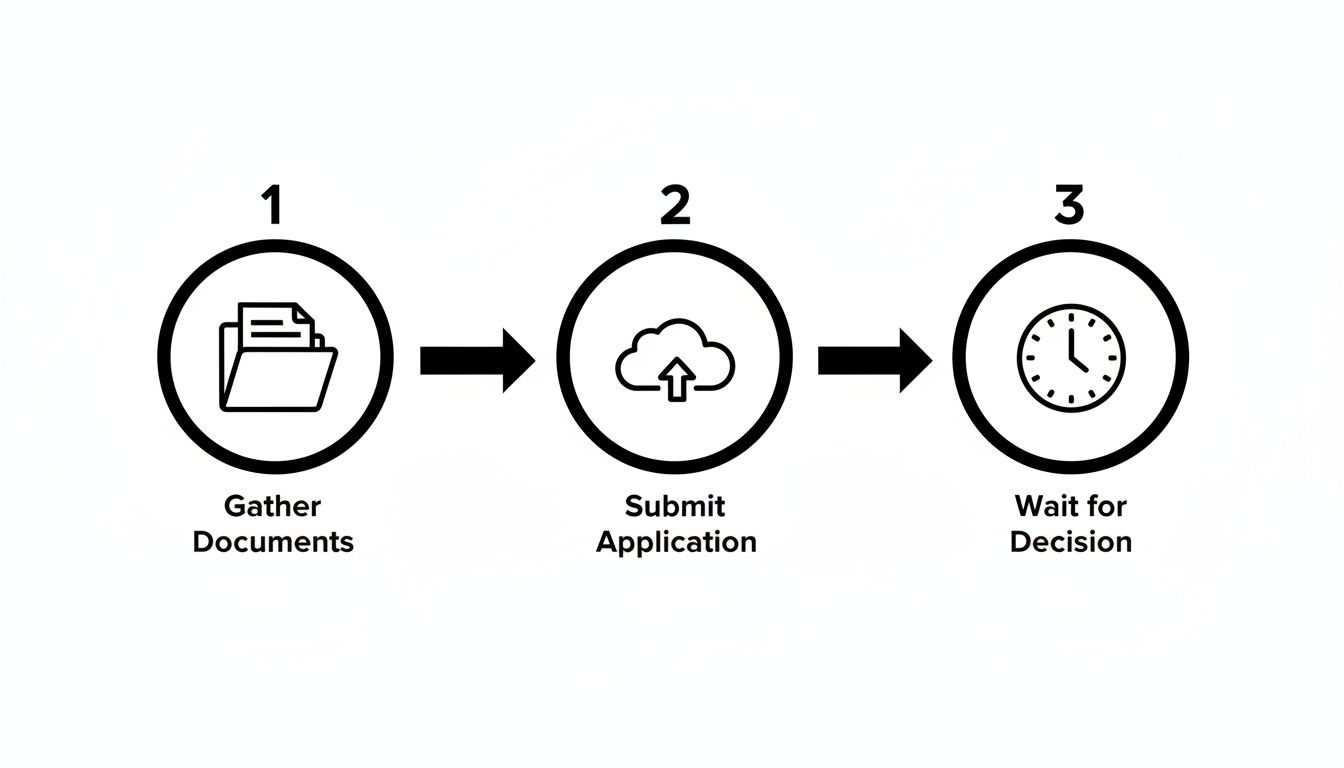
This process shows exactly why having every single document correct from the start—especially that all-important insurance certificate—is non-negotiable.
Travel Insurance vs Expat Medical Insurance
This is probably the single biggest point of confusion, and it’s a critical one. Submitting the wrong type of insurance is a guaranteed denial. Travel insurance and expat medical insurance are two completely different animals.
Think of travel insurance as a temporary safety net for a vacation. It’s built for short trips, covering things like a lost suitcase, a cancelled flight, or a medical emergency to get you stable enough to fly home. It is not designed for someone living in a country long-term and will be rejected by any consulate.
Expat medical insurance, on the other hand, is real, comprehensive health coverage, just like the plan you’d have back home. It’s designed for long-term stays and covers everything from routine check-ups and specialist visits to hospitalizations. Consulates demand this robust coverage because they need proof that you won’t become a drain on their public healthcare system.
Understanding Your Tax Obligations
Ah, taxes. The topic every nomad loves to hate. The big question is always, “Will I have to pay taxes in two countries?” The honest answer? It’s complicated, and getting it wrong can be incredibly expensive.
Your tax situation usually boils down to a couple of key things:
- Tax Residency: Many countries will consider you a tax resident if you spend more than 183 days there in a year. Once you cross that line, you’re often on the hook for local taxes.
- Tax Treaties: Your home country and host country likely have an agreement in place to prevent “double taxation”—getting taxed twice on the same income.
While a few digital nomad visas come with special tax breaks, most don’t automatically shield you from local tax laws. To avoid a financial nightmare, it’s absolutely essential to get advice from a tax professional who specializes in expat and international tax law.
Trying to figure all this out, especially the health insurance part, can feel like a full-time job. Expat Global Medical specializes in providing compliant, comprehensive insurance plans that tick all the boxes for the strictest digital nomad visa requirements worldwide. Protect your health and secure your visa by exploring your options at https://expatglobalmedical.com.