The dream of working from anywhere isn’t some far-off fantasy anymore. It’s a real, tangible career path, and your goal of logging in from another…
The dream of working from anywhere isn’t some far-off fantasy anymore. It’s a real, tangible career path, and your goal of logging in from another country is more achievable than ever before. This massive shift, driven by new tech and a shared hunger for flexibility, has completely reshaped the professional world.
The New Normal Is Global
The idea of joining a team meeting from a different time zone is no longer a novelty; it’s a core part of how modern companies operate. What started as a forced experiment has quickly become a strategic advantage, as businesses finally recognize that great talent isn’t confined to a single zip code. This opens up incredible opportunities for professionals like you who want international experience without having to put their careers on hold.
The numbers don’t lie. As of early 2025, a staggering 80% of employees whose jobs can be done from a distance are working in either hybrid (52%) or fully remote (26%) roles. In the U.S. alone, experts predict the remote workforce could hit 36.2 million people by 2026—a massive leap from just a few years ago.
Why This Shift Matters To You
This widespread acceptance of remote work is the tailwind for your international plans. It means more companies already have the policies, tools, and—most importantly—the culture to support employees working from anywhere. The conversation has shifted from, “Can I work remotely?” to “Okay, how do we make this work effectively across different countries?”
Understanding this bigger picture is crucial. It helps to know the challenges companies are navigating, like adopting the best practices for managing remote teams to keep everyone connected and productive across borders.
The biggest change isn’t just the technology that lets us connect from anywhere. It’s the corporate mindset that now trusts and empowers employees to deliver great work, regardless of their physical address.
The Practical Implications for Your Journey
While this global shift is great news for your ambition, it also shines a light on the practical hurdles you’ll need to clear. This isn’t just about packing a laptop and catching a flight. A successful move requires careful planning around a few non-negotiable details that protect both you and your employer.
Here are the key areas you absolutely have to get right:
- Legal Authorization: Getting the correct visa is the first and most critical step. Without it, everything else is a non-starter.
- Health and Safety: Comprehensive expat medical insurance is the bedrock of your security abroad. It’s not a “nice-to-have”; it’s an essential requirement for both your visa and your well-being.
- Financial Planning: You need a solid plan for navigating cross-border taxes and banking to avoid expensive surprises down the road.
This guide will walk you through each of these critical areas, step-by-step. We’ll turn your dream of working remotely from another country into a well-executed, real-world plan. With the right preparation, you can confidently join the millions of professionals who have already made the world their office.
Decoding Visas and Your Legal Right to Work
Before you even start daydreaming about your new life abroad, we need to talk about the single biggest hurdle: your legal status. The entire dream of working remotely from another country lives or dies based on your right to be there and, crucially, your right to earn a living.
It’s easy to get lost in the maze of visas and work permits, but let’s simplify it. Think of your passport as the key that gets you through the front door of a country. A visa, on the other hand, is the set of house rules that tells you what you’re allowed to do once you’re inside.
One of the most common—and costly—mistakes aspiring remote workers make is trying to work on a tourist visa. This is a huge gamble. Getting caught can mean hefty fines, immediate deportation, and even a long-term ban from re-entering the country. Immigration officials are a lot savvier than people give them credit for.
Understanding Your Visa Options
The great news is that as remote work has exploded in popularity, countries have started to catch up. They’re creating new legal pathways for people just like you. Generally, your options will fall into one of three buckets.
- Tourist Visa: This one is exactly what it sounds like—for tourism only. It strictly prohibits any kind of work, whether you’re getting paid by a local company or your employer back home. Don’t fall into the trap of thinking you can just fly in and work quietly from a café.
- Digital Nomad Visa: These are the real game-changers. Over 50 countries now offer these specialized visas specifically for professionals who work for foreign employers or have their own international clients. You’ll typically need to show proof of a steady income, have health insurance, and provide a clean criminal record.
- Traditional Work Permit: This is the path for anyone hired by a local company in their destination country. It’s a much more involved process that’s usually sponsored by the employer, and it directly ties your legal right to live in the country to that specific job.
This decision-path flowchart can help you visualize how to start thinking through your move.
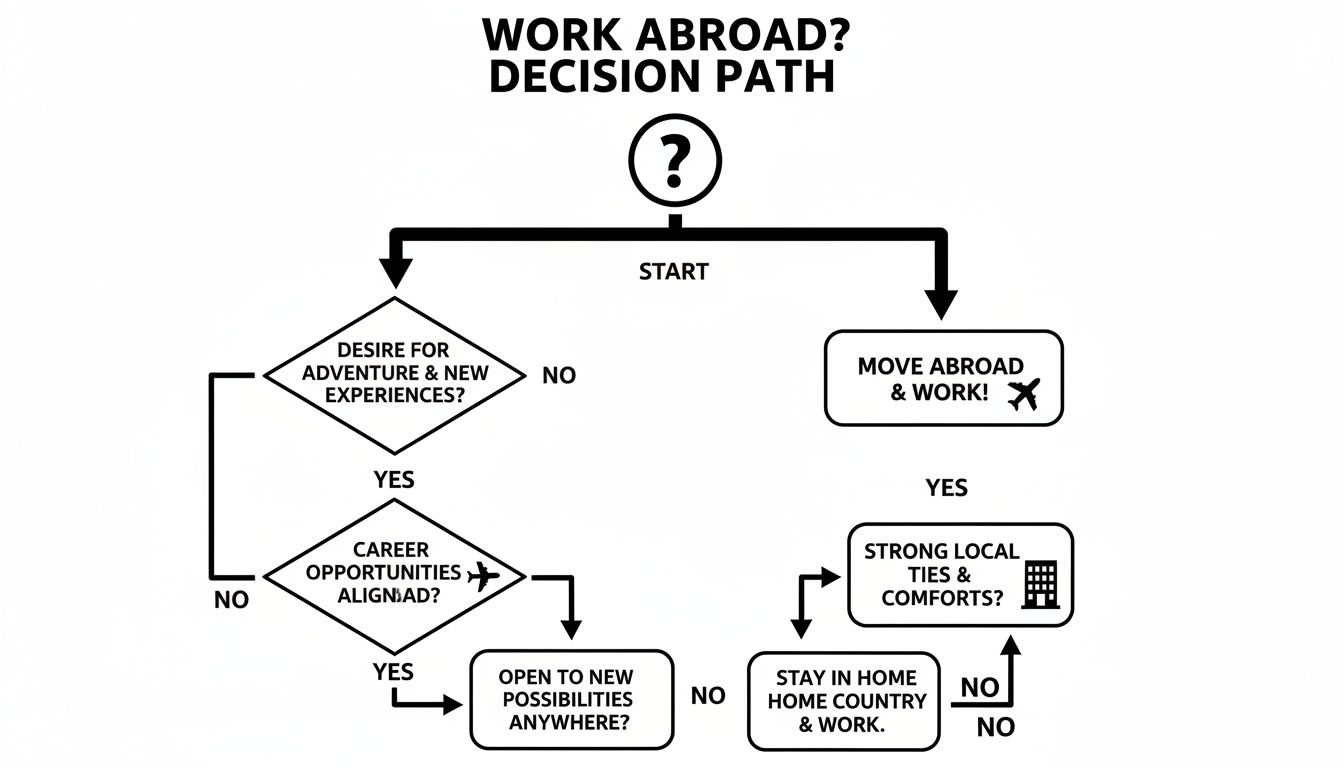
The bottom line is that the moment you decide to work from another country, a whole series of legal and logistical questions pop up. You have to answer them before you go any further.
Real-World Visa Scenarios
Let’s make this tangible. Imagine a freelance graphic designer who earns a consistent income from clients all over the world. She’d likely be a perfect candidate for Spain’s digital nomad visa, since she can easily prove a stable income stream that originates from outside of Spain—a key requirement. A critical part of her application will be proving she has comprehensive expat medical insurance that meets Spain’s criteria for the duration of her stay.
Now, contrast her with a software developer who just landed a job with a tech startup in Germany. His situation is completely different. He’ll need a German work permit, sponsored by his new employer. His legal status is tied directly to that job, unlike the freelancer who has more independence. The German government will still require proof of adequate health coverage before issuing the permit.
Understanding these distinctions is critical. Your visa path often aligns with whether you see yourself as a temporary resident or someone setting down more permanent roots. You can dig deeper into this by exploring the key differences between an expat and an immigrant in our detailed guide.
The single most important rule is to get your information directly from the source. Always consult the official government immigration website for your target country. Third-party blogs and forums can be helpful for personal stories, but they are not a substitute for official legal requirements.
Actionable Steps for Your Research
To avoid getting bad advice or making an expensive mistake, you need a methodical research plan.
Your first stop should always be the official embassy or consulate website for your destination country. These sites are the definitive source for accurate, up-to-date info on visa types, application steps, and all the required paperwork.
Look for sections on their website labeled “long-stay visas,” “residence permits,” or “digital nomad visas.” Pay very close attention to the eligibility criteria, especially the requirements for expat medical insurance. Many countries specify minimum coverage levels for hospitalization, emergency care, and medical evacuation.
Create a detailed checklist of every single requirement. Getting your legal status and insurance coverage right from the very beginning is the foundation for a successful, stress-free life working abroad.
Why Expat Medical Insurance Is Non-Negotiable
While sorting out your visa feels like a huge win, the single most important decision you’ll make for your safety and financial security is getting the right health insurance. It’s a dangerous and potentially bankrupting assumption to think your domestic plan will have your back while working remotely from another country. That’s a gamble you simply can’t afford.
Let me paint you a picture I’ve seen play out too many times. An American remote worker is loving life in Thailand—the culture, the food, the low cost of living. Then, a sudden case of dengue fever, which is common there, lands them in the hospital. The care is excellent, and they make a full recovery. Great news, right?
Not quite. The $15,000 hospital bill arrives, and their U.S. health plan offers zero direct coverage. They’re forced to pay the whole thing out-of-pocket, clinging to the slim hope of a partial reimbursement that might never materialize. Just like that, the dream becomes a financial nightmare.
The Critical Difference of a True Expat Plan
Now, let’s rewind. This time, our remote worker had a proper expat medical insurance plan. When the emergency hits, they call their insurer’s 24/7 assistance line. The insurance company immediately coordinates with the hospital, guarantees payment, and handles all the paperwork.
Our worker gets to focus on one thing: getting better. No stress, no looming debt. That’s the profound difference a specialized international plan makes. It’s not just about having coverage; it’s about having a global support system when you’re at your most vulnerable.
Expat medical plans are built from the ground up for a global lifestyle. They’re designed for people who need care in multiple countries, require access to international hospital networks, and might face an emergency thousands of miles from home. More than just a safety net, this insurance is often a mandatory requirement for securing a long-stay or digital nomad visa.
What Defines a Quality International Health Plan
Not all international insurance is created equal. When you start comparing options, it’s easy to get lost in the jargon. But a few core features are absolutely non-negotiable for anyone serious about living and working abroad.
Here’s what you need to demand from any potential plan:
- High Coverage Limits: Medical costs can be astronomical. A good plan should offer coverage well into the millions to protect you from a catastrophic event.
- Direct Billing Network: This is a game-changer. It means the insurer pays the hospital directly, so you aren’t stuck footing a massive bill upfront and chasing reimbursement.
- Worldwide Coverage (Including Home Country Visits): The policy should cover you in your new home base, on side trips to other countries, and for short visits back to your home country.
- Emergency Medical Evacuation: This is an absolute must-have. If you have a serious medical emergency where local facilities can’t handle it, this coverage pays to transport you to the nearest center of medical excellence. This single benefit can prevent a six-figure expense.
“People often underestimate the cost and complexity of a medical evacuation. It can easily exceed $100,000, depending on the location and medical needs. Having this coverage isn’t a luxury; it’s a fundamental component of responsible international living.”
The push for remote work isn’t just a trend; it’s a global shift. Research shows 55% of employees want to work remotely at least three days a week, and a massive 83% report being more productive when they do. With 62% of managers now rating remote productivity higher, the doors to working abroad are wide open. But with that freedom comes risk—from unfamiliar healthcare systems to emergencies far from home. A specialized expat medical insurance plan is built to handle these exact challenges. You can explore more about how global teams are reshaping work on ginitialent.com.
Domestic vs. Expat Medical Insurance: A Critical Comparison
The gap between what your home insurance provides and what you actually need abroad is vast. Understanding these differences is key to protecting your health and your savings. This table breaks it down clearly.
| Feature | Typical Domestic Health Insurance | Expat Global Medical Plan |
|---|---|---|
| Geographic Coverage | Limited to your home country, with very restricted (if any) international emergency coverage. | Global coverage, often including your home country for short-term visits. |
| Provider Network | Restricted to a specific network of local doctors and hospitals. | Extensive global network of top-tier hospitals and clinics. |
| Direct Billing | Rare or non-existent for international claims. You pay first and seek reimbursement later. | Standard feature in many plans, with the insurer paying the hospital directly. |
| Emergency Evacuation | Almost never included. This would be a massive out-of-pocket expense. | A core, essential benefit designed to get you to the best possible care. |
| Visa Compliance | Unlikely to meet the specific requirements of foreign governments for long-stay visas. | Designed to meet and exceed the insurance requirements for most digital nomad and expat visas. |
The takeaway is simple: relying on a domestic plan is like bringing a rowboat to cross an ocean. For anyone truly embracing a global lifestyle, understanding the specifics of digital nomad health insurance is the first step toward proper protection.
Ultimately, a proper expat medical plan is an investment in your peace of mind. It’s the foundational piece of your support system, allowing you to embrace the incredible experience of working from another country with the confidence that you’re protected, no matter what.
Managing Your Finances Across Borders
So, you’ve sorted out your visa and found the perfect spot to set up your remote office. Now for the part that trips up a lot of people: money. Working remotely from another country isn’t just a lifestyle change; it’s a financial one, and managing your money across borders brings a whole new set of challenges.
The good news? A little bit of smart planning can save you from major headaches and costly mistakes down the road.
First things first, you need to get your head around the concept of tax residency. This isn’t about what passport you hold. It’s about which country has the legal right to tax your income, and it’s usually determined by where you spend your time and have your main economic connections.
A common benchmark many countries use is the 183-day rule. Spend more than 183 days—that’s roughly six months—in another country during their tax year, and you’ll likely be considered a tax resident. This means you could be on the hook for local income tax on everything you earn while you’re there.
The Double Taxation Dilemma
The big fear for almost every remote worker is the nightmare of being taxed twice—once in your home country and again where you’re living. It’s a valid concern, but thankfully, most countries have double taxation agreements (DTAs) specifically to prevent this.
These treaties are the rulebook that decides which country gets priority to tax your income, making sure you don’t pay the full rate in both places. But they don’t work automatically. You have to actively claim the benefits and prove your situation, which is exactly why getting professional help is non-negotiable.
A cross-border tax advisor isn’t a luxury; it’s a necessity for anyone working abroad long-term. They can save you thousands of dollars and prevent serious legal headaches by ensuring you comply with the laws of both your home and host countries.
Trying to figure this out on your own is a recipe for disaster. Investing in a consultation with an expert who understands the specific treaty between your two countries is one of the smartest moves you can make. It’s a key step in any successful move abroad, just like the other essentials we cover in this step-by-step guide for future expats.
A Real-World Financial Scenario
Let’s make this real. Imagine you’re a Canadian citizen working for a Toronto-based company, but you’ve decided to live in sunny Lisbon, Portugal, for the next year. Here’s a quick look at what your financial to-do list might look like:
- Pinpoint Your Tax Residency: Since you’ll be in Portugal for well over 183 days, you’re almost certainly going to become a Portuguese tax resident. This is the trigger that kicks off your tax obligations there.
- Talk to a Pro: Your next call should be to a tax advisor who specializes in the Canada-Portugal treaty. They’ll walk you through how to report your income in both countries and, crucially, how to use foreign tax credits so you’re not double-taxed.
- Open a Local Bank Account: You’ll be earning in Canadian Dollars but spending in Euros. Doing everything from your Canadian account will get expensive fast. A Portuguese bank account is essential for paying rent, buying groceries, and living like a local.
Practical Banking and Currency Tips
Getting your banking sorted is a huge piece of the puzzle. If you just rely on your bank from back home, you’ll get eaten alive by fees for international transfers and ATM withdrawals.
Here’s how to set yourself up for financial success:
- Embrace Multi-Currency Accounts: Services like Wise or Revolut are game-changers. They let you hold multiple currencies at once and convert between them at rates that traditional banks simply can’t match.
- Dodge ATM Fees: See if your home bank is part of a global banking alliance, which can slash or even eliminate fees at partner ATMs abroad. Many newer fintech banks also throw in a certain number of free international withdrawals each month.
- Consider a Local Credit Card: If you can get one, a local credit card simplifies daily purchases and can help you start building a credit history in your new country—super useful if you ever think about staying longer.
Dealing with fluctuating exchange rates is one of the constant challenges. For a deeper dive into handling multiple currencies, external resources can provide more detailed strategies. Getting a handle on your cross-border finances from day one gives you the freedom to truly enjoy the adventure of working from anywhere in the world.
Aligning With Your Employer for a Smooth Transition
You can have your visa sorted and insurance lined up, but the entire dream of working remotely from another country can come to a screeching halt without one thing: your employer’s blessing. This isn’t just about asking for permission. It’s about forging a partnership that makes your international move a success for both you and the business.
Walking into that conversation unprepared makes your request feel like a spur-of-the-moment whim, not a serious professional step. The goal is to get ahead of your manager’s natural concerns—compliance, productivity, team cohesion—and frame this as a clear win for the company, not just a personal adventure.
Think of it as building a business case. A well-researched, professional proposal shows you’ve thought through the logistics and are committed to making this work seamlessly.
Framing Your Proposal as a Win-Win
Before you even think about scheduling that meeting, you need to arm yourself with data. The good news? The numbers are overwhelmingly on your side.
For instance, a compelling study in Nature Human Behavior found that remote employees often work 10% longer, which translates to about four extra hours a week. And it gets better: 77% of remote workers are just as productive, if not more so, than their office-based colleagues.
This isn’t an anomaly. Gallup’s research shows fully remote employees have a 29% engagement rate, a significant jump from the 20% seen in on-site staff. Add to that the 84% of employees who feel more productive in a remote setting, and you have a very strong argument. You can dig into more stats about the impact of remote work on business outcomes at venasolutions.com.
Presenting these facts shifts the conversation from what the company might lose to everything it stands to gain.
Your proposal needs to answer the question your manager is thinking but not asking: “How does this benefit my team and the bottom line?” When you lead with hard data on productivity and engagement, you position your request as a strategic move, not just a lifestyle choice.
Building Your Remote Work Agreement Checklist
A formal remote work agreement is your best friend here. It’s the cornerstone of a successful arrangement, wiping out any ambiguity and setting professional expectations from day one. By suggesting one yourself, you show you’re serious about accountability.
Here are the non-negotiables to include in your proposed agreement:
- Time Zone and Core Hours: Nail down your working hours in both your new local time and the team’s primary time zone. Propose a block of “core hours” where you guarantee you’ll be online and available for meetings and real-time collaboration.
- Performance Metrics: Suggest clear, measurable KPIs to track your output. This moves the focus from hours clocked to results delivered, giving your manager a tangible way to see your impact.
- Communication Protocols: Define exactly how you’ll stay plugged in. Commit to regular check-ins, active participation on platforms like Slack or Teams, and proactive status updates on all your projects.
- IT and Data Security: Show you understand the company’s security protocols. Confirm you’ll use a secure, private internet connection and follow all data handling rules, including using a VPN if that’s the company policy.
- Health and Safety: Acknowledge your responsibility for securing your own comprehensive expat medical insurance. This proactively addresses a key liability concern for your employer and shows you’ve thought through your personal well-being.
Presenting a draft of this agreement proves you’re not just asking for a favor; you’re proposing a structured, professional, and entirely workable plan. It makes it infinitely easier for your boss to visualize how this arrangement succeeds and, ultimately, to give you that enthusiastic “yes.”
Common Questions About Working Abroad
As your dream of working remotely from another country gets closer, the big-picture plans start giving way to all the nitty-gritty, practical questions. It’s totally normal to have a long list of “what ifs” and “how tos” running through your mind at this stage.
We’ve pulled together some of the most common questions that pop up when you’re in the final planning phase. Getting solid answers to these will give you the confidence to nail down the last few details and step onto that plane feeling completely ready.
Do I Really Need Special Health Insurance?
Yes, absolutely. If there’s one question you have to get right, it’s this one. The answer is a non-negotiable “yes.”
Trying to rely on your domestic health plan is one of the biggest—and most common—financial risks you can take. These plans are built for your home country’s healthcare system and, frankly, offer next to nothing in terms of meaningful coverage when you’re abroad.
Sure, they might advertise some “emergency overseas coverage,” but dig into the fine print. It’s often incredibly limited. More often than not, it requires you to pay enormous sums out-of-pocket first and then fight for reimbursement when you get home. A true expat medical insurance plan is a different beast entirely. It’s designed specifically for your situation and is often a mandatory visa requirement.
Think of it this way: your domestic plan is like a local library card—it’s fantastic in your hometown but useless in another country. An expat plan is your global passport to quality healthcare, giving you access and protection wherever you are.
These specialized plans are designed from the ground up for a global lifestyle. They come with high coverage limits, access to vast international hospital networks, and direct billing so you aren’t left holding a massive bill. Critically, they include emergency medical evacuation—a benefit that could easily save you over $100,000 if you need to be transported for life-saving care.
Can I Just Work on a Tourist Visa?
This is such a tempting shortcut, but it can land you in serious trouble. The short answer is no. A tourist visa is for one thing: tourism. It explicitly forbids any kind of work, and it doesn’t matter if you’re being paid by a local company or your employer back home.
Immigration officials are getting much savvier about spotting people trying to bend these rules. If you get caught, you could be facing hefty fines, immediate deportation, and even a multi-year ban from re-entering the country—or an entire region, like Europe’s Schengen Area.
- The Risk: You’re jeopardizing your whole trip and potentially creating long-term problems for any future travel.
- The Solution: Always, always pursue the correct legal pathway. Many countries now offer digital nomad visas designed specifically for remote workers, and nearly all of them require proof of comprehensive expat medical insurance as part of the application.
What Happens if I Get Sick With Something Minor?
This is where a good expat medical plan really proves its day-to-day value. It’s not just for worst-case scenarios and catastrophic emergencies. A quality international health insurance policy covers your routine and minor care, too.
Imagine you come down with a nasty flu in Mexico or need a specialist to look at a nagging skin issue in Thailand. A solid plan will have your back, covering things like:
- Visits to a general practitioner or a specialist
- Prescription medications you need
- Diagnostic tests and lab work
- Minor outpatient procedures
This means you can get minor health issues sorted out right away without stressing about the cost, which helps you stay healthy and productive. Plus, many insurers now offer virtual doctor consultations—an incredibly convenient perk when you’re in a new and unfamiliar place, allowing you to get medical advice without even leaving your apartment.
How Do I Handle My Taxes?
Taxes are another area where you absolutely cannot just “wing it.” If you stay in another country for more than 183 days (roughly six months) in a year, you will almost certainly be considered a tax resident there. That means you could owe local income taxes on your earnings.
The key is to figure out if a double taxation agreement (DTA) exists between your home country and your new host country. These treaties are designed to prevent you from being taxed twice on the same income. But navigating them is notoriously complex.
Honestly, the best move you can make is to consult with a tax advisor who specializes in expat and cross-border tax issues before you leave. That initial investment can save you thousands of dollars and a world of headaches down the line, giving you total peace of mind.
Navigating these details is the final step in building a secure foundation for your life abroad. At Expat Global Medical, we specialize in removing the uncertainty around healthcare, providing robust plans that protect you from minor illnesses to major emergencies. Secure your peace of mind and get your free quote today at https://expatglobalmedical.com.