Think of your health insurance from back home like a key that only opens one door—the one to your local healthcare system. The minute you pack your bags and move abroad as an expat, that key becomes useless. This is exactly why worldwide medical insurance coverage, often called expat medical insurance, was created. It’s the master key for your health, built for a life that spans borders. It’s not the same as short-term travel insurance, which is really just for emergencies; this is comprehensive, long-term medical protection designed for the unique needs of expatriates.
Why Your Local Health Plan Is Not Enough Abroad

The biggest blind spot for new expats is assuming their domestic health plan will somehow stretch across oceans. It won’t. Your policy from home is designed to work with a specific network of doctors, hospitals, and billing systems. Once you’re living in a new country, that entire framework is completely irrelevant.
This creates a massive, and frankly dangerous, gap in your safety net. And trying to get by on a local plan in your new country can be just as tricky. Many are not designed for foreign residents and come loaded with eligibility hurdles or surprising limitations. Without a proper international plan tailored for expats, you’re left exposed to the full, unfiltered cost of medical care.
The True Purpose of Expat Medical Insurance
Let’s be clear: worldwide medical insurance isn’t a luxury item for an expat. It’s a fundamental tool for a stable and secure life abroad, engineered from the ground up for the realities of being a global citizen.
Think of it as your global access pass to healthcare. This pass ensures you can get quality medical attention for almost anything, anywhere. The core features that make this possible are:
- Global Portability: Your coverage follows you. Moving from Lisbon to Singapore? Covered. Hopping between expat hubs for work? You’re still covered.
- Comprehensive Care: This is about more than just emergencies. It’s for your routine check-ups, specialist visits, hospital stays, and prescription drugs as an expat.
- Direct Billing: The best plans have agreements with hospitals all over the world. This means the insurer pays the hospital directly, so you aren’t stuck footing a massive bill upfront and waiting for reimbursement.
Worldwide medical insurance is built to work seamlessly across different healthcare systems, currencies, and languages. It’s the bridge that closes the gap left by local insurance plans, giving expats consistent, reliable protection for both their health and their finances.
This kind of insurance tackles the hard reality that 1 in 4 people globally can’t get the essential medicines they need, and that out-of-pocket health costs can be financially devastating. For an expat, a solid plan is your primary defense against these risks, giving you genuine peace of mind whether you’re a digital nomad, a retiree, or on a corporate assignment.
Decoding Your International Health Plan’s Core Benefits
Opening up an international health insurance policy can feel like you’re trying to read a foreign language. The terms are unfamiliar, the stakes are high, and it’s easy to get lost in the details. Let’s translate the core benefits of a worldwide medical plan into plain English so you know exactly what you’re buying for your life as an expat.
Think of your policy as a sturdy building held up by a few essential pillars. Each one represents a core benefit designed to protect you in different situations. Once you understand these pillars, you’re well on your way to making a confident choice for your life abroad.
The Two Main Pillars: Inpatient and Outpatient Care
At the heart of any solid expat health plan are two fundamental benefits: inpatient and outpatient care. Together, these cover the vast majority of medical needs you might run into as an expat.
- Inpatient Care: This is for the serious stuff—medical situations that require you to be admitted to a hospital. It covers the big-ticket items like your hospital room, surgeon’s fees, diagnostic tests (think MRIs or CT scans), and any medications you’re given during your stay. Picture this: you’re an expat in Thailand and come down with a severe case of pneumonia that requires hospitalization. Inpatient care is what covers that entire event from start to finish.
- Outpatient Care: This bucket covers pretty much everything else that doesn’t require an overnight hospital stay. We’re talking about routine doctor’s appointments, specialist consultations, prescriptions you pick up from a pharmacy, and minor procedures. If you’re living in Spain and need to see a dermatologist for a nagging skin condition, your outpatient benefits would cover the visit and any creams they prescribe.
A truly robust plan for an expat will have strong coverage for both, making sure you’re protected whether you have a minor illness or a major medical emergency.
Understanding Your Financial Share
When you buy an insurance plan, you’re essentially entering a cost-sharing partnership. The insurer handles the bulk of major expenses, but you’re typically responsible for a portion. The two main concepts you need to get comfortable with as an expat are deductibles and copayments.
A deductible is a set amount you pay out-of-pocket each year before your insurance kicks in. For example, if your plan has a $1,000 deductible, you’ll pay the first $1,000 of your medical bills yourself. After you’ve met that, your insurer takes over and starts covering costs based on your plan’s terms.
A copayment or coinsurance is a percentage or fixed fee you pay for a specific service after you’ve met your deductible. This keeps costs shared throughout the year. Often, choosing a higher deductible will result in a lower monthly premium, which gives you the flexibility to tailor the plan to your financial comfort zone.
Understanding these cost-sharing elements is critical for any expat. They directly influence both your upfront premium payments and your out-of-pocket expenses when you seek medical care.
This financial structure is especially important given that global healthcare costs are on the rise. Medical cost inflation just keeps accelerating, with projections pointing to a 10.3% jump in 2026. This sustained, double-digit growth often blows past general inflation—with cancer treatments being a primary driver—making comprehensive coverage more essential than ever for expatriates. You can dive deeper by checking out the 2026 Global Medical Trends report.
Critical Safety Nets: Evacuation and Repatriation
For any expat living abroad, some of the most vital benefits are the ones you hope you’ll never have to use. Medical evacuation and repatriation are your ultimate safety nets, designed to protect you in the absolute worst-case scenarios.
Medical evacuation is the service that gets you from a place with inadequate medical facilities to the nearest top-tier hospital that can give you the care you need. If you suffer a serious injury while exploring a remote part of Peru, this benefit covers the cost of an emergency flight to a major city hospital. Our detailed guide on medical evacuation insurance breaks down exactly how this essential service works for expats.
Repatriation of remains is a benefit that, in the unfortunate event of a death abroad, covers the costs of transporting the deceased’s body back to their home country. While it’s a difficult thing for an expat to think about, this coverage lifts a massive logistical and financial weight off of a family’s shoulders during an already distressing time.
Choosing Your Geographic Area of Coverage
One of the biggest decisions you’ll make when picking out an expat health plan is the geographic area it covers. This single choice directly shapes how much you’ll pay and how useful the plan actually is for you, so it’s critical to get it right.
Think of it like buying a transit pass for a city. You wouldn’t pay for an all-zone pass if you only ever travel within the city center, right?

It’s the same logic with your insurance. Paying for coverage in countries you’ll never set foot in is a fast way to overspend. On the flip side, underestimating where you might need care can leave you with dangerous—and expensive—gaps in your protection as an expat.
Let’s break down the common options so you can find that perfect balance.
Worldwide vs. Worldwide Excluding the USA
The most common fork in the road you’ll face is choosing between two main options: Worldwide coverage and Worldwide Excluding the USA. The difference sounds simple, but the financial impact is massive.
Including the United States in your coverage can crank up your premiums by 30% to 50%, sometimes even more. This isn’t arbitrary; it’s a direct reflection of the U.S. healthcare system, which is far and away the most expensive on the planet. Insurers have to charge a lot more to cover the potential costs of treatment there.
So, how do you decide? It all comes down to being honest about your expat lifestyle and plans.
- Worldwide Coverage: This is the go-to for expats who genuinely spend a lot of time in the U.S., travel there constantly for business, or simply want the absolute certainty of being covered no matter where they are. It’s maximum geographic freedom.
- Worldwide Excluding the USA: For the vast majority of expats, this is the smarter, more cost-effective choice. If your home base is in Europe, Asia, or Latin America and you have no plans to visit or seek medical care in the U.S., this option delivers huge savings without sacrificing an ounce of quality care elsewhere.
Take an American expat retiring in Portugal. If they don’t plan on flying back to the U.S. for medical care, choosing a “Worldwide Excluding the USA” policy is a brilliant financial move. They get robust protection where they actually live and travel, for a fraction of the cost.
Comparing Geographic Coverage Options for Expats
To make this even clearer, this table breaks down the common coverage areas for expat health insurance. It’s designed to help you quickly see the differences and figure out which option is the most practical and cost-effective for your specific situation.
| Coverage Type | Typical Included Regions | Ideal For | Relative Cost |
|---|---|---|---|
| Worldwide | All countries, including the USA | Expats who frequently travel to or spend significant time in the U.S. | Highest |
| Worldwide Excluding USA | All countries except the USA | The majority of expats living in Europe, Asia, Latin America, Africa, or Oceania. | Moderate |
| Regional (e.g., Europe only) | A specific continent or group of countries | Expats whose work and travel are confined to one part of the world. | Lower |
| Country-Specific | A single country of residence | Expats who rarely or never travel outside their host country. | Lowest |
As you can see, aligning your coverage with your real-world footprint is the key to getting the best value as an expat. There’s no sense in paying a premium for U.S. coverage if your life is firmly planted in Southeast Asia.
Aligning Coverage with Your Expat Lifestyle
Beyond the big U.S. decision, some insurers offer even more focused geographic plans. You might find policies that cover specific regions like Europe, Southeast Asia, or Latin America. These are fantastic options if your life and travels as an expat are mostly contained within one part of the world.
To get this right, just map out your life for the next year or two. Ask yourself some practical questions:
- Where will I be living most of the time?
- What countries will I realistically visit for work or vacation?
- Do I have close family in a high-cost country that I might visit often?
Answering these helps you build a coverage map that truly matches your expat life. This strategic thinking ensures every dollar of your premium is working to protect you where you actually are. For more tailored advice, our guide on how to choose the right expat medical insurance by country digs deeper into fine-tuning your plan.
By carefully selecting your geographic area, you can lock in powerful, affordable worldwide medical insurance coverage that fits your global journey perfectly.
Navigating Pre-Existing Conditions and Policy Exclusions
Let’s have the frank conversation every expat needs about what their insurance will and won’t cover. Two things tend to cause the most headaches and sleepless nights: pre-existing conditions and policy exclusions. Getting your head around these from the start is the only way to avoid a rejected claim and a massive, unexpected bill down the road.
A pre-existing condition is just what it sounds like—any health issue you had before your new insurance policy kicked in. This isn’t just about major illnesses like diabetes or asthma. It could be a past knee surgery or even a recurring back problem. To an insurer, these conditions are a known risk, and they have very specific ways of handling them when you apply for an expat plan.
And trust me on this: being totally upfront about your medical history isn’t just a good idea, it’s non-negotiable. Trying to hide a condition to snag a lower premium might seem clever at first, but it can blow up in your face, leading to denied claims or even having your policy cancelled right when you need it most.
How Insurers Approach Pre-Existing Conditions
When you list a pre-existing condition on your application, insurers generally take one of two routes to figure things out. This whole process is called underwriting. The two main types are moratorium and full medical underwriting, and each has its own set of pros and cons that will directly affect your coverage.
- Moratorium Underwriting: Think of this as the “wait and see” approach. It’s usually faster because you don’t have to fill out a massive health questionnaire. The policy simply excludes treatment for any pre-existing conditions you’ve had in the last few years (typically 2-5 years). The good news? That condition might become eligible for coverage later on, but only after you’ve gone a set amount of time on the policy (usually two years) without needing any treatment, advice, or having symptoms for it.
- Full Medical Underwriting (FMU): This is the more thorough, “cards on the table” method. You provide your complete medical history right at the beginning. An underwriter reviews everything and makes a clear decision before your policy even starts. They might cover the condition completely, cover it but with a higher premium, or exclude it from your plan. It’s more work upfront, but the huge advantage is certainty. You know exactly what is and isn’t covered from day one.
So which one is for you? It really depends on your health and how much uncertainty you can live with. If your conditions are minor or happened a long time ago, a moratorium might be simpler. But for any expat with more recent or chronic health issues, full medical underwriting gives you priceless peace of mind.
The big takeaway here is that having a pre-existing condition doesn’t automatically mean you can’t get fantastic expat health insurance. It just means you need to be honest during the application and pick the underwriting style that makes the most sense for your life.
Understanding Common Policy Exclusions
Beyond pre-existing conditions, every insurance policy has a list of exclusions—specific situations, treatments, or conditions that it won’t pay for. These aren’t buried in the fine print to trick you; they’re standard practice to keep plans affordable for everyone by leaving out non-essential or extremely high-risk activities.
Knowing these exclusions helps you set realistic expectations. While the exact list will differ between insurers, most plans are not going to cover things like:
- Elective Cosmetic Procedures: Any treatment that isn’t medically necessary, like plastic surgery purely for aesthetic reasons.
- Injuries from Extreme or Professional Sports: If you’re a professional skydiver or race car driver, you’re going to need a specialized insurance rider.
- Fertility Treatments: Things like IVF are usually excluded unless you buy a specific high-end plan or add-on.
- Self-Inflicted Injuries: Harm from suicide attempts or intentional self-harm is generally not covered.
Always, always read the “General Exclusions” section of any policy before you sign on the dotted line. If you’re ever unsure about a specific activity or treatment, just ask the insurer directly.
As you dig deeper, our guide on managing pre-existing conditions with travel insurance offers even more practical insights. This knowledge is what turns your worldwide medical insurance into the reliable safety net you need for your life abroad.
How to Select the Right Plan for Your Expat Life
Choosing a worldwide medical insurance plan isn’t about grabbing something off the shelf. It’s about building a healthcare safety net that fits your unique life abroad. The perfect plan for a digital nomad bouncing around Southeast Asia is going to look completely different from what a family needs while putting down roots in Dubai.
It all starts with an honest look at your personal needs, lifestyle, and what you absolutely can’t live without. Of course, you first need to handle the practicalities of moving, like securing your UAE Residence Visa. Once those logistics are sorted, you can focus on finding a plan that’s a true solution for your expat journey, not just a generic policy.
Match Plan Features to Your Expat Profile
Every expat’s story is different, and your insurance should be, too. The real key is figuring out which benefits are “nice-to-haves” and which ones are total non-negotiables for your situation.
Let’s break it down for a few common expat types:
- For the Digital Nomad: You live and die by flexibility and emergency support. Your priorities should be plans with outstanding medical evacuation coverage, solid outpatient benefits for those unexpected illnesses, and a massive global hospital network that gives you true “work from anywhere” freedom.
- For the Expat Family: Your world revolves around comprehensive, routine care. Focus on plans that offer robust coverage for maternity, pediatric check-ups, dental, and vision. A high annual limit is also essential to make sure every member of the family is protected.
- For the Retiree Abroad: Stability and managing long-term health are everything. Look for plans with excellent coverage for pre-existing conditions, prescription medications, and specialist visits. Lower deductibles and copays can also help you manage predictable healthcare costs on a fixed income.
Taking this personalized approach means you aren’t wasting money on benefits you’ll never touch, while ensuring your most critical needs as an expat are fully covered.
A Practical Step-by-Step Selection Guide
Once you know what kind of expat you are, you can start comparing plans with a clear head. Following a structured process takes the guesswork out of it and helps you land on a decision you can feel good about.
- Assess Your Healthcare Priorities: First, make a list of your must-haves. Do you need dental and vision? Is mental health support a priority? What about alternative therapies like acupuncture or chiropractic care?
- Determine Your Budget: Get real about what you can afford each month in premiums versus what you could comfortably pay for a deductible if an emergency strikes. A higher deductible usually means a lower premium, but you have to be okay with that out-of-pocket risk.
- Compare Quotes from Top Carriers: Never settle for the first option. Get quotes from several reputable global insurers that specialize in expat health plans. You’re not just comparing price—you’re looking at the fine print on annual limits, geographic restrictions, and how they handle pre-existing conditions.
This flowchart shows the two main ways insurers will look at your medical history, which can help you decide which path is better for you.
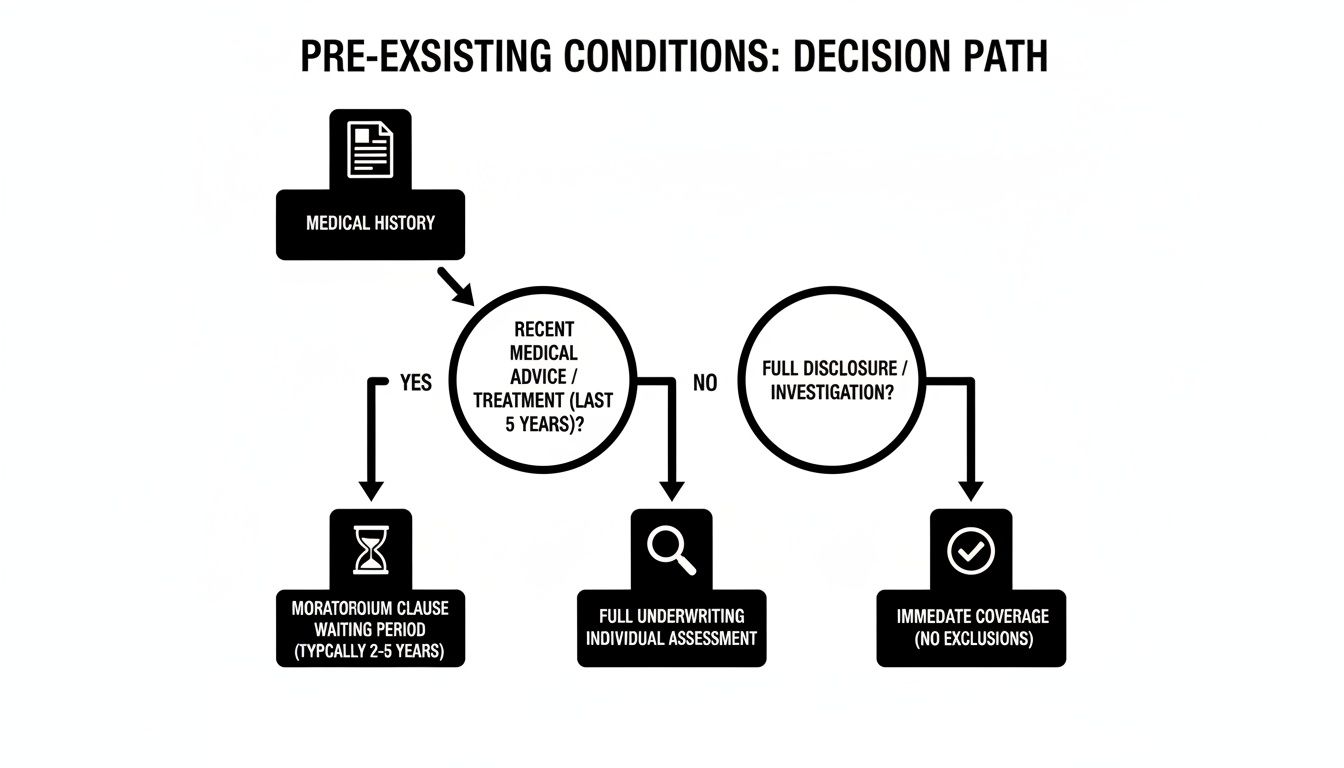
Whether you go for a faster moratorium or the certainty of full medical underwriting really depends on your health history and how much ambiguity you’re comfortable with as an expat.
Spotting the Critical Details in the Fine Print
The difference between a good plan and a great one is often buried in the details. When you’re reviewing policy documents, there are a few things you absolutely need to zoom in on.
Pay close attention to the insurer’s definition of “medical necessity,” because this can make or break a claim approval. You also need to understand their claims process—is it a simple online portal or are you going to be messing with paper forms? Finally, check the network of direct-billing hospitals in your area to make sure you can get convenient, cashless care when you need it.
A truly effective expat plan is more than just a list of benefits. It’s a partnership with an insurer who provides clear communication, responsive support, and a seamless claims process when you need it most.
The global healthcare scene is always in flux. While many countries are trying to improve universal health coverage, big gaps often remain, especially when it comes to financial protection. According to the WHO, only about one-third of countries have managed to boost both service coverage and financial protection since 2000. This is exactly why private worldwide medical insurance coverage is so crucial for expats—it bridges those gaps. By choosing your plan carefully, you’re making sure you can get quality care without facing crippling out-of-pocket costs.
Finding Your Ideal Plan with an Expat Insurance Broker
Trying to navigate the wild world of international insurance by yourself is a recipe for a headache. After you’ve spent hours weighing benefits, comparing geographic zones, and trying to figure out how your pre-existing conditions fit in, you’re often left feeling more confused than when you started. This is the exact moment when partnering with a specialist expat insurance broker becomes your smartest move.

Instead of getting bogged down comparing dozens of policies from carriers you’ve never even heard of, a good broker does all that heavy lifting for you. Think of them as an expert guide for your expat journey—one who already knows the terrain and can lead you straight to the best options without any detours.
Why Partner with an Insurance Specialist?
Working with an expert broker is all about gaining clarity and confidence. They aren’t tied to a single insurance company, which means their loyalty is to you and your unique needs as an expat. This independence is what allows them to give you unbiased, personalized advice that truly serves your best interests.
A specialist broker brings several key advantages to the table that you just can’t get on your own.
- Access to Premier Carriers: Brokers have long-standing relationships with the world’s top global insurers for expats. This opens up a curated selection of high-quality plans, including some that aren’t even available to the general public.
- Personalized Recommendations: They take the time to really understand your situation—your destination, your family’s health needs, your budget—to find a plan that’s a perfect fit. No cookie-cutter solutions here.
- Expert Navigation: From translating complex policy jargon to helping you breeze through the application process, a broker demystifies every single step. This saves you an incredible amount of time and helps you avoid costly mistakes.
This kind of guidance is more important than ever. Even as public healthcare expands in some countries, there are still massive gaps in financial protection. The World Health Organization recently reported that a staggering 2.1 billion people globally face financial hardship when they need healthcare. For an expat, that number drives home the importance of having the right supplementary worldwide medical insurance coverage to guard against those all-too-common out-of-pocket costs. You can dig into the full 2025 Global Monitoring Report for more on these findings.
Achieving the Optimal Balance of Coverage and Cost
At the end of the day, the goal is to find a plan that gives you robust protection without blowing up your expat budget. A broker excels at finding this sweet spot. They can quickly determine whether a “Worldwide” or “Worldwide Excluding USA” plan makes the most sense for you and identify policies that handle any pre-existing conditions you might have in the right way.
An expert broker acts as your advocate, ensuring you secure a plan that is not just affordable upfront but provides reliable, comprehensive protection when it matters most. Their insight is the key to confident decision-making for any expat.
By leaning on their expertise, you can move forward with a policy that’s truly tailored to your global lifestyle. This partnership transforms what can be a complicated and stressful purchase into a simple, clear process, making sure you are fully prepared for your life abroad. The right guidance is the final, essential piece in securing your health and financial well-being, no matter where your journey takes you.
Your Questions Answered: How Expat Medical Insurance Works in Real Life
Even after digging into the details, you probably still have some practical questions swirling around. That’s perfectly normal. Let’s tackle some of the most common ones we hear from expats to clear up any lingering confusion.
Getting these fundamentals down will help you move forward feeling completely confident in your healthcare plan.
Isn’t Worldwide Medical Insurance Just a Fancy Name for Travel Insurance?
Not even close, and getting this wrong is a huge mistake for an expat. Think of travel insurance as a temporary safety net for a vacation. It’s designed to handle short-term trip disasters—lost luggage, a cancelled flight, or a sudden medical emergency—and then it’s done. It’s for tourists.
Worldwide medical insurance is your actual health insurance while you’re living abroad. It’s the long-term, comprehensive coverage that acts just like your plan back home, paying for routine doctor visits, wellness checks, specialist care, and major hospital stays. For anyone building a life in a new country, this is the real deal.
What Happens If I Move to a New Country? Can I Keep My Plan?
Absolutely. This is one of the single biggest perks of a proper expat health plan. These policies are designed from the ground up for a mobile lifestyle, so they’re completely portable. All you need to do is let your insurance provider know about your new home base.
Keep in mind, your premium will likely be adjusted. If you move from a country with affordable healthcare to one that’s notoriously expensive, your rate will probably go up (and the reverse is also true). But the crucial part is that your coverage travels with you, no gaps, no interruptions.
The real beauty of an expat plan is its continuity. Local plans chain you to one country’s healthcare system. Worldwide medical insurance moves with you, giving you a stable, reliable shield no matter where you decide to call home next.
How Does a Deductible Work on an International Plan?
A deductible on an international plan is exactly what you’re used to back home. It’s simply the amount of money you agree to pay out-of-pocket for your medical care each year before your insurance company starts chipping in.
Let’s say your plan has a $1,000 deductible. You’d pay for the first $1,000 of your covered medical bills yourself. Once you hit that mark, your insurer takes over and starts paying for the rest, usually covering something like 80% or 100% of the remaining costs. Many expats choose a higher deductible as a smart way to lower their monthly premium, which gives you a bit more control over your budget.
Trying to figure all this out on your own can feel overwhelming, but you don’t have to go it alone. The team at Expat Global Medical lives and breathes this stuff. We’re here to offer personalized advice and help you compare top-tier plans from the world’s best insurers for expats. Secure your peace of mind and get a free, no-obligation quote today.