

For anyone living a global lifestyle, whether you’re a full-time expat or a frequent traveler, understanding the difference between standard travel insurance and true expat medical insurance is critical. This isn’t just about saving a few bucks; it’s about having the right kind of security. An annual expat medical plan is your all-year, comprehensive health shield, designed for living abroad. Standard travel insurance, even an annual policy, is more like a temporary patch for short, one-off journeys.
The real question is: do you need a simple travel safety net for vacation emergencies, or a serious international health plan that moves with you?
Why Annual Expat Medical Insurance is a No-Brainer for Expats

If you live or work abroad for any significant amount of time, an annual expat medical plan isn’t just “travel insurance.” It’s your primary health coverage. Unlike single-trip policies that evaporate the moment you get home, annual expat plans are built for a life that isn’t tied to one place. They offer renewable, year-round protection that functions like a domestic health plan, but with global reach.
This approach completely removes the headache of buying a new policy every time you cross a border or decide to take a quick vacation. It’s a seamless safety net, covering your health needs whether you’re settled in your overseas base or exploring a new country on the side.
The Value Breakpoint
You might be surprised at how quickly an annual expat medical plan pays for itself, both in money and peace of mind. If you’re planning on taking two or more international trips in a year, or if you’re actually living outside your home country, an annual plan is almost always the smarter move. This becomes even clearer when you factor in the time and hassle of juggling multiple single-trip policies versus the simple “set it and forget it” nature of one annual contract designed for your health.
The market is catching on. While the term “annual travel insurance” often refers to multi-trip vacation plans, the real growth is in comprehensive medical coverage for long-term travelers. The broader travel insurance sector is on track to jump from USD 29.5 billion in 2025 to USD 94.1 billion by 2033. This trend reflects the needs of modern expats and digital nomads who demand reliable, continuous health coverage, not just emergency travel perks.
Key Differences at a Glance
To make a smart decision, you have to understand the fundamental differences. Both types of plans offer protection, but they are designed for completely different purposes. Standard travel insurance is for tourists; expat medical insurance is for residents.
For a true global citizen, an annual expat medical plan isn’t a luxury—it’s a necessity. It replaces the fragmented, trip-by-trip approach with a unified strategy for health and safety, mirroring the structure of a domestic health plan but with worldwide reach.
The table below offers a clear, side-by-side comparison to help you quickly see which insurance model best fits your lifestyle and health needs.
Annual Expat Insurance vs Single-Trip Coverage At a Glance
| Coverage Aspect | Annual Expat Medical Insurance | Single-Trip Travel Insurance |
|---|---|---|
| Primary Purpose | Comprehensive, long-term health coverage for living abroad. | Emergency medical and travel protection for one specific trip. |
| Coverage Duration | 365 days, typically renewable while overseas. | The exact dates of a single round trip; expires on return. |
| Medical Scope | Covers emergencies, routine care, wellness, and specialist visits. | Primarily covers unforeseen medical emergencies and accidents. |
| Best For | Expats, digital nomads, retirees, and long-term travelers. | Tourists, vacationers, and short-term business travelers. |
Ultimately, the right plan comes down to your lifestyle. Our guide on expat medical versus travel insurance dives even deeper to help you make the call. Next, we’ll get into why standard travel insurance often falls short for the unique demands of expat life.
Why Your Tourist Travel Insurance Is a Terrible Fit for Expat Life
If you’re an expat or digital nomad, thinking standard travel insurance has you covered is like bringing a first-aid kit to perform surgery—it’s just not built for the realities of living abroad. These policies are designed for tourists on a two-week holiday. Their entire focus is on sudden, unexpected emergencies and getting you patched up enough to fly back home.
But “home” is now somewhere else for you, and that fundamental difference creates huge, dangerous gaps in coverage. Standard plans completely ignore the routine health needs that are a normal part of life, no matter where you live. For expats, this means zero coverage for annual check-ups, seeing a specialist for a nagging issue, or any kind of preventive care that keeps you healthy for the long haul.
The Problem With Everyday Healthcare Abroad
Let’s get real. Imagine you’re a digital nomad set up in Lisbon and your shoulder starts acting up, requiring ongoing physical therapy. A standard annual travel policy will almost certainly reject that claim because it’s not a sudden, unforeseen emergency. Or, picture an expat family in Dubai—they’d be paying for their kids’ routine wellness visits and vaccinations completely out of pocket.
These plans are built on the assumption that you have a primary healthcare system waiting for you back in your home country. That entire model collapses when you’re living abroad for months or years at a time. This is precisely the void that expat medical insurance is designed to fill; it acts as your primary health plan, wherever you are in the world.
The core failure of travel insurance for expats is its temporary, emergency-only design. It answers the question, “How do we get you stable and fly you home?” An expat medical plan answers a much more important question: “How do we keep you healthy while you live your life abroad?”
The Gap in Pre-Existing and Chronic Condition Coverage
Another massive red flag is how these policies handle chronic and pre-existing conditions. Most travel insurance plans have strict “look-back” periods and will flat-out refuse to cover conditions you already manage. This creates an unacceptable risk for anyone living overseas with conditions like diabetes, hypertension, or asthma.
An annual expat medical plan, on the other hand, is built to underwrite and cover these ongoing health needs. It provides the continuous, reliable access to medication, specialists, and treatment you need to manage your long-term health properly. Without it, you could be forced to choose between paying astronomical out-of-pocket costs or flying home for care, completely upending the life you’ve built abroad.
Renewability and Direct Billing Make All the Difference
Here’s something most people don’t realize until it’s too late: standard travel insurance is rarely renewable from outside your home country. Once your policy term is up, you often have to be physically back home to buy a new one. This can create a lapse in coverage at the worst possible time.
Specialized annual expat insurance is built for continuity. These plans are annually renewable, ensuring you have uninterrupted coverage without the need to return home. Even better, they offer access to direct billing networks, which means the hospital bills the insurer directly. This is a game-changer, preventing you from having to pay thousands of dollars upfront for medical care and then chasing reimbursement—a common headache with basic travel policies. Any serious annual travel insurance comparison for expats has to prioritize these essential features of a true medical plan.
How to Compare Annual Expat Medical Plans
Picking the right annual expat medical plan requires a totally different mindset than grabbing typical travel insurance. You’re not just covering a short trip; you’re securing your primary health plan for your life abroad. This decision means you have to do a real annual travel insurance comparison that focuses on the specific needs of a global resident, not a temporary tourist.
A good comparison means looking past the flashy marketing and digging into how a policy is actually built. Core factors like medical limits, the logistics of an evacuation, and how the plan handles pre-existing conditions are far more important than perks like trip cancellation. The goal is to find a plan that acts just like a solid health policy you’d have back home, but with a global reach.
This simple decision tree can help you get started, guiding you toward the right type of plan for your lifestyle.
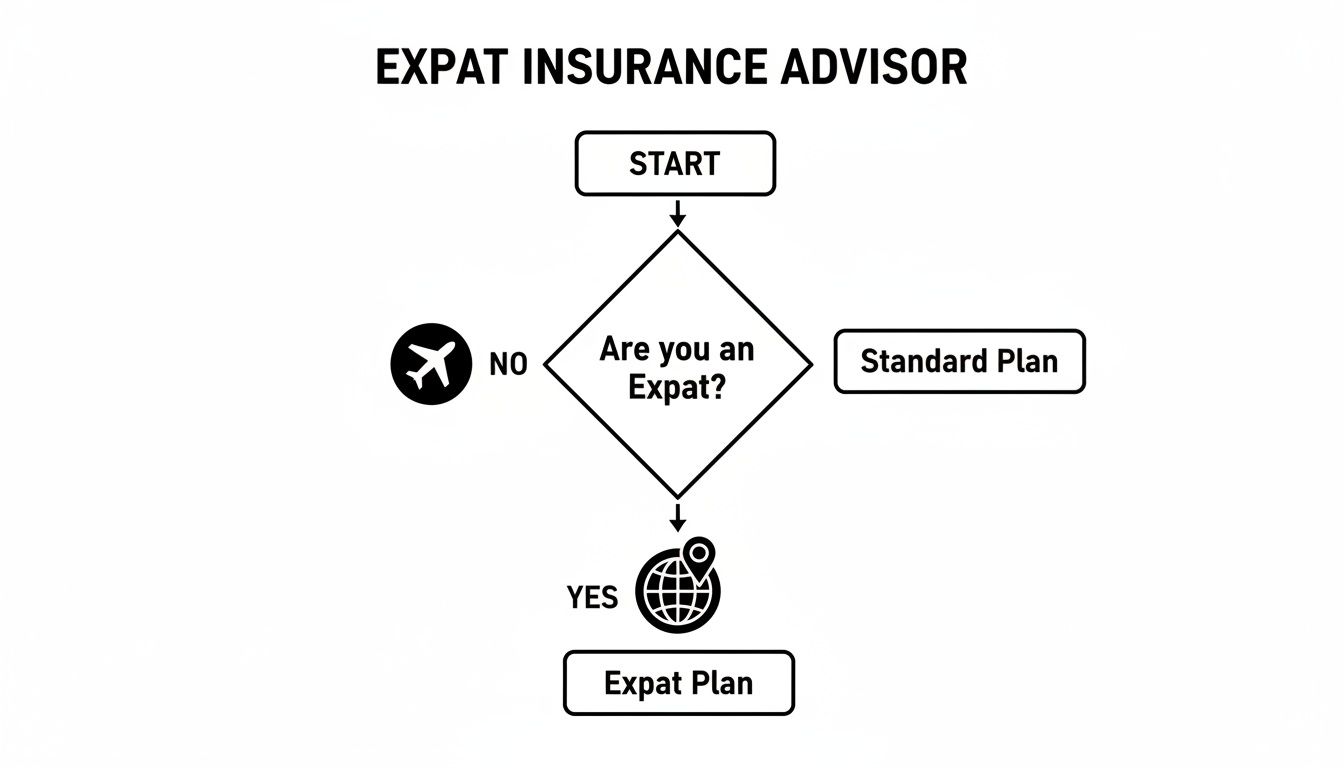
As you can see, the first question—are you an expat?—changes your entire insurance strategy and steers you clear of standard plans that just won’t cut it.
Evaluating Medical Coverage Limits
The first checkpoint should always be the overall medical coverage limit. For any expat, a policy with a limit of $1 million or higher is the baseline. This isn’t just for a worst-case scenario; it ensures there’s enough coverage for serious illnesses, major surgeries, and long hospital stays without you facing financial ruin.
But the total limit is only part of the story. You have to look at the sub-limits, too. A great plan offers strong benefits for the services you’ll actually use, such as:
- Outpatient Care: This is for your routine doctor visits, specialist appointments, and diagnostic tests that don’t require a hospital stay.
- Prescription Drugs: Does the plan cover your ongoing medications, or just a short-term emergency prescription?
- Preventive Care: Look for coverage for annual physicals, vaccinations, and health screenings. These are vital for staying healthy long-term.
A policy can flash a high overall limit but be incredibly weak on these day-to-day health needs. For an expat, solid outpatient and preventive benefits are non-negotiable. Our detailed guide to understanding international travel insurance coverage can help you make sense of these policy details.
Analyzing Emergency Medical Evacuation
Emergency medical evacuation is a critical feature, but not all evacuation benefits are the same. Your focus should be on the quality of the provider’s logistics and the strength of their network, not just the dollar amount on the policy. A top-tier plan provides a coordinated medical response, not just a flight home.
When you compare plans, ask these questions:
- Who is coordinating the evacuation? Look for providers with their own in-house medical teams and established global assistance networks.
- Where will they take me? The best policies evacuate you to the “nearest center of medical excellence,” not just back to your home country, which could be thousands of miles and a dangerous flight away.
- Does it cover repatriation of remains? It’s an uncomfortable thought, but this is a crucial component that gives your family peace of mind.
A $1,000,000 evacuation benefit is useless if the assistance team is unresponsive or doesn’t have the network to pull off a complex evacuation from a remote location. The real value is in the quality of the 24/7 assistance service.
This kind of detailed look is more important than ever. The global travel insurance market is expected to jump from around USD 22.1 billion in 2025 to USD 50.1 billion by 2033. This growth is pushing insurers to offer more specialized plans that emphasize robust emergency services and catastrophic illness coverage—which is great news for discerning expats.
Demystifying Pre-Existing Condition Coverage
For a lot of expats, how a plan covers pre-existing conditions is the single most important factor. Standard travel insurance almost always excludes them, but a true expat medical plan is designed to underwrite and cover them. The trick is understanding how they do it.
Look for a plan that offers full medical underwriting. This process involves a deep dive into your health history to offer you coverage—sometimes with a higher premium or specific exclusions—instead of just issuing a blanket denial. You should also clarify the “look-back period,” which is the amount of time an insurer will search your medical history for undisclosed conditions. Shorter is always better.
Some high-end plans might even offer a pre-existing condition waiver if you buy the policy within a certain window after making your first travel deposits. This can be an incredible benefit, but you have to act fast to get it.
Understanding Your Area of Coverage
Expat medical plans usually give you two main geographic coverage options: “Worldwide” and “Worldwide Excluding the USA.” The price difference between them is significant. Because of the sky-high cost of healthcare in the United States, adding it to your coverage area can bump your premium by 30-50% or more.
Your choice should come down to your actual needs:
- Worldwide Excluding USA: This is perfect for expats who don’t plan on spending much, if any, time in the U.S. and don’t need coverage there.
- Worldwide: This is essential for U.S. citizens who plan to visit home frequently or for any expat who travels to the U.S. on a regular basis.
Some plans also include limited home country coverage (like 30-60 days per year) as a built-in benefit, which is great for visiting family during the holidays without needing a full worldwide plan.
Clarifying Deductibles and Out-of-Pocket Maximums
Finally, you need to get a handle on the cost-sharing structures to manage your budget. Two terms define how much you’ll pay before the insurance company takes over completely.
- Deductible: This is the fixed amount you pay out-of-pocket for eligible medical care each year before your insurer starts to pay. Choosing a higher deductible will get you a lower premium.
- Out-of-Pocket Maximum: This is the absolute most you will have to pay for covered medical expenses in a policy year. Once you hit this cap, the insurance company pays 100% of covered costs.
A low out-of-pocket maximum acts as a crucial financial safety net against catastrophic medical bills. For an expat family living in Singapore, a plan with a manageable family deductible might be far more valuable than one with niche adventure sports coverage they’ll never use. Balancing the monthly premium against a deductible and out-of-pocket max you can actually afford is the final step in a smart annual travel insurance comparison.
Comparing Plans with Real-World Expat Scenarios

Let’s be honest—feature lists and policy documents can be pretty dry. The best way to really understand how an annual travel insurance comparison works is to see these plans in action. When we apply the abstract details to real-life situations, it becomes much easier to see what truly matters in an expat medical plan.
What’s perfect for a young digital nomad will almost certainly be the wrong choice for a family with kids or a retired couple. By walking through a few common expat personas, we can see how the right mix of benefits, deductibles, and network access is a deeply personal decision.
Persona 1: The Remote Worker in Mexico
Meet Alex, a 30-year-old freelance graphic designer living it up in Mexico City. He’s healthy and active but wants solid, everyday medical care that won’t drain his savings. For him, the priorities are strong outpatient benefits for regular check-ups or minor illnesses and a good local network of doctors.
Alex is weighing two options:
- Plan A (High Deductible, Catastrophic Focus): This plan looks impressive on paper with a massive $2 million medical limit. The catch? It comes with a steep $5,000 deductible, meaning it’s really only designed for major accidents, not routine care.
- Plan B (Balanced Outpatient Coverage): This one has a lower $1 million limit but a much more reasonable $1,000 deductible. More importantly, it offers co-pays for specialist visits and covers preventive care before he has to meet his deductible.
For someone in Alex’s shoes, Plan B is the clear winner. That high limit on Plan A is tempting, but the huge deductible makes it practically useless for his main need: accessing affordable, day-to-day healthcare. He’d be paying out-of-pocket for almost every doctor’s visit, which defeats the entire purpose of having the insurance.
Persona 2: The Retiree Couple in Spain
Now, let’s consider David and Susan, a couple in their late 60s who are retiring to Spain’s sunny Costa del Sol. David is managing hypertension, and Susan has a history of joint problems. Their biggest concerns are getting comprehensive coverage for their pre-existing conditions and having a predictable, low out-of-pocket maximum to safeguard their retirement funds.
They’re looking at two very different plans:
- Plan C (Exclusionary Policy): This option has an attractively low premium, but it includes a strict clause that excludes all care related to David’s hypertension. It’s cheap upfront but leaves them financially exposed.
- Plan D (Underwritten Policy): This plan costs more and requires full medical underwriting. But after a review, it agrees to cover both of their pre-existing conditions and includes a low $3,000 out-of-pocket maximum for each of them.
In this case, Plan D is the only responsible choice. The lower premium of Plan C is a classic false economy. A single complication from David’s condition could easily result in medical bills reaching tens of thousands of dollars. For retirees, financial predictability is everything. Plan D’s cap on out-of-pocket spending ensures that even in a bad year, their medical costs are finite. This is why knowing how to find medical travel insurance for pre-existing conditions is often the most critical piece of the puzzle for older expats.
The most expensive insurance policy is the one that fails to cover you when you need it most. For expats with known health concerns, paying a higher premium for fully underwritten coverage isn’t an expense—it’s an essential investment in security.
Persona 3: The Expat Family in the UAE
Finally, we have Mark and Sarah, a young family with two small children relocating to Dubai for Mark’s job. Their needs are complex. They’re planning to have another child, so robust maternity benefits are a must. They also need regular wellness check-ups and vaccinations for the kids, plus worldwide coverage for their frequent trips back home to see family.
They’ve narrowed it down to two family-focused plans:
- Plan E (Regional Coverage): A solid plan with excellent benefits within the Middle East. It has great pediatric coverage, but it completely lacks maternity options and only provides emergency care outside the region.
- Plan F (Global Premier Plan): This policy is more expensive but provides true worldwide coverage, including generous benefits in their home country. It also features a full maternity rider (with a waiting period) and comprehensive wellness and dental coverage for the children.
For this family, Plan F is the superior option by a long shot. The regional limits of Plan E are just too restrictive for a family that travels internationally. The maternity benefits and wellness care in Plan F align perfectly with their stage of life, giving them a single, seamless solution for their health needs whether they’re in Dubai, on vacation, or visiting family back home.
These scenarios drive home a key point: a proper annual travel insurance comparison must go beyond just the price tag and focus on how a policy’s features align with your unique life abroad.
A Practical Guide to Purchasing Your Expat Insurance Plan
Moving from a theoretical annual travel insurance comparison to actually buying a plan is where the rubber meets the road. The best way to start is with an honest look at your own health needs, your travel habits, and what you’re truly comfortable with financially.
First, just map out your life. Where will you be based? How often do you think you’ll travel to other countries, or even pop back home for a visit? What can you realistically afford in monthly premiums versus what you could pay out-of-pocket for a deductible if an emergency hits?
Answering these basic questions helps you build a profile of your ideal expat medical plan before you even start comparing policies. Doing this groundwork first stops you from getting distracted by fancy features you don’t need or, worse, overlooking a benefit that’s critical for your situation.
Navigating the Application and Underwriting Process
Once you’ve zeroed in on a few promising plans, it’s time to apply. This is the part where honesty isn’t just the best policy—it’s the only policy, especially when it comes to your medical history. Insurers use a process called medical underwriting to size up your health risks and set your final premium.
It can be tempting to fudge the details or leave out old health issues to snag a lower rate, but trust me, that’s a shortcut to disaster. Failing to disclose a pre-existing condition can get your claim denied or even your entire policy canceled, leaving you high and dry. Be painstakingly thorough and transparent; it’s the only way to make sure your coverage will actually be there for you.
Your insurance application is the foundation of your contract with the insurer. Any inaccuracies can void the entire policy just when you need it most. Full disclosure is your best protection.
The global market for this kind of insurance is huge, especially in certain hubs. Europe, for instance, pulls in 39% of global revenue in the travel insurance market, which is on track to hit USD 63.9 billion by 2030. This growth is fueled partly by strict visa requirements, which has created a mature marketplace that gives expats more competitive medical plan options. You can learn more about these global travel insurance market trends on grandviewresearch.com.
Why Consulting a Specialist Broker Is a Smart Move
Trying to decipher the complexities of international medical insurance on your own can feel like learning a new language. A specialist insurance broker can be an incredible ally here. Unlike going directly to a single insurance company, a broker offers unbiased advice and gives you access to a curated list of plans from multiple top-tier carriers.
They live and breathe the fine print, from confusing exclusion clauses to hidden waiting periods for benefits like maternity care. A good broker is your advocate, helping you compare apples to apples and ensuring you end up with a policy that genuinely fits your life abroad.
Your Pre-Purchase Checklist
Before you sign on the dotted line, have a list of crucial questions ready for the insurer or your broker. This final check ensures there are no nasty surprises waiting for you later.
- Claims Process: How do I actually file a claim? What’s the typical turnaround time for reimbursement?
- Direct Billing: Do you have a direct billing network in my new country? Can I get a list of in-network hospitals and clinics?
- Emergency Support: What does your 24/7 assistance line actually do? Who’s coordinating things if I need a medical evacuation?
- Renewability: Can I keep renewing this policy for as long as I live abroad?
- Home Country Coverage: What are the specific rules and limits for getting medical care when I visit my home country?
Getting clear, straightforward answers to these questions is the final piece of the puzzle. It gives you the confidence you need to purchase your plan and start your global adventure with real peace of mind.
Got Questions About Expat Medical Insurance? We Have Answers.
When you’re trying to figure out international health coverage, a lot of questions come up. A quick annual travel insurance comparison shows that a true expat medical plan is a totally different beast than the short-term travel policies most of us are used to.
Let’s clear up some of the most common—and critical—questions that expats and digital nomads run into when trying to lock down their health and safety abroad. Getting these details right is the key to picking a plan with confidence.
Can I Renew My Expat Health Insurance While Living Abroad?
Yes, absolutely. This is one of the biggest things that sets real expat health insurance apart from standard travel policies. These plans are built for continuous, long-term life abroad, so they’re designed to be renewed annually, no matter where you are in the world.
Unlike many travel insurance plans that make you return to your home country to buy or renew, expat plans ensure you never have a gap in coverage. Just be sure to double-check for a “renewable abroad” clause in your policy documents.
Does My Plan Cover Me When I Visit My Home Country?
Most quality expat medical insurance plans do include what’s called “incidental home country coverage.” It’s not meant for moving back home, but it does cover you for eligible medical care during short visits, usually for 30 to 90 days each year.
This is a huge benefit for expats who want to pop home for the holidays or see a trusted family doctor. It’s also something you’ll almost never find in a standard travel insurance policy, which typically excludes any coverage in your country of citizenship. Always check the specific terms and time limits on this feature.
The ability to get care on visits back home transforms an expat plan from a simple overseas policy into a truly global one. It acknowledges that “home” is still part of your life and provides a seamless safety net that tourist plans just can’t offer.
What Is the Difference Between Travel Medical and Expat Health Insurance?
The main difference comes down to purpose and scope. Annual “travel medical insurance” is for emergencies that might happen during multiple short trips throughout the year. Its job is to get you stabilized and, if needed, fly you back home for proper treatment.
“Expat health insurance” is your primary, long-term health plan for actually living abroad. It covers emergencies, of course, but it also handles routine doctor visits, preventative care, specialist appointments, and wellness check-ups. If you’re relocating for a year or more, an expat plan is what you need. This is the most important distinction in any annual travel insurance comparison for global citizens.
How Do Deductibles Work on Annual Expat Plans?
Deductibles on annual expat plans work just like they do back home. It’s the fixed amount you pay out-of-pocket for your medical care each year before the insurance company starts picking up the tab.
For example, if you have a $1,000 deductible, you’ll cover the first $1,000 of your medical bills yourself. Choosing a higher deductible is a great way to lower your monthly premium. On the flip side, a lower deductible means a higher premium, but your insurance kicks in much sooner when you need care.
The trick is to find the right balance—a premium that fits your budget and a deductible you could comfortably pay if a medical emergency hit.
Ready to find the right protection for your life abroad? The experts at Expat Global Medical have been helping expats, retirees, and global nomads secure reliable international health coverage since 1992. Get a free quote today and build a plan that truly safeguards your global lifestyle.