When you’re living or working in another country long-term, expat medical insurance isn’t just a good idea—it’s an absolute necessity. It’s a completely different animal from the short-term travel policy you’d buy for a vacation. This is about comprehensive, ongoing access to quality healthcare, making sure the gaps in your home country’s plan don’t leave you in a tough spot, medically or financially.
Why Your Domestic Health Plan Is a Key That Won’t Fit
Think of your health insurance from back home like the key to your old house. It works perfectly on that one specific lock, letting you into a familiar network of doctors, hospitals, and clinics.
But the moment you move abroad, you’re trying to jam that same key into a totally different door. It just won’t turn.
That’s the core issue with trying to rely on a domestic health plan as an expat. These policies are built from the ground up to work with local provider networks, pricing, and regulations. They simply weren’t designed to operate in another country’s healthcare system, which almost always has its own unique rules and costs.
The Healthcare Passport Analogy
The best way to think about expat medical insurance is as your universal ‘healthcare passport.’ While your domestic plan is stuck at the border, a global plan is built for a life without them. It gives you access to medical care and financial protection almost anywhere you decide to call home.
This isn’t just about convenience; it’s about being prepared. Without this “passport,” you’re effectively uninsured, facing the full—and often shocking—cost of any medical care you might need.
This coverage can be the difference between getting top-notch care at a private hospital right away and trying to figure out a foreign public system with long waits and language barriers. The risk of going without it is huge, since most domestic plans (including Medicare) offer little to no real coverage overseas. For a deeper dive, you can learn more about why U.S. health insurance doesn’t work abroad in our guide.
A lot of people believe their home plan will cover emergencies anywhere. While some might offer a tiny reimbursement for a true life-or-death crisis, it’s usually just a fraction of the bill. You’ll likely have to pay the full cost upfront and then fight for that small refund months later.
Finding the Right Expat Health Insurance Plan
Choosing the right expat health insurance can feel like navigating a complex map without a compass. The secret is realizing that the best plan isn’t a one-size-fits-all solution; it’s a direct reflection of your unique lifestyle and how long you plan to be abroad. Matching the right coverage to your specific journey is the key to both security and peace of mind.
This simple decision tree helps visualize the very first step in choosing a plan.
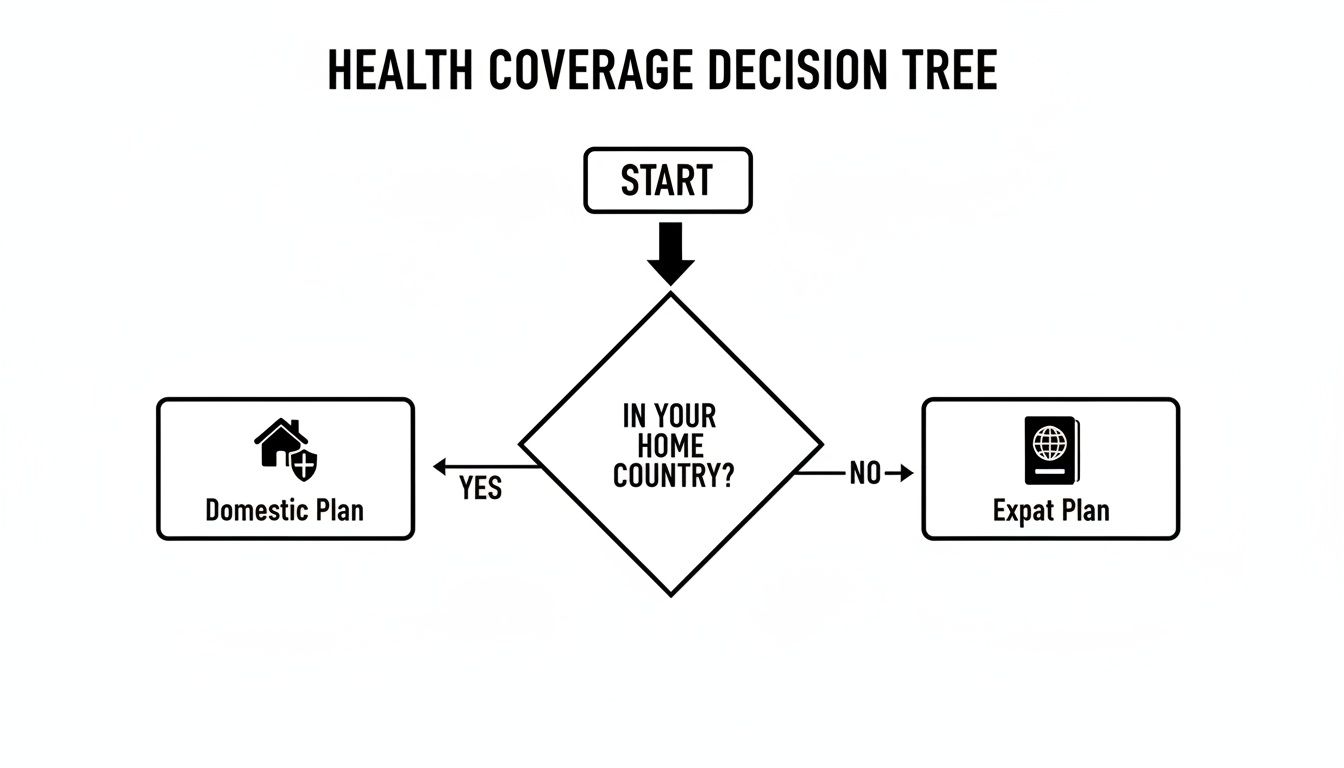
As the flowchart shows, once your life extends beyond your home country’s borders, you’ve entered a new territory. This is where a specialized expat plan becomes essential.
To help you find the perfect fit, let’s walk through the main types of coverage and who they’re built for.
Short-Term Travel Medical for Scouting Trips
Imagine you’re an entrepreneur considering a move to Lisbon. You book a two-month trip to explore neighborhoods, meet with contacts, and get a feel for the city before committing. This is the perfect scenario for short-term travel medical insurance.
This type of plan is designed for trips lasting anywhere from a few days up to a year. Its main job is to cover unexpected medical emergencies—like a sudden illness or an accident—rather than routine care. Think of it as a robust safety net for a temporary stay, ensuring a mishap doesn’t turn into a financial catastrophe.
Comprehensive Long-Term Expat Insurance
Now, let’s say your scouting trip was a success. You’ve decided to relocate your family to Lisbon for the foreseeable future. This is where a true long-term expat medical insurance plan becomes non-negotiable.
This is the most complete form of expat health coverage, built for those living abroad for one year or more. It functions much like a domestic health plan you’d have back home, offering a wide range of benefits that go far beyond just emergencies.
- Routine Doctor Visits: Covers your check-ups, wellness exams, and consultations.
- Hospitalization: Includes inpatient and outpatient care, surgeries, and treatments.
- Prescription Drugs: Provides coverage for medications needed for ongoing conditions.
- Maternity and Dental: Often available as optional add-ons for complete family care.
This kind of plan provides the stable, day-to-day healthcare access you need when you’ve truly made a new country your home. You can find more details in our comparison of the best expat medical insurance plans available today.
Specialized Medical Evacuation Coverage
Finally, consider an adventurous geologist working on a remote project in the Andes or a retiree living in a small, rural village in Thailand. While they might have local healthcare for minor issues, a serious medical event would require transport to a major medical center. This is the critical role of emergency medical evacuation insurance.
This coverage, often included in comprehensive expat plans or available as a standalone policy, pays for the staggering cost of medically necessary transportation. This could mean an ambulance to a better-equipped local hospital or an air ambulance to a different country entirely.
For someone living far from top-tier medical facilities, this coverage is absolutely vital. The cost of a medical evacuation can easily exceed $100,000, making this insurance a literal lifesaver.
To make things even clearer, here’s a quick comparison to help you match your situation to the right type of plan.
Matching Your Lifestyle to the Right Health Plan
| Insurance Type | Ideal For | Typical Duration | Core Benefits |
|---|---|---|---|
| Travel Medical | Short trips, scouting missions, vacations, temporary work assignments | Days to 1 year | Emergency medical, accidents, unexpected illness, trip interruption |
| Long-Term Expat | Expats, retirees, digital nomads, families living abroad | 1+ year (renewable) | Comprehensive care including routine visits, hospitalization, wellness |
| Medical Evacuation | People in remote areas or countries with limited healthcare infrastructure | Varies (standalone or add-on) | Medically necessary transport to an adequate medical facility |
Ultimately, selecting the right plan is about honestly assessing your situation. Are you testing the waters, making a permanent move, or living somewhere remote? Answering this question is the first and most important step toward securing your health and well-being abroad.
Navigating Pre-Existing Conditions and Exclusions
Let’s be honest: the real value of any expat medical insurance isn’t just in the big, splashy benefits. It’s hidden in the details—specifically, the exclusions and conditions. While the main benefits tell you what’s covered, the fine print defines the boundaries of your protection.
Getting familiar with these terms before you need to make a claim is one of the smartest things you can do. It’s how you avoid nasty surprises and make sure your safety net is as strong as you think it is.

One of the biggest anxieties for any expat is how an insurer will handle a pre-existing condition. This is just industry-speak for any medical issue you had before your new policy’s start date, whether you were officially diagnosed or not.
How Insurers Approach Pre-Existing Conditions
Insurers use a process called medical underwriting to get a clear picture of your health history. This helps them figure out your eligibility and what your premium should be. Unlike many domestic plans you might be used to, international policies have very specific rules for existing conditions. This is why being totally transparent on your application is so important.
When you apply, the insurer will comb through your medical history and decide on a path forward. Here’s what that usually looks like:
- Full Coverage: They might cover your condition without any strings attached, especially if it’s something minor or very well-managed.
- Coverage with a Surcharge: Sometimes, they’ll agree to cover the condition but will add a bit to your premium to account for the higher risk.
- Impose a Waiting Period: Another possibility is that they’ll cover the condition, but only after a set amount of time—say, 24 months—has passed without any symptoms or treatment.
- Exclusion: In some cases, the insurer will offer you a policy but will permanently exclude any and all costs related to that specific condition.
It’s a huge myth that having a pre-existing condition automatically disqualifies you from getting coverage. Many insurers are more than willing to find a workable solution, but you have to be upfront. Honesty during the application process is absolutely non-negotiable.
For a much deeper dive into this topic, you can learn more about pre-existing conditions and travel insurance in our dedicated guide.
Understanding Common Policy Exclusions
Beyond pre-existing conditions, every single policy has a list of general exclusions. Think of these as the hard-and-fast rules—situations or treatments that are never covered, no matter what. Reading this section of your policy is just as critical as reviewing your benefits.
You’ll find that some exclusions are pretty standard across the board:
- High-Risk Activities: Your average plan isn’t going to cover injuries from things like skydiving, mountaineering, or professional sports. For that kind of thrill-seeking, you’ll likely need to buy a special add-on or “rider.”
- Politically Unstable Regions: If you’re traveling to or living in a country with an active travel advisory or that’s designated as a war zone, any medical issues you have there are frequently excluded.
- Self-Inflicted Injuries: Harm that comes from suicide attempts or substance abuse is almost universally excluded from coverage.
- Cosmetic Procedures: Elective surgeries that aren’t medically necessary, like most plastic surgery, won’t be covered.
When you take the time to carefully review these details, you can sign your policy documents with genuine confidence. You’ll know exactly what you’re getting, ensuring your expat medical insurance delivers the security and peace of mind you’re paying for.
What Determines the Cost of Your Global Health Plan
Figuring out the price of an expat medical insurance plan can feel a bit like cracking a code. In reality, though, it’s a pretty logical calculation based on a handful of key factors that paint a picture of your personal risk profile and the level of protection you need. Once you understand these moving parts, you can see exactly where your money goes and how to tweak your plan to fit your wallet.
The biggest factor, hands down, is your age. It’s a simple statistical reality: as we get older, the odds of needing medical care go up, and so do the premiums. Insurers have to price their plans to reflect this, which is why a policy for a 28-year-old digital nomad will look a lot different than one for a 65-year-old retiree, even if the benefits are exactly the same.
Where You Live Matters Most
Your geographic area of coverage has a massive impact on what you’ll pay. This is all because healthcare costs can vary wildly from one country to the next. A plan that covers you in Southeast Asia or Latin America is going to be far more affordable than one that includes the United States.
In fact, expat health coverage is facing skyrocketing costs, with the SIP Health Cost Index ranking the USA #1 for private healthcare and international insurance expenses, followed by Hong Kong and Singapore. This has a huge effect on premiums for expats everywhere and is part of a larger trend where global medical inflation is expected to hit 10.4%. You can discover more insights about these global cost trends.
Choosing a plan that excludes the USA can often reduce your premium by 30-50%. If you only travel back to the U.S. for short visits, you can often add temporary coverage, which is a much more cost-effective strategy.
Balancing Benefits and Your Budget
Finally, the richness of your benefits package is directly tied to your premium. A basic, inpatient-only plan that covers major hospital stays will naturally cost less than an all-inclusive plan that adds outpatient visits, prescriptions, dental, and vision.
The good news is that you have direct control over two key levers to manage your costs:
- Deductible: This is the amount you pay out-of-pocket before your insurance kicks in. A higher deductible means a lower monthly premium. Simple as that.
- Co-insurance: This is the percentage of costs you agree to share with the insurer after you’ve met your deductible. Opting for a higher co-insurance percentage will also bring your premium down.
By strategically adjusting these elements, you can find that sweet spot between rock-solid protection and a monthly payment that doesn’t cause any financial stress.
The Booming World of Global Insurance
When you move abroad, you’re not just making a personal leap—you’re joining a massive, ever-growing community of global citizens. This worldwide shift hasn’t gone unnoticed by the insurance industry, which has stepped up with specialized expat medical insurance designed for the unique challenges of living and working far from home.
This isn’t some small, niche corner of the market anymore. The international health insurance sector is already a behemoth, clocking in at $29.04 billion, and it’s on track to hit $31.68 billion soon. That explosive growth is driven by people just like you: expats, digital nomads, and retirees all looking for solid, reliable protection. You can find more details on the latest expat health insurance trends on ExpatInsurance.com.
Why Relying on Local Insurance Can Be a Gamble
At first glance, grabbing a local insurance plan in your new country might seem like the simplest option. But it’s a choice that often comes with a whole host of hidden risks.
Healthcare quality, regulations, and even the financial stability of insurance companies can swing wildly from one country to the next. A plan that looks perfectly fine in one place might offer shockingly weak coverage in another, or it could be backed by an insurer with shaky finances.
This is exactly why a dedicated expat plan is so crucial. Think of it as a guarantee of quality, ensuring you get a consistent, high standard of care no matter where your adventures take you.
Working with a global insurance specialist adds a vital layer of security. These experts exclusively partner with top-tier, financially sound insurance carriers who have a proven history of serving the international community. They’ve already done the vetting for you, so you can be sure the policy you choose is backed by a reliable company that actually pays claims when you need them to.
This curated approach means your expat medical insurance isn’t just a piece of paper—it’s a dependable shield, giving you the freedom to build your life abroad with real peace of mind.
What’s Next for Expat Medical Insurance?
The world of expat medical insurance is always on the move, changing with how and where we decide to live our lives. As more people pack their bags for the long haul, the insurance market is playing catch-up, rolling out smarter, more flexible plans for a world with fewer borders.
A huge part of this shift comes from the changing face of the expat community itself. We’re seeing aging populations retiring to sunny destinations and a massive wave of digital nomads logging in from every corner of the globe. This isn’t just a trend; it’s a demographic earthquake pushing insurers beyond basic emergency plans toward comprehensive wellness and chronic care for people on the move.
The Booming IPMI Market
This evolution is lighting a fire under the International Private Medical Insurance (IPMI) market. Right now, this slice of the health coverage pie is valued at a staggering USD 17.6 billion. But hold on, because forecasts show it rocketing to nearly USD 33.2 billion by 2030. That’s a direct reflection of the explosion in global workers and retirees. Want to dig deeper? You can discover more insights about the global IPMI market size.
This isn’t just about more people moving abroad. It’s about a fundamental change in what they expect. Today’s expats demand seamless, top-shelf healthcare that feels just as reliable as what they’d get back home, no matter where they are.
Looking down the road, we can expect a few key things to become the new normal:
- More Customization: Forget one-size-fits-all. Plans are becoming more like a build-your-own adventure, letting you tailor benefits to exactly what you need, from mental health support to preventative wellness checks.
- Telehealth as a Standard: Virtual consultations with doctors and specialists will be a given, not a perk. Getting medical advice from anywhere in the world will be as easy as opening an app.
- A Focus on Staying Healthy: Insurers are realizing it’s better to keep you healthy than to just patch you up. Expect to see more coverage for wellness programs and health screenings to catch issues before they become problems.
Keeping an eye on these trends is crucial for planning a secure future abroad. It really drives home the importance of picking an insurance partner who isn’t just meeting your needs today but is ready for the future of global healthcare.
How To Select And Secure Your Expat Health Plan
You’ve already unpacked the essentials of expat health coverage—what it means, why it matters, and how it works. Now it’s time to pick the exact plan that fits your new life overseas. Think of this as the moment you take all that research off the shelf and put it into practice, so you can relax knowing you’ve got the right protection in place.

Breaking the process into four clear steps makes it feel a lot less overwhelming. Before you know it, you’ll move from hesitation to complete confidence in your coverage choice.
Your Four Steps To Global Health Security
Securing your health protection is like laying a solid foundation for your new home abroad. Skip a step and the whole structure wobbles. Follow them in order, and you build real stability.
-
Assess Your Unique Needs
Pause and take stock. What does your family’s medical history look like? Any chronic conditions to factor in? Which countries will you spend the most time in? And, of course, how much can you comfortably allocate to premiums? This honest inventory becomes your blueprint. -
Compare Quotes With Expert Help
Don’t navigate the marketplace solo. A broker who specializes in expat plans opens doors to multiple insurers at once—and gives you straight-talk advice. You see side-by-side comparisons, save hours, and avoid missing a critical detail. -
Review The Fine Print
Now it’s time for detective work. Examine the schedule of benefits, exclusions, waiting periods, and claim limits. This is where you verify that each policy actually covers what you need—no surprises later. -
Complete Your Application
With a favorite in sight, fill out the paperwork thoroughly. Disclose everything about your medical history; those honest details are what make your policy bulletproof when you need it most.
“Working with a specialized broker is the single best way to navigate a complex global insurance market. Their guidance steers you to plans that balance cost and comprehensive protection.”
As you plan your move and explore options like flexible tax residencies for global travelers, keep in mind that robust expat health coverage is a non-negotiable part of a truly secure international lifestyle. Wherever your adventure takes you, the right policy safeguards both your health and your wallet.
Your journey to a secure life abroad starts with the right protection. Let the experts at Expat Global Medical provide a free, no-obligation quote and personalized guidance to help you find the perfect plan. Get your free quote today and take the first step toward total peace of mind.