
Imagine this: you’re an expat, thousands of miles from home, and you’re suddenly facing a serious medical emergency. The health crisis is frightening enough, but now you’re staring down a logistical and financial nightmare. This is exactly when repatriation insurance becomes more than just a policy—it becomes your lifeline.
This coverage, a key component of any robust expat medical insurance plan, is specifically designed to handle the immense cost and complex arrangements of transporting you back to your home country for medical care. In a worst-case scenario, it also covers the sensitive process of returning your remains.
The Lifeline For Expats Living Abroad

When you’re living abroad, getting your head around your medical insurance is non-negotiable. And while you hope you’ll never need it, repatriation coverage is an essential piece of any solid expat health plan. It’s the safety net that prevents a medical crisis from spiraling into a devastating financial burden for you and your family.
Think of it this way: your expat health insurance pays for treatment where you are. But what if the best care—or your crucial support system of family and friends—is back home? Repatriation insurance is what bridges that gap. It’s the specialized benefit that takes over the incredibly intricate and costly logistics of getting you from a foreign hospital bed to a familiar one.
What Does Repatriation Insurance Cover?
This isn’t just about booking a flight. It’s a full-service coordination that manages every single detail of your transport during what is an intensely stressful time. For any expat, that peace of mind is invaluable. You know there’s a clear path home if the unexpected happens.
Before we dive deeper, here’s a quick overview of what repatriation insurance is all about for an expatriate.
Repatriation Insurance At A Glance
| Coverage Component | Primary Purpose | Target Audience |
|---|---|---|
| Medical Repatriation | Transporting you to your home country for ongoing medical care. | Expats, long-term travelers, global workers. |
| Medical Evacuation | Moving you to the nearest adequate medical facility. | All international travelers, especially in remote areas. |
| Repatriation of Remains | Covering the costs and logistics of returning remains home. | All expats and their families. |
This table highlights how these benefits work together within an expat medical plan to provide a complete safety net, ensuring you get the right care in the right place, no matter what happens.
Key services managed by this coverage typically include:
- Medically Supervised Transport: This could be anything from a commercial flight with a medical escort to a private, fully equipped air ambulance, depending on how serious your condition is.
- Logistical Coordination: The insurer’s assistance team handles all the heavy lifting. They’ll talk to doctors at both ends, organize ground transportation, and deal with all the medical customs and paperwork.
- Repatriation of Remains: In the tragic event of a death abroad, the policy covers the expensive and emotionally draining process of returning the deceased to their home country for burial or cremation.
Repatriation insurance is fundamentally about providing a safe and medically sound journey home. The costs for an air ambulance can easily soar past $100,000, making this coverage absolutely essential for protecting your financial well-being as an expat.
Without it, you and your family would be left to figure out an incredibly complex and emotionally taxing situation all on your own. The costs can be staggering and often demand upfront payment, which can wipe out a lifetime of savings in an instant. This guide will demystify this critical coverage, giving you the clear, actionable insights every expat needs to be truly protected, no matter where in the world life takes you.
Medical Repatriation vs. Medical Evacuation
When you’re an expat living abroad, getting a handle on the fine print of your international health plan isn’t just a good idea—it’s absolutely essential. As you explore repatriation insurance coverage, you’ll run into two terms that sound almost the same but do completely different jobs: medical repatriation and medical evacuation. It’s a common mistake to use them interchangeably, but that confusion can be a real problem during a crisis.
Here’s a simple way to think about it: Medical evacuation is the emergency response team rushing to the scene. Medical repatriation is the carefully planned journey back home to recover. One tackles the immediate danger, while the other is all about your long-term healing. Both are critical parts of a solid expat medical plan, but they kick in under different circumstances with very different end goals.
The Immediate Need: Medical Evacuation
Medical evacuation is all about one thing: getting you to the nearest hospital that can properly treat you, as fast as possible. This happens when you have a serious, often life-threatening, injury or illness. The only goal here is to stabilize your condition with immediate, high-quality care.
This might mean being moved from a remote village to a major city in the same country. Or it could involve being airlifted to a neighboring country with better hospitals. For instance, an expat who gets badly injured in a rural part of Cambodia might be evacuated to a top-tier hospital in Bangkok, Thailand.
The decision to evacuate is purely medical. It boils down to a single question: Can the local facilities give you the treatment you need? If the answer is no, the evacuation process begins. You can dive deeper into the specifics in our guide on what is medical evacuation insurance.
Medical evacuation prioritizes immediate, life-saving treatment. The destination is chosen based on medical necessity and proximity, not the patient’s home country.
Once you’re stable and receiving care at that capable hospital, the job of medical evacuation is done. This is the crucial hand-off point where your coverage needs to shift, and where medical repatriation might come into play.
The Journey Home: Medical Repatriation
Medical repatriation, on the other hand, is the organized transport that brings you back to your home country for ongoing care. This only happens after the initial emergency is under control and you are medically stable enough to handle a long-distance trip. The focus is no longer on immediate survival but on your long-term recovery.
The trigger for repatriation is entirely different. It’s a decision made with your doctors and insurance provider, and it considers factors that go beyond just the immediate medical need.
The key differences really stand out when you put them side-by-side:
- Destination: Evacuation takes you to the nearest adequate facility. Repatriation takes you to your home country.
- Timing: Evacuation is an urgent, emergency response. Repatriation is a planned, coordinated transfer once you’re stable.
- Purpose: Evacuation is for immediate, life-saving treatment. Repatriation is for ongoing care, rehab, and the comfort of being near family.
Let’s go back to our example. After being evacuated from Cambodia to Bangkok and having successful surgery, our expat might be facing months of physical therapy. At this stage, medical repatriation insurance coverage would step in to arrange and pay for their flight from Thailand back home to the United States. There, they can continue their recovery surrounded by their support network and in a familiar healthcare system. This distinction is exactly why a first-rate expat health plan needs both, creating a seamless safety net that protects you from the moment of crisis all the way through to your final recovery.
What’s Actually Included in Your Repatriation Coverage?

When you’re dealing with a medical crisis halfway across the world, the last thing you want to do is decipher confusing insurance jargon. Let’s break down what repatriation insurance really means in practical terms. It’s not just a single benefit on your expat health plan; it’s a fully coordinated service designed to lift an enormous logistical and financial burden off your shoulders when you’re most vulnerable.
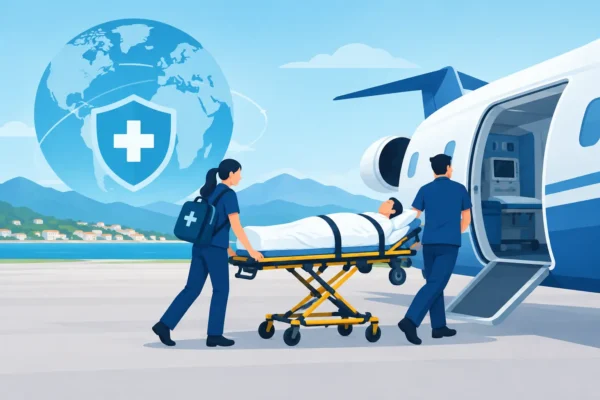
At its heart, this coverage is about getting you home safely for medical care. This isn’t just booking a seat on a commercial flight. If your condition is serious, it means arranging a private air ambulance—essentially a flying ICU staffed with a dedicated medical team. Your insurer handles every single detail, from finding the right aircraft to equipping it with the specific life-support you need.
The Medical Transport Lifeline
Coordinating an air ambulance is an incredibly complex operation. The assistance team from your insurance provider works directly with your doctors abroad and the receiving hospital back home. They manage flight plans, secure permits, and arrange ground transport at both ends to create a seamless “bed-to-bed” transfer.
This expert management allows you and your family to focus on what matters most: your recovery. You’re not stuck trying to figure out the mind-boggling logistics of an international medical flight.
And the financial protection is huge. Without insurance, an air ambulance can easily top $100,000, and providers often demand payment upfront. Repatriation coverage absorbs this potentially catastrophic expense.
Support for Your Family and Dependents
A medical emergency doesn’t just affect the patient; it impacts the whole family. That’s why high-quality expat medical plans often extend repatriation benefits beyond just getting you home. These thoughtful services are designed to keep your family together and reduce everyone’s stress.
Common family support benefits often include:
- A Family Member’s Travel: If you’re hospitalized abroad and facing a long recovery, your policy might cover a round-trip ticket for a loved one to fly to your bedside. That emotional support can be absolutely vital.
- Return of Dependent Children: If you’re hospitalized and your kids are left without a guardian, the policy will arrange and pay for their safe, escorted trip back to your home country.
- Pet Return: Some premium plans even cover the cost of getting your pets home if you are medically repatriated and can no longer care for them.
These inclusions show that great coverage is about protecting your life, not just your health. We dive deeper into these benefits in our guide to travel insurance with evacuation coverage.
Repatriation insurance is built to manage every part of a crisis. Its job is to eliminate logistical hurdles and financial stress, ensuring a safe, medically supervised journey home for your continued care and recovery.
The Sensitive Task of Repatriating Remains
In the tragic event of a death abroad, the coverage also handles the difficult and emotionally taxing process of repatriation of mortal remains. This is a critical piece of the puzzle for any expat family.
The insurer coordinates with local authorities, consulates, and funeral homes to manage all the complex legal and logistical steps. This includes arranging necessary documents, like local death certificates and transit permits, and covering the high costs of preparation and transportation. This compassionate service relieves your family of a heavy burden during an awful time, ensuring your remains are brought home with dignity.
The need for these services is growing right along with the global expat community. The worldwide medical repatriation market was valued at USD 8.9 billion in 2023 and is expected to reach USD 15.7 billion by 2032, a clear sign of how essential this protection has become for a mobile global population.
When Repatriation Coverage Becomes a Lifesaver

It’s one thing to read a policy document, but it’s another thing entirely to see what is repatriation insurance coverage in action. These aren’t just abstract benefits on a page; they are critical support systems that kick in during an expat’s worst moments.
Let’s walk through a few real-world scenarios. This is where you see how this coverage can turn a potential catastrophe into a manageable crisis.
Crisis in Thailand: Alex’s Story
Picture Alex, an expat building his freelance career from a small town in Thailand. One afternoon, a serious motorbike accident leaves him with multiple fractures and internal injuries. The local hospital’s emergency surgery saves his life, but his condition is far from simple.
He’s facing several more specialized surgeries and a year of intensive rehab. While the Thai hospital did a fantastic job, his doctors and family back home agree that his long-term recovery would be best handled in the United States. There, he has a support system and familiarity with the medical environment. This is the moment his expat medical insurance becomes an absolute lifeline.
From Chaos to Coordinated Care
Without repatriation coverage, Alex’s family would be facing an impossible task. They’d have to scramble to find an air ambulance, somehow pull together a six-figure upfront payment, and coordinate with doctors on two different continents—all while paralyzed by the emotional trauma of the accident.
Instead, they make a single call to their insurer’s 24/7 emergency hotline.
The assistance team takes over immediately. They start by consulting with Alex’s doctors in Thailand to ensure he’s stable enough for the long-haul flight. From there, they manage every single detail:
- Air Ambulance, Arranged: They charter a private medical jet, fully staffed with a doctor and a flight nurse to monitor Alex.
- Medical Logistics, Handled: The team makes sure the jet is equipped with all the specific life-support equipment and medications Alex needs.
- Bed-to-Bed Transfer, Coordinated: They organize ground ambulances on both ends of the journey and secure a bed for him at a top orthopedic hospital near his family.
- All Costs, Covered: The insurer pays the air ambulance provider directly. This shields Alex from a staggering bill that could have easily topped $150,000.
Because of his repatriation benefits, Alex is flown home safely to begin the long road to recovery, surrounded by his loved ones. His family gets to focus on him, not on logistics or finances.
When Family Health Demands a Return Home
Now, let’s look at the Miller family, expats living in Spain for a work assignment. Their world is turned upside down when their young daughter, Chloe, is diagnosed with a rare childhood cancer. The Spanish oncologists are excellent, but the recommended protocol is highly specialized, with the world’s leading experts based at a children’s hospital in their home state of Texas.
The emotional weight is crushing. They need to get Chloe the absolute best care, and they desperately need the support of their extended family. The thought of arranging international medical transport for their sick child is terrifying.
When a medical situation requires long-term, specialized treatment, being in a familiar healthcare system, speaking your native language, and having family nearby can be just as important as the medical care itself.
This is another clear-cut case for medical repatriation. The family’s expat medical insurance provider steps in, recognizing that the “medically necessary” move is the one that gives Chloe the best chance at a full recovery.
The insurer’s team coordinates everything with her doctors in Spain and the specialists in Texas. They arrange for Chloe and her mother to fly on a commercial flight, accompanied by a dedicated pediatric nurse to monitor her health the entire way. The policy covers business-class seats for comfort and space, the nurse’s time, and all the required medical equipment for the journey.
For the Millers, repatriation coverage was so much more than financial relief. It gave them the breathing room to focus solely on their daughter’s health, knowing the complicated journey home was in expert hands. These stories get to the heart of why repatriation insurance exists: to provide a clear, supported, and financially secure path home right when you need it most.
How Repatriation Fits Into Your Expat Health Plan
When you’re setting up a life overseas, it’s easy to compartmentalize your insurance needs—one policy for health, another for your travels, and so on. But repatriation coverage isn’t something you just buy off the shelf. It’s a critical feature woven directly into any high-quality expat medical insurance plan, serving as a lifeline during your most vulnerable moments.
Think of your expat health plan as a multi-layered shield. The core protects you from the day-to-day scrapes—doctor visits, hospital stays, and treatments in your host country. Repatriation is a specialized, hardened layer of that shield, designed for one specific, high-stakes emergency: getting you home for the care you need.
Without this integrated feature, your health plan has a massive blind spot. It might cover your initial treatment, but it leaves you stranded—both logistically and financially—if the path to recovery involves a long-haul journey back home.
The Role of Insurers in Facilitating Repatriation
Insurance companies are the engine that makes medical repatriation happen. They provide both the financial muscle and the logistical expertise needed to pull off these incredibly complex operations. In fact, insurers play the dominant role in this market.
Recent data shows that insurance companies funded roughly 68% of all medical repatriations. Private, out-of-pocket payers accounted for 23%, with government agencies picking up the remaining 9%. This really underscores how essential a formal insurance plan is. For instance, a major global provider like Cigna Healthcare handles over 90 evacuation cases every year and maintains 100% direct-to-provider payment for emergencies. You can find more detailed market data about medical repatriation services and their funding sources on marketreportsworld.com.
A true expat medical plan provides the robust, long-term security needed for life abroad. This includes comprehensive repatriation benefits that a standard, short-term travel policy simply cannot match.
Differentiating From Basic Travel Insurance
This is where many expats make a costly mistake. They assume a basic travel policy offers the same level of protection as a dedicated expat medical plan. While most travel insurance includes some form of repatriation benefit, the coverage is almost always limited and designed for short trips—not for someone living and working abroad. You can explore a deeper comparison in our article on Medevac travel insurance.
Here’s where they really differ:
- Coverage Limits: Travel insurance repatriation benefits often have low financial caps. These are rarely enough to cover the six-figure cost of a private air ambulance.
- Policy Duration: These plans are built for short-term trips of a few weeks or months, not the year-round, continuous coverage an expat needs.
- Scope of Care: Expat plans are designed for your overall health management while living abroad. Travel policies are focused on unexpected emergencies that happen during a vacation.
When you’re looking at your own policy, don’t just scan for the word “repatriation.” Dig into the details. Make sure the coverage limit is substantial—ideally $1 million or more—and confirm it’s part of a dedicated expat health plan. This is how you ensure you’re not just covered for a trip, but fully protected for your life as a global citizen, avoiding catastrophic out-of-pocket costs during a crisis.
Navigating the Repatriation Claims Process
When you’re facing a medical crisis abroad, the last thing you want is a mountain of paperwork and logistical headaches. The good news is that activating your repatriation benefits is designed to be straightforward, shifting the heavy lifting from your shoulders directly onto your insurer’s.
It all starts with one crucial step: calling your insurance provider’s 24/7 emergency assistance line. This isn’t your average customer service number. It’s a dedicated team of medical and logistical experts, ready to jump into action and manage your crisis from anywhere in the world.
The First Call and What Happens Next
Once you make that call, the assistance team takes immediate control. They’ll start by gathering the essential details about your medical situation and where you are.
From that moment on, they kick off a coordinated effort to ensure your safety and well-being. This is where a top-tier expat medical plan truly proves its worth.
- Medical Consultation: The team gets on the phone with your local doctors to get a crystal-clear understanding of your diagnosis, prognosis, and what you need medically.
- Logistical Assessment: They’ll then figure out if repatriation is not only medically necessary but also safe to undertake. This includes determining the level of care you’ll need during the journey home.
- Full-Service Coordination: Your insurer handles everything. They arrange the flight—whether that’s a commercial flight with a medical escort or a private air ambulance—and coordinate all the ground transport and even secure your hospital bed back home.
This visual shows how repatriation elevates a base plan into truly comprehensive coverage.

The flow from a basic plan to one that includes repatriation shows how this single benefit transforms standard insurance into a real global safety net.
Essential Documentation for a Smooth Process
While the insurer manages the logistics, you or a family member will need to supply some key documents. Having these ready to go can seriously speed things up.
- Your Insurance Policy Information: Keep your policy number and personal details easily accessible.
- Medical Records: The assistance team will need access to any reports, test results, and notes from the local hospital.
- Physician’s Statement: A formal letter from the treating doctor confirming your diagnosis and officially recommending repatriation is often required.
- Identification: You’ll need copies of your passport and other ID for all the travel and administrative arrangements.
The key takeaway is that you are not alone. The system is designed so that your insurer’s expert team manages the immense logistical challenges, allowing you to focus completely on your health and recovery.
After your claim is filed, understanding how to negotiate your insurance settlement can make a real difference in the final outcome. This kind of support provides incredible peace of mind, proving the system is built to have your back when you’re at your most vulnerable.
Got Questions About Repatriation Insurance? We’ve Got Answers.
Even after you’ve got the basics down, it’s natural to have some practical “what if” questions. Let’s dig into some of the most common things expats ask us about repatriation insurance and how it plays out in the real world.
Do I Need It If My Host Country Has Great Healthcare?
This is a great question. While top-notch local healthcare is a huge relief, it doesn’t replace the need for repatriation coverage. A serious medical event is about more than just the quality of the immediate care—it’s also about what happens after.
Your recovery is a long road. Being near family, friends, and your own support system can be a game-changer for your long-term healing and mental health. Plus, imagine trying to navigate follow-up appointments and physical therapy while dealing with a language barrier. Repatriation gives you the option to return home to a familiar environment when you need it most.
What Does An Air Ambulance Cost Without Insurance?
Honestly? It’s staggering. An air ambulance is one of the single biggest financial risks an expat can face. Without a solid expat medical insurance plan, you’d be looking at paying the entire bill upfront.
The final cost hinges on things like the distance, the patient’s medical needs, and the type of aircraft required. But to give you a real sense of the numbers, here are some ballpark figures:
- Within Europe or from Mexico to the U.S.: $25,000 – $50,000
- From South America or Asia to the U.S.: $75,000 – $150,000+
- From a remote location like Australia to Europe: Can easily soar past $200,000
These numbers show exactly why understanding what repatriation insurance coverage is so critical for an expat. The protection it offers is massive. It’s no surprise that the global travel insurance market, valued at nearly USD 31.25 billion, is expected to keep growing as people become more aware of these risks. You can get a deeper look into travel insurance market trends on fortunebusinessinsights.com.
A single medical flight can wipe out a lifetime of savings. Repatriation insurance is designed to absorb this catastrophic financial shock, ensuring a medical crisis doesn’t become a financial one.
Can I Choose My Hospital Back Home?
While you can certainly state your preference, the final decision is a team effort. Your insurer’s medical team will work directly with your doctors in your host country and with a receiving physician back home.
Their number one priority is to make sure your transfer is smooth and your care continues without a hitch. They’ll aim to get you to a hospital in or near your home city that is fully equipped to handle your specific condition and long-term recovery needs.
Will My Family Be Able to Travel With Me?
In most cases, yes. The best expat medical plans with repatriation benefits usually include a provision for a family member to travel with you. If you’re on an air ambulance, one family member can typically join, as long as space and medical protocols allow.
If you’re stable enough to be flown home on a commercial flight with a medical escort, the policy will often cover a plane ticket for a companion to accompany you.
Protecting yourself while living abroad isn’t a one-size-fits-all game. At Expat Global Medical, we help expats, retirees, and global employers find solid insurance plans that include comprehensive repatriation benefits, making sure you always have a clear and fully-funded path home when you need it most.