
A scooter accident in Bali, a sudden appendicitis in Mexico City, or a prescription that runs out in Lisbon can turn a flexible overseas lifestyle into a costly logistical problem. Health insurance for digital nomads abroad is not simply a travel checklist item. It is the plan that determines where you can receive care, who pays the provider, and what happens if the local hospital cannot treat you.
For US-connected remote workers, the biggest mistake is assuming a domestic health plan will function overseas or that a credit card travel benefit is enough. Both may provide limited help in a true emergency, but they are often a poor fit for ongoing life outside the United States. The right coverage depends on how long you will be abroad, where you will live, your health history, and whether you need routine care as well as emergency protection.
Why travel coverage may not be enough
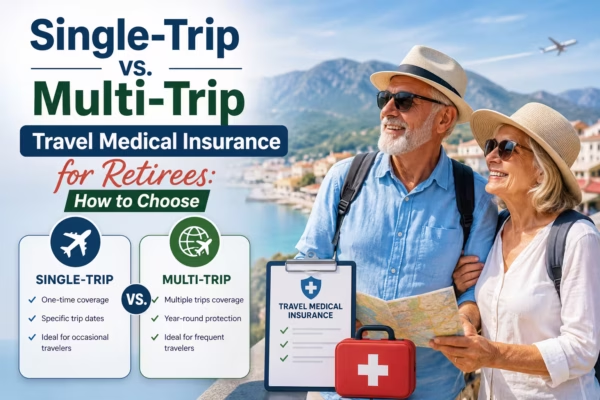
Travel medical insurance is designed primarily for unexpected illness and injury during a trip. It can be an appropriate, cost-conscious option for a short international stay, a trial period abroad, or travel between countries while you decide where to settle. It commonly includes emergency treatment, hospitalization, and emergency medical evacuation, subject to the plan’s limits and exclusions.
The trade-off is that travel plans may limit preventive care, routine doctor visits, prescription refills, maternity care, and treatment for pre-existing conditions. Some plans also have time limits that make them impractical for a nomad who keeps extending a stay abroad. Calling yourself a traveler does not change the policy terms. Your actual duration abroad and coverage needs matter.
International health insurance is generally better suited to someone living outside the US for an extended period or moving regularly between countries. These plans can offer broader benefits for inpatient and outpatient care, specialists, diagnostics, prescriptions, mental health services, and preventive treatment. Coverage is usually renewable, which can provide more continuity if your location or health needs change.
Neither category is automatically better. A healthy freelancer taking a four-month working trip through Southeast Asia may reasonably prioritize emergency protection and evacuation. A remote employee based in Spain for a year, or a couple moving country to country with ongoing prescriptions, may need a more comprehensive international medical plan.
What health insurance for digital nomads abroad should cover
Start with the practical question: if you needed medical care next week, what kind of care would you expect to receive? A plan should be evaluated around that answer, not just its monthly premium.
Hospital and emergency benefits are the foundation. Review coverage for inpatient treatment, surgery, intensive care, ambulance services, and emergency room visits. Then look at outpatient benefits. Doctor consultations, diagnostic tests, specialist visits, physical therapy, and prescription medication can become meaningful expenses even when there is no major emergency.
Evacuation deserves separate attention. A hospital in your current destination may be competent for basic care but unable to provide trauma, cardiac, neurological, or advanced neonatal treatment. Medical evacuation coverage coordinates transport to the nearest appropriate facility when medically necessary. It is not a flight home for convenience, and it may not apply if comparable care is available locally. Still, it can be one of the most valuable protections in regions with limited specialist care.
If your work takes you to higher-risk locations, consider emergency security evacuation as well. Civil unrest, natural disasters, and political instability are different risks from a medical emergency, and they are not always covered under a health plan.
Also check whether a policy includes direct billing with providers. Paying a hospital deposit out of pocket and seeking reimbursement later can be difficult, especially during an emergency. A carrier’s international provider network and 24/7 assistance team can make a real difference when care must be arranged quickly.
Choose your coverage area carefully
A worldwide plan excluding the United States is often less expensive than worldwide coverage that includes the US. For many nomads, that is sensible. Medical care in the US is expensive, and including it can substantially increase premiums.
But excluding the US is not always the right choice. If you return frequently to visit family, spend several months a year stateside, or want the option to receive planned treatment there, you need to understand exactly what the plan allows. Some policies provide limited emergency coverage during short US visits even when the US is otherwise excluded. Others do not. Do not rely on assumptions based on a plan name or a verbal description.
Your destination also affects the available carrier options, local regulations, provider access, and price. A plan that works well for a nomad moving through Portugal, Thailand, and Colombia may be less appropriate for someone stationed in the Middle East, working in remote Africa, or relocating with children to a country that requires specific local insurance documentation.
The details that can change the value of a plan
Premium is visible. Policy conditions are where coverage often succeeds or fails. Before enrolling, review the deductible, coinsurance, annual maximum, and benefit limits. A lower premium with a high deductible may be appropriate if you have savings available for routine or moderate costs. A richer plan may be worthwhile if you expect frequent outpatient care or prefer more predictable expenses.
Pre-existing conditions require especially careful review. Some international plans may exclude a condition, apply a waiting period, offer coverage after underwriting, or decline the application based on medical history. The correct answer varies by carrier and individual circumstances. Full, accurate disclosure is essential. Failing to disclose a prior diagnosis or treatment can jeopardize a future claim when you need help most.
Mental health, maternity, dental, vision, and wellness benefits are also not interchangeable across plans. Maternity benefits may require a waiting period. Mental health coverage may have visit limits or different inpatient and outpatient rules. Dental and vision may be optional add-ons rather than core benefits. If these services matter to you, compare them before purchase instead of discovering a limitation after receiving care.
Finally, read the rules around adventure activities and work. Scuba diving, motorcycling, trekking at altitude, and other activities may be excluded or require an added benefit. Likewise, health insurance does not replace business liability coverage, workers’ compensation requirements, or local visa and residency compliance.
A better way to compare plans
Comparing international insurance is not about finding the longest benefits list. It is about finding coverage that matches the way you actually live abroad. Begin by documenting your expected countries, travel schedule, age, family members, US visit plans, medical history, regular medications, and preferred budget range. This gives the comparison a useful framework.
Then compare plans on the same basis. Look at their geographic area, deductible, outpatient coverage, evacuation benefit, pre-existing condition treatment, provider network, claims process, and renewal terms. A cheap policy can be expensive if it leaves a major gap in the places where you spend most of your time. Conversely, paying for extensive US coverage may not make sense if you will not be there.
An independent broker can help clarify those differences because the goal should be the right plan, not the most profitable one for the advisor. Expat Global Medical has spent more than 30 years helping internationally mobile clients compare established global carriers and understand how benefits work before enrollment. That guidance can also be valuable after purchase, particularly when claims, hospital admission, or emergency coordination create pressure.
Before you leave, make the plan usable
Insurance only helps when you can use it. Save your insurer’s emergency assistance number in your phone, carry a digital and printed copy of your policy details, and understand whether you must contact the carrier before non-emergency treatment or hospitalization. Ask how prescriptions are handled in each destination and carry sufficient medication, along with a copy of the prescription and a physician letter when appropriate.
It is also wise to identify reputable clinics near your first destination before you need one. For an emergency, seek immediate care first when circumstances demand it, then notify the assistance team as soon as possible. For planned treatment, contacting the insurer in advance can help confirm eligibility, arrange direct billing, and reduce avoidable surprises.
Your work may be mobile, but your health care plan should not be an afterthought. Choose coverage that reflects where you are going, what care you may need, and how much financial risk you are prepared to carry. That preparation gives you more freedom to focus on the reason you went abroad in the first place.