Finding affordable international health insurance isn’t just about snagging the lowest monthly premium. For expats, it’s about securing smart, long-term value that protects both your health and your wallet while you’re building a life abroad.
True affordability is a balancing act—weighing upfront costs against solid protection to make sure one unexpected medical bill doesn’t derail your entire expat journey.
What Affordable Expat Medical Insurance Really Means
When expats first start hunting for medical coverage, their eyes usually go straight to one number: the monthly premium. And while that number is important, it’s just one piece of a much larger financial puzzle. A cheap plan might save you a little each month, but it could leave you dangerously exposed if a serious medical issue pops up.

Think of it like buying a car. You could get a bare-bones base model with a tempting sticker price, but its true cost shows up the moment you get into an accident. It’s the same with expat medical insurance. A rock-bottom plan might exclude critical services or have a sky-high deductible that makes it practically useless when you actually need to use it.
Looking Beyond the Premium
To really understand what makes affordable international health insurance genuinely cost-effective for an expat, you have to look at the whole picture. Real value is found in the balance between what you pay and the protection you get back. This means getting familiar with a few key components that shape your total potential costs:
- Deductible: This is what you have to pay out-of-pocket for medical care before your insurance company starts chipping in. Lower premiums often come hand-in-hand with higher deductibles.
- Coinsurance/Copay: Even after you’ve met your deductible, you might still share a percentage of the bill with your insurer (that’s coinsurance) or pay a flat fee for specific services (a copay).
- Out-of-Pocket Maximum: This is the absolute most you’ll have to pay for covered healthcare in a policy year. A good expat plan keeps this limit from getting out of control.
The real goal is to find a plan where your premium, plus any potential out-of-pocket costs, fits your expat budget and comfort level with risk. It’s a strategic decision, not just a race to the bottom on price.
A Growing Global Need for Expat Coverage
The demand for trustworthy expat medical insurance is definitely on the rise. The global insurance market has grown substantially, and the international health insurance slice of the pie is performing especially well.
This boom is fueled by demand from people in both developed and emerging economies, particularly in places with limited public healthcare options. You can dive deeper into these market dynamics by reading the full report on global insurance trends.
Ultimately, a truly affordable plan is one that stops a medical emergency from turning into a financial catastrophe. It gives you access to quality care without forcing you to empty your savings, delivering genuine peace of mind as you embrace your life abroad.
So, How Is Your Expat Medical Insurance Premium Actually Calculated?
To get a handle on your insurance costs, you first need to understand what drives them. Think of your insurance premium like a custom-built car—the final price tag really depends on the parts you choose. Insurers aren’t just pulling numbers out of thin air; they use a straightforward set of factors to figure out your specific rate.
Once you know what these factors are, you can start pulling the right levers to adjust your premium. This is how you build a policy that protects both your health and your bank account, landing you a plan that’s genuinely affordable international health insurance tailored to your life as an expat.
Your Age and Health Profile
The biggest single factor influencing your premium is your age. It’s a simple statistical reality: older individuals are more likely to need medical care, so premiums naturally go up as we age to reflect that higher risk. Your current health and past medical history also play a huge part in the final calculation.
While you can’t turn back the clock on your age, being completely upfront about your health from day one is essential. It’s the only way to guarantee the expat medical insurance plan you choose will actually have your back when you need it most.
Your Chosen Area of Coverage
Where you need coverage is a massive cost driver. Expat health plans are typically split into two main buckets:
- Worldwide Coverage Including the USA: This is, by a long shot, the most expensive option. The United States has the highest healthcare costs on the planet, and adding it to your plan can easily double your premium.
- Worldwide Coverage Excluding the USA: This option covers you everywhere else and is far more affordable. It’s a fantastic choice for expats who don’t expect to spend much time or need medical care back in the U.S.
Opting to exclude the USA is one of the single most effective ways to slash your premium without sacrificing the quality of your care anywhere else. For a more detailed look at how location affects pricing, our international medical insurance cost guide breaks it all down.
Your Deductible and Cost-Sharing Levels
Your deductible is simply the amount you agree to pay out-of-pocket before your insurance kicks in. It’s a classic trade-off: picking a higher deductible almost always means you’ll pay a lower monthly premium.
By agreeing to cover a larger chunk of the initial costs yourself, you’re signaling to the insurer that you’ll likely only use the plan for bigger medical events. This lowers their risk, and they pass those savings on to you as a lower premium.
This is a powerful lever to pull for making a plan more affordable, especially if you’re a healthy expat who mainly wants a safety net for major, unexpected health issues.
The Scope of Benefits and Policy Limits
Not all plans are built the same. A basic plan covering only hospitalizations (inpatient care) will be much cheaper than a comprehensive one that also includes regular doctor visits, prescriptions, and dental work (outpatient care). The total dollar amount the policy will pay out annually, known as the policy limit, also moves the needle on price.
A plan with a $1,000,000 annual limit will cost less than one with a $5,000,000 limit. Finding the sweet spot means taking a hard look at your personal needs as an expat and what level of risk you’re comfortable with.
Comparing Two Real-World Expat Scenarios
To see how all these pieces fit together, let’s look at two very different expats.
Scenario 1: The Digital Nomad
A 30-year-old digital nomad is living and working her way through Southeast Asia. She’s healthy and wants a basic plan that covers her worldwide excluding the USA. She’s also comfortable with a high deductible of $5,000 because she’s mainly looking for catastrophic coverage for emergencies. Her premium will be on the very low end, thanks to her age, health, coverage area, and high deductible.
Scenario 2: The Retiree
A 65-year-old retiree is moving to Mexico but wants the flexibility to visit family and see his specialists back in the USA. He needs a comprehensive plan that includes U.S. coverage, has a low deductible of just $1,000, and covers his pre-existing conditions. His premium will be substantially higher due to his age, the costly inclusion of the U.S., and the much richer benefits package.
Choosing the Right Health Plan for Your Expat Lifestyle
Not all expats are cut from the same cloth, and your insurance plan shouldn’t be either. The secret to finding affordable international health insurance is all about matching your coverage to your real life abroad. An adventurous digital nomad hopping across continents has wildly different needs than a family putting down roots in a European city.
Think of choosing a plan structure like picking the right tool for a job. You wouldn’t bring a sledgehammer to hang a picture frame, right? In the same way, you shouldn’t be paying for a top-tier, all-inclusive plan if what you really need is a solid safety net for emergencies.
The Three Main Flavors of Expat Medical Insurance Plans
Expat medical insurance generally comes in three main varieties, each built for a different level of need and budget. Getting your head around these categories is the first step to making sure your policy fits your lifestyle—and you’re not paying for bells and whistles you’ll never use.
Let’s break them down.
Expat Medical Insurance Plan Types Compared
This table gives a quick overview of how the main plan types stack up against each other, helping you see at a glance which one might be the best starting point for you as an expat.
| Plan Type | Typical Coverage | Relative Cost | Best For |
|---|---|---|---|
| Inpatient-Only | Hospital stays, surgeries, major medical events (“catastrophic” coverage). | $ (Lowest) | Healthy, budget-conscious expats & digital nomads who need a safety net for major emergencies. |
| Comprehensive | Inpatient care plus routine outpatient services like doctor visits, specialists, and prescriptions. | $$ (Moderate) | Expat families, individuals with ongoing health needs, or anyone wanting predictable, all-around coverage. |
| Modular | A core inpatient plan with optional add-ons (modules) for dental, vision, maternity, etc. | $-$$$ (Variable) | Expats who want to customize their coverage precisely, like retirees or those planning a family. |
As you can see, the right choice really hinges on what you expect from your healthcare while you’re away from home.
A Deeper Dive Into the Plan Types
- Inpatient-Only Plans: This is your essential “major medical” or catastrophic coverage. It kicks in when you’re admitted to a hospital for things like surgery, an overnight stay, or intensive care. Because it leaves out routine care, it’s almost always the most budget-friendly option for expats.
- Comprehensive Plans (Inpatient + Outpatient): This is the go-to for most expats. It bundles everything from an inpatient plan and adds coverage for outpatient services. That means your regular doctor visits, specialist consultations, lab tests, and prescriptions are covered, too.
- Modular Plans: These are the ultimate “build-your-own” plans. You start with a core inpatient policy and then tack on “modules” or riders for specific benefits you know you’ll need. Common add-ons include dental, vision, maternity care, and wellness checks, letting you create a truly custom fit.
The single most effective way to manage your insurance costs is to be brutally honest about what you truly need as an expat. Are you looking for a shield against the absolute worst-case scenarios, or do you need a partner for managing your day-to-day health? Your answer points directly to the right plan.
Matching Plans to Real-World Expat Profiles
Let’s see how this plays out in the real world with three common expat scenarios. Each one highlights the trade-offs between what you pay and what you get, helping you pinpoint where you might fit.
Case Study 1: The Digital Nomad in Southeast Asia
- Profile: A 28-year-old freelance developer, healthy and active, bouncing between Thailand and Vietnam.
- Priority: Keeping costs rock-bottom while having a safety net for a serious accident or illness.
- Best Fit: An inpatient-only plan. This gives him ironclad protection against the high costs of hospitalization from a motorbike accident or a nasty illness like dengue fever—his biggest worries. Since minor check-ups are incredibly cheap to pay for out-of-pocket in that region, he skips outpatient coverage and keeps his premium super low.
Case Study 2: The Expat Family Moving to Europe
- Profile: A couple in their late 30s with two young kids, relocating to Spain for a new job.
- Priority: Total peace of mind, routine care for the children, and quick access to specialists.
- Best Fit: A comprehensive plan (inpatient + outpatient). This is a no-brainer for an expat family. They’re covered for everything from an unexpected hospital stay to the kids’ routine wellness visits, vaccinations, and specialist appointments. The slightly higher premium is an investment that pays off in predictable healthcare costs and broad protection for the entire family.
Case Study 3: The Retiree in Mexico
- Profile: A 66-year-old retiree who needs to manage a chronic condition.
- Priority: Consistent, comprehensive care, reliable prescription drug coverage, and access to a strong network of high-quality hospitals.
- Best Fit: A modular plan. She starts with a strong comprehensive core plan and then adds on specific modules for dental and vision. This structure lets her get the exact benefits she needs for her ongoing health without paying for extras she’ll never use, like maternity care. Knowing which hospitals and clinics accept her plan is also vital, which is why it helps to learn about PPO vs. HMO abroad and understanding international health networks for expats.
Of course, medical insurance is just one piece of the puzzle. Getting a handle on your complete financial picture is crucial for a successful life abroad. You can find some excellent general expat financial planning tips to help you see the whole board.
By taking a clear-eyed look at your own lifestyle, priorities, and comfort with risk, you can confidently pick a plan that gives you the right protection without draining your bank account.
Proven Strategies to Lower Your Expat Medical Insurance Costs
Finding truly affordable international health insurance isn’t about chasing the absolute cheapest plan on the market. It’s about being smart and strategic, building a policy that fits you perfectly. With the right approach, you can seriously trim your monthly premium without ever skimping on the quality of care you get when you need it most.
Think of it like building with LEGOs. You get to pick the exact pieces you need and leave out the expensive, specialized ones you’ll never use. Every choice you make—from your deductible to your coverage area—is a lever you can pull to make your plan more budget-friendly.
Your expat lifestyle is the blueprint for this entire process. Are you a globe-trotting nomad, settling down with family, or enjoying a well-deserved retirement? Each path comes with its own set of needs.
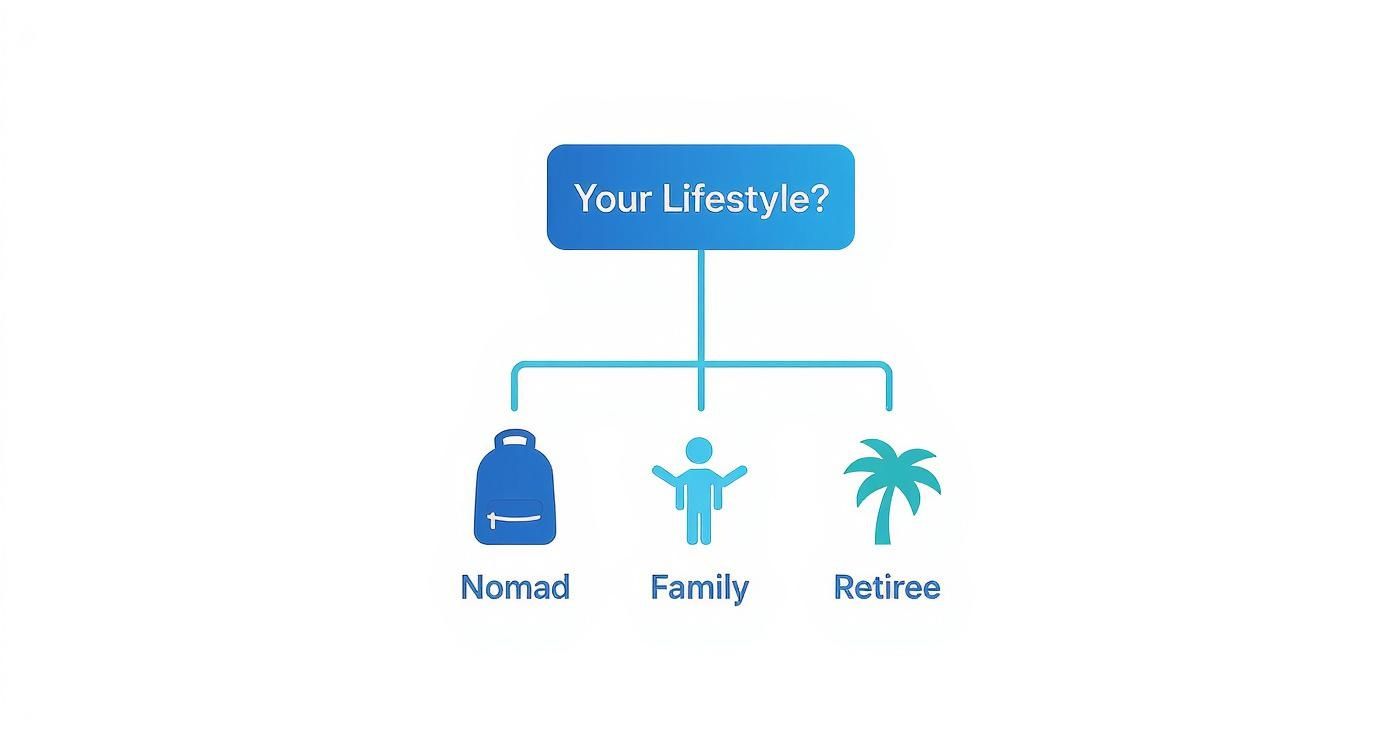
The takeaway here is simple: your personal journey dictates your insurance strategy. It’s all about making sure you only pay for the protection that actually aligns with your life abroad.
Choose a Higher Deductible
One of the quickest ways to bring down your premium is to opt for a higher deductible. A deductible is simply the amount you agree to pay out-of-pocket for medical care before your insurance plan starts paying the bills.
By choosing a higher number, you’re taking on a little more of the initial financial risk yourself. Insurers love this, and they’ll reward you with a lower monthly premium. This is a fantastic strategy for healthy expats who just want a solid safety net for major, unexpected emergencies, not for frequent trips to the doctor for minor things.
Strategically Exclude High-Cost Regions
Where you get your coverage has a massive impact on your final price tag. Healthcare in the United States is famously the most expensive in the world, and adding the USA to your plan can easily double your premium.
If you have no plans to spend significant time or get medical care in the U.S., choosing a “Worldwide excluding the USA” plan is a total game-changer for an expat. This one move can dramatically slash your costs while still giving you top-notch coverage everywhere else. It’s probably the single most powerful cost-cutting tool you have.
Embrace Cost-Sharing Options
Beyond the deductible, many plans offer other ways to share costs, like copayments or coinsurance. This just means you’ll pay a small, fixed fee or a percentage of the bill for medical services after you’ve met your deductible.
By agreeing to a bit of cost-sharing, you’re showing the insurer that you’ll be a mindful user of healthcare services. In return, they offer a more competitive premium. It’s a win-win for managing your expat budget.
Pay Your Premium Annually
This one’s a no-brainer if you can swing it. Most insurance providers will give you a nice discount—often between 5-10%—if you pay your entire year’s premium upfront instead of month by month.
It does require a larger initial payment, but that annual discount is basically free money back in your pocket. It’s an incredibly easy way to make your affordable international health insurance even more so.
Critically Assess Optional Add-Ons
Many modern insurance plans are modular, letting you tack on extras like dental, vision, or enhanced maternity coverage. While these can be great, they also add to your premium. Be honest with yourself about what you really need right now as an expat.
The good news is that you can often add these benefits later if your life changes. By starting with a strong core plan and skipping the bells and whistles for now, you keep your initial costs down while keeping the flexibility to upgrade your coverage down the road.
Having a cost-effective safety net is non-negotiable for expats. Unexpected medical bills can cause financial ruin, a global issue that pushes millions into hardship. Beyond health insurance, being smart about other big-ticket items is key to making expat life affordable. You can explore more strategies to save money on international travel essentials to keep your budget healthy, too.
Comparing the Best Providers for Expat Medical Insurance
Picking an insurance provider can feel like you’re trying to find your way through a maze. The market is flooded with options, but a few key players consistently stand out for offering reliable, affordable international health insurance that’s actually built for expats. The right choice isn’t just about a list of features; it’s about finding a provider whose strengths match your life.

This review cuts through the noise. Instead of just rattling off benefits, we’ll connect the top providers to what expats actually need. You’ll see which company is the go-to for comprehensive family plans, who excels at flexible options for solo adventurers, and which one offers unbeatable value for budget-conscious remote workers.
Cigna Global for Comprehensive Expat Family Coverage
When you’re moving your family abroad, the number one priority is solid, reliable care with no ugly surprises. Cigna Global is a true powerhouse here, known for its massive network and robust plans that cover everything from routine check-ups to serious medical emergencies. They are the perfect fit for expat families who want total peace of mind.
Their plans start with a strong foundation of inpatient care, which you can then customize with outpatient, wellness, dental, and vision modules. This lets you build a single policy that covers pediatric care for the kids and wellness benefits for the parents.
Among the leading providers, companies like Cigna Global, International Medical Group (IMG), and GeoBlue really dominate the expat market. Cigna Global alone covers over 86 million customers across more than 200 countries, with access to a staggering 1.65 million healthcare providers worldwide. That huge network is a game-changer for expat families who need easy access to quality care, no matter where they are. You can learn more about how top insurance companies compare and see the details for yourself.
IMG for the Flexible Digital Nomad
Digital nomads need insurance that’s as flexible and mobile as they are. This is where International Medical Group (IMG) really shines, offering some of the most customizable and affordable international health insurance plans you can find. Their modular approach is perfect for nomads who want to keep costs down by paying only for what they need.
IMG’s plans are well-known for their excellent value. You can pick and choose different coverage levels and deductibles to get your premium just right. This makes them a top choice for younger, healthy individuals who are mainly looking for catastrophic coverage but still want the option to add more benefits if their situation changes down the road.
For a digital nomad, getting worldwide coverage (excluding the U.S.) at a competitive price is a huge win. IMG’s plans deliver this, providing a solid safety net without the high cost of a bells-and-whistles policy.
GeoBlue for U.S. Expats Needing Stateside Coverage
For American expats who travel back to the U.S. often or simply want access to their doctors back home, GeoBlue is an excellent choice. As an independent licensee of the Blue Cross Blue Shield Association, GeoBlue gives you seamless access to the massive Blue Cross Blue Shield network inside the United States.
This integration is their secret sauce. It means you can use your plan in the U.S. just as easily as you can abroad, a major plus for retirees or any expat with close ties to home. While adding U.S. coverage will always bump up the price, GeoBlue offers competitive plans that make this option much more accessible for U.S. expats.
Their plans also tend to include modern features like telemedicine and direct billing, simplifying the whole process of getting care wherever you happen to be. This convenience, combined with their strong U.S. network, makes GeoBlue a top contender for any American living abroad.
Your Simple Checklist for Securing Expat Medical Insurance
Turning what you’ve learned into a real, tangible insurance plan is the final step. Think of this simple checklist as your road map—it’s here to guide you from the initial research phase all the way to enrollment without the usual headaches.
By walking through these steps, you can confidently find a plan that protects not just your health but also your wallet as you start your new life abroad. Let’s get you insured.
Assess Your Expat Needs and Budget
First things first, take an honest look at your personal situation. What’s your age? Do you have any pre-existing conditions to consider? Who else is coming with you that needs to be on the policy? Decide if you’re looking for a bare-bones safety net for emergencies or if you need comprehensive coverage for things like routine check-ups and prescriptions.
At the same time, figure out a realistic monthly or annual budget. Knowing what you can comfortably spend will immediately help you filter out the noise and avoid paying for benefits you’ll never use. This is the foundation of a smart, targeted search.
Your personal health profile and financial comfort level are the two most important guideposts in this process. Being honest about both will lead you to the most suitable and sustainable plan for your life abroad.
Compare Quotes from Multiple Providers
Whatever you do, don’t just go with the first quote you see. You should aim to get detailed proposals from at least three different insurance providers. This is the only way to compare not just the monthly premiums, but also the deductibles, coverage limits, and which doctors you can see.
Pay attention to the little things, like how each company handles outpatient visits, those tricky pre-existing conditions, or emergency medical evacuation. Putting the options side-by-side is the key to spotting which provider truly offers the best value for you as an expat.
Review the Policy Details Carefully
Once you’ve zeroed in on a strong contender, it’s time to read the fine print. I know, it’s not the most exciting part, but it’s crucial. Pay close attention to the policy wording, especially the sections on exclusions, limitations, and the claims process. You need to know exactly what isn’t covered before you sign on the dotted line.
Before you make that final decision, also make sure all your other pre-move ducks are in a row. For a complete rundown, check out this helpful expat checklist for what you need before leaving the U.S., which covers a lot more than just insurance. Follow this simple process, and you’ll end up with a plan that delivers genuine peace of mind.
Got Questions About Expat Medical Insurance? We’ve Got Answers.
Stepping into the world of expat medical coverage can feel a bit overwhelming, and it’s natural to have questions. Getting clear, honest answers is the only way to feel confident in your choice and find a plan that’s genuinely affordable. Let’s tackle some of the most common things expats ask.
Getting the right info from the start helps you sidestep common mistakes and ensures the plan you pick actually has your back when you need it.
Can I Just Use Travel Insurance Instead of Expat Medical Insurance?
Nope, and this is a big one. These two types of insurance are built for completely different jobs. Think of travel insurance as a temporary safety net for a vacation—it’s designed for trip cancellations, lost bags, and sudden medical emergencies during a short trip. It’s a band-aid for travel mishaps.
Expat medical insurance, on the other hand, is your actual health plan for living abroad long-term. It works just like the coverage you’d have back home, handling everything from routine doctor’s appointments and prescriptions to major surgeries and hospital stays. Trying to live overseas on a travel policy is a huge financial gamble that can leave you dangerously exposed.
Does “Affordable” Mean I’m Getting Lower Quality Care?
Absolutely not. Finding an affordable plan is all about being smart and strategic with your coverage, not about cutting corners on quality. The world’s top-tier insurance providers all give you access to incredible networks of high-quality hospitals and English-speaking doctors.
You bring the cost down by tailoring the plan to what you actually need as an expat. For example, you can:
- Pick a higher deductible, which lowers your monthly premium right away.
- Exclude coverage in super expensive regions, like the USA, if you don’t plan on needing care there.
- Skip optional add-ons you won’t use, like dental or maternity benefits.
This approach lets you get excellent care without paying for bells and whistles that don’t fit your life.
How Do Insurers Handle Pre-Existing Conditions?
This is probably one of the most critical questions for expats, and the answer really changes from one insurer to the next. The most important thing you can do is be 100% upfront about your medical history when you apply. Hiding something is the fastest way to get a future claim denied.
Full disclosure isn’t just a good idea—it’s non-negotiable. Hiding a condition can void your policy right when you need it most, leaving you on the hook for the entire medical bill.
Generally, insurance companies will handle pre-existing conditions in one of three ways:
- Exclusion: The specific condition and any related treatments are permanently left out of your coverage.
- Moratorium: They might agree to cover the condition, but only after a waiting period (often 24 months) where you’ve had no symptoms, treatment, or advice for it.
- Coverage with a Surcharge: Some of the more premium plans might cover the condition from day one but will add a bit extra to your premium to do so.
Finding the right fit means taking a close look at how different insurers view your specific health profile.
Ready to find a plan that protects your health without wrecking your budget? The team at Expat Global Medical specializes in helping expats sort through the noise to find reliable, affordable coverage. Get a free, no-obligation quote today and get the peace of mind you deserve.