Relying on your health plan from back home is one of the most common—and costly—mistakes an expat can make. The reality is, these plans are built for a life you’re leaving behind, offering little to no real coverage once you’re living overseas. The best expat medical insurance isn’t just a slightly better option; it’s a completely different type of policy designed for a global life, covering everything from emergency surgery to routine doctor’s visits across borders. Without it, you’re exposed to massive out-of-pocket bills that your domestic plan simply won’t touch.
Why Your Domestic Health Insurance Is Not Enough Abroad
Starting a new life abroad is an incredible adventure, but it comes with a unique set of healthcare challenges that your standard domestic insurance policy was never designed to handle. Too many expats assume their coverage travels with them, only to discover the hard way—usually during a medical emergency—that they’re dangerously unprotected.
Your domestic plan is built around a local network of doctors and hospitals. The moment you move abroad, you’re considered “out-of-network.” This means that even if your plan claims to offer some emergency coverage internationally, it will be severely limited. Forget about routine check-ups, specialist visits, or managing ongoing treatments—those are almost guaranteed to be excluded.

Uncovering the Critical Coverage Gaps
The failure of domestic insurance abroad really comes down to three things: provider access, claims, and emergency support. Without a global network, you’ll be forced to pay for everything in cash upfront and then navigate a bureaucratic nightmare trying to get reimbursed. It’s a frustrating process that rarely ends in your favor.
The core issue is that domestic insurance systems are geographically restricted. They are not built for the realities of international life, where access to a direct-billing network and global support is non-negotiable for true peace of mind.
This problem becomes life-threatening in a serious medical crisis. Domestic policies almost never cover medical evacuation. If you suffer a severe injury or illness in a country that can’t provide the necessary care, the cost of an emergency flight to a better-equipped hospital can easily top $100,000. That’s a bill you’d be paying entirely on your own. We break this down even further in our guide on why U.S. health insurance doesn’t work abroad.
Domestic vs. Expat Insurance at a Glance
When you put the two types of plans side-by-side, the differences are impossible to ignore. A typical domestic plan just can’t compete with one designed specifically for expats.
| Feature | Domestic Health Insurance | Expat Medical Insurance |
|---|---|---|
| Provider Network | Limited to your home country | Global access to hospitals and doctors |
| Direct Billing | Rarely available internationally | Standard feature in most plans |
| Medical Evacuation | Almost never included | A core, essential benefit |
| Claims Process | Complex, requires translation and currency conversion | Streamlined for multiple currencies and languages |
At the end of the day, trying to make your home country’s insurance work abroad is a huge gamble. The best expat medical insurance isn’t a luxury—it’s a fundamental piece of your toolkit for protecting your health and finances. It provides a safety net that is borderless, just like the life you’re building.
What to Look for When Comparing Expat Medical Insurance Plans
Picking the right expat medical insurance can feel like trying to solve a puzzle in another language. You’re hit with a bunch of unfamiliar terms and confusing clauses. But once you get a handle on the core pieces, you can start comparing policies like a pro and find one that actually fits your life abroad. The best way to do this is to break each plan down and see if it truly protects both your health and your wallet.
This isn’t just a niche problem anymore. The world is more connected than ever, and people are moving abroad in staggering numbers. As of 2024, there are over 87 million of us living and working outside our home countries. That global shift is fueling massive demand for specialized medical insurance. The market, already valued at USD 331 million in 2024, is expected to jump to USD 532 million by 2031.
Why the boom? Because standard health plans from back home just don’t work for the expat life—they almost always leave out critical needs like getting care in another country or even just at the local foreign hospital. To really grasp the scale of this, you can dig into the full research on these market trends.
Coverage Limits and Annual Maximums
The annual maximum is the absolute most an insurer will pay out for your medical bills in a single policy year. You might see a plan with a $1 million limit and think, “That’s a huge number, I’ll be fine.” The reality is, a serious accident or a complicated illness can burn through that faster than you’d believe, especially if you’re in a country with a high-cost healthcare system like the U.S. or Singapore.
For most expats, a plan with an annual maximum of at least $2 million to $5 million is a much safer bet. It provides a solid financial cushion. Some of the more premium plans even come with unlimited coverage, which gives you the ultimate peace of mind, knowing there’s no ceiling on your care.
Deductibles and Cost Sharing
A deductible is simply what you have to pay out of your own pocket before your insurance coverage kicks in. It’s tempting to go for a plan with a high deductible because it usually means a lower monthly premium. Be careful, though. This can come back to bite you if an unexpected medical issue pops up.
Let’s say you pick a plan with a $5,000 deductible to keep your monthly payments down. A few months later, you need a minor surgery that costs $4,500. In that scenario, you’d be on the hook for the entire bill. You’re essentially trading predictable monthly costs for unpredictable, and potentially much larger, out-of-pocket hits.
A Word of Advice: Your deductible should match what you can comfortably afford to pay at a moment’s notice. Ask yourself: if I had to pay the full deductible amount tomorrow, would it cause serious financial stress? If the answer is yes, you’re better off with a lower deductible and a slightly higher premium. It’s the smarter, safer move.
Provider Network Access
The provider network is the list of hospitals, clinics, and doctors that have an arrangement with your insurance company to bill them directly. This is a huge deal for convenience and managing your cash flow. If you go “out-of-network,” you often have to pay for everything upfront and then chase down your insurer for reimbursement later.
When you’re looking at a plan’s network, ask these questions:
- Is Direct Billing Common? Does the insurer have a strong direct-billing network where you’re moving? This is key to avoiding massive upfront payments for hospital stays.
- What About Flexibility? Can you see a doctor outside the network? If you can, what’s the process for getting your money back?
- Are the Hospitals Good? Take a look at the facilities in the network. Are they reputable and up to the standards of care you’re used to?
Emergency Medical Evacuation
This is one feature you absolutely cannot skip. It’s a non-negotiable for any expat. If you have a serious medical emergency in a place that can’t provide the care you need, this coverage pays to transport you to the nearest capable hospital. That could be in a neighboring country or even all the way back home.
The cost for a medical flight is astronomical, easily running from $50,000 to over $250,000. Without this benefit, a flight that saves your life could completely destroy you financially. Make sure your policy includes robust evacuation coverage as a core benefit, not just some optional add-on you have to pay extra for.
Pre-Existing Conditions and Portability
A pre-existing condition is any health issue you had before your insurance policy started. Insurers handle these in wildly different ways. Some will refuse to cover the condition entirely. Others might make you wait a certain period before coverage begins. The best plans, however, will offer full coverage from day one, sometimes for a slightly higher premium.
Global portability is another must-have. Your expat journey might not be a one-and-done move; you could end up relocating again. A portable plan moves with you, so you don’t have to re-apply and go through medical underwriting all over again. This ensures you have continuous protection, which is crucial for covering any new conditions that pop up while you’re insured.
Comparing the Top International Insurance Providers
Choosing the right expat medical insurance isn’t about finding a one-size-fits-all plan. It’s about matching a provider’s core strengths to your specific life abroad. Some carriers are built for corporate families who need massive networks, while others excel at providing flexible, budget-friendly options for digital nomads. A surface-level comparison won’t cut it.
This breakdown dives into the major players—Cigna Global, GeoBlue, IMG, and VUMI—through the lens of real-world expat scenarios. We’ll look at who they’re really for, where their plans shine brightest, and what kind of person gets the most value from them. Understanding these distinctions is the key to getting coverage that feels like it was made just for you.
Before we jump into the carriers, it helps to have a clear framework for what makes a great policy. Think of it in terms of financial safety, access to care, and emergency readiness.
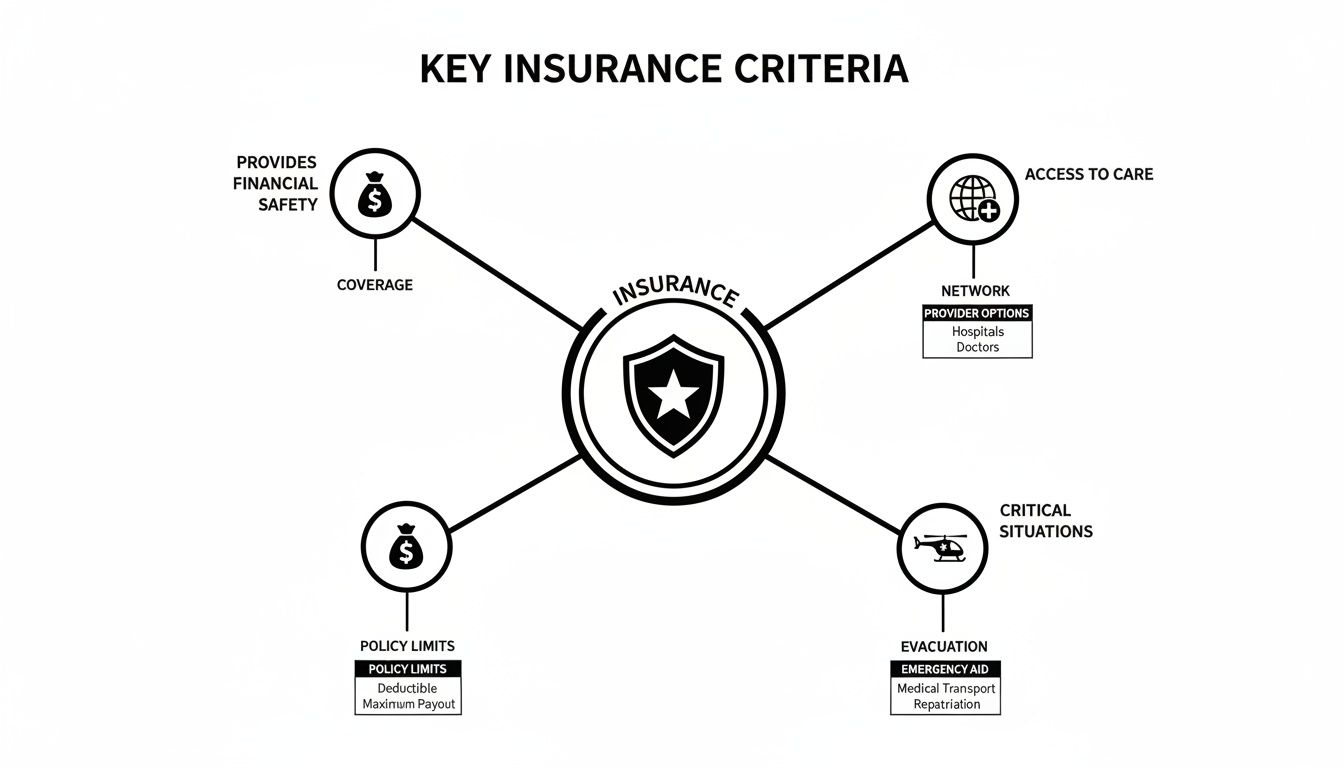
This visual really nails the essentials. A solid plan balances robust financial protection with easy access to quality healthcare, ensuring you’re covered when it matters most.
Cigna Global: A Top Choice for Corporate Expats and Families
Cigna Global has earned its reputation as a powerhouse, largely thanks to its enormous, well-established direct-billing network. This makes it a go-to for corporate professionals and families who value convenience above all else. With Cigna, paying out-of-pocket for major medical care is rarely a concern at in-network hospitals, which is a massive relief during a health scare.
Their plans are often structured to handle the demands of corporate assignments, offering strong benefits and streamlined administrative support. This is why so many employers choose Cigna for their international teams. Families also gravitate toward their comprehensive maternity and wellness benefits, which are typically standard in their higher-tier Gold and Platinum plans.
Cigna’s greatest asset is its global infrastructure. For an expat who needs widespread, cashless access to top-tier hospitals, particularly in major business hubs, Cigna’s network is hard to beat.
Of course, this premium service and vast network come at a price. While Cigna delivers incredible value, it’s not always the most cost-effective choice for solo travelers or digital nomads with simpler needs.
GeoBlue: The Gold Standard for U.S. Expats
For American citizens living overseas, GeoBlue is often the clear winner. Their standout feature is the deep integration with the Blue Cross Blue Shield (BCBS) network back in the United States. This is a game-changer for U.S. expats who travel home frequently or simply want the comfort of knowing they can get seamless care in the States.
Here’s why that connection is so powerful:
- Seamless U.S. Coverage: When in the U.S., a GeoBlue member can use the vast BCBS network just like someone with a domestic plan. No hoops to jump through.
- Curated Global Network: Outside the U.S., GeoBlue doesn’t just aim for size; they curate a network of elite, English-speaking doctors and premier facilities.
- Smart Plan Design: The Xplorer plans are built specifically for U.S. expats, offering versions with or without U.S. coverage to help control costs.
This dual-network advantage makes GeoBlue the ideal solution for Americans who refuse to compromise on healthcare, whether they’re at home or abroad.
IMG: Flexible and Budget-Conscious Plans
International Medical Group (IMG) has built its brand on flexibility and affordability. This makes them a favorite among a wide range of expats, from digital nomads and missionaries to long-term travelers and anyone watching their budget.
IMG’s strength is its modular approach. You typically start with a core plan and then add on riders for specific needs like adventure sports, dental and vision, or political evacuation. This lets you build a policy that covers what you need without paying for extras you don’t. For a closer look, check out our guide to the top 10 international health insurance plans for expats in 2025, where providers like IMG are analyzed.
While their network might not have the same footprint as Cigna’s in every single country, IMG offers solid global coverage with a clear focus on value. Their claims process is straightforward, and the ability to customize deductibles and co-insurance helps expats keep their monthly premiums in check.
VUMI: Premium Service in Latin America and Beyond
VUMI (VIP Universal Medical Insurance Group) is all about a premium, high-touch experience, especially for expats in Latin America and the Caribbean. While their plans are global, their network and service are exceptionally strong in this region, making them a top contender for anyone relocating there.
VUMI sets itself apart with a “VIP” service model. This translates to benefits like second medical opinions from world-renowned specialists and guaranteed access to the best hospitals. Their plans are for those who are willing to invest in exceptional care, white-glove support, and ultimate peace of mind.
You’ll find their plans often come with very high annual limits and extensive coverage for cancer, chronic conditions, and other critical illnesses. For the discerning expat who puts best-in-class medical access first, VUMI is a name to know.
Comparing Top Expat Insurance Carrier Strengths
To make things even clearer, let’s break down how these top carriers stack up against each other based on who they serve best and what makes them unique.
| Carrier | Ideal Expat Profile | Primary Network Strength | Standout Feature |
|---|---|---|---|
| Cigna Global | Corporate professionals, families, and those prioritizing convenience. | Massive global direct-billing network in major hubs. | Seamless cashless access to high-quality hospitals. |
| GeoBlue | U.S. citizens living abroad who want strong U.S. and international coverage. | Integrated with the Blue Cross Blue Shield network in the USA. | Best-of-both-worlds coverage at home and abroad. |
| IMG | Digital nomads, missionaries, budget-conscious expats, and long-term travelers. | Solid global reach with a focus on value and flexibility. | Modular, “a la carte” plan design to control costs. |
| VUMI | Expats in Latin America/Caribbean, and those seeking premium, high-touch service. | Deep network and exceptional service in Latin America. | VIP-level benefits, including second medical opinions. |
Ultimately, the “best” provider depends entirely on you—your destination, your budget, your health needs, and your nationality. This comparison should give you a solid starting point for figuring out which carrier’s philosophy aligns with your own.
How to Match a Plan to Your Expat Lifestyle
The idea of a single “best expat medical insurance” is a myth. The right plan is a direct reflection of your life—where you’re going, what you’ll be doing, and what your health looks like. A policy that’s perfect for a retiree putting down roots in one country is completely wrong for a young family moving every few years for work.
The goal isn’t to find some universally acclaimed “best” plan. It’s to find the plan that best fits you. This means taking a hard look at your lifestyle, your destination, and your personal health needs to build a strategy that matches your reality on the ground. This kind of practical planning is just as important as mastering smart packing strategies for international travel—a successful move abroad is built on smart preparation.

Scenario 1: The Digital Nomad in Southeast Asia
Picture a freelance web developer bouncing between Thailand, Vietnam, and Malaysia. Their main concerns are keeping costs low while having solid coverage for a sudden accident or illness. They don’t need maternity benefits or chronic care management, but strong emergency medical evacuation is non-negotiable.
For this kind of expat, a high-deductible plan focused on catastrophic events is usually the smartest play. It keeps the monthly premiums affordable but ensures they’re protected from something financially devastating, like a motorbike crash that requires surgery and a flight to a top-tier hospital in Bangkok. Portability is also key; the policy has to move with them across borders without a fuss. We dive much deeper into this in our guide to health insurance for modern digital nomads.
Scenario 2: The Retiree in Mexico
Now, let’s think about a U.S. retiree settling into a community near Lake Chapala, Mexico. Their needs are the complete opposite. They need robust coverage for managing pre-existing chronic conditions like high blood pressure, along with routine check-ups and prescription drug benefits.
Their ideal plan would have a lower deductible and comprehensive outpatient services. They would also want a policy with an extensive network of doctors and hospitals in their specific region of Mexico. Since they plan on visiting family back in the States, a plan that includes limited, non-emergency U.S. coverage is a huge plus, letting them see their long-time physicians at home.
The retiree’s plan must focus on stability and predictable costs. Unlike the nomad, their goal is not just emergency protection but consistent, accessible management of their long-term health in their new home.
Scenario 3: The Corporate Executive in Dubai
A corporate executive moving their family to Dubai has an entirely different set of needs. Their insurance is often dictated by strict local visa laws that mandate a specific level of health coverage. For them, premium care and total convenience are the top priorities.
Their plan absolutely has to be compliant with Dubai Health Authority (DHA) regulations. It should also feature a wide direct-billing network that includes elite private hospitals like American Hospital Dubai. Since it’s a family on the move, the policy must also have:
- Comprehensive Maternity Coverage: This includes prenatal care, delivery, and postnatal visits without long waiting periods.
- Pediatric Care: Routine wellness checks and vaccinations for the kids are essential.
- Dental and Vision Riders: These are often added for complete family protection.
For this executive, the quality of care and a seamless experience are more important than the cost. They need a plan that just works, letting them focus on their job and family.
Scenario 4: The Young Family in Europe
Finally, imagine a young family heading to Germany for a three-year work assignment. Their focus is on wellness, preventive care, and benefits that support a growing family. They’re looking for a plan that works well with the local healthcare system but gives them the extra flexibility and access of private insurance.
Their ideal policy would offer strong wellness benefits, like annual physicals and health screenings. Mental health support is also a fast-growing priority for families adjusting to life abroad. The sheer size of the expatriate health insurance market—valued between USD 17 billion and USD 25 billion in 2024—shows just how diverse and critical these needs are. This market exists because expats face unique risks, from navigating health in new environments to needing care where local systems are unfamiliar or difficult to access.
By matching your personal profile to a plan’s core design—whether it’s built for emergencies, chronic care, legal compliance, or family wellness—you can find coverage that truly supports your life abroad.
Getting From Research to Real Coverage: Your Step-by-Step Plan
Turning all your research into a final decision can feel like a huge leap. But it doesn’t have to be overwhelming.
With a clear, structured approach, you can move confidently from understanding the options to securing the best expat medical insurance for your life abroad. This simple, four-step plan will help you translate your unique needs into the right policy, taking the guesswork out of the equation.
Step 1: Start With a Personal Health Audit
Before you even glance at a single plan, take a moment for a personal health audit. This applies to you and any family members you need to cover. Are there any pre-existing conditions, like asthma or high blood pressure, that need regular management? Maybe you anticipate needing specific services, like maternity care or mental health support.
Jot down a list of your non-negotiables. This might include:
- Chronic Condition Management: Coverage for routine check-ups, prescriptions, and specialist visits.
- Preventive Care: Annual physicals, wellness screenings, and immunizations.
- Family Planning: Access to maternity benefits, pediatric care, or even fertility treatments.
Being brutally honest and thorough here is the most important part of the whole process. Think of this self-assessment as the blueprint for everything that follows.
Step 2: Map Out Your Geographic Footprint
Next up, think about where you’ll need coverage. An expat medical plan is defined by its geographic scope, and getting this wrong can be an expensive mistake.
Ask yourself a few critical questions:
- Where will I live? Will you be based in a single country, or do you expect to move between multiple locations?
- Do I need U.S. coverage? This is a big one. Including the United States in a policy drives the premium up significantly due to its notoriously high healthcare costs. If you’re a U.S. citizen planning frequent trips home, it’s a must. Otherwise, excluding it is one of the easiest ways to save a lot of money.
- How often will I travel? If you’re a frequent flyer who will be outside your primary country of residence often, you need to make sure your policy offers robust worldwide protection.
Your answers here will directly determine if you need a regional plan, a worldwide-excluding-USA plan, or a full-blown global policy.
Step 3: Set a Realistic Budget
With your health and location needs locked in, it’s time to talk numbers. Your budget isn’t just about the monthly premium—it’s also about what you might have to pay out-of-pocket. You need to consider both deductibles (what you pay before the insurance kicks in) and co-insurance (the percentage of costs you share with the insurer).
Finding the right balance is key. A higher deductible will lower your monthly premium, but it means you’ll pay more upfront if you need care. A lower deductible offers more predictable costs but comes with a higher monthly payment. Choose a deductible you could comfortably pay tomorrow without financial strain.
Figure out what you can reasonably afford each month while making sure your potential out-of-pocket costs won’t put you in a financial bind if something unexpected happens.
Step 4: Get Personalized Quotes and Expert Advice
Once you have your needs, location, and budget finalized, you’re ready to start getting quotes. Honestly, going directly to individual carriers is a slog. It’s time-consuming, the options are confusing, and it’s hard to compare apples to apples.
Working with a specialist broker is a much smarter move. An independent broker can gather quotes from multiple top-tier providers like Cigna, GeoBlue, and IMG, presenting you with a curated list of options that are already filtered to match your criteria.
At Expat Global Medical, we simplify this final step. We take your profile and do the legwork for you, providing clear, side-by-side comparisons and expert guidance. This ensures you’re not just buying a policy—you’re making a well-informed decision that secures your health and financial well-being, no matter where your journey takes you.
Still Have Questions About Expat Medical Insurance?
Even with all the research in the world, a few questions can still linger. That’s perfectly normal. Picking the best expat medical insurance is a big move, and feeling confident in the details is what really matters.
This is where we tackle the practical, real-world questions we hear from expats every day. Let’s get you some clear, straightforward answers to clear up any final doubts so you can choose a plan with total confidence.
What Is the Real Difference Between Expat Insurance and Travel Insurance?
This is, without a doubt, the most common point of confusion. While they both give you medical protection when you’re abroad, they’re built for completely different situations and timelines.
- Travel Insurance: Think of this as short-term, emergency-focused coverage. It’s for trips that last anywhere from a few days to maybe a year. Its job is to handle the unexpected—a sudden accident, a surprise illness, or a cancelled flight. It was never designed for routine healthcare or managing a chronic condition.
- Expat Medical Insurance: This is your long-term, comprehensive health plan for living abroad, not just visiting. It works just like the health insurance you’d have back home, covering everything from emergencies and hospital stays to specialist visits, regular check-ups, and often, preventive care.
Here’s the simplest way to see it: travel insurance is a temporary safety net for a vacation. Expat insurance is a proper healthcare solution for someone building a life in a new country.
How Does Coverage for Pre-Existing Conditions Really Work?
Figuring out pre-existing conditions is a huge deal for most expats. A pre-existing condition is simply any medical issue you had before your new insurance policy kicks in. Insurers tend to handle this in one of three ways:
- Full Coverage: This is the ideal scenario. Some providers will cover your condition right from day one, though it might mean a higher premium.
- Waiting Period: More commonly, a plan will have a waiting period—often 12 to 24 months—before it starts covering costs related to your specific condition.
- Exclusion: In some situations, an insurer might offer you a policy but permanently exclude any and all coverage for your pre-existing condition.
I can’t stress this enough: you have to be completely upfront about your medical history when you apply. Hiding a condition is a massive gamble that can get your policy cancelled right when you need it the most.
Transparency is your best policy. Disclose everything upfront to ensure your insurer provides a plan that genuinely covers you. Hiding a condition is a risk that is never worth taking.
Can I Keep My Plan if I Move to Another Country?
Absolutely, as long as you choose a plan with global portability. This feature is one of the defining characteristics of a true expat medical insurance policy. It’s literally designed to move with you.
Let’s say you have a portable plan and you decide to relocate from Spain to Thailand. You just let your insurance provider know about your new home base. They’ll adjust your premium to reflect the local healthcare costs, but you won’t have to re-apply or go through the whole medical underwriting process again. This is crucial for maintaining continuous coverage, protecting both your health and your wallet.
Do I Have to Pay for Treatment Upfront?
This really comes down to your provider’s network and the kind of care you’re getting. For big medical events like a hospital stay, most top-tier expat plans offer direct billing. This means the hospital sends the bill straight to the insurance company, and you’re only on the hook for your deductible or co-insurance.
For routine stuff like a doctor’s visit, it can vary. If you go to a clinic outside your insurer’s direct network, you’ll likely have to pay upfront and then file a claim to get reimbursed. When you’re comparing plans, pay close attention to the strength of the insurer’s direct-billing network in the country you’ll be calling home.
Navigating the world of international insurance can be complex, but you don’t have to do it alone. The team at Expat Global Medical has been helping expats secure the right coverage since 1992. We work with the world’s leading carriers to provide personalized advice and a clear path to protecting your health abroad. Get your free, no-obligation quote today and find the perfect plan for your global lifestyle.