When you’re an expat, the best expat medical insurance isn’t just a souped-up travel policy. It’s a long-term, comprehensive plan built for someone actually living abroad. Think of it as your primary health coverage, offering robust protection for everything from hospital stays to routine doctor visits, plus critical benefits like emergency evacuation. It’s what provides real financial security and peace of mind.
Understanding Your Expat Medical Insurance Essentials

Moving to another country is an incredible adventure, but one of the biggest mistakes you can make is relying on your health plan from back home or a basic travel policy. Frankly, they just aren’t designed for the realities of living somewhere new long-term.
Travel insurance is for temporary trips—it’s there for acute emergencies like a sudden accident or unexpected illness. It almost never covers routine check-ups, preventive care, or the ongoing management of chronic conditions. That’s where proper expat medical insurance comes in, providing continuous, comprehensive coverage that functions just like a primary health plan would.
Core Policy Components You Must Know
Getting a handle on the basic building blocks of any policy is the first step to making a smart decision. These key terms are what define your coverage and how much you’ll end up paying out-of-pocket.
- Inpatient Care: This covers any treatment where you are formally admitted to a hospital, like for surgery or a serious illness. It’s the absolute foundation of any legitimate medical plan.
- Outpatient Care: This is for services that don’t require a hospital stay. We’re talking about doctor’s appointments, specialist consultations, lab tests, and prescription drugs.
- Deductible: This is the amount you pay for your healthcare first, before the insurance company starts covering costs. Choosing a higher deductible is a common way to lower your monthly premium.
- Co-insurance: Once your deductible is met, co-insurance is the percentage of costs you share with the insurer. For example, an 80/20 split means they pay 80%, and you handle the remaining 20%.
Why Your New Country May Require Coverage
Beyond just protecting your health and finances, having the right insurance is often a legal requirement. As you navigate the process of becoming a legal resident, you’ll find that healthcare is a major piece of the puzzle. It’s smart to research digital nomad visa requirements for your target countries, as they frequently have specific insurance mandates.
More and more countries now require proof of adequate private medical insurance before they will grant a residency visa. This is their way of making sure new residents won’t become a financial strain on the local public healthcare system.
If you can’t show you meet these requirements, you risk having your visa denied or running into serious complications with your residency status down the road. For a deeper look at what these policies include, you can learn more about the features of international medical insurance for expats on our site.
The table below breaks down the fundamental differences between a policy built for a traveler and one designed for an expat resident.
| Feature Comparison | Travel Insurance | Expat Medical Insurance |
|---|---|---|
| Primary Purpose | Short-term emergency coverage (e.g., accidents) | Long-term, comprehensive healthcare |
| Routine Care | Typically excluded | Generally included (doctor visits, check-ups) |
| Pre-Existing Conditions | Often excluded or very limited | Can be covered, often with underwriting |
| Duration | Days or weeks | Annual, renewable policies |
How to Evaluate Expat Medical Insurance Plans
Once you get a feel for the basics, it’s time to create a mental framework for actually comparing plans side-by-side. Looking past the sticker price on the premium is absolutely essential. The real value of any policy is hidden in the details—its structure, what it actually covers, and who you can see. Not all expat medical insurance is created equal, and the “best” plan is always the one that fits your specific situation.
One of the first, and biggest, decisions you’ll make is defining your coverage area. Insurers typically split the world into two camps: “Worldwide” and “Worldwide excluding the USA.” There’s a simple reason for this: the staggering cost of healthcare in the United States. If you add U.S. coverage to your plan, be prepared for your premiums to jump, sometimes by 50% or more.
So, if you’re an expat who won’t be spending much time in the U.S. or seeking treatment there, opting for an “excluding USA” plan is one of the smartest ways to keep your costs down. For American expats, however, having the option to fly home for care makes U.S. coverage a non-negotiable feature, even if it comes at a higher price.
Assessing Medical Networks and Direct Billing
Beyond where you’re covered, you need to know how you’ll get care. The best expat medical insurance is always backed by an extensive direct-billing medical network. In plain English, this means the insurer has relationships with local hospitals and clinics, allowing them to pay for your treatment directly.
Without a solid direct-billing network, you’re on the hook for paying every medical bill out of your own pocket and then chasing the insurer for reimbursement. This can put a massive dent in your finances, especially if you need expensive surgery or a long hospital stay. Always investigate an insurer’s network in your new home country before you even think about signing up.
Think of an insurer’s network as your lifeline in a medical crisis. A plan might look like a great deal, but if its network is thin on the ground where you live, you’ll be stuck with the burden of upfront payments and stressful paperwork. That completely defeats the purpose of having insurance in the first place.
Scrutinizing Limits and Exclusions
Every single insurance policy has fine print, and understanding the limits and exclusions is what separates a savvy expat from one who gets a nasty surprise. First, check the annual policy limit—the maximum amount the insurer will pay out in a given year. A $1 million limit might sound like a lot, but a major medical event in certain countries can burn through that figure faster than you’d think.
Just as important are the specific sub-limits and exclusions for certain types of care. Here are the big ones to watch out for:
- Pre-Existing Conditions: How does the plan handle health issues you had before you enrolled? Some will impose a waiting period, others might add a surcharge to your premium, and some will just refuse to cover the condition at all.
- Maternity Care: If you’re planning to start or grow your family abroad, you need a plan with strong maternity benefits. Be aware that these almost always come with a waiting period, typically 10-12 months, before the coverage kicks in.
- Mental Health: Coverage for things like therapy, counseling, and psychiatric care can vary dramatically from one plan to another. As mental wellness gets more attention globally, you’ll find that the top-tier plans are starting to offer much better support in this area.
When weighing your options, it’s helpful to get a sense of what private healthcare actually costs, like understanding private mental health assessment costs in the UK, to see if a plan’s limits are realistic. This kind of context is more important than ever. The international health insurance market was estimated at roughly $29.04 billion in 2024 and is expected to hit $31.68 billion in 2025. You can dig into more data on this growing market over at The Business Research Company.
Finally, whatever you do, don’t overlook medical evacuation and repatriation benefits. If you get seriously ill or injured somewhere without good medical facilities, this coverage is what pays to get you to the nearest top-tier hospital. For expats living in remote areas or developing countries, this isn’t just a nice add-on; it’s an absolute must-have.
Comparing Top Expat Medical Insurance Providers
When you start digging into the world of expat medical insurance, you’ll quickly realize a few big names pop up again and again. While there are dozens of companies out there, a handful of providers consistently earn top marks for their reliability, solid coverage, and genuine understanding of the expat lifestyle. Ultimately, choosing the right one boils down to matching your personal situation with a provider’s unique strengths.
The market is dominated by these key insurers for a good reason. By 2025, industry reviews and broker lists repeatedly highlight a small group as the go-to choices for long-term expats. Cigna Global, GeoBlue (specifically for U.S. citizens), and IMG Global consistently rank high for their massive networks, flexible plan designs, and telehealth services. You can see how the market is shifting in this London Loves Business article.
Let’s break down what really sets these industry leaders apart from the pack.
Cigna Global: A Leader in Flexibility
For many expats, Cigna Global is the first name that comes to mind, and that’s largely due to its incredibly modular plan structure. Instead of boxing you into rigid packages, Cigna lets you build a policy that fits your actual needs.
You start with a core inpatient plan—Silver, Gold, or Platinum—and then bolt on optional modules for things like outpatient care, medical evacuation, and vision and dental. This approach is perfect for expats who want to fine-tune their coverage and avoid paying for benefits they’ll never touch. For instance, a young, healthy digital nomad might grab a high-deductible inpatient plan and skip the outpatient module to keep their premium down.
On the other hand, a family moving to Europe might go all-in with a Platinum plan and add every module for complete peace of mind. This level of customization is Cigna’s biggest selling point.
Cigna’s strength lies in its “build-your-own-plan” philosophy. It empowers expats to align their coverage directly with their budget and health priorities, preventing overpayment for unnecessary benefits. This makes it a top contender for those who value tailored protection.
GeoBlue: The Top Choice for US Expats
For American citizens living abroad, GeoBlue brings a powerful and unique advantage to the table: seamless access to the Blue Cross Blue Shield (BCBS) network back in the United States. This is a huge differentiator.
Many U.S. expats want the freedom to return home for planned medical procedures or to visit their trusted family doctors. With a GeoBlue Xplorer plan, you get in-network access to one of the largest and most respected provider networks in the U.S.
This completely eliminates the common headache of fighting with out-of-network claims when you’re back on home soil. Because GeoBlue is designed from the ground up for U.S. passport holders, it has become the default choice for Americans who prioritize easy access to stateside care.
IMG Global: Balancing Cost and Comprehensive Care
International Medical Group (IMG) has built a stellar reputation for delivering reliable, cost-effective plans that hit the sweet spot for a wide range of expats—from students and missionaries to long-term retirees.
IMG’s plans are known for being straightforward, offering solid, all-around coverage without some of the premium frills you might find with other providers. Their Global Medical Insurance plan is a go-to option, providing long-term, annually renewable coverage with flexible choices for deductibles and coverage areas.
This makes IMG an excellent choice for budget-conscious expats who still demand robust protection. They offer a fantastic middle-ground, delivering all the essential benefits and a strong direct-billing network at a very competitive price.
To help you see how these providers stack up at a glance, we’ve put together a simple comparison table. This gives you a quick snapshot of where each one shines.
Comparing Leading Expat Medical Insurance Providers
This table provides a side-by-side comparison of key features, benefits, and target audiences for top-rated expat medical insurance providers.
| Provider | Best For | Key Strengths | Coverage Area Options | Network Access Highlights |
|---|---|---|---|---|
| Cigna Global | Expats wanting customized coverage | Highly flexible, modular plan design lets you build your policy. Strong global network and robust wellness support. | Worldwide; Worldwide excluding USA | Extensive global direct-billing network with over 1.65 million hospitals and professionals. |
| GeoBlue | U.S. citizens living abroad | Unmatched access to the Blue Cross Blue Shield network for seamless medical care within the United States. | Worldwide; Worldwide excluding USA | The power of the BCBS network in the U.S. and a carefully curated network of elite providers globally. |
| IMG Global | Budget-conscious expats and digital nomads | Excellent balance of comprehensive benefits and affordable premiums. Wide range of plan options for different needs. | Worldwide; Worldwide excluding USA; Options for specific regions. | Strong global network with direct-billing capabilities, making it easy to access care without upfront payment. |
For a much deeper dive into the specifics of each plan, be sure to check out our full international health insurance comparison guide.
In the end, the “best” provider is entirely dependent on your life. An American retiree in Mexico who wants to fly home for specialist care has totally different needs than a British family relocating to Dubai. By understanding the core strengths of each insurer—Cigna’s customization, GeoBlue’s U.S. network, and IMG’s value—you can make an informed choice that secures your health and finances, no matter where your journey takes you.
Choosing the Right Plan for Your Expat Life
Feature lists and abstract comparisons will only get you so far. The real test of an expat medical insurance plan is how it holds up in the real world—for your specific life, in your chosen country. To show you what I mean, let’s walk through four common expat profiles and see which plans make the most sense.
This is a practical, case-study approach. We’re moving beyond just features on a page to show how a policy’s structure, network, and benefits directly impact your health and financial security. By seeing how these plans work for others, you can start to visualize which one is the right fit for you.
To help you get started, this decision tree illustrates how your main priority—whether it’s flexibility, access to care back in the U.S., or budget—can point you toward the right type of plan.
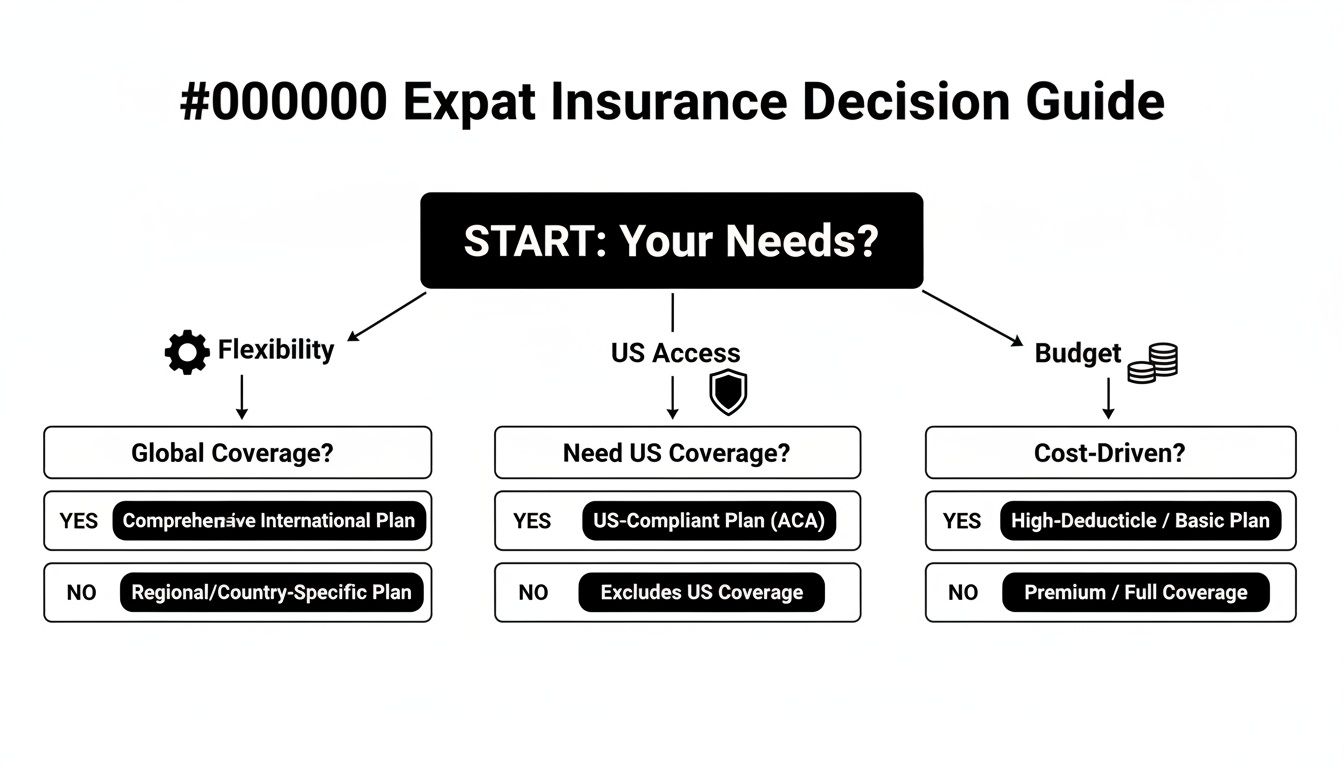
As you can see, figuring out your single biggest priority is the fastest way to narrow the field and focus on the providers that actually align with what you need.
Scenario 1: The Digital Nomad in Southeast Asia
Let’s start with Alex, a 28-year-old freelance graphic designer living in Chiang Mai, Thailand. He’s healthy, active, and keeps his cost of living low so he can travel more. For him, the biggest risks are a sudden accident or a serious, unexpected illness.
- Healthcare Needs: Solid emergency medical care, potential medical evacuation from more remote spots, and basic outpatient coverage for minor stuff. Alex isn’t looking for maternity, dental, or high-end wellness benefits.
- Recommendation: An IMG Global Medical Insurance plan with a high deductible. IMG is known for hitting that sweet spot between cost and essential coverage, which is perfect for a budget-conscious nomad.
- Rationale: By opting for a higher deductible—say, $5,000—Alex can slash his monthly premium. The plan still gives him robust inpatient coverage and access to a strong global network, which is critical when you’re hopping between countries like Thailand, Vietnam, and Indonesia.
Scenario 2: The Corporate Transferee in Dubai
Now, let’s picture Sarah, a 42-year-old marketing director who just moved to Dubai for her job. Her company gives her an insurance stipend, so she’s looking for a premium plan that offers comprehensive care and, crucially, direct-billing access at top-tier private hospitals.
- Healthcare Needs: Full inpatient and outpatient coverage, a deep direct-billing network, wellness benefits, and probably vision and dental add-ons.
- Recommendation: A Cigna Global Gold or Platinum plan. Cigna’s modular design lets Sarah essentially build the exact policy she wants.
- Rationale: Cigna has an extensive and highly-regarded network in the UAE, meaning Sarah can get care at the best facilities without having to pay out of pocket first. The plan’s flexibility allows her to add modules for wellness and dental, creating a truly all-in-one policy.
Scenario 3: The Retiree in Portugal
Here we have Robert and Susan, an American couple in their late 60s retiring to the Algarve coast in Portugal. They are managing some pre-existing conditions, like hypertension, and they absolutely want the peace of mind that comes with high coverage limits and the option to fly back to the U.S. for specialized care if needed.
- Healthcare Needs: Comprehensive coverage that includes chronic condition management, very high annual limits, and seamless access to healthcare in both Portugal and the United States.
- Recommendation: A GeoBlue Xplorer Premier plan. This plan is built from the ground up for U.S. citizens and offers unlimited annual benefits.
- Rationale: GeoBlue’s killer feature is its deep integration with the Blue Cross Blue Shield network back in the States. This gives Robert and Susan in-network access to their trusted doctors back home, no questions asked. Meanwhile, the plan has a strong European network for their day-to-day needs in Portugal.
For retirees managing chronic conditions, robust medical evacuation coverage is non-negotiable. It ensures you can be transported to a center of excellence if local facilities can’t provide the required care. This benefit is a cornerstone of any high-quality expat plan.
If you want to get a better handle on this critical benefit, you can check out our guide that explains what medical evacuation insurance is and why it’s so vital for expats.
Scenario 4: The Family in Germany
Finally, meet the Millers—David, Emily, and their two young kids, ages 4 and 7. They’re moving to Berlin for David’s engineering job. Their top priorities are excellent pediatric care, routine check-ups, and comprehensive coverage for everyone, including potential maternity benefits down the road.
- Healthcare Needs: Strong outpatient benefits for frequent doctor visits, easy access to pediatric specialists, vaccination coverage, and a maternity option with a reasonable waiting period.
- Recommendation: A comprehensive plan from a provider like Cigna Global or Allianz Care.
- Rationale: A family needs a plan with low (or no) co-pays for routine doctor visits, because with young kids, those appointments can add up fast. A provider with a strong European network ensures they can find pediatricians and specialists without a hassle. And if they plan on growing their family abroad, adding a maternity module from the start is essential.
Managing Your Application and Claims

Choosing the right expat medical insurance plan is a huge step, but it’s really just the beginning. The next, equally important, part is getting through the application and, down the road, the claims process. Knowing how these systems work ahead of time can save you a world of stress when you actually need to use your coverage.
The application isn’t just paperwork; it’s where the insurer gets to know you through a process called underwriting. They review your medical history to figure out your risk profile, which ultimately determines if they can offer you a policy and at what price. This is exactly why being completely honest and thorough is non-negotiable.
The Underwriting and Application Process
When you apply for a plan, you’ll need to give a detailed rundown of your health history, especially any pre-existing conditions. Insurers need this to make a fair assessment of your application. Trying to hide a condition might seem tempting, but it can backfire badly, leading to a denied claim or even having your entire policy cancelled when you need it most.
Based on what you disclose, an insurer will usually handle a pre-existing condition in one of three ways:
- Offer full coverage: This is pretty common for minor issues that are well-managed.
- Apply a premium loading: They might bump up your premium by a certain percentage to account for the added risk.
- Place an exclusion: This is also common. The insurer agrees to cover you for everything except that specific pre-existing condition.
An experienced broker can be a game-changer during underwriting. We know how different insurers view certain medical conditions and can steer you toward the one most likely to give you favorable terms. This alone can save you tons of time and frustration.
Your best bet is to prepare a clean, detailed application from the start. Gather your medical records, have a list of medications and past treatments ready, and answer every single question with total transparency. It builds trust with the insurer and significantly speeds up the approval process.
Demystifying the Claims Experience
Once your policy is active, the rubber really hits the road when it comes to filing a claim. There are two main ways medical bills are handled, and understanding the difference is key to managing both your money and your expectations.
The best-case scenario is direct billing. This is where the hospital or clinic bills your insurance company directly. You just show your insurance card, pay your deductible or co-pay (if you have one), and the insurer handles the rest behind the scenes. This is most common when you use a doctor or hospital within your insurer’s approved network.
The other method is the pay-and-claim model. Here, you pay the medical provider for the treatment upfront, right out of your own pocket. Then, you submit all the detailed invoices and proof of payment to your insurer to get reimbursed. It works, but it can put a temporary dent in your finances, especially for more expensive procedures.
Tips for a Smooth Claims Process
Filing a claim doesn’t have to be a nightmare. A little bit of prep work can make a huge difference in getting your money back quickly and without any fuss.
- Keep Meticulous Records: Always, always get itemized bills and receipts for any medical service. Make sure the paperwork clearly states your diagnosis, the treatment you received, and a full breakdown of the costs.
- Understand Pre-Authorization: For anything that isn’t an emergency, like a planned surgery, most insurers require pre-authorization. This means you have to get their approval before you get the treatment to make sure it’s covered.
- Communicate Clearly: When you’re ready to submit, fill out the claim form completely and attach every piece of required documentation. If you’re even a little unsure about something, just call the insurer’s claims department and ask.
Your Top Expat Insurance Questions Answered
When you’re sorting through expat medical insurance plans, questions are going to pop up. It’s only natural. You’ll find yourself wondering how certain benefits work, what specific terms really mean, and why policies are put together the way they are. This section tackles the most common questions we hear from expats, giving you direct, no-nonsense answers.
Getting these fundamentals right from the start is a game-changer. A solid understanding helps you dodge expensive mistakes, like thinking your old health plan has you covered or brushing off a benefit you’ll desperately need later. These answers are designed to give you the clarity and confidence to pick the right plan for your health and financial well-being abroad.
Can I Just Use My Domestic Health Insurance While Living Abroad?
The short answer here is almost always no. Your home country’s health plan is built for residents living in that country. It wasn’t designed for the expat life and will typically offer little to no real coverage once you’ve moved overseas long-term.
Sure, it might cover a genuine emergency during a two-week vacation, but it’s not going to pay for routine doctor’s visits, ongoing prescriptions, or specialist care in your new home. That’s precisely why a dedicated expat medical insurance plan is non-negotiable—it’s specifically designed to provide comprehensive medical access across borders.
What’s the Difference Between Medical Evacuation and Repatriation?
These two terms are often thrown around together, but they cover very different—and equally critical—situations. Knowing the distinction is key to understanding their immense value in any good policy.
- Medical Evacuation covers the cost of getting you to the nearest qualified medical facility if the local hospital can’t handle your condition. For expats in remote areas or countries with less-developed healthcare, this is an absolute lifeline.
- Repatriation covers the cost of transporting you back to your home country for medical care or, in the worst-case scenario, returning your remains.
Both are essential parts of the best expat medical insurance plans. They provide a crucial safety net, no matter how far from home you are.
How Do Insurers Handle Pre-Existing Conditions?
This is easily one of the most critical questions for anyone applying for coverage. Insurers will look at pre-existing conditions during the underwriting process, and how they handle them can vary quite a bit. The one non-negotiable rule? Full and honest disclosure on your application.
“Be completely transparent about your health history. Hiding a pre-existing condition can lead to claim denials or even policy cancellation when you need coverage the most. An experienced broker can help you find a carrier with underwriting guidelines that are favorable to your specific situation.”
After reviewing your history, an insurer will usually take one of three paths: they might offer full coverage (common for minor, well-managed conditions), apply a surcharge to your premium, or place an exclusion on the policy, meaning they’ll cover you for everything except that specific condition.
Why Are Plans with USA Coverage So Much More Expensive?
The reason plans that include the USA cost so much more is straightforward: the healthcare system in the United States is exceptionally expensive. A single hospital stay, a necessary surgery, or a course of treatment in the U.S. can easily cost several times more than the exact same care would in other developed countries.
To take on that massive financial risk, insurers have no choice but to charge a much higher premium. Because of this, opting for a “Worldwide excluding USA” policy is one of the single most effective ways to lower your premium if you don’t expect to need medical treatment in the States.
Figuring out these details is where having an expert in your corner makes all the difference. At Expat Global Medical, we help you cut through the complexity and find the plan that perfectly matches your life abroad. Get your free, personalized quote today and move forward with total confidence.