Choosing the best international health insurance is all about picking the right expat medical insurance plan, not just a standard travel policy. While travel insurance is great for short-term hiccups, long-term expat plans are built to provide the kind of robust, ongoing healthcare you’d expect back home. The best ones give you access to huge global networks, direct billing with hospitals, and critical benefits like medical evacuation.
Navigating Your Expat Medical Insurance Options

Moving abroad is a massive undertaking with a long to-do list, but sorting out your health coverage is arguably one of the most important boxes to tick. It’s about protecting both your health and your finances.
A common trip-up for new expats is mixing up travel insurance with a dedicated expat medical plan. Getting this distinction right from the start is the key to making a smart choice for your life abroad.
Travel insurance is a short-term fix. Think of it as coverage for things that can go wrong on a vacation or a brief trip—sudden medical emergencies, a canceled flight, or lost bags. It was never designed for routine check-ups, managing ongoing conditions, or any kind of comprehensive care.
On the other hand, expat medical insurance is built for people living abroad for a year or more. It works just like your health plan at home, covering a whole range of medical services to keep you healthy, not just patch you up in an emergency.
Travel Insurance vs. Expat Medical Insurance
The fundamental differences between these two policies directly affect how you get care and how you’re protected financially. As an expat, you need a plan that supports your life abroad long-term, from annual physicals to managing a chronic condition.
| Feature | Travel Insurance | Expat Medical Insurance |
|---|---|---|
| Primary Purpose | Short-term emergency medical events and travel mishaps. | Long-term, comprehensive medical care for residents abroad. |
| Coverage Scope | Limited to urgent care, accidents, and sometimes evacuation. | Includes inpatient, outpatient, wellness, and preventive care. |
| Duration | Typically covers trips up to 90 or 180 days. | Annual policies that are renewable for long-term stays. |
| Ideal For | Tourists, vacationers, and short-term business travelers. | Expats, digital nomads, retirees, and international employees. |
The simplest way to think about it is proactive vs. reactive care. Expat medical insurance is designed to maintain your health while living abroad. Travel insurance is just a safety net for sudden, unexpected problems.
This isn’t just a practical distinction; it can be a legal one, too. Many countries require proof of comprehensive health coverage before they’ll issue a residency permit. A simple travel policy often won’t cut it. For a bigger picture on settling in, this complete guide to thriving as an expat in the Netherlands is a great resource that covers all sorts of integration topics.
The global health insurance market is massive—it hit an estimated $1.96 trillion in 2024, which shows just how vital this coverage has become. A big driver for this growth is that medical inflation is outpacing general inflation, making solid expat medical insurance an essential financial shield for expats everywhere.
Decoding the Core Features of Top Expat Medical Plans

Before you can find the right expat medical insurance plan, you have to learn to speak the language of insurance. Every policy is built around a few core concepts that directly control what you’ll pay out-of-pocket and how protected you really are. Getting these right is the first step toward feeling financially secure overseas.
The big three terms you absolutely must master are deductibles, co-insurance, and annual limits. Your deductible is simply the amount you have to pay for medical care before your insurance company starts chipping in. Think of it as your initial share of the cost.
Once you’ve paid your deductible, co-insurance kicks in. This is just a cost-sharing deal where you pay a percentage of the remaining bill (say, 20%), and the insurer handles the rest (80%). Finally, the annual limit is the absolute maximum your insurer will pay for all your claims in a policy year. For expats, this number needs to be high—often in the millions.
Inpatient vs. Outpatient Coverage: A Critical Distinction
Every solid expat medical plan is built on a foundation of inpatient and outpatient care. The difference between them is crucial because it determines your access to both everyday and emergency medical services.
Inpatient coverage is for when you’re formally admitted to a hospital, usually for at least one night. This is for the big, serious stuff—think major surgery in Dubai or intensive care after an accident in Mexico. It covers the priciest parts of healthcare, like the hospital room, surgeon’s fees, and medications administered during your stay.
Outpatient coverage, on the other hand, handles all the medical care that doesn’t require a hospital bed. This is your day-to-day stuff: routine doctor’s visits, seeing a specialist, getting diagnostic tests like X-rays or bloodwork, and picking up prescriptions. For an expat family, this is the part of your plan you’ll probably use the most.
A classic mistake is choosing a plan with minimal outpatient benefits just to save a few bucks on the premium. While it lowers the upfront cost, you can quickly find yourself paying a fortune out-of-pocket for routine care, which completely undermines the point of having insurance in the first place.
Medical Evacuation and Repatriation: Your Lifeline Abroad
For any expat, but especially for those living in places with questionable medical standards, medical evacuation and repatriation are completely non-negotiable. Frankly, these benefits are often what separate a basic plan from the best expat medical insurance you can get.
Medical evacuation coverage arranges and pays to get you to the nearest hospital that can actually handle your condition. This could be an ambulance ride to a better facility in the next city or an air ambulance to a neighboring country if you have a serious illness or injury.
Repatriation takes it a step further. It covers the cost of getting you all the way back to your home country for treatment, assuming you’re medically stable enough to travel. This benefit offers incredible peace of mind, knowing you can get home for long-term recovery with your family nearby.
Of course, your access to care is also shaped by your plan’s network. It’s well worth your time to understand the differences between PPO vs. HMO networks abroad to see how they affect which doctors and hospitals you can use.
To really nail these concepts down, it helps to see them in action. This table breaks down what these terms actually mean for an expat living abroad.
Understanding Key Expat Insurance Terms
| Term | What It Means for You | Real-World Example |
|---|---|---|
| Deductible | The initial amount you pay out-of-pocket before your insurance begins to cover costs. | You have a $1,000 deductible. After a minor surgery costing $5,000, you pay the first $1,000, and your insurance evaluates the remaining $4,000. |
| Inpatient Care | Coverage for treatment that requires you to be admitted to a hospital for one or more nights. | You’re hospitalized for three days with pneumonia. Your policy covers the cost of the room, doctor’s fees, and IV treatments. |
| Medical Evacuation | Emergency transport to the nearest adequate medical facility when local care is insufficient. | While trekking in a remote part of Peru, you suffer a severe injury. Your plan covers the cost of a helicopter to a major hospital in Lima. |
Once you have a firm grasp of these core features, you can look at any policy and know exactly what you’re getting. This confidence is key to choosing a plan that truly protects you, no matter where your journey takes you.
When you’re trying to pick an expat medical insurance provider, it feels like navigating a crowded marketplace. Honestly, there’s no single “best” provider. The smarter way to go about it is to compare the big names based on what actually matters for your life abroad.
The real differences often come down to the size of their doctor network, how flexible their plans are, and what their customer service is like when you actually need them.
Let’s break down the providers most expats end up choosing. We’ll look at their core strengths and figure out who they’re really built for, so you can see which one clicks with your specific situation.
Cigna Global: A Leader in Network and Flexibility
Cigna Global is a go-to for a reason. They have a massive, well-established network that covers over 200 countries. What this means for you is that you’re very likely to find a doctor or hospital in their network almost anywhere you land. This simplifies everything, especially direct billing, so you’re not paying huge sums out of pocket.
Their plans are also famously modular. You get a core inpatient plan, and then you can bolt on extras like outpatient care, wellness, vision, and dental. This setup is perfect if you want to dial in your coverage and not pay for benefits you’ll never use. A young digital nomad might ditch the wellness and dental add-ons, but an expat family would probably want both.
Ideal for: Expats who want a huge global network and the power to build a plan from the ground up.
GeoBlue: Insurance for US Citizens Abroad
GeoBlue has carved out a super valuable niche: they focus entirely on U.S. citizens living overseas. As an independent licensee of the Blue Cross Blue Shield Association, they offer something few others can—seamless access to the Blue Cross Blue Shield network when you’re back in the States.
This is a game-changer for American expats who travel home often or plan to move back eventually. Their Xplorer Premier plan, for example, lets you stay covered for up to nine months a year while you’re in the U.S. Both their main plans (Essential and Premier) also come with unlimited annual benefits, which is a huge safety net for worst-case scenarios.
For American expats, GeoBlue perfectly bridges the gap between life abroad and healthcare access back home. That integration with the Blue Cross Blue Shield network is a standout feature you just won’t find with most international insurers.
Allianz Care: Strong Support and a Family Focus
Allianz Care is another giant in the space, known for processing claims efficiently and putting a real emphasis on supporting expat families. They offer an Expat Assistance Program (EAP) that goes way beyond typical medical coverage, giving you access to mental health counseling, legal and financial advice, and even help finding childcare.
This all-in-one approach makes them a really compelling choice for families dealing with the stress and complexity of moving to a new country. Their plans are tiered clearly—Care, Care Plus, and Care Pro—with big annual limits from $2,500,000 to $5,000,000. That’s serious protection for major medical events.
Ideal for: Expat families and anyone who wants comprehensive support services wrapped into their medical plan.
Provider Comparison At a Glance
To cut through the noise, it helps to see how these companies stack up side-by-side. This table gives you a quick rundown of their main strengths.
| Provider | Key Differentiator | Annual Benefit Range | Ideal Expat Profile |
|---|---|---|---|
| Cigna Global | Highly customizable modular plans and a massive global network. | $500,000 to Unlimited | The expat who wants to build a tailored plan. |
| GeoBlue | Seamless access to the Blue Cross Blue Shield network in the USA. | Unlimited on all plans | The U.S. citizen living or working abroad. |
| Allianz Care | Strong family-oriented benefits and Expat Assistance Program. | $2,500,000 to $5,000,000 | Families seeking robust support services. |
| IMG Global | Wide range of plan tiers and optional benefit riders. | $1,000,000 to $8,000,000 | Budget-conscious expats needing flexibility. |
IMG Global: A Spectrum of Choices
IMG Global has earned a reputation for offering a wide spectrum of plans that work for different budgets and needs. They have four main tiers—Bronze, Silver, Gold, and Platinum—so it’s easy to see the trade-offs between cost and benefits and find a sweet spot.
A key feature with IMG is their optional riders. You can add coverage for things like adventure sports, term life insurance, or dental and vision, which allows for a good bit of customization. Their Platinum plan is especially robust, with maternity benefits and an $8,000,000 annual limit, making it a strong contender for anyone looking for top-tier coverage.
The global health insurance market is absolutely booming, which just goes to show how essential this kind of coverage has become. Valued at roughly $2.14 trillion in 2024, the market is expected to hit $4.45 trillion by 2032. This isn’t just random growth; it’s being pushed by an aging global population and sky-high healthcare costs, highlighting why locking in a solid expat medical insurance plan is so important. You can dig into these trends in this detailed report from Fortune Business Insights.
At the end of the day, the best provider for you comes down to your life. By comparing their core strengths—Cigna’s network, GeoBlue’s U.S. access, Allianz’s family support, or IMG’s flexibility—you can pick the right partner to protect your health on your journey, wherever it takes you.
Matching Your Expat Medical Insurance to Your Lifestyle
The best expat medical insurance is never a one-size-fits-all product; it’s a direct reflection of your life. A plan that works for a young digital nomad hopping between countries will look completely different from one built for a family putting down roots in a new city.
The most critical step in this whole process is matching your coverage to your specific expat profile. Get this right, and you can make a decision with confidence.
This infographic lays out the core features every expat should look at, no matter their lifestyle.
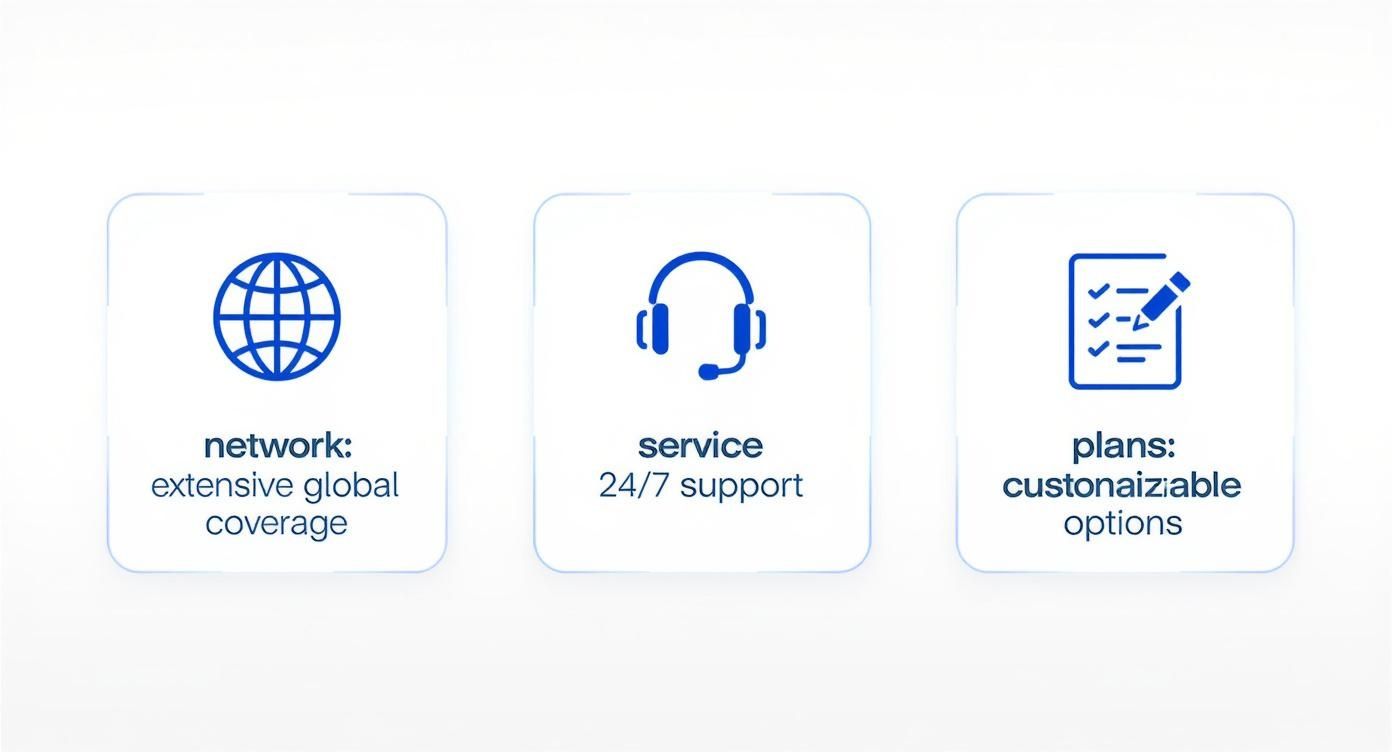
Ultimately, the right plan strikes a balance between a wide provider network, responsive customer service, and the flexibility to meet your unique needs.
The Digital Nomad Profile
If you’re a digital nomad, you need two things above all else: agility and bulletproof emergency support. Your lifestyle means you’re constantly on the move, often in places with wildly different standards of medical care. The last thing you want is a policy that locks you into a tiny network or makes you jump through hoops during a crisis.
Your top priorities should be:
- Broad Global Coverage: You need a plan that moves with you, working seamlessly across multiple countries without forcing you to update your policy every time you cross a border.
- Strong Emergency Evacuation: This is completely non-negotiable. If you have a serious accident in a remote area, you need total assurance that your insurance will cover the cost of getting you to a top-tier medical facility.
- Telehealth Services: Having access to virtual consultations is a game-changer. It allows you to get medical advice for minor issues without derailing your travel plans to track down a clinic.
For the digital nomad, flexibility is everything. A plan with a high deductible for routine stuff but an ironclad, unlimited benefit for major emergencies often hits that perfect sweet spot between affordability and real protection.
Before you sign on the dotted line, ask some pointed questions:
- Is my coverage automatic worldwide, or do I have to notify you every time I change countries?
- In practical terms, what does your emergency medical evacuation process actually look like?
- Are telehealth services included, and can I use them from any country?
The Expat Family Profile
Moving abroad with your family makes healthcare a whole lot more complex. You’re not just thinking about emergencies anymore. You’re planning for routine check-ups, potential pregnancies, and the everyday well-being of your kids. Your focus has to shift from “just in case” coverage to a plan that works like a comprehensive policy back home.
Your key priorities will include:
- Comprehensive Outpatient Care: This is essential for all the day-to-day stuff—routine doctor’s visits, pediatric check-ups, vaccinations, and specialist consultations.
- Maternity and Newborn Coverage: If you’re planning to grow your family, look for plans with generous maternity benefits. Just be mindful of the typical 10-12 month waiting period before the coverage actually kicks in.
- Wellness and Preventive Benefits: Things like annual physicals, dental check-ups, and vision care are crucial for keeping your family healthy in the long run.
A family’s checklist needs to dig into the fine print:
- What are the exact limits and waiting periods for maternity and newborn care?
- Does the plan cover routine pediatric wellness checks and vaccinations?
- Is there a single family deductible, or does each person have an individual one to meet?
Finding the right plan often comes down to your destination. For more specific advice, you can learn how to choose the right expat medical insurance by country in our detailed guide.
The Retiree Profile
Retirees moving abroad have their own distinct set of priorities. You’re more likely to need ongoing care for chronic conditions and want the peace of mind that comes from knowing you have predictable, reliable access to high-quality healthcare. Cost is always a factor, but solid, comprehensive coverage is the real goal.
Your main considerations should be:
- Chronic Condition Management: Make sure the policy provides strong, long-term coverage for any pre-existing conditions you might have.
- High Annual Limits: Your plan needs to have a high or unlimited annual benefit to shield you from the potentially catastrophic costs of a major medical event.
- Repatriation Options: Many retirees value the option to return to their home country for significant medical treatment, which makes repatriation a key benefit to look for.
When evaluating plans, retirees need to ask:
- How does this plan cover my pre-existing conditions, and what are the underwriting requirements?
- What is the policy on lifetime renewability? Is there a risk my coverage could be canceled as I get older?
- Does the plan include repatriation benefits to my home country specifically for medical treatment?
Understanding Expat Medical Insurance Costs and How to Get the Best Quote
Trying to nail down the cost of an expat medical insurance plan can feel a bit like chasing a moving target. But once you pull back the curtain, it’s actually pretty straightforward. Your final premium isn’t some random number—it’s a direct reflection of your personal profile and the specific coverage you build for yourself.
Three main levers control your price tag more than anything else: your age, the deductible you select, and where in the world you need coverage. Each one has a significant impact on your final quote.
Key Factors That Determine Your Premium
Your age is always the starting point. Statistically speaking, our healthcare needs tend to increase as we get older, and insurance premiums reflect that reality. It’s simply a matter of risk assessment, so older expats will see higher base prices.
Next up is your deductible. This is the amount you agree to pay out-of-pocket for medical care before your insurer starts chipping in. Opting for a higher deductible is a popular way to bring down your monthly premium, but it means you’ll have to cover more of the initial costs yourself if you need to see a doctor or visit a hospital. It’s a trade-off between upfront savings and potential out-of-pocket expenses.
Finally, we have the biggest cost driver of all: your area of coverage. The decision of whether or not to include the USA in your plan can make or break your budget.
The cost of healthcare in the United States is in a league of its own, towering over the rest of the world. Because of this, adding comprehensive USA coverage to an expat medical insurance plan can easily double the premium. It’s the single most significant factor in determining your final cost.
This is why you have to be honest with yourself about whether you really need full-blown coverage in the U.S. or if a plan with limited coverage for short trips home would be enough. To dig deeper, check out this in-depth international medical insurance cost guide that really breaks down all the numbers.
Illustrative Cost Examples
To put this into perspective, let’s look at how these factors influence premiums for a few different expat profiles. These are just ballpark figures, but they paint a clear picture of the price differences.
| Expat Profile | Coverage Area | Deductible | Estimated Annual Premium |
|---|---|---|---|
| 30-Year-Old Digital Nomad | Worldwide Excluding USA | $2,500 | $1,800 – $2,500 |
| 30-Year-Old Digital Nomad | Worldwide Including USA | $2,500 | $3,600 – $5,000 |
| 45-Year-Old Expat Family | Worldwide Excluding USA | $1,000 | $6,000 – $8,500 |
| 65-Year-Old Retiree | Worldwide Excluding USA | $5,000 | $4,500 – $6,000 |
The savings from excluding the U.S. are impossible to ignore. The global health insurance market is absolutely booming, projected to hit $2.69 trillion by 2025 and an astonishing $5.12 trillion by 2034. This growth is fueled by expanding economies and ever-rising healthcare costs, with North America—and the U.S. in particular—continuing to dictate pricing trends across the entire industry.
The Smart Way to Get a Quote
So, what’s the best way forward? The smartest move is to work with an independent broker who knows this world inside and out. A specialist like Expat Global Medical isn’t tied to one company, so we don’t just push a single policy. Our job is to give you unbiased advice and help you stack up the best options from multiple leading insurers, side-by-side.
This approach saves you the massive headache of trying to research and compare dozens of providers on your own. Instead, you get a handpicked selection of quotes that actually match your situation, ensuring you get the absolute best value for your health and your wallet.
Got Questions About Expat Medical Insurance? We’ve Got Answers.
Jumping into the world of expat medical insurance can feel a bit overwhelming, and it’s natural to have questions. Let’s clear up some of the most common ones so you can feel confident you’re making the right call for your life abroad.
What’s the Real Difference Between Travel and Expat Medical Insurance?
It’s easy to mix these two up, but they’re built for completely different situations. Travel insurance is your short-term safety net for vacations and brief trips. Its main job is to bail you out of sudden, unexpected trouble—think a broken leg from a skiing accident, a bad case of food poisoning, or even lost luggage.
Expat medical insurance, however, is your long-term, comprehensive healthcare solution for life in another country. It acts just like your health plan back home, covering everything from routine physicals and specialist visits to serious surgeries and managing chronic illnesses. It’s designed for living, not just visiting.
The simplest way to think about it: travel insurance is for emergencies on a trip, while expat medical insurance is for your day-to-day health while you actually reside abroad.
Will My Pre-Existing Conditions Be Covered?
This is a huge deal for many people, and the answer really comes down to the insurer and how they assess your application. Most will look at your medical history before making a decision, usually in one of two ways.
- Full Medical Underwriting: You’ll need to lay all your cards on the table and provide your complete medical history. Based on that, the insurer might cover your conditions without issue, charge a higher premium, exclude them from coverage, or in some cases, decline the application.
- Moratorium Underwriting: This route doesn’t require an upfront declaration. Instead, the policy automatically excludes any condition you’ve had symptoms of or treatment for in the last few years (typically 2 to 5 years). The good news? Those conditions can become eligible for coverage down the line, but only after you’ve gone a set period (usually 2 years) on the policy without any symptoms or treatment.
Honesty is always the best policy here. Being upfront ensures your coverage will be there for you when you actually need it.
Can I Just Keep My Health Insurance From Home?
You might be able to keep your domestic plan active, but relying on it for healthcare overseas is a gamble that rarely pays off. Most plans from back home, including U.S. Medicare, offer virtually no coverage outside your home country’s borders, except perhaps for the most extreme, life-or-death emergencies.
Trying to use a domestic plan abroad usually means you’ll pay for everything out-of-pocket first. Then you’ll face a mountain of paperwork and a frustrating, often losing, battle to get reimbursed. These plans simply weren’t built for the realities of global healthcare. A proper expat medical insurance plan is designed to work with providers worldwide, handle direct billing, and navigate different medical systems seamlessly.
How Do Claims Actually Work With an Expat Medical Plan?
The best expat medical plans make the claims process as painless as possible, no matter where you find yourself needing care. It generally works in two ways.
The first, and by far the easiest, is direct billing. If you go to a hospital or clinic within your insurer’s network, they handle the bill directly with the insurance company. This means no hefty upfront payments for you on covered treatments, which is a massive relief.
The second method is reimbursement. This comes into play if you see a provider who isn’t in the network. You’ll pay for the services yourself and then submit the receipts and documentation to your insurer to get your money back. Most modern insurers have made this pretty straightforward with online portals and mobile apps for quick uploads. Expats often wonder about using their existing insurance for medical or dental procedures outside their primary coverage area. For insights into understanding dental implant insurance coverage when seeking care abroad, especially in places like Tijuana, Mexico, this guide is a helpful resource.
Ready to secure the right protection for your life abroad? The team at Expat Global Medical specializes in helping expats compare top-tier plans to find the perfect fit. Get your free, no-obligation quote today and take the first step toward peace of mind. Learn more at https://expatglobalmedical.com.