If you’re an expat or a digital nomad, the question isn’t if you need insurance. That’s a given. The real question is: what kind of coverage do you need for a life lived abroad? Spoiler alert: a standard travel policy is nowhere near enough. For long-term living, the conversation must shift from travel insurance to Expat Medical Insurance.
Why Your Life Abroad Needs More Than a Travel Band-Aid

Think of a typical travel insurance plan as a first-aid kit. It’s perfect for patching up the small stuff on a short trip—a canceled flight, a lost bag, or a sprained ankle during a two-week vacation. It’s built for temporary problems that interrupt a holiday.
But when you live abroad, you’re not on holiday. You’re building a life, and that life comes with all the same health needs you’d have back home. This is where expat medical insurance comes in. It acts as your comprehensive health plan, designed specifically for the realities of long-term international living. Relying on a short-term travel policy is like trying to use a band-aid for a serious illness. It just won’t cut it.
The Dangerous Gaps in Standard Coverage
Your domestic health plan and basic travel policies leave massive blind spots once you move overseas. They simply weren’t designed to handle the complexities of international healthcare, leaving you financially exposed right when you’re most vulnerable.
These plans almost always fall short in a few critical ways:
- Routine and Preventive Care: Forget about getting check-ups, wellness visits, or dental work covered by standard travel insurance. Expat medical insurance is designed to cover these.
- Chronic Condition Management: If you need to manage an ongoing condition like diabetes or hypertension, a short-term travel policy won’t help. A dedicated expat plan can.
- Catastrophic Illness or Injury: The coverage limits on travel plans are a drop in the bucket for major medical events, which can easily soar past $100,000. Expat plans offer high limits for true security.
- Emergency Medical Evacuation: Getting you to a quality hospital can be astronomically expensive, a feature that’s often missing or severely limited in basic plans but is a cornerstone of expat medical coverage.
This is where your domestic and short-term plans fail, and why a dedicated expat medical plan is non-negotiable for anyone living abroad.
Why Your Current Insurance Falls Short Abroad
Let’s break down the differences. The table below highlights why only a dedicated expat medical plan is suitable for an international lifestyle.
| Coverage Feature | Domestic Health Plan | Short-Term Travel Insurance | Expat Medical Insurance |
|---|---|---|---|
| Primary Purpose | Healthcare in home country | Trip interruption & emergencies | Primary health coverage abroad |
| Routine Check-Ups | Yes (in-network) | No | Yes |
| Chronic Conditions | Yes (in-network) | No | Yes, with underwriting |
| Emergency Evacuation | No | Limited, with low caps | Yes, comprehensive coverage |
| Choice of Doctors | Restricted to network | Limited to emergency facilities | Wide global network of providers |
| Renewability | N/A abroad | Not for long-term stays | Annually renewable, continuous |
As you can see, only an expat medical plan is built from the ground up to provide the continuous, comprehensive care you need while living internationally.
The numbers back this up. The global travel insurance market is projected to hit USD 98.74 billion by 2034, with long-stay policies growing by a massive 19.84%. This isn’t just a trend; it’s a huge shift showing that long-term travelers and expats now realize their old plans just don’t work for a global lifestyle.
Without proper expat medical insurance, you’re essentially gambling with your health and your savings. Understanding these differences is the first step toward securing the right protection. For a deeper dive into what you’ll need, check out our guide on finding the right digital nomad health insurance.
What’s Expat Medical Insurance Really For?
When most people hear “travel insurance,” their minds jump to lost bags or canceled flights. But if you’re an expat, thinking this way isn’t just incomplete—it’s dangerous. The real question isn’t “do I need travel insurance?” but “what is my primary health plan while living abroad?”
Living abroad means you’re not guarding against a ruined trip. You’re guarding against a ruined life.
The real job of expat medical insurance isn’t to pay you back for a travel headache. Its mission is to be your primary health plan, one that works across international borders. It’s the financial shield standing between you, your health, and the staggering costs of global medical care.
Put it this way: you wouldn’t dream of living in your home country without health insurance. Why on earth would living somewhere else be any different? Expat medical insurance steps in to fill that exact role, making sure you have solid, reliable access to good doctors and hospitals, no matter what your address is.
More Than Just Vacation Mishaps
A standard travel policy is built for temporary fixes. It’s designed to stabilize you in an emergency, patch you up, and get you back home where your real insurance can take over.
An expat medical plan, on the other hand, is built for the long haul. It’s there for the full spectrum of healthcare needs that pop up when you’re not just passing through a country, but actually building a life there. The entire structure is designed to replace—and often, be better than—the health plan you left behind.
It’s a huge mistake to see expat insurance as some kind of travel add-on. It’s essential infrastructure for your life abroad, right up there with finding a place to live or opening a bank account. This is your safety net for everything from a routine check-up to a life-changing emergency.
Because its purpose is so different, the policy itself is built differently, focusing on your long-term well-being instead of just short-term crisis control.
The Four Pillars of Health Security Abroad
To really get it, you have to look at the core components that make a true expat medical plan different from a simple travel policy. For anyone asking, “do i need travel insurance for long-term living?”, these four pillars are the non-negotiables that only a true expat plan provides.
-
Comprehensive Medical Coverage: This is the foundation. We’re talking about everything from doctor’s visits and hospital stays to major surgery and prescription drugs. It’s built to handle a catastrophic diagnosis or a serious accident, with high coverage limits, often $1 million or more, to protect you from financial ruin.
-
Access to Quality International Hospitals: A great plan doesn’t just pay the bills; it opens doors. This means you get access to a strong network of trusted hospitals and clinics around the world. Many have direct billing, so you aren’t stuck paying a massive bill out-of-pocket and hoping for reimbursement later.
-
Emergency Medical Evacuation: If you have a serious medical crisis in a place without top-tier medical facilities, this benefit is literally a lifesaver. It covers the cost of transporting you to the nearest center of medical excellence—a flight that can easily top $100,000. This isn’t just about getting home; it’s about getting to the right care, fast.
-
Ongoing and Preventive Care: Life abroad isn’t just about emergencies. Expat plans often cover routine wellness checks, cancer screenings, and even help manage chronic conditions like diabetes or hypertension (this is subject to underwriting, of course). This focus on keeping you healthy long-term is something you’ll never find in a standard travel policy.
At the end of the day, expat medical insurance isn’t about protecting your vacation. It’s about protecting your life. It ensures a health crisis doesn’t spiral into a financial one, giving you the freedom to build a life anywhere in the world with real confidence.
Matching Your Insurance to Your Lifestyle
Not all time spent abroad is the same, so why would the insurance be? The right policy comes down to your lifestyle and how long you plan to be away. Choosing the wrong one is like bringing a tent on a trip where you need a house—it might work for a night, but it’s completely unsustainable for actually living somewhere.
To properly answer “do I need travel insurance?”, you must first determine if you’re a traveler or an expatriate. Each scenario carries vastly different risks and requires a very specific kind of protection.
Which Traveler Persona Are You?
Let’s break it down into three common profiles. Seeing where you fit will instantly clarify what kind of coverage you should be looking for.
-
The Two-Week Tourist: This is your classic vacationer. The biggest worries are trip interruptions and sudden medical emergencies. A single-trip travel insurance policy is built for exactly this.
-
The Six-Month Nomad: This person is exploring the world for an extended period but doesn’t have a permanent foreign address. A long-stay travel medical policy can be a good middle ground, but it’s still focused on emergencies, not comprehensive health.
-
The Full-Time Expat: This is someone who lives, works, or has retired abroad. They are residing internationally. Their healthcare needs mirror those they’d have at home, including routine check-ups, managing chronic conditions, and major medical care. This is where expat global medical insurance becomes the only suitable choice.
This decision tree helps visualize the simple choice between a temporary trip and a long-term international lifestyle.
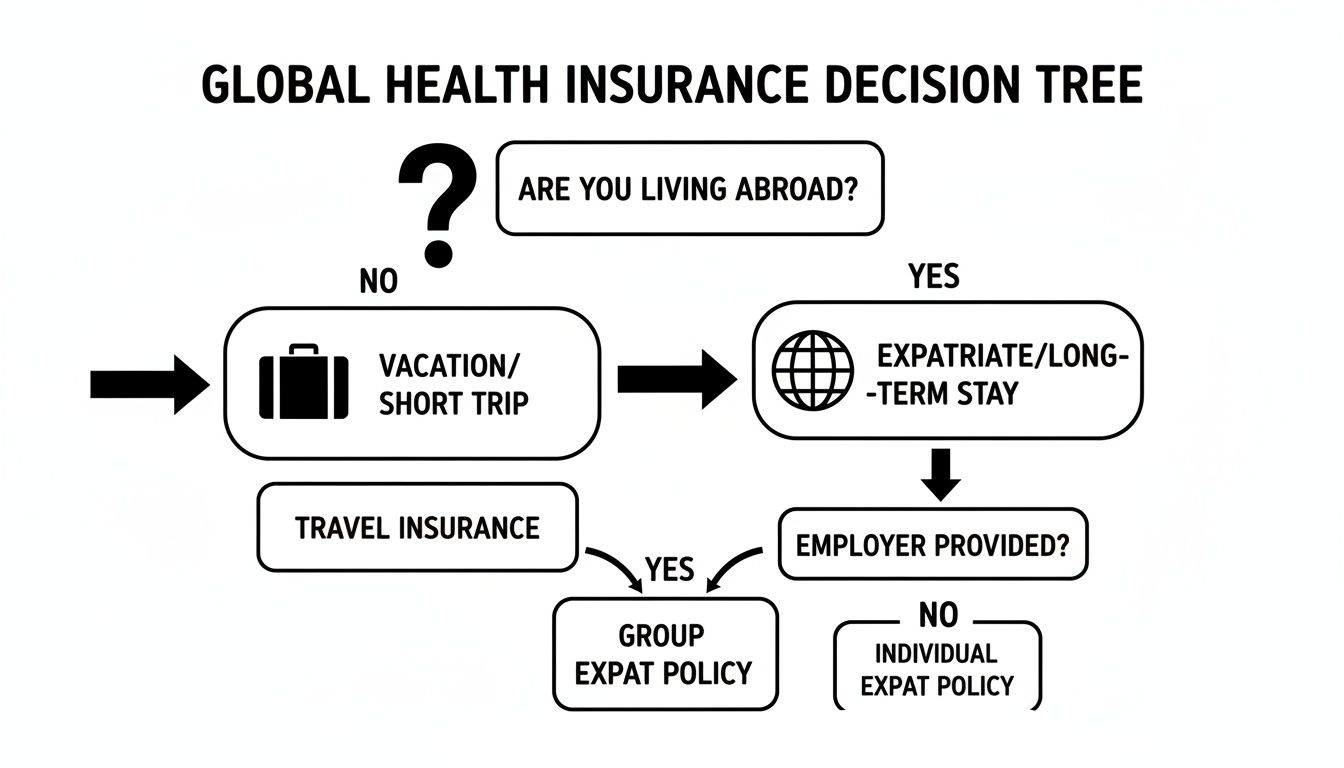
The image makes it clear: once your journey shifts from a temporary vacation to an established life abroad, your insurance needs fundamentally change from being travel-focused to health-focused.
Policy Showdown: Single Trip vs. Annual vs. Expat Medical
Understanding these personas makes it much easier to see why different policies exist. While the single-trip market is huge, pulling in USD 16,521.6 million in revenue, the real story is in the details. The long-stay options crucial for expats are the fastest-growing segment, showing a major shift in how people think about this.
At the end of the day, vacationers need trip protection, but expats need life protection.
To cut through the noise, here’s a head-to-head look at how these three main policy types stack up.
Policy Showdown Single Trip vs Annual vs Expat Medical
| Feature | Single-Trip Insurance | Annual Multi-Trip Plan | Expat Global Medical Plan |
|---|---|---|---|
| Primary Purpose | Vacation protection | Frequent short trips | Primary health coverage |
| Typical Duration | Days or weeks | Capped per trip (e.g., 90 days) | 12 months, renewable |
| Medical Limit | Lower (e.g., $50,000) | Moderate (e.g., $100,000) | High (e.g., $1M+) |
| Routine Care | No | No | Yes, often included |
| Pre-existing Conditions | Excluded or very limited | Usually excluded | Can be covered (with underwriting) |
| Medical Evacuation | Basic coverage | Moderate limits | Comprehensive, high limits |
| Renewability | No | Annual renewal for trips | Annual renewal for residency |
The bottom line is simple. A policy’s medical limit and its stance on routine care are the clearest signs of what it’s for. A plan with a $50,000 limit is for emergencies only. A plan with a $2 million limit that covers wellness exams is designed to be your actual health insurance.
For anyone planning to live overseas, the choice becomes obvious. A single-trip or even an annual travel plan creates dangerous gaps in coverage that can lead to financial disaster. Only a dedicated expat medical plan provides the robust, continuous protection you need to truly safeguard your health and finances abroad.
Making this distinction is the most important step in your insurance journey. To dig deeper into specific policy features, check out our guide on how to choose the right travel insurance for your needs.
Your Checklist for Choosing an Expat Medical Plan
When you start digging into different expat medical plans, it’s ridiculously easy to get lost in the weeds. Marketing jargon and endless feature lists all start to blur together, making it tough to figure out what actually matters. To ensure you get the right insurance, you must cut through the noise and focus on the core elements of a true expat medical plan.
This isn’t about finding the cheapest plan; it’s about finding the smartest one. A truly solid expat medical plan is built on a few non-negotiable pillars. Think of this as your no-nonsense buyer’s guide—a checklist to make sure the policy you pick is a real safety net, not just a flimsy travel perk.
High Coverage Limits for Worst-Case Scenarios
The first thing you need to look at—and it’s the most important—is the overall coverage limit. A basic travel policy might top out at $50,000. That sounds like a lot of money, right? Well, not when you’re staring down a serious medical emergency. A single night in an ICU in some parts of the world can eat up thousands, and a major surgery can blow past that limit in a heartbeat.
That’s why a proper expat medical plan needs to offer a high maximum benefit, often $1 million or more. This isn’t for a sprained ankle. It’s for the catastrophic stuff that could otherwise lead to financial ruin, like a sudden, severe illness or a major accident. A high limit is your ultimate defense against the unpredictable.
Worldwide Coverage That Actually Matches Your Life
Next, you need to verify the plan’s geographic reach. You’ll see “worldwide coverage” thrown around a lot, but it can mean different things to different insurance companies. Some plans will quietly exclude high-cost countries—the United States is the usual suspect—or offer very limited coverage there.
Your expat medical plan absolutely must line up with your real-life travel patterns and where you’ll be living.
- Global Coverage: This is the gold standard if you’re a true globetrotter, frequently hopping between different regions.
- Global Excluding USA: This is a very popular option that can bring your premium down quite a bit, especially if you have no plans to spend time in the U.S.
- Regional Plans: These cover specific zones, like Europe or Southeast Asia, and can be a great cost-effective choice if your life is pretty much centered in one part of the world.
And don’t forget to check if your home country is included for visits. The last thing you want is to be visiting family back home only to discover you’re technically uninsured.
A powerful expat medical policy isn’t just about the money; it’s about access. It ensures you can get to the right doctors in the right facilities, no matter where you are when a crisis hits. This access is the key to both your physical and financial well-being.
Emergency Medical Evacuation: The Ultimate Safety Net
This might be the most critical and misunderstood benefit of all: emergency medical evacuation. If you suffer a serious injury or illness somewhere without the right medical facilities, this benefit pays to get you to the nearest hospital that can actually provide the care you need.
Let’s paint a picture. An expat living in a remote corner of Central America has a massive heart attack. The local clinic is simply not equipped for cardiac surgery.
- Without solid evacuation coverage: The expat is stuck. They’re forced to rely on substandard care, and the outcome could be life-threatening.
- With solid evacuation coverage: The insurance company steps in, arranging and paying for a medically equipped flight to a world-class hospital in Miami or Mexico City. This service alone can easily cost over $100,000, but it can be the difference between a full recovery and a tragedy.
This isn’t a luxury item on a policy. For anyone living or traveling outside of major, well-developed cities, it’s an absolute necessity.
Key Terms You Have to Understand
Finally, let’s demystify the fine print by looking at two terms that directly hit your wallet.
- Deductible: This is the amount of money you have to pay out of your own pocket before the insurance company starts kicking in. A higher deductible usually means a lower monthly premium, but you have to be honest with yourself—can you comfortably afford to pay that amount if something happens?
- Direct Payment: Look for providers that offer direct payment (sometimes called direct billing) to their network of hospitals. This is a game-changer. It means the insurer pays the hospital bills directly, so you aren’t stuck paying a massive bill upfront and then chasing down a reimbursement later.
By running through this checklist, you can move from a place of uncertainty to one of real confidence, knowing the plan you choose truly has your back, wherever you are in the world.
Avoiding Common Pitfalls and Policy Exclusions

Choosing an expat medical plan feels like a massive win, a huge step toward securing your new life abroad. But the real value of that policy isn’t in the brochure—it’s tucked away in the fine print. The gap between feeling protected and actually being protected often comes down to understanding the common exclusions that trip up even the most seasoned expats.
Think of your policy as a contract. And like any contract, the devil is in the details. Glazing over the specifics can lead to a rejected claim right when you need help the most, turning a medical hiccup into a full-blown financial disaster.
The Traps Hiding in Plain Sight
Before you even think about signing, you need to put on your most critical reading glasses and dive into the policy documents. While certain exclusions are pretty standard across the industry, how each insurer defines them can be wildly different. Knowing what to look for is your best defense.
Here are some of the most common reasons a claim gets denied:
- Undisclosed Pre-existing Conditions: This is the big one. Hiding a known health issue when you apply is the fastest way to get your entire policy voided. Absolute honesty isn’t just the best policy; it’s the only one.
- High-Risk Sports and Activities: Love to scuba dive, ski, or climb mountains? Your standard plan probably doesn’t. Many insurers consider these “hazardous” activities and won’t cover injuries unless you buy a special add-on or rider.
- Acts of War and Terrorism: It’s an uncomfortable thought, but it’s a reality of insurance. Nearly all policies will exclude injuries you get in a country where there’s active political unrest or war.
- Mental Health and Substance Abuse: Coverage for mental healthcare can be all over the map. What’s almost universally excluded, though, is any injury or illness that’s a direct result of drug or alcohol abuse.
These common exclusions show that asking “do I need travel insurance?” is just the first step. The critical follow-up question is, “what exactly will this insurance refuse to cover?”
Understanding your policy isn’t just about knowing what’s included—it’s about being acutely aware of what is not. This knowledge empowers you to avoid costly assumptions and ensure the plan you choose truly aligns with your life.
Beyond the Obvious Exclusions
It doesn’t stop with that list. A few other tricky details can completely change how your coverage works in the real world. These are the areas where a “cheaper” plan often ends up costing you a whole lot more.
Territorial Restrictions
It’s a shock for many expats when they discover their “global” plan has some very specific geographic holes—especially when it comes to the United States. Thanks to the sky-high cost of healthcare there, many policies either exclude the U.S. entirely or only offer very limited emergency coverage for short visits. If you plan on spending time back home, you have to confirm what your plan says.
Waiting Periods
Don’t make the mistake of assuming your benefits kick in on day one. It’s common for expat medical plans to have waiting periods for certain types of care before they’ll pay a dime. Watch out for these, especially for:
- Maternity and newborn care (often a 10-12 month wait)
- Major dental work
- Preventive care and screenings
‘Reasonable and Customary’ Charges
You’ll see this phrase buried in your policy, and it’s a big deal. It’s the insurance company’s way of protecting itself from being overcharged. It means they’ll only pay what they decide is the “standard” rate for a medical service in a particular city or country. If your hospital charges more, that difference comes out of your pocket. This makes sticking to in-network providers a very smart move.
Navigating all these details, especially when you have a complex health history, can feel overwhelming. You can get a much deeper understanding of how insurers approach this by reading our detailed guide on pre-existing conditions.
Securing Your Health and Peace of Mind Abroad
Getting to grips with international insurance can feel like a maze, but securing your life abroad really comes down to one core realization. The question was never just “do I need travel insurance?” It was always, “how do I protect my health and finances with a primary medical plan while I live my life on a global scale?”
By now, you see how standard travel policies just don’t cut it for long-term stays. You understand why a genuine expat medical plan isn’t a luxury—it’s essential infrastructure for a life lived across borders.
This isn’t just about dodging a worst-case scenario; it’s about enabling the best-case one. It’s about the freedom to build a life, chase a career, or enjoy retirement anywhere in the world, confident that a health crisis won’t spiral into a financial catastrophe. Real peace of mind comes from knowing you have a proper safety net, one built for long-term residency, not a two-week vacation.
Your Path to Protection
Moving abroad is a massive life decision. Choosing your medical coverage deserves that same level of care. You now have the knowledge to see past the marketing slogans and focus on what actually matters for your situation.
Here are the key takeaways to lock in your final decision:
- Match the Plan to Your Lifestyle: Short-term travel insurance is for holidays. A comprehensive expat medical plan is for living.
- Prioritize the Pillars: Insist on high coverage limits, worldwide access, robust medical evacuation, and options for routine care.
- Read the Fine Print: Pay close attention to exclusions, territorial limits, and waiting periods. This is where costly surprises hide.
Making the right choice means you’re ready for anything, from a simple check-up to a life-altering emergency. Beyond health, locking down your digital security is another key to true peace of mind abroad. For complete online protection, it’s worth checking out resources like The Best VPN for Expats: Your Guide to Staying Connected & Secure Abroad.
You don’t have to navigate this decision alone. Expert guidance is the most effective way to cut through the complexity and find a plan that perfectly aligns with your unique life, destination, and budget.
Choosing the right plan is the final, critical step in your journey. We can help you find the perfect coverage for your global lifestyle. By speaking with a specialist, you can get personalized advice and a clear, no-obligation quote that delivers the security you deserve.
Got Questions About Expat Insurance? We’ve Got Answers.
Even after you get the big picture, a few specific questions always seem to pop up. Let’s tackle some of the most common ones head-on to clear up any lingering doubts you might have about finding the right expat medical insurance for your life abroad.
My Health Insurance From Back Home Says It Covers Emergencies Abroad. Is That Good Enough?
This is a classic—and dangerous—misconception. While your domestic health plan might mention some form of emergency coverage for travel, relying on it as an expat is a huge gamble.
That kind of coverage is built for a two-week vacation, not for someone living in another country. It’s designed to stabilize you in a crisis and nothing more. It almost never touches non-emergency care, essential follow-up appointments, or the ongoing management of a chronic condition.
Worse, you’ll often be forced to pay the entire hospital bill upfront—we’re talking tens of thousands of dollars—and then wrestle with your insurance company for reimbursement months later. The most critical gap? It lacks serious medical evacuation coverage, a service that can easily top $100,000 on its own. A real expat medical plan is designed for residency, giving you continuous, comprehensive protection, not just a band-aid for a travel mishap.
What’s the Difference Between Medical Evacuation and Repatriation?
These two sound alike, but they cover very different—and equally vital—scenarios. Getting this right is key to knowing if you’re truly protected.
- Medical Evacuation: This is all about getting you to the nearest adequate medical facility if the care you need isn’t available where you are. It could mean a flight to a better hospital in the next city or even across the border to a neighboring country.
- Repatriation: This service transports you back to your home country for medical treatment, recovery, or to be closer to family.
A solid expat plan includes both. Together, they create a safety net that ensures you get the best possible care, no matter where an emergency strikes. You’ll find that standard travel policies often have laughably low limits on these benefits, if they offer them at all.
Can I Get an Expat Medical Plan After I’ve Already Moved Abroad?
Yes, absolutely. In most situations, you can still buy a global medical plan even if you’re already living outside your home country.
It’s always smarter to get your coverage sorted before you leave to avoid any gaps in protection, but it’s definitely not too late if you’re already overseas. Just be aware that some insurance providers might have slightly different underwriting rules or waiting periods if you apply while abroad. Your best bet is to chat with a specialist who can look at your specific situation and find the quickest, smoothest path to getting you covered.
Are Digital Nomads Considered Expats for Insurance?
From an insurance standpoint, you bet they are. Digital nomads face the exact same risks as a traditional expat because they live outside their home country for long stretches and need medical coverage that moves with them.
The fundamental issue is the same: their healthcare needs extend far beyond the sudden emergencies that a basic travel insurance policy is built to handle. The very nature of the flexible, multi-country lifestyle of a digital nomad demands a proper, long-term global medical plan. So when a digital nomad asks, “do I need travel insurance,” what they should really be asking about is an expat medical plan built for long-term global living.
Figuring out these details is the first step to securing your new life abroad with confidence. The team at Expat Global Medical has been helping expats and digital nomads find their perfect fit since 1992. Get a free quote today and see how we can protect your global journey.