
Before you even start looking at plans, there’s one fundamental truth you need to grasp: expat medical insurance is not the same as standard travel insurance. This isn’t just a minor detail; it’s the most critical distinction to make. One is a quick patch for a two-week holiday, while the other is your primary healthcare plan for a life lived abroad.
Getting this wrong is the first, and often most expensive, mistake new expats make.
Why Your Vacation Policy Won’t Cut It Abroad

It’s an easy trap to fall into. You assume the travel policy that covered your vacation in Spain will be just fine for your year-long work contract in Dubai. Unfortunately, that assumption can backfire spectacularly, leaving you exposed to massive financial and medical risks.
The two products are built for entirely different realities. A standard travel policy is designed for tourists, plain and simple. Its job is to handle emergencies and hiccups related to a specific trip for a limited time, usually less than 90 days.
What Standard Travel Insurance Actually Covers
Think of travel insurance as a “trip protection” package. It’s there for the “what ifs” of travel, not the certainties of daily life. Its main benefits are usually:
- Trip Cancellation/Interruption: Gets your money back for non-refundable flights and hotels if a covered emergency forces you to cancel.
- Lost or Delayed Luggage: Gives you some cash to buy essentials if your bags decide to take a different flight than you did.
- Short-Term Emergency Medical: This is the big one. It covers unexpected accidents or sudden illnesses that happen during your trip. But the coverage limits are often low, and it absolutely will not cover routine check-ups, ongoing treatments, or long-term care.
This kind of plan is perfect for a holidaymaker. For someone building a life in a new country? It’s dangerously insufficient.
An expat isn’t just visiting; they’re a resident. Your healthcare needs shift from dealing with temporary travel mishaps to managing your overall, long-term well-being in a foreign healthcare system.
The Expat Medical Insurance Difference
Expat medical insurance, on the other hand, is your actual health plan—just with a global passport. It’s specifically designed for people living outside their home country for six months or more.
This insurance operates on the understanding that you’ll need more than just an emergency hotline. It provides access to a global network of doctors, specialists, and hospitals for everything from routine care to major medical events.
If you want to go deeper, we’ve put together a full comparison of expat medical insurance vs. travel insurance that breaks it all down.
The key features you’ll find in an expat plan include:
- Comprehensive Inpatient and Outpatient Care: Covers everything from hospital stays and surgeries to specialist visits and prescription drugs.
- Management of Pre-existing Conditions: Many plans will cover ongoing health issues, which are almost universally excluded from standard travel policies.
- Robust Medical Evacuation: Ensures you can be moved to the nearest world-class facility—or even back home—if local care isn’t up to snuff.
Ultimately, choosing your expat medical insurance requires a mental shift. You’re not buying a simple add-on for a trip; you’re investing in your long-term health and financial stability while living abroad.
Figuring Out Your Own Healthcare Needs Abroad
Picking the right expat medical insurance doesn’t start with comparing quotes. It starts way before that, with a good, honest look at your own situation. Grabbing a generic plan is like rolling the dice; building one around your life is a smart move for your health and your wallet.
This isn’t about finding a magical one-size-fits-all policy. It’s about creating a clear blueprint of your absolute must-haves. That way, you can quickly weed out the plans that just won’t cut it.
Where Are You Headed and What’s the Healthcare Scene Like?
The quality and cost of medical care can be wildly different from one country to the next. Your destination is easily the biggest factor shaping your insurance needs. If you’re moving somewhere with top-notch but pricey private healthcare, like Switzerland or the United States, you’ll need a policy with seriously high coverage limits.
On the flip side, if you’re relocating to a place where the medical system isn’t as developed—think parts of Southeast Asia or Latin America—then solid emergency medical evacuation coverage becomes non-negotiable. This is what gets you transported to a better hospital if the local clinics can’t handle a serious injury or illness.
Don’t just assume you’ll be fine with the local system. Dig into both the public and private healthcare standards where you’re going. A great way to get the real story is to ask other expats about their experiences with wait times, quality of care, and how easy it is for foreigners to get treatment.
What’s Your Current Health Situation?
This is the part where you have to be completely straight with yourself. Do you have any pre-existing conditions? We’re talking about things like diabetes, asthma, or a heart condition. A lot of standard travel policies will flat-out refuse to cover these, which is a huge reason they’re a bad fit for anyone living abroad long-term.
Expat medical insurance is built differently. These plans often have options to cover chronic conditions, although you might have a waiting period or pay a bit more in premiums. Trust me, skipping over this detail is a massive gamble.
Think about these two very different scenarios:
- A retiree moving to Portugal: They’ll need a plan that covers routine check-ups, ongoing prescription refills for a chronic condition, and quick access to specialists.
- A young digital nomad heading to Thailand: With no chronic health issues, their priority is probably catastrophic coverage for accidents and a rock-solid evacuation plan.
Your age and general health are the foundation for figuring out what level of inpatient (hospital stays) and outpatient (doctor visits) care you really need.
What Kind of Life Will You Be Living?
Your day-to-day life and hobbies abroad also have a huge say in your insurance needs. An office worker in Berlin has a totally different risk profile than a ski instructor in the French Alps or someone who loves to scuba dive in Mexico.
Pay close attention to the fine print, because many policies have specific exclusions for activities they consider “high-risk.” If you plan on doing any of these, you absolutely must confirm your policy covers it:
- Skiing or snowboarding (especially off-piste)
- Scuba diving
- Riding a motorcycle
- Rock climbing or mountaineering
If you don’t have an “adventure sports” add-on or an equivalent rider, a claim for an injury you get while doing one of these activities will likely be denied. You’ll be stuck with the entire bill.
It helps to know what’s happening in the industry so you can advocate for yourself. The global travel insurance market is expected to be worth USD 27–31 billion in 2025 and could balloon to USD 98.7 billion by 2034. But here’s the kicker: single-trip policies still make up over 61% of global premiums. This tells you the industry is still mainly focused on short-term tourists. As an expat, you’re in a smaller but vital market, and you have to be proactive to find a specialist provider who gets what long-term, comprehensive coverage really means. You can discover more insights about this growing market and what it means for people like you.
Your Essential Expat Insurance Coverage Checklist
Alright, you’ve figured out what you need on a personal level. Now it’s time to get into the nuts and bolts of what a rock-solid expat medical plan actually includes. This isn’t about ticking boxes for the sake of it—it’s about understanding what each piece of coverage does for you in a real-world mess.
Think of this as your non-negotiable checklist for sizing up any policy that lands in front of you. Generic advice is useless when you’re thousands of miles from home. You need a plan built for the realities of living abroad long-term, and that means putting real, comprehensive benefits ahead of flashy perks.
This infographic gives a great visual breakdown of the core areas to think about when you’re sizing up your personal healthcare needs.
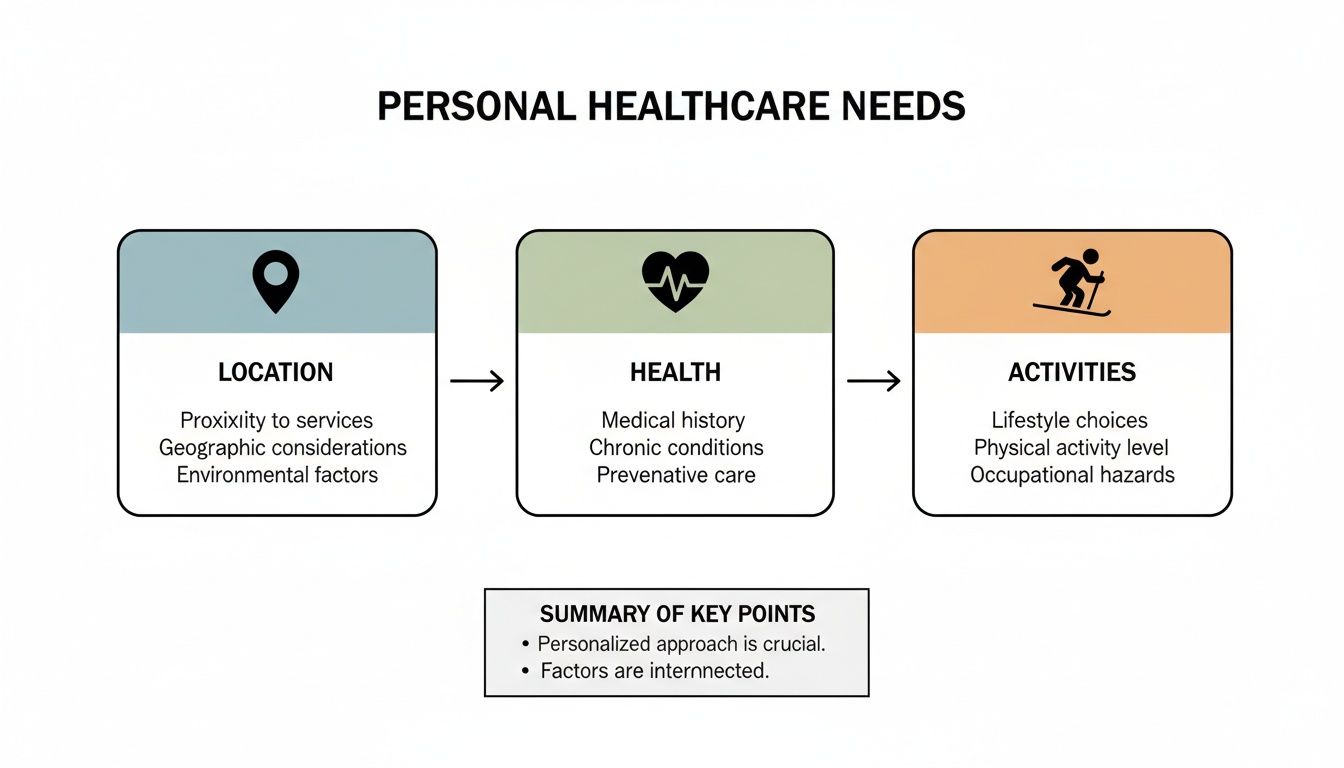
It really drives home how your destination, your current health, and what you plan on doing are the three pillars that should dictate what kind of coverage you’re looking for.
Inpatient And Outpatient Care: The Heart Of Your Plan
First things first. The absolute foundation of any decent expat medical insurance is how it handles inpatient and outpatient care. These two pillars are the backbone of your day-to-day and emergency health needs.
- Inpatient Coverage: This is for when you’re admitted to a hospital. It needs to cover your room, any surgery, ICU costs, medications, and all the specialist fees while you’re there. A single catastrophic event, like a bad car accident, can easily skyrocket into hundreds of thousands of dollars. This is why unlimited or extremely high inpatient limits are essential.
- Outpatient Coverage: This bucket covers everything else—all the medical care you get without being admitted. We’re talking doctor’s appointments, specialist visits, diagnostic tests like X-rays and MRIs, and your prescription drugs. Solid outpatient benefits are what you’ll use for managing your general health and catching small problems before they blow up into big ones.
When you’re comparing plans, don’t just glance at the numbers. A policy that skimps on outpatient care might look cheaper at first, but it’ll nickel-and-dime you into the poorhouse every time you need to see a doctor.
High Lifetime Maximums For The Truly Unexpected
While day-to-day care is important, the real test of an insurance plan is how it holds up in a worst-case scenario. This is where the overall policy maximum—the total amount the plan will pay out over its lifetime—becomes critical.
Most experts I talk to recommend a bare minimum limit of $1,000,000, but honestly, higher is always better. A serious illness or a major accident in a country with expensive healthcare can burn through lower limits shockingly fast. A high maximum is your guarantee that you won’t be left with a life-changing bill if you need long, intensive treatment.
Don’t get suckered in by a lower premium tied to a low policy maximum. The entire point of insurance is to shield you from financial ruin. A plan with a $50,000 limit is dangerously inadequate for any long-term expat.
Emergency Medical Evacuation And Repatriation
For anyone living abroad, emergency medical evacuation is a non-negotiable. Period. This coverage pays to get you from wherever you are to the nearest hospital that can actually treat you properly, especially if local facilities aren’t up to the task.
Imagine you’re hiking in a remote corner of Peru and have a serious fall. Medical evacuation is what pays for the air ambulance to a top-tier hospital in Lima. Without it, you could be staring at a bill for $25,000 to $100,000 (or more) for the transport alone.
On a similar note, repatriation of remains is a tough but necessary benefit. It covers the significant costs and logistical nightmare of returning a deceased person’s body to their home country. It’s a grim thought, but this coverage lifts a massive financial and administrative weight off your family’s shoulders during an awful time. Our guide explaining international travel insurance coverage goes deeper into why these protections are so vital.
Navigating Pre-Existing Conditions
This is one of the biggest areas where expat insurance and standard travel policies diverge. If you have a pre-existing condition—anything from asthma and diabetes to a past heart issue—you absolutely must find a plan that will cover it.
Here’s what you need to look for:
- Full Coverage: The best-case scenario. Top-tier plans will cover your condition after a medical underwriting process.
- Waiting Periods: Some policies will cover you, but only after a “waiting period” (often 12-24 months) has passed without issues.
- Exclusions: Steer clear of any plan that puts a permanent exclusion on your condition. This leaves you totally exposed and defeats the purpose of having insurance.
Always be 100% transparent about your medical history when you apply. Hiding a condition isn’t just a bad idea; it can be considered fraud, leading to your policy being canceled and all your claims denied right when you need help the most.
Many people confuse the robust coverage needed for pre-existing conditions in an expat plan with the limited emergency-only coverage of a short-term travel policy. Let’s clear that up.
Standard Travel Insurance vs. Expat Medical Insurance
It’s crucial to understand that a quick vacation policy is worlds apart from a comprehensive health plan for living abroad. One is a band-aid for emergencies; the other is your primary healthcare.
| Coverage Feature | Standard Travel Insurance (Short-Term) | Expat Medical Insurance (Long-Term) |
|---|---|---|
| Purpose | Trip cancellation, lost luggage, medical emergencies | Comprehensive, primary health coverage abroad |
| Duration | For the specific length of one trip (days/weeks) | Long-term, typically annual and renewable |
| Routine Care | No coverage for check-ups or wellness visits | Yes, covers doctor visits, diagnostics, physicals |
| Pre-Existing Conditions | Almost always excluded, or for acute onset only | Can be covered, often after medical underwriting |
| Mental Health | Very limited, if any | Often included for therapy and counseling |
| Choice of Doctor | Limited to emergency providers, often pay-first | Access to a wide network of doctors and hospitals |
| Renewability | Not designed for renewal or long-term stays | Guaranteed renewability, regardless of health changes |
This table makes it plain to see: relying on travel insurance for an expat life is a recipe for disaster. You need a plan built for residency, not a vacation.
Optional Benefits Worth Considering
Beyond the core essentials, many expat plans let you add on extra benefits to customize the policy to your life. They’ll add to the premium, of course, but the value can be well worth it.
- Dental and Vision: Routine cleanings, fillings, and new glasses are rarely in a base plan. If you don’t have this covered elsewhere, adding it on can save you a bundle on out-of-pocket costs.
- Wellness and Preventative Care: This is a great one. It covers things like annual physicals, cancer screenings, and vaccinations, helping you stay on top of your health.
- Home Country Coverage: For many expats, this is a game-changer. It lets you get non-emergency medical care back in your home country for a set period each year (like 30 or 60 days). Perfect for seeing your trusted family doctor when you’re home for a visit.
By working through this checklist methodically, you can cut through the marketing fluff and see the real substance of an insurance policy. This is how you find a plan you can count on, no matter where in the world you end up.
Navigating Deductibles, Limits, And The Fine Print

Let’s be honest, the real value of an expat medical plan is rarely found on the flashy brochure. It’s buried deep in the policy document, and that’s where you uncover the true cost and strength of your coverage.
A common mistake is focusing only on the monthly premium. That number doesn’t tell the whole story and can lead to some nasty surprises and significant out-of-pocket costs down the line. To really understand what you’re buying, you need to get comfortable with the fine print. It defines exactly how much financial risk you share with the insurance company.
Unpacking Your Financial Responsibilities
Three key terms dictate what you’ll actually pay when you need medical care: the deductible, co-insurance, and the out-of-pocket maximum. If you can get a firm grip on these, you’ll be able to compare plans far more effectively than someone just looking at the price tag.
- Deductible: This is the amount you have to pay out of pocket for covered medical services before your insurance plan starts to pay a dime. Think of it as your initial share. A higher deductible usually means a lower monthly premium, but it also means you’re on the hook for more of the initial expense.
- Co-insurance: Once you’ve paid your deductible, co-insurance kicks in. It’s a percentage of the remaining medical bill that you share with the insurer. A very common split is 80/20, which means the insurance company pays 80% of the bill, and you pay the remaining 20%.
- Out-of-Pocket Maximum: This is your financial safety net. It’s the absolute most you will have to pay for covered services in a policy year. Once your combined payments for deductibles and co-insurance hit this ceiling, the insurance company covers 100% of all covered costs for the rest of the year.
Here’s how it works in the real world. Imagine your policy has a $1,000 deductible, 80/20 co-insurance, and a $5,000 out-of-pocket max. You end up with a hospital bill for $21,000.
First, you pay the $1,000 deductible. On the remaining $20,000, your 20% co-insurance comes to $4,000.
Your total payment is $5,000 ($1,000 + $4,000). You’ve now hit your out-of-pocket maximum, so the insurer covers the rest of that bill and any other covered costs for the year.
Scrutinizing Policy Limits and Exclusions
Beyond what you pay, it’s just as critical to understand what the policy won’t cover. This is where a careful review of limits and exclusions saves you from future headaches and the shock of a denied claim.
For expats, two types of limits are especially important. The per-incident limit is the maximum amount a plan will pay for a single illness or injury. The lifetime maximum is the total amount the plan will pay out over the entire life of the policy. For any serious long-term expat insurance, you should be looking for a lifetime maximum of at least $1,000,000 to protect against truly catastrophic events.
Then there’s the exclusions list. This is arguably the most important section to read, as it’s the insurer’s definitive list of things they absolutely will not pay for.
Common Red Flags In The Exclusions List
Every policy has exclusions, but some are bigger red flags than others for an expat. You need to pay close attention to these common carve-outs to make sure you’re not left exposed.
- High-Risk Activities: Lots of plans won’t cover injuries from adventure sports like skiing, scuba diving, or even just riding a motorcycle. If you plan on doing any of these things, you’ll need to find a policy that includes them or purchase a special rider or add-on.
- Pre-existing Conditions: As we’ve mentioned, this is a big one. You need to know exactly how your plan handles any health issues you had before the policy started. Vague or overly broad language here is a major cause for concern.
- Specific Geographic Locations: Some policies won’t cover you in certain countries due to political instability, war, or sky-high healthcare costs (like the U.S.). Always double-check that your destination—and any other countries you plan to visit—are fully covered.
Diving into these details transforms you from someone simply buying a product to someone making an informed investment in their health and financial security. The time you spend reading the fine print now is an investment that pays huge dividends if you ever have to file a claim.
How To Vet An Insurance Provider You Can Actually Trust
An ironclad policy on paper means absolutely nothing if the company behind it is a ghost when you need them most. Once you’ve scrutinized the fine print of the coverage, the next critical step is to shift your focus from the contract to the provider.
The quality of an insurer’s service and support network is what separates a genuine safety net from a worthless piece of paper. This part of your research is crucial. When you’re facing a medical emergency in a foreign country, you need a competent, responsive team on your side, not a labyrinthine call center that puts you on hold. How a company performs under pressure is the ultimate test of its value.
Evaluating The Provider’s Network And Support System
The first thing to look for is the size and quality of their direct-billing network. A vast network means the insurer has pre-existing relationships with hospitals and clinics worldwide. When you get care at an in-network facility, the hospital bills the insurance company directly. This saves you from paying a massive bill upfront and waiting weeks (or months) for reimbursement.
Beyond the network, their emergency support is paramount. You have to confirm they offer 24/7 multilingual emergency assistance. A medical crisis doesn’t stick to business hours, and you need to know you can reach a professional who can coordinate care, guarantee payment to a hospital, and guide you through the local healthcare system, day or night.
To properly vet a provider, don’t be afraid to ask these pointed questions:
- How extensive is your direct-billing network in my destination country? Get specific names of hospitals if you can.
- What is the average turnaround time for claim reimbursement? Anything longer than a few weeks is a potential red flag.
- Is your emergency assistance line staffed by medical professionals or a standard call center? This distinction matters in a true crisis.
- Can you give me a real-world example of how you handled a complex medical evacuation? Their answer will reveal their actual experience and capabilities.
Reading Between The Lines Of Customer Reviews
Customer reviews offer a raw, unfiltered look into a company’s real-world performance. But you have to be smart about where you look. Company-curated testimonials on their own website are often cherry-picked and can be misleading.
Instead, dig into independent third-party review sites, expat forums, and social media groups. Look for detailed stories, not just star ratings. Pay close attention to reviews that describe the claims process, customer service responsiveness during an emergency, and ease of communication.
A pattern of complaints about slow claim payments, denied claims for unclear reasons, or difficulty reaching support staff is a massive warning sign. Remember, one or two negative reviews are normal for any business, but a consistent theme of poor service is a clear signal to steer clear.
The Broker Advantage: Finding A True Partner
Navigating the world of global insurance providers can be overwhelming. This is where partnering with a specialist insurance broker becomes an invaluable strategy. A good broker doesn’t work for any single insurance company; they work for you.
They have deep knowledge of the market and have already vetted the providers. A specialist broker understands the nuances of different plans and can match you with an insurer known for reliability and excellent service in your specific region. We’ve done some of this homework for you by compiling a list of the best global health insurance providers based on our decades of experience.
Working with a broker offers several key advantages:
- Insider Knowledge: They know which companies have the strongest networks and the most efficient claims processes.
- Advocacy: If you run into an issue with a claim, your broker can act as your advocate, leveraging their relationship with the insurer to help resolve the problem.
- Time Savings: They do the heavy lifting of comparing complex policies, saving you hours of research and potential confusion.
Choosing a provider you can trust is just as important as choosing the right coverage. By vetting their network, support systems, and reputation, you ensure that the promises made in the policy document are backed by a reliable, responsive organization ready to help when it matters most.
Your Top Questions About Expat Insurance Answered
Even after doing your homework, a few specific questions always seem to pop up right when you’re about to pull the trigger on a plan. These are the practical, real-world queries that can make or break your decision. Let’s clear up the confusion so you can move forward with total confidence.
I’ll tackle the most common questions I hear from expats, using my experience to give you the straight scoop on situations you’re very likely to face.
Do I Really Need Insurance If My New Country Has Public Healthcare?
In almost every scenario, the answer is a resounding yes. While many countries offer fantastic public healthcare, these systems are built for citizens, not always for expats. That often means you could be facing long waiting lists for specialists or any procedure that isn’t a life-or-death emergency.
More importantly, public healthcare systems almost never cover medical evacuation. If something serious happens and you need to be flown home or to a regional center of excellence for care, you’re on your own. Expat medical insurance is designed specifically to plug these gaps, giving you immediate access to private hospitals and doctors for faster, often better, care. It also covers you when you travel outside your new home base.
Trying to get by on a local public system alone is a huge gamble. You’re betting against long waits, language barriers in crowded clinics, and the potentially bankrupting cost of an emergency evacuation if the local care isn’t up to snuff for your condition.
What’s The Single Biggest Mistake People Make When Buying a Plan?
Easy. Choosing the cheapest plan they can find without bothering to read the fine print. I get the temptation—moving abroad is expensive. But those rock-bottom plans are cheap for a reason. They usually come with dangerously low coverage limits that wouldn’t even begin to cover a serious accident or illness.
These “bargain” plans are also notorious for having massive lists of exclusions, especially for pre-existing conditions. They often lack a good direct-billing network, meaning you’re stuck paying thousands of dollars out of pocket and hoping for reimbursement. Always, always prioritize comprehensive coverage from a reputable company over the lowest price tag. You find out the true value of good insurance the moment you actually need to use it.
How Far in Advance Should I Sort This Out?
Give yourself a comfortable runway. Ideally, you should start the process at least one to two months before your move. That might sound like a lot, but it’s a realistic buffer for the entire application and underwriting process.
This timeframe gives you the space you need to:
- Properly research and compare different quotes and plans without feeling rushed.
- Dig up any medical records the underwriters might ask for.
- Fill out the application and wait for the official approval.
Getting your policy locked in well before you fly ensures you’re covered from day one. Making a panicked, last-minute decision is how people end up with policies full of holes.
Can’t I Just Use My Insurance From Back Home?
This is a non-starter and a massive financial risk. Most domestic insurance plans, especially those from the U.S., provide little to no coverage outside of your home country’s borders. At best, they might cover a catastrophic emergency during a short vacation, but that’s it.
They simply weren’t built for the realities of living abroad. A domestic plan won’t help you with routine check-ups, specialist visits, or ongoing prescriptions in another country. If you plan on living overseas for more than a couple of months, a dedicated international health policy isn’t just a smart move—it’s absolutely essential.
Choosing the right insurance is the bedrock of protecting your health and finances while living abroad. At Expat Global Medical, our specialists have been helping expats navigate these decisions and find the perfect plan since 1992.
Get a free, no-obligation quote today and chat with an expert who truly understands what global citizens like you need. Start your adventure with confidence.