
Choosing the right expat medical insurance plan boils down to a simple, yet crucial, principle: match the coverage scope to your global lifestyle, not just the price. This is less about hunting for the lowest premium and more about securing a reliable safety net that follows you, no matter where you are. It means digging into the plan’s worldwide network, understanding how it handles emergencies abroad, and making sure it can move with you if you relocate again.
Your Framework for Comparing Expat Health Plans

When you’re living abroad, your health insurance isn’t just another bill to pay; it’s a critical piece of your life’s infrastructure. Whether you’re a digital nomad setting up shop in Bali or a retiree soaking up the sun in Mexico, the plan you choose has to work seamlessly across borders. Comparing expat medical insurance plans is a completely different ballgame than picking a domestic policy back home.
First things first, you need to get one distinction clear: short-term travel insurance is not the same as a long-term expat medical plan. Travel insurance is for temporary trips—think covering a broken leg on a ski holiday. Expat medical insurance, on the other hand, is comprehensive health coverage for when you’re living outside your home country for the long haul. It’s designed to cover everything from routine check-ups to serious illnesses.
The Growing Need for Global Coverage
The demand for solid international plans has absolutely skyrocketed. The global market for this type of insurance has seen some serious growth, fueled by the ever-increasing number of expats living and working abroad. While this boom means more options to choose from, it also makes a careful, methodical comparison more important than ever. A plan’s true value is tied directly to its global network and its ability to provide care wherever you might land. You can find more insights on the international health insurance market at The Business Research Company.
This growth really drives home a key takeaway for any expat starting their search:
A low premium is totally irrelevant if the plan lacks a strong, accessible network of hospitals and doctors in your new home country. Your focus should be on practical, real-world access to quality care.
To make sense of the different moving parts, it helps to have a quick reference. This table breaks down the most important factors you’ll be looking at.
Key Expat Insurance Comparison Points at a Glance
| Comparison Factor | Why It Matters for Expats | Quick Tip |
|---|---|---|
| Coverage Area | Does it cover your new country, home country, and frequent travel spots? A “worldwide excluding USA” plan is common and cheaper. | List all countries you’ll spend significant time in over the next year to ensure they’re all included in the policy. |
| Network Quality | Are there well-regarded, in-network hospitals and English-speaking doctors near you? Direct billing is a huge plus. | Ask the insurer for a list of in-network facilities in your specific city, not just the country. |
| Overall Limit | The maximum amount the plan will pay per year. A low limit can be financially devastating in a serious medical crisis. | Look for annual limits of at least $1,000,000. Medical costs, especially for emergencies, can escalate quickly abroad. |
| Deductibles & Co-insurance | This is what you pay out-of-pocket. Higher deductibles mean lower premiums but more financial risk for you. | Model your total expected cost: Annual Premium + Deductible + (Estimated Co-insurance Payments) = True Annual Cost. |
| Emergency Evacuation | Crucial if you live somewhere with subpar medical facilities. This covers transport to the nearest suitable hospital. | Verify that this covers transportation to the nearest adequate facility, not just back to your home country. |
| Pre-existing Conditions | How does the plan handle conditions you already have? This is one of the biggest hurdles for many expats. | Be upfront about your medical history. Hiding a condition can lead to a denied claim when you need it most. |
Think of this table as your cheat sheet. As you review different policy documents, you can quickly check them against these critical points to see how they stack up.
Starting Your Comparison the Right Way
Before you even look at a single policy document, you need to start with a high-level assessment of your own situation. This personal evaluation acts as a filter, helping you instantly weed out unsuitable plans and zero in on the ones that actually make sense for your expat life.
Start by asking yourself these foundational questions:
- Where will you be? List your primary country of residence and any other countries you plan to visit frequently.
- What’s your current health status? Be brutally honest about any pre-existing conditions or ongoing medical needs for yourself and anyone else on the policy.
- What does your expat life look like? Are you an adventure-seeker who needs coverage for activities like scuba diving? Or do you mainly need routine wellness checks for your family?
Answering these questions first gives you the framework you need for a truly meaningful comparison. It shifts your focus from a vague search for the “best” plan to a targeted mission to find the right expat medical insurance plan for you.
Decoding the Core Components of Your Expat Medical Coverage

To really compare expat medical insurance plans, you have to look past the glossy brochures and get into the weeds of what a policy actually covers. The language can feel a bit dense at first, but wrapping your head around a few key concepts is the only way to protect both your health and your wallet while living abroad.
These are the core pieces that determine how much you’ll pay out-of-pocket versus what the insurer covers when you need care. Getting this part wrong can lead to some nasty surprise bills, completely undermining the security you were trying to buy in the first place.
The Financial Pillars of Your Plan
Before we even talk about specific medical benefits, you need to understand the three financial pillars that define your side of the cost-sharing deal. Think of them as levers that control the balance between your monthly premium and what you’ll pay when you actually see a doctor.
-
Deductible: This is the amount you have to pay for your own medical care before your insurance company starts chipping in. If your plan has a $1,000 deductible, you’re on the hook for that first $1,000 of costs.
-
Co-insurance: Once you’ve paid your deductible, co-insurance kicks in. It’s a percentage of the remaining cost that you still have to cover. A very common split is 80/20, meaning the insurer pays 80% of the bill and you pay the other 20%.
-
Out-of-Pocket Maximum: This is the absolute most you will have to pay for covered services in a policy year. After you hit this limit through your deductible and co-insurance payments, your insurance plan pays 100% of the costs for covered benefits.
A lower premium almost always means a higher deductible and a higher out-of-pocket maximum. It’s a trade-off between predictable monthly costs and potential financial risk if you have a major medical event.
Let’s say you need an unexpected surgery in Southeast Asia that costs $20,000. With a $1,000 deductible and 20% co-insurance, you’d first pay the $1,000. Then, you’d pay 20% of the remaining $19,000 (which is $3,800). Your total would be $4,800, assuming this doesn’t exceed your out-of-pocket max. Understanding this simple math is fundamental to comparing expat medical plans effectively.
Essential Coverage Areas for Expats
While those financial terms are universal, the types of coverage that matter most are pretty unique to the expat lifestyle. Your plan needs to be built for the reality of needing care far from home. These are the non-negotiables.
Inpatient and Outpatient Care
These two categories are the bedrock of any solid expat medical plan.
-
Inpatient Coverage: This kicks in when you’re formally admitted to a hospital for something like surgery, a serious illness, or an accident. It covers the room, board, and all the services you receive during your stay.
-
Outpatient Coverage: This is for all the medical care that doesn’t require a hospital admission. Think routine doctor’s visits, consultations with specialists, lab tests, X-rays, and prescription drugs.
For expats, strong outpatient benefits are absolutely critical for managing day-to-day health, whether it’s getting a flu shot in Germany or seeing a specialist for a nagging shoulder injury. Be wary of cheap plans that only cover inpatient care—that’s a major red flag for any expat.
Emergency Medical Evacuation
This is arguably the single most important benefit for any expat. If you have a serious medical emergency in a place without adequate facilities, this coverage pays to get you to the nearest top-tier hospital.
This could mean a flight from a remote part of Costa Rica to a leading hospital in Miami. Without this benefit, a medical transport flight can easily top $100,000, a financially catastrophic event for almost anyone. If you want to dive deeper into this topic, you can learn more about how medical evacuation insurance works in our detailed guide.
Beyond the Basics: What to Look For in an Expat Plan
A great expat health plan does more than just cover the big disasters; it supports your total well-being. As you dig into your options, keep a close eye out for these often-overlooked but vital benefits.
-
Pre-existing Conditions: How does the insurer handle health issues you had before the policy started? Some plans impose waiting periods, while others might exclude the condition entirely. Being completely transparent during your application is crucial.
-
Maternity Care: If you’re planning to start or grow your family abroad, this is a must-have. Maternity coverage almost always has a waiting period of 10-12 months, so you absolutely have to plan ahead.
-
Mental Health Support: Life abroad can be stressful. Good plans now include access to therapy and counseling, providing a vital support system when you need it most.
Paying attention to these details is what separates an adequate plan from a great one. It ensures your policy is a true partner in your health journey, not just a piece of paper for emergencies.
Understanding a Plan’s Global Network and Portability
When you’re comparing expat medical insurance plans, the provider network is where the rubber really meets the road. A plan with a tempting low premium is completely worthless if you can’t find a single qualified doctor or hospital in your new city that actually accepts it.
Because of this, the strength and real-world accessibility of an insurer’s global network should be a top priority in your evaluation. It’s not just about a fancy logo on a website; it’s about practical, on-the-ground access to care when you need it most.
In-Network vs. Out-of-Network: Why It Matters to Your Wallet
This is a critical distinction that has a massive impact on what you’ll pay. It’s simple, but you need to get it right.
-
In-Network Providers: These are the hospitals, clinics, and doctors who have a pre-negotiated deal with your insurance company. Using them means you’re guaranteed the lowest possible rates for services. A huge bonus is that many of these facilities offer direct billing, where they bill the insurer for you. No massive upfront payments.
-
Out-of-Network Providers: These providers have no contract with your insurer. While your plan might still cover some of the bill, you will almost always pay more out-of-pocket. This usually comes in the form of a higher co-insurance percentage and sometimes even a separate, much higher deductible.
Let’s say a visit to an in-network specialist in Lisbon is covered at 90% after you meet your deductible. That same visit to a doctor who is out-of-network could drop your coverage to just 60%, leaving you with a much bigger bill to handle. To get a better feel for these structures, our guide on understanding international health networks for expats breaks it all down.
How to Actually Vet a Provider Network
Don’t just take an insurer’s word for it when they claim to have a “vast global network.” You have to do your own homework.
Before you even think about committing to a plan, use the provider’s online search tool. Look up facilities in the specific city you’re moving to, and don’t forget to check any other places you plan on visiting often. You’re looking for a healthy mix of hospitals, general practitioners, and specialists. Major international carriers like Cigna, GeoBlue, and IMG usually have robust, easily searchable databases. A strong, visible network in your area is a great sign of a well-established and reliable insurer.
Pro Tip: Don’t just rely on the online directory. Actually call two or three of the listed “in-network” hospitals in your target city. Ask to speak to the billing department and confirm that they have a direct-billing agreement with the specific insurer you’re considering. This one small step can save you a world of headaches down the line.
The structure of the global health insurance market also offers clues. While North America has historically dominated, the Asia-Pacific region is now the fastest-growing market. This regional shift means you must check a plan’s network where it matters most—to you. Leading expat plans often solve this by integrating networks from top-tier carriers like Lloyd’s and IMG, ensuring you have seamless access whether you’re in Bangkok or Berlin.
Portability: The Non-Negotiable Feature for Expats
For an expat, change is often the only constant. You might be in Costa Rica today but get a dream job offer in Portugal next year. This is where portability becomes absolutely essential.
Portability is simply the ability for your expat medical insurance plan to move with you from one country to another. Crucially, it means you don’t have to re-apply and go through medical underwriting all over again.
Imagine you develop a chronic condition like diabetes while living in your first host country. If your plan isn’t portable, you could find it incredibly difficult—or even impossible—to get new coverage for that condition when you move. A truly portable plan ensures continuity of care, which is absolutely vital for long-term peace of mind. As you compare plans, always ask the carrier or your agent to confirm that the policy is globally portable and find out what the process is for updating your country of residence.
Calculating Your True Cost Beyond the Monthly Premium
The monthly premium is just the sticker price on an expat medical insurance plan. It almost never tells the whole story of what you’ll actually end up paying. I’ve seen it happen time and again: a plan with a temptingly low premium hides a sky-high deductible and painful co-insurance, leading to shocking out-of-pocket bills right when you need care the most.
To really figure out which plan makes the most financial sense, you have to look past that monthly number and model your total expected healthcare costs for the year. This isn’t as intimidating as it sounds. It’s a straightforward projection that helps you make a decision based on your total financial risk, not just an appealing monthly payment.
Building Your Simple Financial Model
At its core, this model boils down to three key numbers for any plan you’re looking at: the annual premium, the deductible, and the out-of-pocket maximum. Your goal is to map out the best-case, worst-case, and a realistic “likely” scenario for what you’ll spend on healthcare in a year.
A good starting point is this simple formula:
Total Annual Premium + (Your Estimated Medical Expenses up to the Out-of-Pocket Max) = Your True Annual Cost
Running this calculation forces you to see how a plan with a higher premium could actually save you thousands if you have a major medical event. It completely shifts your mindset from hunting for short-term savings to ensuring long-term financial stability.
Of course, this number-crunching only matters if the plan actually works for you on the ground. You need practical access to care where you live and travel.
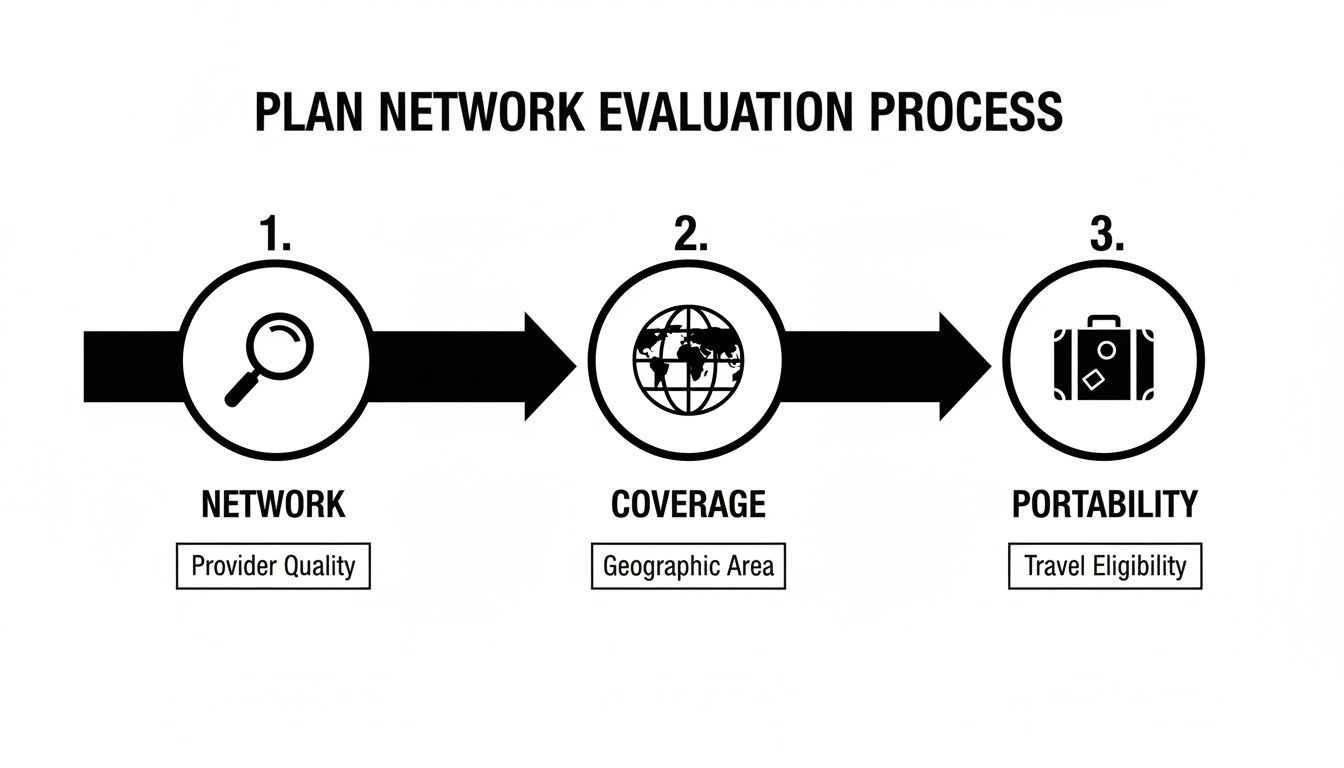
This process highlights a critical point: your financial analysis is only meaningful after you’ve confirmed the plan’s network and coverage area fit your lifestyle.
Running Scenarios for Different Expat Profiles
Let’s put this into practice with a few real-world expat scenarios. We’ll compare two hypothetical plans to see how the “cheaper” option isn’t always the best deal.
- Plan A: Low premium, high risk. $300/month ($3,600/year), with a $5,000 deductible and an $8,000 out-of-pocket max.
- Plan B: High premium, low risk. $500/month ($6,000/year), with a $1,000 deductible and a $4,000 out-of-pocket max.
To see how these plans perform under pressure, we’ve created a quick comparison table modeling the total annual costs for three common expat profiles.
Sample Cost Comparison for Different Expat Scenarios
| Expat Profile | Plan A (Low Premium, High Deductible) | Plan B (High Premium, Low Deductible) | Annual Cost Analysis |
|---|---|---|---|
| Healthy Digital Nomad (28, Thailand, one $150 doctor visit) | $3,600 premium + $150 out-of-pocket = $3,750 Total | $6,000 premium + $150 out-of-pocket = $6,150 Total | Plan A is the clear winner for low medical usage. The risk of high costs is minimal. |
| Family with Young Kids (Spain, $7,000 in medical bills) | $3,600 premium + $5,400 out-of-pocket* = $9,000 Total | $6,000 premium + $2,200 out-of-pocket** = $8,200 Total | Plan B is $800 cheaper. The lower deductible provides significant savings. |
| Retiree with Chronic Condition (65, Mexico, $25,000 in bills) | $3,600 premium + $8,000 (hits OOP Max) = $11,600 Total | $6,000 premium + $4,000 (hits OOP Max) = $10,000 Total | Plan B is $1,600 cheaper. The lower out-of-pocket maximum is the deciding factor. |
*Plan A: Pays the full $5,000 deductible. Then pays 20% of the remaining $2,000 in bills ($400), for a total of $5,400 out-of-pocket.
**Plan B: Pays the full $1,000 deductible. Then pays 20% of the remaining $6,000 in bills ($1,200), for a total of $2,200 out-of-pocket.
As you can see, the “best” plan completely depends on your situation. For the healthy digital nomad, Plan A makes perfect sense. But for the family and the retiree, the higher-premium plan actually saves them a lot of money.
For expats with predictable or high medical needs, the out-of-pocket maximum is the single most important number to compare. It represents your absolute worst-case financial liability for the year.
The retiree in Mexico, for example, will easily hit their out-of-pocket max on either plan. With Plan A, their total annual cost is the $3,600 premium plus the full $8,000 max, totaling $11,600. With Plan B, their cost is the $6,000 premium plus the much lower $4,000 max, for a total of $10,000.
In this high-usage scenario, Plan B is significantly cheaper, saving the retiree $1,600. The higher premium bought them a much lower cap on their financial risk. For more insights on this topic, you can read our guide on the factors that influence international health insurance cost.
This exercise proves why you can’t just look at the monthly premium. You have to account for your own health, your family’s needs, and your personal tolerance for financial risk.
Your Final Checklist for Choosing an Expat Plan
You’ve done the heavy lifting. You’ve narrowed down the sea of options to two or three solid plans and you’re finally ready to make a call. This is where you switch from comparing big-picture features to getting really granular with the fine print.
This last step is all about doing your due diligence. It’s about asking the tough questions and making absolutely sure there are no nasty surprises waiting for you down the line. A little extra scrutiny now can save you a world of headaches later.
Digging Into the Policy Wording
Every single expat insurance policy has an “exclusions” section. This is where you need to put on your detective hat, because it’s where the insurer spells out exactly what they will not cover. Reading this isn’t just a suggestion; it’s a non-negotiable step in the process.
Look for specific things that might apply to your life abroad. For example:
- Adventure Sports: Dreaming of scuba diving in Thailand or skiing the Alps? Many standard policies consider these “high-risk” activities and won’t cover them. You might need to add a special rider to be protected.
- Pre-existing Conditions: Even when a plan says it covers pre-existing conditions, the exclusions section might detail specific waiting periods or limitations. You need to verify that the legal wording matches what the sales agent told you.
- Geographic Exclusions: Some policies have clauses that flat-out void your coverage if you travel to certain high-risk countries. Make sure your travel plans don’t include any locations on that list.
Don’t just skim the summary of benefits. The official policy document is the legally binding contract. When it comes time to file a claim, what’s written in that document is the only thing that matters.
This careful review ensures the plan you pick actually fits the life you intend to live. It’s how you avoid thinking you’re covered for something, only to get a claim denied because of a single line in the fine print.
Verifying the Claims and Assistance Process
A fantastic plan on paper means nothing if filing a claim is a bureaucratic nightmare. Before you sign anything, you need to know exactly how their claims process works. The last thing you want in an emergency is to be desperately searching for a fax machine in a remote village just to send in your receipts.
Get on the phone with the carrier or your agent and ask these direct questions:
- Is your claims process completely digital? Can I submit everything I need—receipts, forms, doctor’s notes—through a mobile app or an online portal?
- What’s the average turnaround time for reimbursements? There’s a huge difference between getting your money back in two weeks versus two months. This is critical for your financial planning.
- How does the 24/7 emergency assistance line actually work? Give the number a call. Does a real person pick up quickly? This is your lifeline in a crisis, so you should absolutely test it out.
A smooth, modern claims process is a great sign. It shows the insurer has invested in making life easier for its members, which is exactly the kind of support you need when you’re thousands of miles from home.
Checking Real-World Reviews and Reputation
Okay, for the last step, it’s time to step away from the glossy brochures and official websites. You need to find out what actual customers are saying. Search for reviews on independent forums, expat Facebook groups, and consumer websites. But don’t just glance at the star ratings—read the stories.
Pay close attention to what people say about:
- Claims Handling: Do you see a pattern of complaints about unfairly denied claims or painfully slow reimbursements? On the flip side, positive reviews that praise a fast, fair claims experience are worth their weight in gold.
- Emergency Assistance: Look for stories from people who actually needed a medical evacuation or help finding a hospital in a crisis. How did the insurer perform when the pressure was on?
- Customer Service: When members had a problem, were the support agents actually helpful and able to solve the issue? Or did it sound like they were just reading from a script?
This kind of feedback gives you an invaluable look at how the company really operates behind the scenes. Sure, every company will have a few grumpy customers, but a consistent pattern of complaints is a massive red flag. By combining your own detailed analysis with the real-world experiences of other expats, you can make your final choice with complete confidence.
Got Questions About Expat Medical Insurance? We’ve Got Answers.
As you get closer to picking a plan, the questions tend to get more specific. It’s totally normal. Moving from the big picture to the nitty-gritty details is a crucial part of making a confident choice. Here are some of the most common questions that come up for expats, along with some straight-talking advice.
Life abroad isn’t just about healthcare, of course. Many practical financial questions pop up, too. For example, figuring out how to open a US bank account for non-residents is a common hurdle, and it’s essential for managing things like insurance premiums and getting claims reimbursed smoothly.
Can I Just Keep My Plan from Back Home?
This comes up a lot, but the short answer is almost always no. Your domestic health insurance, whether it’s from an employer or one you bought yourself, is built for one country. Its network of doctors and hospitals is local.
Once you’re living abroad, that plan offers next to no real protection. You might get some bare-bones coverage for a true emergency if you’re on a quick trip back home, but that’s it. Trying to rely on it as an expat is a massive gamble that could leave you facing truly astronomical medical bills. You need an expat medical insurance plan built for global living.
What Happens if I Have a Pre-Existing Condition?
This is probably one of the most critical points to get right. When you’re applying for expat medical coverage, you have to be completely honest about your medical history. No fudging the details.
Insurers have a few standard ways of handling pre-existing conditions:
- Waiting Periods: They might agree to cover the condition, but only after a “waiting period” of 12 to 24 months of continuous coverage.
- Higher Premiums: Some will cover you from day one but will add a surcharge to your monthly premium to account for the higher risk.
- Exclusions: In other cases, they’ll offer you a policy but will permanently exclude any and all treatment related to that specific condition.
Trying to hide a pre-existing condition is a terrible idea. If the insurance company finds out later—and they often do—they can deny your claims or even cancel your policy outright, leaving you high and dry.
How Much Coverage Do I Really Need?
It’s tempting to opt for a lower annual limit to get a cheaper premium, but this can backfire spectacularly. Serious medical care costs a fortune, and it adds up faster than you can imagine. A single medical evacuation flight can easily top $100,000.
Because of this, we always recommend an annual coverage limit of at least $1,000,000. Anything less than that introduces a level of financial risk most people simply can’t afford to take. The small savings on your premium just aren’t worth the risk of potential financial ruin.
Will My Expat Plan Cover Me When I Visit Home?
This is a great question, and you absolutely need to check the fine print. Most quality international plans do provide some coverage for short trips back to your home country, but it’s never unlimited.
Here’s what to look for:
- Time Limits: Coverage is usually limited to trips of 30, 45, or maybe 60 days per year.
- Reduced Benefits: The amount of coverage might be lower in your home country than in your new country of residence.
- The USA Problem: If your home country is the United States, coverage is almost always an expensive, optional add-on. U.S. healthcare costs are just too high to be included as standard.
Before you sign up, always find the section on “home country coverage” in the policy documents and read it carefully. That way, you know exactly what you’re getting when you fly back to see family and friends.
Choosing the right plan isn’t just about buying insurance; it’s about securing your peace of mind so you can enjoy your life abroad. At Expat Global Medical, our team helps expats cut through the confusion to find coverage that actually fits. Get a free quote today and let us help you find the perfect plan for your global adventure.