
Think of expat medical insurance as your personal, portable healthcare plan for life abroad. It’s a specific type of medical coverage built for individuals and families living outside their home country for the long haul—typically one year or more. Unlike your domestic plan or the short-term travel policy you buy for a vacation, this insurance is designed to move with you, ensuring you have access to quality medical care no matter where you are in the world.
Your Global Healthcare Safety Net
Moving to a new country is an incredible adventure, but figuring out healthcare can feel overwhelming. The reality is, your health insurance from back home usually offers little to no coverage overseas. At the same time, relying on a local plan in your new country can mean dealing with long waiting periods, language barriers, or limited benefits for foreigners.
This is exactly where expat medical insurance steps in. It’s not just another policy; it’s more like a global healthcare passport. It’s a safety net specifically woven for the realities of a globally mobile life.
Beyond Basic Travel Insurance
It’s easy to confuse an expat plan with standard travel insurance, but they are fundamentally different tools for different jobs. Travel insurance is for short-term emergencies—think a broken arm from a ski trip or a sudden illness that cuts your two-week holiday short. It was never intended for routine check-ups, managing ongoing conditions, or any long-term health needs.
An expat medical insurance plan, on the other hand, provides deep, continuous coverage. It’s built to act as your primary health insurance while you live abroad, covering the full spectrum of medical needs.
An expat medical plan ensures you don’t have to compromise on your health just because you’ve crossed a border. It provides continuity of care, financial protection against catastrophic costs, and access to a trusted network of doctors and hospitals worldwide.
Core Benefits of an Expat Plan
These plans are engineered to solve the real-world healthcare puzzles that come with living in a new country. They blend a level of flexibility and security that domestic or travel policies just can’t offer.
Here’s what you can generally expect:
- Comprehensive Medical Coverage: This goes way beyond just emergencies. We’re talking about hospital stays, surgeries, cancer treatment, and diagnostic tests.
- Geographic Flexibility: Your coverage follows you. It works whether you’re in your new host country, traveling for a weekend getaway, or even visiting family back home.
- Access to Quality Care: Insurers build extensive global networks of vetted hospitals and English-speaking doctors, taking the guesswork out of finding reliable care.
- Emergency Medical Evacuation: This is a non-negotiable benefit. It covers the staggering cost of transporting you to the nearest top-tier medical facility if local care isn’t up to the task.
At the end of the day, getting the right expat medical insurance is about protecting both your health and your finances. It delivers the peace of mind you need to fully embrace your new life, knowing you have a solid plan for any medical situation, big or small.
Who Actually Needs Expat Medical Insurance?
The need for expat medical insurance isn’t a one-size-fits-all deal. It’s deeply personal and tied directly to your life abroad. While the core benefit is universal—getting quality healthcare when you need it—the why behind it changes dramatically depending on who you are and where you’re headed.
Trying to rely on local public systems or, worse, going uninsured is a massive gamble. In many countries, you won’t even qualify for public coverage right away. Even if you do, you could be facing long waits and a frustrating language barrier. To get a clearer picture, let’s look at the real-world situations of people who call the world their home.
The Retiree Seeking Peace of Mind
For anyone retiring abroad, healthcare is usually priority number one. Many are managing chronic conditions or simply want the guarantee of consistent, high-quality care as they get older. The thought of navigating a foreign healthcare system, especially with a pre-existing condition, can be incredibly stressful.
A solid expat medical insurance plan provides stability. It means you can keep seeing specialists, get your prescriptions filled, and access top-tier hospitals without worrying if you’re covered. This is all about preserving your quality of life and enjoying retirement without the nagging fear of a surprise medical bill.
For a retiree, a robust expat medical plan is more than just insurance; it’s a commitment to your long-term well-being. It gives you the freedom to choose your doctor and hospital, ensuring the continuity of care that’s so critical in your golden years.
The Digital Nomad Embracing Freedom
Digital nomads live a life of incredible freedom, often bouncing between countries every few months. This constant movement creates a messy healthcare puzzle that a standard insurance policy just can’t solve. A local plan you bought in Spain is useless during your three-month stint in Thailand.
This is where a flexible expat medical insurance plan becomes non-negotiable. It acts as your reliable, constant companion, covering you no matter which border you cross.
- Seamless Coverage: A global plan means you’re not scrambling to buy a new policy every time you get a new passport stamp.
- Emergency Ready: It provides a crucial safety net for unexpected injuries or illnesses, no matter how remote your co-working space is.
- Global Network Access: You can tap into a network of trusted, English-speaking doctors, taking the guesswork out of finding care in a new city.
Without this kind of specialized coverage, a simple medical issue could completely derail your plans and leave you with overwhelming out-of-pocket costs.
The Expat Family Putting Down Roots
When you move your family abroad, your healthcare needs multiply instantly. You need a plan that covers everyone—from routine check-ups and vaccinations for the kids to potential maternity care and emergency services for the whole crew.
A comprehensive family plan ensures everyone has access to the best care possible. This includes:
- Pediatric Care: Making sure your kids can see a pediatrician for regular wellness visits and get immediate care when they inevitably get sick.
- Maternity Coverage: If you’re looking to grow your family, having solid maternity benefits is a must, as these costs can be sky-high overseas.
- Emergency Services: Knowing that in a serious emergency, your entire family is covered for hospitalization and necessary treatments provides peace of mind you just can’t put a price on.
Ultimately, whether you’re a retiree, a nomad, a family, or an employee on an overseas assignment, the common thread is the need for reliable, portable, and comprehensive medical protection. It’s about matching the right coverage to your journey, so your health is never left to chance.
Breaking Down Your Coverage Options
Trying to understand an expat medical insurance plan can feel a bit like learning a new language. You’ll see terms like “inpatient,” “outpatient,” and “medical evacuation” thrown around, and it’s easy to get lost in the jargon.
The best way to think about it is like building a custom safety net. You start with a strong, essential core and then add layers of protection that make sense for your specific life and where you’re headed.
The Foundation: Your Core Coverage
At its heart, every solid expat plan is built on a foundation of core coverage. This isn’t for your routine check-ups; it’s the heavy-duty protection for major, often unexpected, medical events. These are the big-ticket items that could otherwise be financially devastating.
Most core plans will have you covered for:
- Hospitalization: This handles the costs if you’re admitted to a hospital, like your room, nursing services, and meals.
- Surgery: It includes fees for the surgeon and everything associated with the operating room.
- Emergency Care: This ensures you’re protected in urgent medical situations that need immediate attention.
- Cancer Treatment: Access to critical treatments like chemotherapy and radiation is a standard part of most core plans.
As you can see, all kinds of people—from retirees settling down in a new country to digital nomads on the move and families putting down new roots—rely on these foundational benefits.
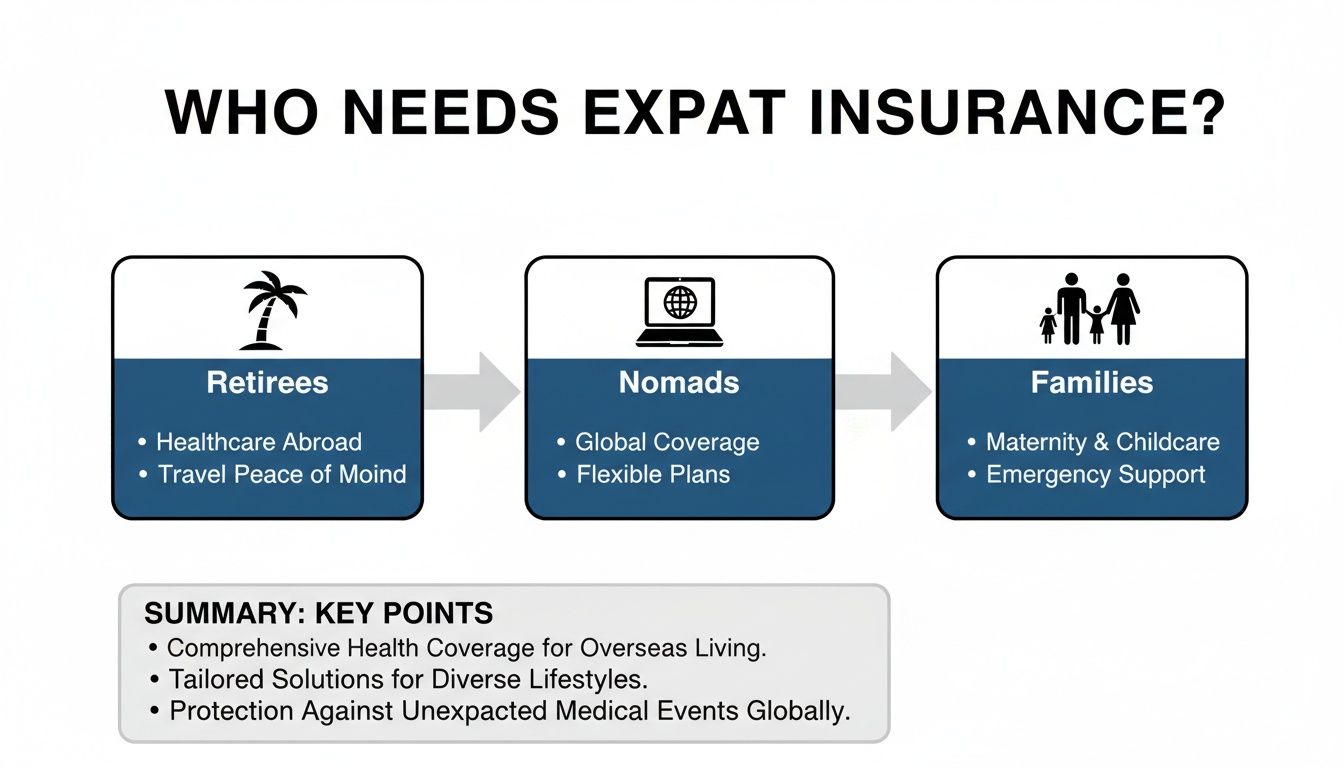
This just goes to show that no matter what your life abroad looks like, a solid healthcare plan is the universal bedrock of a secure and worry-free experience.
Tailoring Your Plan with Optional Add-Ons
Once you’ve got that core foundation locked in, you can start customizing your plan with optional benefits. Think of these as riders that let you pay only for the services you actually think you’ll need, giving you control over both your coverage and your budget.
Some of the most common add-ons include:
- Outpatient Care: This is for all the medical care that doesn’t require an overnight hospital stay. It covers things like routine doctor’s visits, seeing a specialist, and diagnostic tests like X-rays or blood work.
- Dental and Vision: Your core plan won’t cover a routine teeth cleaning or new glasses. This add-on provides coverage for cleanings, fillings, and basic optical needs.
- Wellness and Preventive Care: This benefit is all about proactive health, covering annual physicals, vaccinations, and important health screenings to catch issues early.
- Maternity Coverage: If you’re planning on growing your family abroad, this rider covers prenatal care, delivery, and postnatal care. Just be aware that this benefit almost always comes with a waiting period before you can use it.
The Lifeline of Medical Evacuation
One of the most critical, yet frequently misunderstood, parts of any expat medical insurance policy is medical evacuation. It’s a game-changer.
Imagine you’re in a remote area or a country with a less-than-stellar healthcare system and you suffer a serious injury or fall gravely ill. The local clinic might not be equipped to give you the life-saving care you need.
Medical evacuation is not a luxury; it’s your lifeline. It covers the staggering cost—often exceeding $100,000—of transporting you to the nearest top-tier medical facility capable of treating you properly. In severe cases, it can even cover getting you all the way back home.
Without this, you could be left stranded, facing not just a medical crisis but an impossible financial one, too. For any expat, especially those living in less-developed regions, this coverage is absolutely non-negotiable.
Expat Plans vs. Travel Insurance: A Clear Distinction
One of the biggest mistakes people make is confusing a long-term expat plan with short-term travel insurance. While they both offer medical protection, their purpose and scope are worlds apart. Travel insurance is for short trips and unexpected emergencies; an expat plan is your primary health insurance for living abroad.
The differences become even clearer when you consider how healthcare provider networks operate. You can learn more by checking out our guide on understanding international health networks for expats.
To make it simple, let’s break down the key differences side-by-side.
Long-Term Expat Medical Insurance vs. Travel Medical Insurance
A direct comparison of key features to help you understand which type of coverage is right for your international journey.
| Feature | Long-Term Expat Medical Insurance | Short-Term Travel Medical Insurance |
|---|---|---|
| Primary Purpose | Acts as your primary, comprehensive health insurance while living abroad for a year or more. | Covers unexpected medical emergencies and trip-related issues during a short vacation or trip. |
| Routine Care | Typically covers routine check-ups, preventive care, and chronic condition management. | Almost never covers routine care, preventive services, or pre-existing conditions. |
| Coverage Limits | High annual limits, often $1,000,000 or more, for ongoing and major medical events. | Lower limits, focused on stabilizing an emergency before you can return home. |
| Medical Evacuation | A core benefit designed to transport you to the nearest center of medical excellence. | Often focuses on repatriation (getting you back to your home country) rather than the best nearby hospital. |
| Renewability | Annually renewable, providing continuous coverage for as long as you live abroad. | Not renewable. It covers a fixed trip duration and expires when you get back home. |
By breaking down the components of an international health plan, you can move from feeling overwhelmed to empowered. It’s all about strategically building a policy that gives you robust protection for the big stuff while adding the specific day-to-day benefits that deliver true peace of mind on your global journey.
What Goes Into the Price of Your Premium?
Let’s get straight to the biggest question on every expat’s mind: “So, what’s this actually going to cost me?”
The price tag on an expat medical insurance policy isn’t a one-size-fits-all number. It’s a personalized calculation, and knowing what drives the cost is the first step to finding that sweet spot between great coverage and a comfortable budget.
Think of it like setting the dials on a sound mixer—adjusting your age, location, and plan design changes the final output. The main factors insurers look at are your age, where you need coverage, and how much of the initial cost you’re willing to handle yourself.
Your Age and Medical History
This one’s the foundation of any premium calculation. Statistically speaking, the older we get, the more likely we are to need medical care. It’s just a fact of life, and insurance pricing reflects that reality. Premiums naturally tick up with age because the associated risk does, too.
Your medical history also comes into play, although every provider handles it a bit differently. While pre-existing conditions can sometimes mean higher premiums or specific exclusions on a policy, being completely upfront during your application is non-negotiable. It’s the only way to ensure your plan is there for you when you actually need to use it.
Your Geographic Area of Coverage
Where you plan to live and travel has a huge impact on your costs. Medical care doesn’t cost the same everywhere—not by a long shot. Your premium will be directly tied to the cost of healthcare in the countries you select for coverage.
The classic example? The United States. Healthcare in the USA is exceptionally expensive, so any plan that includes it will be significantly pricier. In fact, many expats who don’t need stateside coverage save a massive amount of money by choosing a “Worldwide excluding USA” plan.
Your Deductible and Cost-Sharing Choices
This is where you get to take the wheel. The deductible you select is one of the most direct ways to manage your premium. A deductible is simply the amount you agree to pay out-of-pocket for medical care before your insurance company starts paying its share. It works just like the deductible on your car insurance.
Choosing a higher deductible will lower your monthly or annual premium. This is a trade-off: you pay less for the plan itself, but you agree to take on more of the initial cost if you need medical care. Finding the right balance here is the key to creating a financial safety net that feels both effective and affordable.
You can see exactly how these factors change the numbers in our detailed guide on the cost of international health insurance.
The Influence of Global Medical Inflation
Finally, it’s important to know that your premium isn’t set in a bubble. It’s also shaped by powerful economic forces, especially global medical inflation. This is the rate at which healthcare costs—from hospital stays and new medicines to advanced technologies—are climbing around the world.
This trend is a major reason why premiums get adjusted over time. Industry reports show global medical cost inflation is forecast to be around 10.3% in 2026, staying in double-digit territory and far outpacing general consumer inflation in most places. You can discover more insights about these ongoing IPMI cost pressures.
By understanding how your age, location, and policy choices intersect with these market forces, you can make a truly informed decision that balances robust coverage with a budget that makes sense for your life abroad.
How to Choose the Right International Health Plan
Navigating the world of expat medical insurance can feel like trying to find your way through a new city without a map. There are so many providers, plans, and confusing options that it’s easy to get overwhelmed. But trust me, making a confident choice is much simpler when you have a clear, step-by-step framework to follow.
The secret is to start with yourself, not the insurance policies. Before you even look at a quote, you need a crystal-clear picture of what you actually need. By getting a handle on your personal situation first, you can immediately filter out the noise and focus only on the plans that are a true fit for your life abroad.
Assess Your Personal and Family Needs
The best insurance plan is one built around your unique health profile and lifestyle, plain and simple. Start by taking a detailed inventory of your personal requirements.
Think about your family’s medical history and any ongoing health needs. Do you have a pre-existing condition that requires regular specialist visits or prescriptions? Are you planning to grow your family, which would make maternity coverage an absolute must? These factors will heavily influence the type of plan that will actually serve you well.
Next, think about your destination. The quality and cost of healthcare can vary dramatically from one country to another. Do a little research on the local healthcare system where you’ll be living.
- Is the public system accessible to expats? In many countries, there are long waiting periods before you can enroll, if you even can.
- What is the standard of private care? Understanding this will help you determine the level of coverage you’ll need for real peace of mind.
- Are there language barriers? Access to a network of English-speaking doctors can be a massive relief when you’re dealing with a medical issue.
This initial self-assessment is the most important step you’ll take. It creates the blueprint you’ll use to measure every policy you consider, ensuring you don’t overpay for benefits you’ll never use or find yourself underinsured when it matters most.
Compare Providers Beyond the Price Tag
Once you have a handle on your needs, you can start comparing insurance providers. It’s tempting to let the monthly premium be your main guide, but the cheapest plan is rarely the best value. A truly effective expat medical insurance plan offers a lot more than just a low price.
Look at the insurer’s reputation and track record. How do they handle claims? Reading reviews and testimonials from other expats can give you invaluable insight into their customer service. A responsive, helpful support team is a huge asset when you’re navigating a health issue in a foreign country.
An insurer’s network is its backbone. A plan is only as good as the doctors and hospitals it gives you access to. Prioritize providers with a strong, established network of high-quality facilities in your destination country.
Also, evaluate how user-friendly their processes are. Do they offer direct billing, where the hospital bills them directly, or will you have to pay upfront and file for reimbursement? A seamless claims process can make a world of difference during what’s already a stressful time.
Scrutinize the Fine Print
Every insurance policy has its own set of rules, and the crucial details are always hidden in the fine print. This is where you’ll find the information that truly defines your coverage. It’s not exactly thrilling reading, but it’s absolutely critical.
Pay close attention to waiting periods. Many plans have them for specific benefits like maternity or complex dental work, meaning you have to be enrolled for a certain amount of time before you can use that coverage. Also, understand exactly how the policy handles pre-existing conditions. Some may cover them after a waiting period, while others might exclude them completely.
Finally, create a simple checklist to compare quotes side-by-side. This is the only way to make sure you’re making an apples-to-apples comparison.
Your Plan Comparison Checklist:
- Annual Limit: Is the maximum coverage amount high enough for a true worst-case scenario?
- Deductible: How much will you have to pay out-of-pocket before the insurance kicks in?
- Geographic Coverage: Does the policy cover all the countries you plan to live in or visit?
- Key Exclusions: What specific treatments or conditions are not covered? This is a big one.
- Evacuation Benefit: Does it cover transport to the nearest top-tier medical facility if local care isn’t adequate?
By following this structured approach, you can cut through the complexity and choose a plan with confidence. You’ll end up with a policy that doesn’t just check a box but truly has your back, no matter where your journey takes you.
Using Your Health Plan Around the World
An expat medical insurance policy is a fantastic tool, but it’s only as good as your ability to use it when you actually need it. Think of it less as a piece of paper and more as your global healthcare partner. Knowing the ins and outs of how it works in a real-world scenario is what makes it truly valuable.
At the end of the day, using your plan boils down to two things: getting medical care and making sure the bills get paid. There are two main ways this happens: direct billing or reimbursement.
Direct billing is the smoothest route. The hospital or clinic sends the bill straight to your insurer, and they handle it. This keeps your out-of-pocket expenses to a minimum.
The other path is reimbursement. You pay for the medical services upfront and then file a claim with your insurance company to get your money back, which means you’ll need to hang on to all your receipts and medical reports. It’s crucial to know which method your provider uses for different types of care to avoid any surprises.
Finding Care and Handling Emergencies
So, you’re in a new country and need to see a doctor. What’s the first step? Always check your insurer’s provider network. These are the hospitals and clinics they’ve already vetted, where direct billing is usually set up, and you can trust the quality of care. Most insurers have an online portal or a 24/7 help line to point you toward an in-network, English-speaking doctor nearby.
In a true medical emergency, though, the priority is simple: get to the closest hospital immediately. Once you’re safe, you or a family member can call your insurer’s emergency assistance line. They will jump in to coordinate with the hospital, guarantee payment, and, if the situation is dire, arrange for a medical evacuation. Our guide on medical evacuation insurance breaks down just how vital this benefit can be.
Having 24/7 access to multilingual support is a cornerstone of a quality expat plan. This team is your advocate, helping you navigate local healthcare systems, overcome language barriers, and manage the logistics of your care from start to finish.
The Rise of Telehealth for Global Citizens
One of the most practical and convenient features of modern expat health plans is access to telehealth services. This lets you have a video consultation with a qualified doctor right from your laptop or phone, no matter where you are in the world. It’s a game-changer for non-urgent issues, getting prescriptions refilled, or even getting a quick second opinion without the hassle of travel.
It’s clear that expats and global nomads are demanding this kind of flexible care. The global expatriate health insurance market is expected to nearly double, reaching USD 33.2 billion by 2033, with a steady growth rate of about 7.4% each year. This boom shows just how essential these specialized medical plans have become for anyone building a life abroad. By getting comfortable with these practical features, you can make sure your health is protected, no matter where your adventures take you.
Got Questions? We’ve Got Answers
Digging into international health insurance can definitely bring up a few questions. It’s a big decision, after all. Here are some straightforward answers to the things we get asked most often, helping you clear up any confusion and move forward with confidence.
Can I Just Use My Insurance From Back Home?
For anything longer than a short vacation, relying on your domestic health plan is almost never a viable option. Those plans are designed specifically for one country’s healthcare system. They rarely, if ever, cover routine medical care once you’re living overseas.
Sure, they might step in for a true, life-or-death emergency on a two-week trip, but they are not built for someone residing abroad for several months or years. To be properly protected, an expat medical insurance plan is an absolute must.
What About My Pre-Existing Conditions? Are They Covered?
This is a big one, and the answer really varies from one insurer to the next. Some might cover pre-existing conditions right away (usually for a higher premium), while others will apply a waiting period before your benefits kick in. In some cases, a provider might exclude a specific condition entirely.
The most important thing you can do is be completely open and honest about your medical history when you apply. This is where a specialized broker becomes so valuable—they know which insurers are more likely to provide the coverage you need for your specific health profile.
Is Medical Evacuation Really Necessary?
Think of medical evacuation as your ultimate safety net. It covers the staggering cost of getting you from wherever you are to the nearest hospital that can actually give you the care you need. This becomes critical if you’re in a location with limited or subpar medical facilities. For very serious situations, it can even cover flying you all the way back home.
If you’re living in or even just traveling through a remote area or a country with a developing healthcare system, this coverage isn’t a luxury—it’s essential. An emergency evacuation can easily cost tens or even hundreds of thousands of dollars out of pocket, which makes it one of the most critical components of a solid international health plan.
At Expat Global Medical, our entire focus is on helping expats, retirees, and digital nomads find the right international health plan for their unique journey. Let us help you explore your options and secure your peace of mind.