Expat medical insurance isn’t just a nice-to-have; it’s a specific type of medical coverage built for individuals and families living outside their home country for the long haul. Think of it as your all-access pass to healthcare, ensuring you’re covered for everything from a routine check-up to a major medical emergency, no matter where your journey takes you.
Why Your Domestic Health Plan Is Not Enough Abroad
Moving abroad is an incredible adventure, but it comes with a critical risk many people don’t see until it’s too late: trying to use a domestic health plan in a foreign country.
Imagine your home-country insurance is a key that only fits one door. It’s perfectly designed for the healthcare system where you live, but its ability to unlock quality, affordable care in another country is severely limited, if not totally useless.
This mismatch can leave you dangerously exposed. Most domestic plans offer little to no coverage outside their national borders, except maybe for a few days of emergency care during a short vacation. They simply weren’t built for the realities of an expat’s life.
The Geographic Gap in Coverage
The moment you become an expat, you step outside your domestic insurer’s established network of doctors and hospitals. Even if your plan claims to have some “out-of-network” international benefits, you’ll almost certainly face some serious hurdles.
You’re likely to run into challenges like:
- Paying Upfront: You could be forced to pay the full, often staggering, cost of medical treatment right out of your own pocket. Then, you’ll have to navigate a maze of paperwork to get even partially reimbursed weeks or months later.
- No Negotiated Rates: Your plan won’t have pre-negotiated rates with local providers, leaving you vulnerable to inflated charges meant for uninsured patients.
- Non-Emergency Exclusions: Forget about coverage for routine check-ups, ongoing treatments for chronic conditions, or even simple prescription refills. Those will almost certainly be denied.
The Financial and Personal Risks
The fallout from being underinsured abroad can be life-altering. An unexpected illness or accident could saddle you with medical bills reaching tens, or even hundreds of thousands of dollars—a financial catastrophe for anyone.
This is exactly why specialized expat medical insurance isn’t a luxury; it’s a fundamental necessity for a secure life abroad.
A dedicated expat medical insurance plan acts as your global healthcare safety net. It’s designed to travel with you, providing a seamless bridge to quality medical care and financial protection, regardless of your location. It ensures you can get the right treatment without hesitation or the fear of financial ruin.
Choosing Your Coverage: Travel vs. Expat Medical Insurance
When you’re planning a move abroad, one of the first—and most confusing—hurdles is figuring out your health insurance. People often mix up travel insurance and true expat medical insurance, but they’re built for completely different worlds. Picking the wrong one can leave you dangerously exposed right when you need protection the most.
Let’s use an analogy. Think of travel insurance as a first-aid kit you’d pack for a camping trip. It’s perfect for short-term, unexpected emergencies—a sprained ankle on a hike, a sudden stomach bug, or a cancelled flight. It’s a temporary fix for a temporary problem.
On the other hand, expat medical insurance is like having your family doctor move abroad with you. It’s a comprehensive, long-term health plan designed for your new daily life. It covers everything from routine check-ups and preventative care to serious medical conditions. It’s built for living, not just visiting.
The Core Purpose Defines the Coverage
The biggest difference boils down to what each plan is designed to do. Travel insurance is laser-focused on emergency medical treatment and trip-related headaches like lost luggage or delayed flights. Its main job is to patch you up and, if things get serious, get you back home for proper care. It almost never touches routine check-ups, ongoing treatments, or pre-existing conditions.
Expat medical insurance, however, is meant to be your primary health coverage while you’re living in another country. It gives you access to a full spectrum of healthcare, just like your plan back home. This means things like hospital stays, specialist visits, mental health support, maternity care, and often even dental and vision are on the table.
Getting this decision right is non-negotiable. Once you move, your old domestic plan becomes virtually useless for overseas care. The flowchart below paints a clear picture of the choice every expat faces.
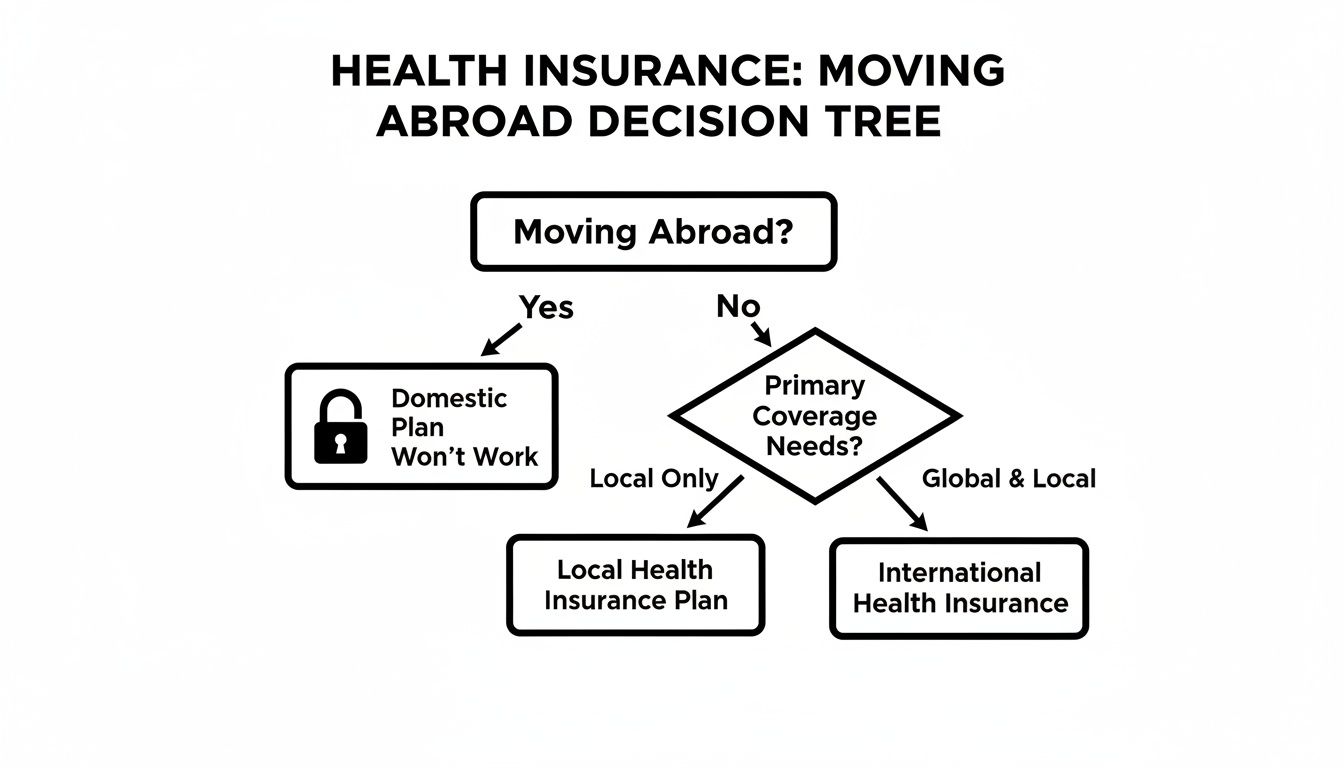
As you can see, your old plan simply isn’t an option. The real decision is between the limited safety net of travel insurance and the robust, comprehensive coverage of an expat medical plan.
Duration and Renewability
Another critical difference is the timeline. Travel insurance policies are strictly short-term, designed to cover a specific trip for a few days, weeks, or maybe a couple of months. You can’t renew them; you just buy a new one for the next trip.
Expat medical insurance plans are annually renewable, giving you stable, continuous coverage for as long as you’re living abroad. This is absolutely essential for managing your long-term health, not to mention satisfying visa requirements. In fact, more than 40 countries now demand proof of valid health insurance for long-stay visas, and a temporary travel policy just won’t cut it.
Choosing the right plan isn’t just about avoiding a few medical bills; it’s about building a foundation for your health and well-being in a new country. Travel insurance is for emergencies on the road, while expat medical insurance is for building a life abroad.
For a deeper dive into this topic, check out our complete guide on expat medical insurance vs. travel insurance to see exactly which one fits your journey.
A Side-by-Side Comparison
To really simplify things, let’s lay out the key differences in a table. This should make the right choice crystal clear.
Comparing Global Insurance Plans
| Feature | Travel Insurance | Long-Term Expat Medical Insurance |
|---|---|---|
| Primary Goal | Covers short-term travel emergencies and trip interruptions. | Provides comprehensive, ongoing healthcare for residents abroad. |
| Coverage Duration | Short-term, tied to the length of a specific trip. | Annually renewable, designed for long-term stays (1+ year). |
| Typical Inclusions | Emergency medical, trip cancellation, lost baggage. | Inpatient, outpatient, wellness, maternity, mental health. |
| Routine Care | Almost never covers routine check-ups or preventative care. | Generally includes wellness visits, screenings, and check-ups. |
| Pre-existing Conditions | Usually excluded or only covered for acute, unexpected episodes. | Can be covered, often with specific terms or underwriting. |
| Renewability | Not renewable; a new policy is needed for each trip. | Annually renewable for continuous, long-term protection. |
At the end of the day, if you’re moving abroad for any significant amount of time—say, six months or more—the answer is simple. You need a proper expat medical insurance plan. It’s the only way to ensure you have the peace of mind that comes from knowing you’re fully covered, from a minor cold to a major medical event, no matter where you decide to call home.
What a Strong Expat Medical Plan Actually Covers
When you start digging into expat medical insurance, the jargon in the policy documents can make your head spin. To cut through the noise, it helps to stop thinking of a plan as just a document and start seeing it as a complete support system for your health and financial security while living abroad.
Without the right pieces in place, you’re left with dangerous gaps that could lead to staggering out-of-pocket costs and a whole lot of stress. A quality plan is a safety net, protecting you from routine doctor’s visits all the way to serious, life-altering emergencies. Let’s break down exactly what a solid expat medical plan should include.

The Unbreakable Foundation: Inpatient and Outpatient Care
At the very heart of any decent expat medical plan are two fundamental types of coverage: inpatient and outpatient care. Think of these as the absolute bedrock of your day-to-day medical protection.
Inpatient care is your coverage for any treatment that requires you to be formally admitted to a hospital. This isn’t just the big stuff like surgery; it covers your room, nursing care, diagnostic tests like MRIs, and all the medications you receive during your stay. A major accident or a sudden illness could easily rack up hospital bills over $100,000, which makes robust inpatient coverage completely non-negotiable.
Outpatient care, on the other hand, covers all the medical services that don’t require an overnight hospital stay. This is the stuff you’ll use most often.
It’s your everyday health management, which includes things like:
- Visits to your family doctor or a general practitioner.
- Consultations with specialists like a cardiologist or dermatologist.
- Prescription drugs you pick up from the local pharmacy.
- Lab work and diagnostic tests done outside of a hospital setting.
A plan without solid outpatient benefits means you’re paying for every single doctor’s visit and prescription out of your own pocket. Those costs add up fast and can even discourage you from getting the preventative care you need to stay healthy in the first place.
The Critical Lifeline: Emergency Medical Evacuation
Let’s be realistic: sometimes the closest clinic or hospital just isn’t equipped to handle a true medical crisis. This is a real risk if you’re living in a remote area or a country with a less-developed healthcare system. This is where emergency medical evacuation becomes one of the most vital parts of your expat medical insurance plan.
Medical evacuation covers the astronomical cost of getting you from where you are to the nearest medical facility that can properly treat you. That might mean a specialized ambulance to a better hospital in the next city over, or it could mean a private, medically-staffed flight to an entirely different country.
An air ambulance isn’t cheap. The costs can run anywhere from $25,000 to over $200,000, depending on how far you need to go and the level of medical care required in transit. Without this coverage, that entire bill would land squarely on your shoulders.
This isn’t a luxury—it’s about getting access to life-saving care when every second is critical. To really grasp its importance, you can learn more about the specifics of medical evacuation insurance and see why it’s a must-have for any expat.
Coverage That Provides True Peace of Mind
Beyond the absolute essentials, the best expat medical insurance plans include benefits that support your total well-being and help you prepare for major life events. These are the elements that turn a basic policy into a true partner in your health.
Mental Health and Wellness
Living in a new country is an amazing adventure, but it can also be incredibly challenging. Access to mental health support is crucial. Top-tier plans now offer coverage for therapy, counseling, and psychiatric care, recognizing that your mental wellness is just as important as your physical health.
Maternity Care
For expats looking to start or grow their family abroad, comprehensive maternity coverage is a must. This should include everything from prenatal check-ups and delivery costs to postnatal care for both mom and the new baby. Be aware that most plans have a waiting period of 10-12 months before maternity benefits kick in, so it’s something you absolutely have to plan for in advance.
Dental and Vision
While dental and vision are often sold as optional add-ons, they can be incredibly valuable. These modules help cover the costs of routine cleanings, fillings, eye exams, and prescription glasses or contacts. It’s a small investment that can save you a lot of money on essential care throughout the year.
By making sure your plan is built on these key pillars—inpatient, outpatient, emergency evacuation, and wellness benefits—you’re creating a powerful shield around your health and your finances. It’s what allows you to truly embrace your new life abroad with confidence, knowing you’re ready for whatever comes your way.
How Expat Medical Insurance Premiums Are Calculated
Figuring out the cost of expat medical insurance shouldn’t be a black box. Insurers don’t just pull numbers out of a hat; they use a clear set of factors to calculate your premium—the amount you pay to keep your policy active. Once you understand what drives these costs, you can see exactly where your money is going and even find ways to tailor a plan to your budget.
The demand for this kind of coverage is exploding, which tells you just how many people are relying on it. The international health insurance market was valued at around USD 168.06 billion in 2023 and is on track to hit USD 274.2 billion by 2032.
This isn’t just an abstract number. It shows how vital these plans have become for global citizens. Let’s break down the key ingredients that determine your final premium.
Your Age and Health Profile
This is, without a doubt, one of the biggest pieces of the puzzle. Generally, the younger you are, the lower your premium. Statistically, younger folks are less likely to need major medical care, so the risk for the insurer is lower. As you get older, the likelihood of health issues cropping up increases, and the cost of insurance reflects that.
Your current health and medical history also matter. While many plans will cover pre-existing conditions (often after a waiting period), having a chronic condition might mean your starting premium is a bit higher.
Your Chosen Area of Coverage
Where you plan to live and travel has a massive impact on your premium. Insurers group countries into different pricing zones based on how much healthcare typically costs there. For instance, a plan that covers you in Southeast Asia will be much, much cheaper than one that includes Western Europe.
But the single biggest price jump comes from including one country in particular: the United States.
- Worldwide Excluding USA: This is a very popular choice for expats. It gives you coverage everywhere on the planet except the U.S. and strikes a great balance between comprehensive protection and affordability.
- Worldwide Including USA: Adding the U.S. to your plan can easily double your premium. This is a direct result of America’s sky-high medical costs, the complex healthcare system, and the risk of malpractice lawsuits.
Being smart about your coverage area is one of the easiest ways to control your costs. If you don’t plan on spending much time in the U.S., excluding it is a simple way to save a significant amount of money.
Your Plan’s Deductible and Cost-Sharing
The final key is the structure of the plan itself. The deductible is the amount you agree to pay out-of-pocket for medical care before your insurance company starts chipping in. The higher you set your deductible, the lower your monthly or annual premium will be.
It works like a seesaw: a high deductible means a lower premium, and a low deductible means a higher premium.
Choosing a higher deductible can make your plan much more affordable, but it’s a trade-off. You’ll need to have enough in savings to cover that amount if a medical emergency pops up.
Cost Examples for Different Expat Profiles
To see how all this comes together in the real world, let’s look at a couple of hypothetical expats.
- The Digital Nomad in Asia: Imagine a 28-year-old remote worker living in Thailand. She opts for a “Worldwide excluding USA” plan and chooses a moderate deductible of $2,500. Her premium might land somewhere between $150 – $250 per month.
- The Family in Europe: Now picture a family of four (parents aged 42 and 40 with two kids) moving to Spain. They need a “Worldwide including USA” plan for visits back home and pick a lower deductible of $1,000 for more predictable out-of-pocket costs. Their combined family premium could easily be in the $900 – $1,500 per month range.
These examples really highlight how your unique situation and the choices you make directly influence your costs. For a more personalized breakdown, check out our complete guide on international health insurance costs.
Meeting Visa Rules and Accessing Local Doctors
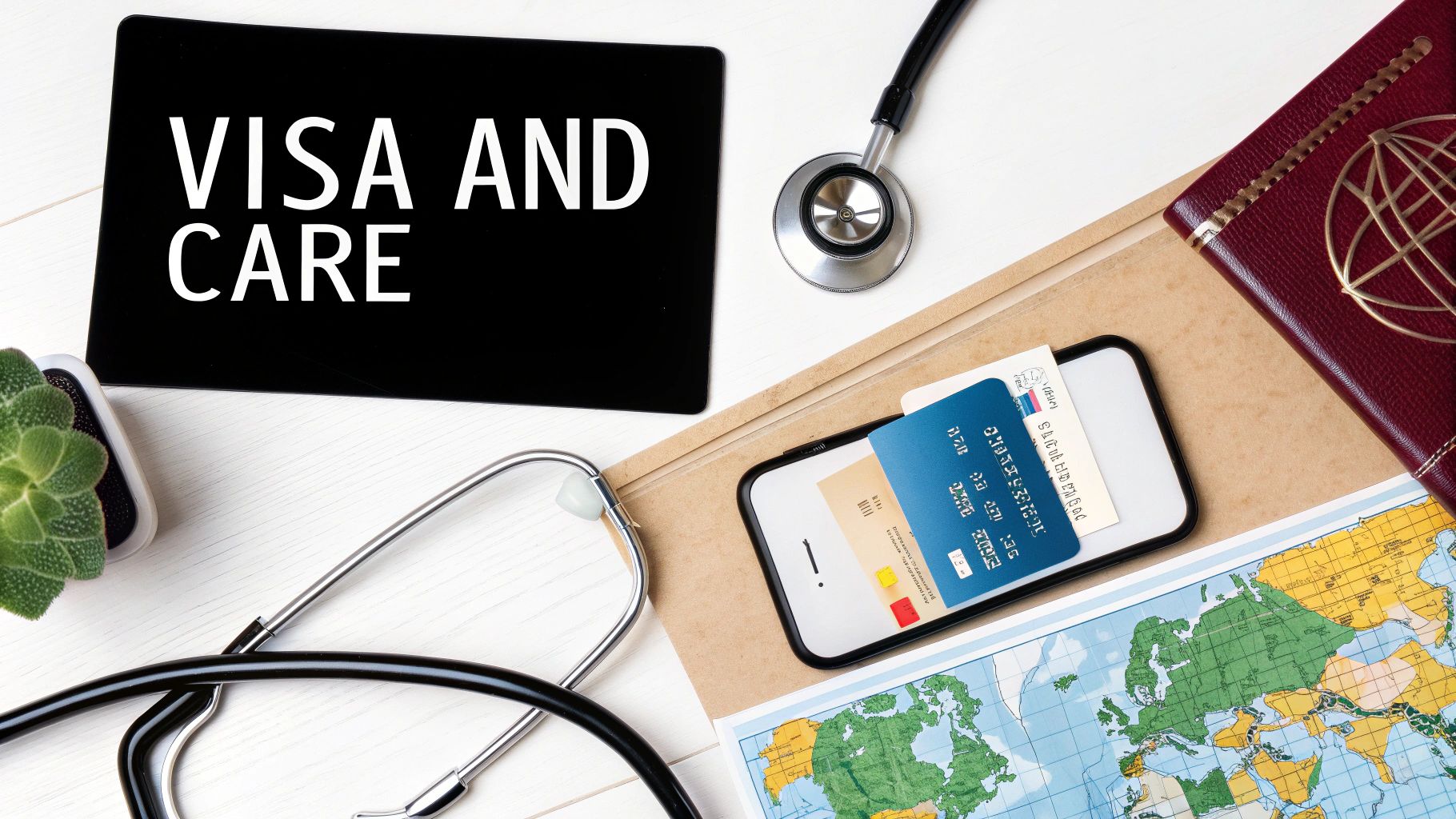
Having a solid expat medical insurance plan is crucial, but it serves a dual purpose you might not expect. It’s not just about protecting your health—it’s often the key that unlocks your legal right to live and work abroad.
More and more countries are cracking down, legally requiring expats to show proof of valid health insurance before issuing a long-stay visa or residency permit. This isn’t just a friendly suggestion; it’s a strict rule designed to ensure newcomers don’t become a financial drain on the local healthcare system.
This trend is only growing. In fact, over 40 countries now demand proof of coverage for entry. The entire Schengen area in Europe, with its 29 member nations, is a prime example, requiring it for anyone planning a long-term stay. You can dig deeper into these specific entry requirements on ExpatriateHealthcare.com.
Navigating Provider Networks and Billing
Once you’ve satisfied the visa officers, your insurance has another job: connecting you to actual doctors and hospitals. The strength of an insurer’s local provider network is what makes your policy useful in the real world. It directly impacts how easily you can get care without headaches.
Think of it like a cell phone plan. A top-of-the-line smartphone is useless if you have no service in your area. In the same way, a fantastic insurance policy won’t do you much good if none of the local clinics or hospitals accept it.
You’ll generally run into two types of systems:
- Direct Billing Networks: This is the gold standard for convenience. The insurer has pre-arranged agreements with a network of hospitals. You just show your insurance card, the provider bills the insurance company directly for covered services, and you avoid massive out-of-pocket payments.
- Pay-and-Claim Systems: If you get care outside that direct billing network, you’ll probably have to pay for everything upfront. You then submit receipts and a mountain of paperwork to your insurer and wait to get reimbursed.
How to Evaluate an Insurer’s Network
Before you even think about signing a policy, do your homework on the insurer’s network in your specific city or region. A huge global network sounds impressive, but what really matters is the number of quality doctors and facilities within a reasonable distance of your new home.
A strong local network is the bridge between your insurance policy and your health. It ensures that when you need care, your primary focus is on getting well, not on navigating payments or finding a qualified doctor who will accept your plan.
When you’re comparing plans, don’t just skim the benefits list. Use the insurer’s online provider search tool. Look for well-regarded hospitals, specialists, and family doctors in your new neighborhood. This one simple step can save you a world of frustration and ensure your expat medical insurance offers real, accessible protection right when you need it most.
Your Checklist for Choosing the Right Expat Insurance
Picking the right expat medical insurance can feel like a huge, complicated puzzle. It really doesn’t have to be. If you break it down into a few logical steps, you can confidently sort through your options and land on a plan that genuinely fits your life abroad.
Think of this checklist as your personal roadmap. It’s designed to help you put everything we’ve talked about into action, guiding you from a bit of self-reflection all the way to your final choice without missing a single important detail.
Step 1: Assess Your Personal and Family Needs
Before you even glance at a policy brochure, you need to get crystal clear on your own unique health situation. A plan that’s perfect for a young, solo adventurer will be a disaster for a family with young kids or someone managing a chronic condition. Being honest and thorough here is the single best way to avoid painful coverage gaps down the road.
Start by asking yourself a few key questions:
- Your Health History: Do you or anyone in your family have pre-existing or chronic conditions that need regular attention?
- Future Family Plans: Are you thinking about starting or adding to your family? If that’s on the horizon, you absolutely need a plan with solid maternity benefits, and don’t forget about that typical 10-12 month waiting period.
- Your Lifestyle: Are you the type to go trekking on weekends, potentially needing coverage for sports injuries? Or is your life more about routine, preventative care?
- Wellness Priorities: Is access to mental health support a must-have? What about routine dental cleanings or annual eye exams? Make a simple list of your “non-negotiables” and your “nice-to-haves.”
Step 2: Define Your Geographic Coverage Area
Where you’re heading is a massive factor in how much you’ll pay and what kind of doctor network you’ll need. The cost and quality of healthcare swing wildly from one country to the next, so your plan has to match up with where you’ll be living and traveling.
Your area of coverage is one of the most significant levers you can pull to manage costs. Excluding high-cost regions like the USA can reduce your premium by as much as 50% if you don’t plan on spending significant time there.
Think through these points:
- Your Home Base: Where will you spend most of the year? Do some quick research on what healthcare is like there—both in quality and cost.
- Travel Habits: Do you see yourself taking frequent side trips to other countries or regions?
- Trips Home: Will you need coverage when you pop back to your home country for visits, especially if home is the United States?
Step 3: Set a Realistic Budget
Okay, now it’s time to find that sweet spot between what you need and what you can comfortably afford. Figure out a monthly or annual premium that works for you, but also think about the other side of the coin: your potential out-of-pocket costs.
- Deductible: How much are you willing to pay upfront before your insurance starts covering the bills? A higher deductible means a lower premium, but it also means you carry more financial risk if something unexpected happens.
- Co-insurance: Are you okay with a plan where you pay a percentage of the bill (say, 20%) after you’ve met your deductible?
- Annual Maximum: What’s the total amount the insurer will pay out in a year? You want this number to be high. It’s your safety net against a worst-case-scenario, catastrophic event.
By working through this checklist methodically, you turn a complex decision into a series of manageable steps. You’ll be able to compare plans based not just on price, but on true value, making sure your chosen expat medical insurance is the right partner for your global life.
A Few Common Questions We Hear About Expat Insurance
When you’re sorting out the details of a move abroad, insurance questions are bound to pop up. It’s a lot to take in. Here are some straightforward answers to the questions we get asked most often by expats getting ready for a new chapter. Getting these points clear is the first step to making sure you’re properly protected.
Can I Just Keep My Insurance Plan From Back Home?
This is easily one of the most common questions, and the answer is almost always a hard no. Your domestic insurance plan is built specifically for one country’s healthcare system and its network of doctors and hospitals. The moment you become a resident elsewhere, that coverage basically becomes useless.
Trying to rely on your old plan is a massive financial gamble. It won’t cover you for routine check-ups, ongoing care for a chronic issue, or visits to a specialist overseas. You’d be stuck paying for everything out of your own pocket and then facing a long, frustrating, and usually unsuccessful fight to get reimbursed.
What Happens if I Move to Another Country Later On?
The expat life is often a mobile one, and your health insurance has to be able to keep up. This is where plan portability is a non-negotiable feature. A true global health plan is designed to follow you, providing uninterrupted coverage as you move from one country to the next.
With a portable policy, you don’t have to start from scratch with a new application and underwriting every time you pack your bags. This is a huge deal, especially if you’ve developed a new health condition since you first got insured. Starting with a global insurer from day one gives you seamless, continuous protection.
Portability means your health coverage isn’t chained to one location. For any long-term expat, it’s a critical feature that gives you the freedom to move globally without risking your access to quality healthcare.
How Do Insurers Handle Pre-Existing Conditions?
Every insurer looks at pre-existing conditions a little differently, but one thing is universal: you must be completely honest and upfront on your application. Hiding something is the surest way to get a future claim denied. Generally, insurers will handle existing conditions in one of a few ways:
- Waiting Periods: Some plans will agree to cover your condition, but only after a certain amount of time has passed (like 24 months) where you haven’t had symptoms or needed treatment.
- Premium Surcharges: The insurer might cover the condition right away but will add a “loading” fee or surcharge to your premium to balance out the higher risk.
- Exclusions: In some situations, the insurer will offer you a policy but will write in a permanent exclusion for any care related to that specific pre-existing condition.
How Does Making a Claim Actually Work When You’re Overseas?
With a good provider, the claims process is surprisingly simple. You’ll usually encounter two main scenarios. The first is direct billing, which is common for major treatments like a hospital stay. The hospital bills your insurance company directly for any covered services, so you have little to no out-of-pocket costs.
For smaller things like a doctor’s visit or picking up a prescription, you’ll typically pay first and then file for reimbursement. You just submit a claim form and your receipts to the insurer, usually through an online portal or a mobile app. Most top-tier global insurers have made this process incredibly fast, getting your money back to you quickly.
Figuring all this out is much easier when you have an expert in your corner. The team at Expat Global Medical has been helping expats find the right coverage since 1992, making sure their health and financial well-being are secure, no matter where they call home.
Get your free, personalized quote today by visiting https://expatglobalmedical.com.