
Think of international student insurance as your health and financial lifeline while you’re studying in another country. It’s far more than just a piece of paper to satisfy a visa requirement; it’s the critical protection that stands between you and a medical bill that could completely upend your education. Essentially, it’s a specialized form of expat medical insurance, tailored for the unique needs of a student living abroad.
What Is International Student Insurance and Why Is It Essential?
When you pack your bags for an overseas adventure, you’re not just leaving home behind—you’re also stepping away from its healthcare system. A simple twisted ankle from exploring your new city or a sudden bout of flu can quickly turn into a financial nightmare in a foreign country.
This is exactly where international student insurance comes in. It’s a specialized type of health coverage designed specifically for the risks you’ll face.
Unlike a basic travel policy meant for a two-week vacation, these plans are built for the long haul. They provide comprehensive medical coverage for the entire length of your academic program, covering everything from emergency room visits and consultations with doctors to prescription drugs. It’s the kind of robust, reliable coverage that’s central to any good expat medical insurance, designed for people living, not just visiting, abroad.
A Non-Negotiable Foundation for Your Success
There’s a good reason so many universities and countries make this insurance mandatory. Without it, a seemingly minor incident could saddle you with tens of thousands of dollars in debt, potentially forcing you to drop out and go home. Your insurance policy acts as a crucial buffer, taking on the financial weight so you can keep your focus where it belongs: on your studies.
The need for this kind of protection is clear when you look at the numbers. The global market for overseas student insurance is booming, expected to reach about $15 billion in 2025 and projected to grow at a healthy 8% each year through 2033. This growth goes hand-in-hand with the explosion in students studying abroad. Australia, for instance, saw a massive 22% year-over-year increase in international student enrollments in 2023.
This specialized insurance is your first line of defense in an unfamiliar healthcare system. It ensures that a medical issue remains just that—a health concern—and doesn’t escalate into a financial crisis that jeopardizes your future.
At the end of the day, getting the right international student insurance is one of the smartest investments you’ll make. It gives you peace of mind, ticks the box for official requirements, and lays a secure foundation for a healthy, successful experience abroad. By understanding the core benefits of plans like those detailed in our guide to international medical insurance for expats, you can make a smart choice that protects both your health and your academic dreams. It’s the key to navigating your new life with confidence.
Decoding the Main Types of Student Health Plans
Picking the right international student insurance can feel like trying to solve a puzzle where all the pieces look the same. But it’s simpler than you think. Most plans fall into three main buckets, each built for a different situation and timeframe. Understanding these options, which are all variations of expat medical insurance, is the first step to building a solid health and financial safety net for your time abroad.
Think of your insurance as a two-part shield. It’s there to protect both your well-being and your wallet from the unexpected.
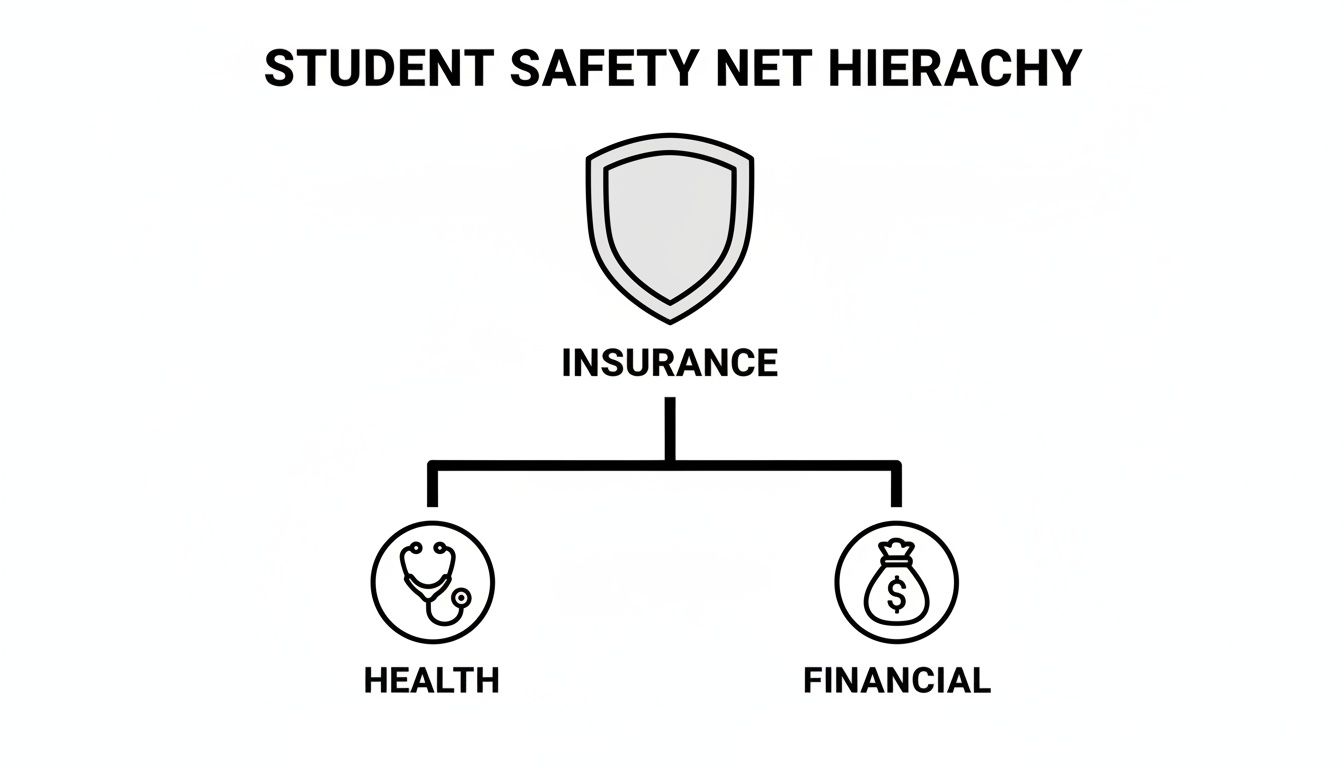
This dual protection is crucial. Proper coverage means you won’t just get the care you need; you’ll also be shielded from medical bills that could derail your studies.
Short-Term Travel Medical Plans
Think of a short-term travel medical plan as a temporary bridge. It’s the perfect solution for those first few weeks in a new country before your main school plan starts, or for shorter stints like a summer course.
These policies are designed to cover emergencies—a sudden illness or an accident—not routine doctor visits. They almost never meet the strict requirements for full-time student visas, but they’re an excellent stopgap to make sure you’re protected from day one.
Student-Specific International Health Plans
This is the real deal for most international students. These are comprehensive plans designed to last the entire academic year, and they’re what expat medical insurance specialists like us almost always recommend. Why? Because they’re built for the realities of living abroad, not just visiting.
Unlike a basic travel policy, these plans go much deeper. They often include benefits that are essential for student life, such as:
- Mental Health Support: Access to therapy and counseling is a lifesaver when you’re dealing with the stress of a new culture and demanding classes.
- Sports Coverage: Got injured playing on the university soccer team? A good student plan will cover it, whereas many other policies won’t.
- Prescription Medications: If you need ongoing medication, this coverage is non-negotiable.
- Preventive Care: Some of the better plans will even cover your annual check-ups and wellness visits.
Choosing a student-specific plan means you’re investing in coverage designed for your lifestyle. It addresses the day-to-day health needs of living abroad, providing a much deeper level of security than a simple emergency-only plan.
The demand for these robust plans is booming for a reason. The international student health insurance market was valued at a massive $5.85 billion in 2024 and is expected to hit $11.34 billion by 2032, growing at an 8.62% clip each year. This makes sense when you consider that nearly 7 million students are projected to study abroad by 2030. Industry leaders like Cigna, IMG, and GeoBlue are at the forefront of this market. If you’re interested in the data, you can dig into the full research on international student insurance trends.
University and Embassy Mandated Plans
Finally, you have the plans that are simply not optional. Many universities and governments have incredibly strict insurance rules you have to follow to get your visa or even enroll in classes. Students on an F-1 visa in the USA or those heading to Australia with its mandatory Overseas Student Health Cover (OSHC) know this well.
These mandated plans are guaranteed to tick all the boxes your school or embassy requires. The downside? They can be more expensive and offer less flexibility than plans you could find through a specialist broker. The single biggest mistake we see students make is buying a cheap, non-compliant plan, only to have the university reject it. They’re then forced to buy the school’s pricey plan at the last minute, essentially paying for insurance twice.
This is where an expert in expat medical insurance can save you a lot of headache and money. We help you navigate the tricky requirements to find a policy that’s not only compliant but also gives you fantastic value.
Comparing International Student Insurance Plan Types
To make it even clearer, here’s a side-by-side look at the three main types of plans. This should help you quickly identify which one best fits your unique situation as you prepare for your studies abroad.
| Feature | Short-Term Travel Medical | Student-Specific Health Plan | University/Embassy Mandated Plan |
|---|---|---|---|
| Best For | Short courses, visa waiting periods | Full academic year or longer | Meeting specific visa/school rules |
| Coverage Focus | Emergency medical only | Comprehensive (emergency & routine) | Varies, but meets minimum legal standards |
| Typical Duration | Days to a few months | 12 months (renewable) | Semester or full academic year |
| Visa Compliant? | Rarely | Often, but must be verified | Yes, always |
| Flexibility | High (many provider choices) | Moderate (customizable benefits) | Low (often one required provider) |
| Key Benefits | Accident & illness, evacuation | Adds mental health, sports, prescriptions | Guaranteed to include required benefits |
Ultimately, understanding these core differences is the key. It ensures you’re not just buying a policy, but investing in the right protection for your health, finances, and peace of mind while you pursue your education abroad.
Navigating University and Country Insurance Requirements

When you’re gearing up to study abroad, your health insurance isn’t just a good idea—it’s a non-negotiable requirement for both your visa and your university enrollment. But here’s the catch: the rules are all over the map. A policy that gets an immediate thumbs-up for a student in Spain could be flat-out rejected for someone heading to Australia.
This tangled web of regulations is where many students make their first, and often most expensive, mistake. Grabbing a generic plan online without digging into the fine print can lead to a denied visa application or, worse, being forced to buy a second, pricey university plan right after you land. The first step to a smooth start is understanding exactly what your destination demands.
Country-Specific Mandates
Many countries have government-enforced insurance rules that are an absolute must for student visa holders. These aren’t suggestions; they’re designed to make sure you won’t put a strain on their local healthcare system if something goes wrong.
- Australia’s OSHC: If you’re heading down under, you have to buy a specific policy called Overseas Student Health Cover (OSHC). It’s a legal requirement for your student visa, and you need to be covered for your entire stay, no exceptions.
- Schengen Area in Europe: For countries in the Schengen zone (think Germany, France, or Italy), your visa application hinges on proving you have health insurance. It must meet specific criteria, including a minimum coverage of €30,000, and it has to be valid across all Schengen member states.
- USA’s J-1 and F-1 Visas: The U.S. plays by different rules depending on your visa. J-1 visa holders, for example, are required to have insurance that includes at least $50,000 for medical evacuation and $25,000 for repatriation of remains. F-1 visa requirements are less defined at the federal level, but that’s where individual universities step in with their own strict standards.
The Critical Role of University Waiver Forms
On top of national laws, your university will have its own list of insurance demands. You’ll typically find these detailed in a document called a “waiver form” or “compliance form.” This piece of paper is your golden ticket to finding an acceptable—and often better—alternative to the school’s default plan.
Think of the waiver form as a checklist. If you want to use an outside plan, it has to tick every single box on that form. Miss just one requirement—like having a U.S.-based claims administrator or specific coverage limits for mental health—and your waiver will be denied, forcing you onto the school’s plan.
The biggest mistake a student can make is assuming any online plan will pass muster. You have to proactively find your university’s waiver form and use it as your shopping guide. It’s the only way to avoid paying for two policies.
For students bound for the United States, getting this part right is especially crucial. You can find more detailed guidance on what to look for in our resources for international student insurance in the USA for non-USA residents.
A Practical Roadmap for Success
This doesn’t have to be a headache. Just follow a clear, step-by-step approach to make sure you get compliant, high-quality coverage without breaking the bank.
- Identify Government Rules: Start by researching the student visa insurance requirements for your destination country. This is your baseline.
- Find the University Waiver Form: Head to your university’s international student office website and hunt down their insurance waiver or compliance form. This document is the key.
- Compare Requirements: Put the government and university requirements side-by-side. Your policy must satisfy the stricter of the two on every single point.
- Seek Expert Guidance: This is where a specialist in expat medical insurance can be a lifesaver. A good broker can analyze your waiver form and point you to pre-vetted, compliant plans that often give you far more bang for your buck than the university’s option.
By treating these requirements as a non-negotiable part of your pre-departure checklist, you empower yourself to make a smart, informed decision. A little proactive research now is the key to protecting your health and your wallet from day one.
Understanding Your Policy Coverage and Exclusions

The quickest way to get hit with a surprise medical bill is to not understand what your international student insurance actually covers. Stop thinking of your policy document as tedious fine print. Instead, see it for what it is: the user manual for your financial safety net. Learning to read it is the single most important thing you can do to protect yourself.
At its heart, a solid policy is built to cover medically necessary treatments for new illnesses or injuries that pop up after your plan starts. It’s all about the essentials that keep you safe and healthy while you’re studying far from home.
The trick is to get familiar with two key parts of your policy: the “Schedule of Benefits” (what’s covered) and the “List of Exclusions” (what’s not). Together, they tell the full story.
What Your Policy Typically Covers
Most quality plans, especially the ones you’ll find from expat medical insurance specialists, lay a strong foundation of coverage. While the nitty-gritty details will vary, you can generally count on seeing a few core benefits.
These standard inclusions are the backbone of your plan, designed to handle the most common medical situations you might face:
- Hospital Stays and Doctor Visits: This is your coverage for inpatient hospital care, trips to the emergency room, and appointments with doctors for covered conditions.
- Prescription Medications: If a doctor prescribes medicine for a covered illness or injury, your plan should step in to help with the cost.
- Emergency Medical Evacuation: If you get seriously sick or hurt somewhere without adequate medical facilities, this benefit pays to transport you to the nearest capable hospital—which might even be in another country.
- Repatriation of Remains: In the tragic event of a death, this covers the cost of transporting remains back to your home country.
It’s impossible to overstate how critical these core benefits are. Medical evacuation is something you hope you’ll never need, but without it, you could be looking at a bill topping $100,000. For any student studying abroad, it’s non-negotiable.
Common Exclusions That Catch Students Off Guard
Knowing what isn’t covered is just as important as knowing what is. Exclusions are the specific situations and conditions the insurance company will not pay for. Ignoring this list is a surefire way to end up with a denied claim and a massive bill.
Here are a few of the most common exclusions that trip students up all the time:
- Pre-Existing Conditions: Most standard plans won’t touch treatments for medical issues you had before the policy began. If you have a chronic condition, you’ll likely need a more specialized plan that explicitly agrees to cover it.
- High-Risk and Adventure Sports: Thinking about rock climbing, scuba diving, or even just playing on a competitive university sports team? Many basic policies wash their hands of injuries from these activities. Always check if you need to buy a separate sports rider to be covered.
- Routine and Preventive Care: Things like annual check-ups, immunizations, and routine dental or vision exams usually aren’t included in basic plans. You might find these benefits in more comprehensive (and more expensive) expat medical insurance plans.
- Mental Health Limitations: While more plans are offering some mental health support these days, the coverage can be pretty limited. It might be capped at a certain number of sessions or have a lower dollar limit. If this is important to you, you need to verify the specifics.
By taking the time to review both what’s included and what’s excluded, you shift from just having insurance to truly understanding your protection. This proactive step lets you use your benefits with confidence and keeps your focus where it belongs: on your education, not on the financial stress of a denied claim.
How To Compare Policies and Choose the Best Plan
Trying to pick an international student insurance policy can feel like you’re staring at a wall of options. When every plan looks a little different, how do you get past the price tag and figure out which one will actually have your back?
The key isn’t finding the cheapest plan—it’s about methodically comparing the handful of features that really matter. Think of it like buying a car. One might have a lower sticker price, but if it has a tiny engine and zero safety features, it’s a terrible deal. That rock-bottom insurance plan could leave you dangerously exposed right when you need it most.
Deconstructing The Core Financial Terms
Before diving in, you need to speak the language. Insurance policies are built around a few core financial terms that dictate how you and the insurer split the costs. Get these down, and everything else becomes clearer.
- Deductible: This is the amount you pay out-of-pocket for medical care before the insurance company starts chipping in. If your plan has a $250 deductible, you’re on the hook for the first $250 of your bills.
- Coinsurance: Once you’ve paid your deductible, coinsurance kicks in. It’s the percentage split of the remaining bill. A common arrangement is 80/20, which means the insurer pays 80% and you cover the other 20%.
- Coverage Limit (or Policy Maximum): This is the absolute ceiling on what the insurance company will pay out during your policy period. A $100,000 limit sounds like a lot, but a serious accident could blow past that in a hurry. Higher is always safer.
A plan with a $0 deductible might sound great, but if it comes with a low coverage limit, it’s a trap. You could be better off with a $500 deductible on a plan with a $1,000,000 maximum. You’re trading a small, predictable upfront cost for massive protection against a worst-case scenario.
Key Factors Beyond The Price
A great plan is about more than just numbers. It’s about practical, real-world protection that works when you’re thousands of miles from home. A side-by-side international health insurance comparison is a fantastic way to weigh these crucial factors.
When you’re comparing, here’s what you need to zero in on:
- Provider Network Quality: Does the plan use a large, reputable network of doctors and hospitals, like Aetna or Cigna in the U.S.? A strong network means more choices for in-network care, which keeps your personal costs way down.
- Emergency Medical Evacuation Limits: This is a non-negotiable. If you get seriously hurt in a remote area, an emergency airlift to a proper hospital can easily cost over $100,000. Your policy needs a high limit for this—the $50,000 required for J-1 visas is a bare minimum. More is always better.
- Repatriation Coverage: In a worst-case scenario, this benefit covers the cost of returning your remains home. It’s a somber but vital part of any good expat medical insurance plan and is often a visa requirement.
- Mental Health and Sports Coverage: Let’s be real—student life is stressful, and many students play sports. Check if the policy offers real mental health benefits. Also, look closely for exclusions on injuries from intramural or club sports, as this is a common blind spot.
With so many variables in play, a structured approach is essential. The table below provides a simple checklist to help you evaluate and compare policies like a pro, ensuring no critical detail is overlooked.
Key Factors for Comparing Student Insurance Plans
Use this checklist to effectively evaluate and compare international student insurance policies.
| Comparison Point | What to Look For | Why It Matters |
|---|---|---|
| Coverage Limit | High policy maximums ($500,000 or more). | Protects you from catastrophic medical bills that could otherwise lead to financial ruin. |
| Deductible | A balance between a low upfront cost and affordable premiums. | A lower deductible means the insurer pays sooner, but a higher one often means a lower monthly premium. |
| Medical Evacuation | A high, separate limit (at least $100,000, but $500,000+ is better). | Ensures you can be transported to a suitable medical facility in an emergency without incurring massive debt. |
| Repatriation of Remains | Adequate coverage (often $25,000 to $50,000) to meet visa and school requirements. | Covers the significant costs of returning remains home, relieving your family of a heavy financial burden. |
| Provider Network | Access to a large, well-regarded network of doctors and hospitals (e.g., Cigna, Aetna). | Guarantees easier access to quality care and helps avoid high out-of-network fees. |
| Mental Health Coverage | Specific benefits for therapy, counseling, and psychiatric care. | Provides crucial support for the stresses of studying abroad, which are often overlooked. |
| Sports & Adventure Coverage | Clear language stating that intramural/club sports or common adventure activities are covered. | Prevents your claim from being denied for an injury sustained during a common student activity. |
| Pre-existing Conditions | The “look-back period” and any waiting periods before a condition is covered. | Determines whether your existing health issues will be covered and when that coverage will begin. |
| Prescription Drugs | Coverage for maintenance medications and new prescriptions. | Essential for managing chronic conditions or unexpected illnesses without high out-of-pocket costs. |
By methodically checking these boxes, you can confidently move beyond a simple price comparison to a true value assessment. This ensures the plan you choose not only fits your budget but also provides the comprehensive safety net you need to study abroad with total peace of mind.
Your Guide to the Enrollment and Claims Process
You’ve done the hard part—you’ve compared the options and picked out the perfect international student insurance plan. So, what’s next? Getting enrolled and knowing how to use your insurance shouldn’t be a headache. The whole system is designed to be pretty straightforward, so you can get covered quickly and use your plan with confidence when you actually need it.
Let’s walk through what that looks like.
Securing Your Coverage Step by Step
Signing up for your plan is almost always a simple online process. Most companies that specialize in expat medical insurance know you have a million other things to do, so they’ve made their applications quick and painless—you can usually knock it out in just a few minutes.
Here’s the typical flow:
- Fill Out the Application: You’ll enter your basic personal details, the dates you’ll be abroad, where you’re going, and the name of your school. It’s a good idea to have your passport and university acceptance letter nearby, just in case you need to reference them.
- Confirm Your Plan Details: This is where you lock in your choices for things like the deductible, the maximum coverage amount, and any extras you decided on, like a sports rider.
- Make the Payment: Most providers let you pay with a credit card. You can usually pay for the whole policy at once or, depending on the company, in installments.
- Get Your Documents: Right after you pay, an email will land in your inbox with everything you need: your insurance ID card, the full policy documents, and a confirmation letter. Keep these documents somewhere safe but easy to access. You’ll need them for your visa appointment and for your school’s insurance waiver form.
Navigating the Claims Process
If you do need to see a doctor, knowing how to file a claim is key. There are two main ways your medical bills are handled, and understanding the difference ahead of time will save you a lot of stress.
The goal is simple: get the care you need without facing a surprise bill. The claims system is there to support you, not to complicate things.
Direct Billing vs. Reimbursement
Which method you use often comes down to the hospital or clinic you visit and its relationship with your insurance provider.
- Direct Billing: This is the ideal scenario. The hospital sends the bill straight to your insurance company, and you’re not caught in the middle. It’s the most convenient option because it means little to no upfront cost for you. This usually happens when you go to a clinic or hospital that is “in-network” with your plan.
- Reimbursement: For smaller things like a quick doctor’s visit, or if you go to an “out-of-network” provider, you’ll likely have to pay for the service yourself first. You’ll then submit the receipts and medical paperwork to your insurer, and they will pay you back for the covered costs.
Here’s a pro tip: for anything that isn’t a true emergency, give your insurance provider’s 24/7 assistance line a call before you get treatment. They can point you to an in-network doctor and walk you through the exact steps, which makes the whole experience a lot smoother.
Got Questions About International Student Insurance? We’ve Got Answers.
Jumping into the world of international student insurance brings up a ton of practical questions. As you start locking in your plans, you’ll probably wonder about the nitty-gritty details of your coverage, when to buy it, and how to make sure you’re getting a good deal. Getting solid answers is the last step before you can truly relax.
Let’s walk through the most common questions we hear from students and their families so you can feel 100% confident about your choice.
Can I Just Use My Insurance from Back Home?
This is probably the number one question we get, but the answer is almost always a hard no. Why? Because most universities and the countries they’re in have very strict rules. They demand an insurance plan from a licensed local insurer that meets specific, non-negotiable standards.
Your plan from home is built for your home country’s healthcare system. It almost never includes essentials for studying abroad, like high-limit emergency medical evacuation or repatriation of remains. Trying to rely on it is a huge gamble that could get your visa application rejected or have your university deny your insurance waiver. Just stick to the requirements your school’s international student office gives you.
What’s the Difference Between Medical Evacuation and Repatriation?
People often hear these two terms together, but they cover very different—and very critical—scenarios. Knowing what each one does shows you why they’re absolute must-haves in any good international student medical plan.
- Medical Evacuation: This covers the astronomical cost of getting you to the nearest top-notch hospital if the local clinics can’t handle your medical condition. We’re talking about a chartered flight to another city or even a different country, which can easily run into the tens of thousands of dollars.
- Repatriation of Remains: This covers the costs of returning your body to your home country in the tragic event of your death. It’s a sensitive topic, but this benefit spares your family an immense financial and logistical nightmare during an already devastating time.
Both are non-negotiable safety nets. They protect your family from crippling financial burdens when a crisis hits.
Should I Buy the University’s Plan or Find My Own?
This is one of the biggest decisions you’ll make about your international student insurance. The university-sponsored plan is easy—it’s guaranteed to be compliant, and you just check a box. But that convenience usually comes with a hefty price tag. They’re often more expensive and less flexible than what you can find on your own.
You can often score a much better deal with more robust coverage by working with a specialist expat medical insurance broker. But here’s the crucial part: any plan you buy on your own must meet every single requirement on your university’s “waiver form.” If it misses even one tiny detail, the school will reject it, and you’ll be forced to buy their expensive plan anyway. You’d end up paying for insurance twice.
Choosing your own plan can save you hundreds, sometimes even thousands, of dollars. The trick is to meticulously compare your chosen policy against the university’s waiver requirements before you click “buy.”
When Is the Best Time to Purchase My Insurance?
The ideal time to buy your insurance is right after your study abroad plans are locked in and you have that acceptance letter in hand. Whatever you do, don’t wait until the last minute.
Many countries require you to show proof of insurance just to apply for a student visa, so you’ll need all your policy documents ready for your embassy appointment. Buying early also means you’re covered from the second you leave your house, protecting you against any travel mishaps on the way to your new school. It’s the final, vital piece of the puzzle for a secure and amazing academic journey abroad.
Trying to make sense of compliance forms and policy jargon can be a headache. At Expat Global Medical, our specialists handle the heavy lifting for you. We’ll make sure you find a plan that ticks every box without breaking the bank. Explore your options and get a free quote today