When you boil it down, getting a Portugal retirement visa rests on three main pillars: showing a stable passive income, having proof of accommodation, and carrying comprehensive expat medical insurance. If you can nail these three, you’re on the fast track to securing the popular D7 “Passive Income” Visa, which is specifically designed for retirees who can support themselves without needing to work in Portugal.
Your Essential Portugal Retirement Visa Checklist

So, you’re planning your retirement in Portugal. The first step is getting a handle on exactly what the officials need to see from you. Don’t think of it as one massive hurdle; it’s more like three distinct milestones you need to hit. Each one proves that you’re ready to live comfortably and responsibly in your new home.
At its core, the D7 visa is all about making sure you won’t be a financial burden on the Portuguese state. That’s why the requirements are so specific. You’ve got to show them you have a reliable, ongoing stream of income, a secure place to live, and a solid plan for your healthcare right from day one, which is where compliant medical insurance comes in.
The Three Pillars of Your Application
To build a rock-solid visa application, you absolutely have to address these three areas. Every document you provide serves a purpose, and together they paint a picture of a well-prepared, self-sufficient person ready to start their new life.
- Stable Passive Income: This is the financial heart of your application. You must prove you have enough money coming in from sources like pensions, Social Security, investments, or rental income to meet Portugal’s minimum threshold.
- A Place to Live: Portuguese authorities need to see you’ve already sorted out your housing. This usually means providing a signed 12-month rental lease or, if you’ve already bought a place, the proof of property ownership.
- Comprehensive Health Insurance: This is a total non-negotiable and a common point of failure for unprepared applicants. You must have a private expat medical insurance policy that covers you in Portugal and across the Schengen Area. This shows you can handle any medical expenses without immediately relying on the public system. For a deeper dive, you can explore our expert guidance on how to retire overseas.
Portugal’s D7 visa has become a top choice for retirees everywhere, especially after they streamlined the requirements to attract more people from places like the US and the UK. To qualify in 2026, a single applicant must prove a stable passive annual income of at least €10,440—which works out to about €870 per month.
Your health insurance policy is more than just a piece of paper; it’s your entry ticket. Submitting an inadequate or non-compliant plan is one of the quickest ways to get your visa application rejected. It must be valid for at least a year and offer specific coverage, including repatriation.
Portugal D7 Visa Requirements at a Glance
To make it even clearer, here’s a simple table summarizing the core financial and dependency requirements for the D7 visa. Think of this as your quick-reference guide.
| Requirement Category | Main Applicant | Spouse/Partner | Dependent Child |
|---|---|---|---|
| Minimum Passive Income | 100% of the Portuguese minimum wage (~€10,440/year) | Additional 50% of the minimum wage (~€5,220/year) | Additional 30% of the minimum wage (~€3,132/year) |
| Proof of Accommodation | Required (12-month lease or property ownership) | Covered under the main applicant’s proof | Covered under the main applicant’s proof |
| Health Insurance | Required (Schengen-compliant, full coverage) | Required (Must be included on the policy) | Required (Must be included on the policy) |
| Criminal Record Check | Required (From home country and any country of residence >1 year) | Required | Required (For children over 16) |
This table lays out the fundamentals, but remember that each consulate might have slight variations. Always double-check the specific list for the embassy or VFS office where you’ll be applying.
Why Expat Medical Insurance Is Non-Negotiable

As you gather all the paperwork for your Portugal retirement visa requirements, it’s easy to see some items as just another box to check. But think of your expat medical insurance policy differently—it’s the master key to your new life in Portugal. Without this specific key, the door to residency simply won’t open.
This isn’t just bureaucratic red tape. It’s a foundational piece of your application, designed to ensure you’re protected from day one without putting an immediate strain on Portugal’s national health service (the SNS).
Portuguese authorities require this for a very practical reason. Until you’re a legal resident and officially registered with the SNS, you’re on your own for healthcare. This policy acts as a bridge, guaranteeing you can handle anything from a minor illness to a major emergency during that transition period.
In fact, submitting the wrong kind of insurance—like a basic travel policy—is one of the most common and easily avoidable reasons for a swift visa rejection. The consulate needs to see a robust, long-term plan meant for living abroad, not just visiting. This is precisely why a dedicated expat health insurance plan is critical.
Decoding the Specific Insurance Mandates
To meet the Portugal retirement visa requirements, your health insurance can’t be just any old plan. It has to tick some very specific boxes that your typical travel or domestic policy almost never will. Consulate officials are trained to look for these exact details on your policy documents.
Here are the non-negotiable points your plan must include:
- Minimum Coverage Amount: The policy needs to offer at least €30,000 in medical coverage. This isn’t an arbitrary number; it ensures you can handle significant hospital bills or unexpected procedures without issue.
- Full Schengen Area Validity: Your insurance has to be valid not just in Portugal, but across the entire Schengen Zone. It’s a standard requirement for long-stay visas in the region, covering you if you decide to hop over to Spain or France for the weekend.
- Emergency Medical Evacuation and Repatriation: This is a big one. Your policy must explicitly cover the costs of emergency medical evacuation to a proper facility and, in a worst-case scenario, the repatriation of remains.
- One-Year Validity: The plan must be valid for at least 12 months from your intended date of arrival in Portugal. A short-term policy will get your application flagged and rejected in a heartbeat.
This is precisely why a specialized expat medical insurance plan is so critical. Companies like Expat Global Medical build policies from the ground up to meet these government mandates, making sure your application has the right documentation from the start.
The Problem with Using Standard Travel Insurance
A common pitfall we see is applicants confusing long-term expat health insurance with short-term travel insurance. They might sound similar, but they serve completely different purposes—and Portuguese consulates can spot the difference a mile away.
Think of it this way: travel insurance is like a first-aid kit you pack for a vacation, designed for temporary emergencies. Expat medical insurance is like having a full-time doctor on call, providing comprehensive care for your new life as a resident.
Travel insurance is built for tourists. It covers things like trip cancellations, lost luggage, and short-term medical emergencies. It was never intended for someone setting up a home in a new country.
Expat health insurance, on the other hand, is structured like a proper domestic health plan. It provides extensive coverage for routine check-ups, specialist visits, and the kind of ongoing care someone actually living in a country needs. Submitting a travel policy signals to the visa officer that you haven’t fully grasped what it means to be a resident, which can unfortunately cast doubt on your entire application.
How Compliant Insurance Strengthens Your Application
Beyond just satisfying a requirement, securing the right medical insurance shows the Portuguese authorities that you’re prepared, responsible, and serious about your move. It proves you’ve planned for your own health and financial well-being.
By investing in a proper expat medical plan, you’re not just getting your visa approved; you’re also buying invaluable peace of mind. Knowing you have access to high-quality private healthcare in Portugal from the moment you land lets you focus on the exciting parts of your new life—like finding the best pastéis de nata—instead of worrying about potential medical bills.
For a deeper dive into finding the right plan, check out our guide on international health insurance for retirees. When it comes to your visa application, this is one area where cutting corners just isn’t an option.
Meeting the D7 Visa Financial Thresholds
While sorting out your expat medical insurance is a key step, proving you can support yourself financially is the real engine that powers your D7 visa application. The good news? Portugal’s financial requirements are some of the most reasonable in Western Europe. Let’s break down the numbers and get clear on exactly what Portuguese authorities consider “passive income.”
Think of the financial threshold not as a massive wall to climb, but as a clear line in the sand. Portuguese officials simply want to see a predictable, recurring income that doesn’t depend on you actively working. This is the heart of the Portugal retirement visa requirements.
What Counts as Passive Income
“Passive income” can sound a bit vague, but for the D7 visa, the definition is pretty straightforward. It’s money you get on a regular basis without having to show up for a daily job. This is the financial foundation that proves you can be self-sufficient.
So, what do Portuguese authorities officially recognize?
- Pensions and Social Security: These are the gold standard for a retirement visa application. They’re stable, predictable, and lifelong.
- Dividends from Investments: Income you earn from stocks, bonds, or mutual funds is a fantastic way to bolster your passive income portfolio.
- Rental Income: If you own property that brings in regular rent, this is a perfectly valid source of income.
- Royalties or Intellectual Property: Money from books, patents, or other intellectual property also fits the bill.
What doesn’t count is active employment income, freelance gigs, or profits from a business you run day-to-day. The key is that the money has to keep coming in, whether you’re exploring Lisbon’s historic streets or relaxing on an Algarve beach.
A common mistake is thinking a big savings account is enough to meet the income requirement. While savings are definitely important (we’ll get to that in a minute), Portuguese consulates prioritize consistent, recurring monthly income over a static lump sum.
Combining Income Streams to Meet the Threshold
Hardly anyone has just one source of passive income. In fact, the strongest applications often come from combining multiple streams to comfortably clear the minimum requirement. The current threshold is tied to the Portuguese minimum wage, which is about €820 per month for the main applicant.
If you’re bringing a spouse, you’ll need to add another 50% (roughly €410/month). For each dependent child, you need an additional 30% (about €246/month).
Let’s look at a real-world example. Imagine a couple, John and Mary, applying for the D7. Their required monthly income is €1,230 (€820 + €410).
- John gets a Social Security payment of €800/month.
- Mary has a small pension that pays €250/month.
- They also own a rental property that nets them €300/month after all expenses.
Their combined passive income is €1,350/month, which puts them well over the €1,230 requirement. By providing clear documentation for all three income sources, they’re building a rock-solid case for their financial stability.
The Portuguese Bank Account and the Unwritten Rule
Before you can even apply, you have to open a bank account in Portugal and get a Portuguese tax ID number, known as a NIF (Número de Identificação Fiscal). This is a non-negotiable first step that shows you’re serious about the move.
Once that account is open, there’s an “unwritten rule” that is absolutely crucial for success. While the law only specifies proof of income, the consulates also want to see a healthy deposit sitting in your new Portuguese bank account. Think of it as your financial safety net.
There’s no official number set in stone, but the widely accepted best practice is to deposit at least a full year’s worth of the required income. For a single applicant, that would be €9,840 (€820 x 12). For a couple, it comes to €14,760 (€1,230 x 12). Showing this balance proves you can handle any surprise costs when you arrive without running into financial trouble.
How to Assemble a Rejection-Proof Application
Putting together your visa application can feel like you’re trying to solve a complex puzzle, but it doesn’t have to be. Once you understand what the Portuguese consulate is looking for, the whole process becomes much clearer and far more manageable. Think of each document as a piece of that puzzle, fitting together to paint a picture of you as a responsible, self-sufficient applicant who will be an asset to Portugal.
Getting methodical here is your best defense against delays or an outright denial. I like to tell clients to imagine they’re building the foundation for their new home in Portugal. If that foundation is weak or has missing pieces, you’re going to have problems down the line. But a strong, meticulously built foundation ensures everything that follows is stable and secure. This is especially true for the big-ticket items like your proof of expat health insurance and your financial statements.
The Essential Document Checklist
Let’s start by laying out the non-negotiable documents you’ll need to track down. Getting these in perfect order is your first major victory on the path to a successful D7 visa submission. Remember, each item on this list serves to prove a specific, critical aspect of your eligibility to the consular officer reviewing your file.
- Valid Passport: This is obvious, but check the dates. It must be valid for at least six months beyond your intended stay in Portugal and have at least two completely blank pages.
- Proof of Passive Income: Time to gather the paperwork. This means collecting official statements from your pension, Social Security benefits, investment accounts, or rental property income to show you meet the financial threshold.
- Proof of Accommodation: You need to prove you have a place to live. A signed 12-month rental lease or the deed to a property you’ve purchased in Portugal is the gold standard here.
- Criminal Background Check: For Americans, this means getting an FBI background check (or the equivalent from your country of residence) and, crucially, having it apostilled.
- Compliant Health Insurance: You’ll need a policy that’s valid for at least one year. It must provide coverage across the Schengen Area for a minimum of €30,000 and include repatriation benefits. This is a critical check, and the proof must be clear and explicit.
- Letter of Intent: This is your chance to tell your story. Write a personal letter explaining exactly why you’ve chosen to retire in Portugal.
Just having these documents isn’t enough; they need to be correctly formatted, translated, and authenticated to be accepted.
Navigating Translations and Apostilles
This is where so many people trip up. You can have every single document on the list, but if they aren’t prepared correctly, your application can be rejected on the spot. Portuguese authorities are very particular: any official document not issued in Portuguese must be translated by a certified translator. This isn’t a job for Google Translate or a friend who speaks the language—it has to be official.
Likewise, key documents like your FBI background check or birth and marriage certificates need to be apostilled. What’s an apostille? It’s a specialized, internationally recognized certificate that authenticates the signature on your document, making it legally valid in other countries that are part of the Hague Convention, like Portugal.
Think of an apostille as an international notary stamp. Without it, your official U.S. documents are just pieces of paper to the Portuguese government. Failing to get the correct documents apostilled is one of the most common—and entirely preventable—reasons for rejection.
The Cornerstone: A Robust Health Insurance Policy
While every document on that checklist is vital, your health insurance policy is a true cornerstone of your application. It’s far more than a simple box to tick. It’s a direct signal to the consulate that you’ve planned for your well-being and will not become a financial burden on Portugal’s public healthcare system (the SNS).
This is exactly why submitting a basic travel insurance plan is a guaranteed red flag. Consular officers see it immediately and know the applicant doesn’t understand the requirements of being a resident. A compliant policy from a provider like Expat Global Medical is designed specifically to meet the strict Portugal retirement visa requirements. Your policy must be robust, intended for long-term residency, and comprehensive.
Portugal continues to draw retirees from all over the world, thanks to its welcoming culture, high safety scores, and very achievable financial requirements for the D7 visa—which are often manageable for those on a standard US Social Security income. You can learn more about the compelling reasons to retire in Portugal on imin-portugal.com. A solid application, anchored by the right expat health coverage, is your key to unlocking this incredible opportunity.
Navigating Your Journey from Application to Arrival
So, you’ve meticulously assembled your application and sent it off. Now what? Your journey to retiring in Portugal enters a new, exciting phase. It’s best to think of this process as a two-act play. Act One is the initial visa application at the Portuguese consulate in your home country. Act Two is your final residency permit appointment after you’ve landed in Portugal.
Moving through these stages successfully requires a bit of patience and a clear roadmap. The first act—the consulate’s review of your D7 visa application—is where all your hard work on the Portugal retirement visa requirements really pays off. A perfectly prepared application, with special attention paid to the expat medical insurance component, is your fastest ticket to getting that approval stamp.
From Submission to Consulate Approval
Once your documents are submitted, the waiting game begins. Processing times can vary quite a bit depending on which consulate you use and how busy they are, but you can generally expect a decision within 60 to 90 days. During this period, consular officers are scrutinizing every detail, from your passive income statements to the specific coverage details of your health insurance policy.
This infographic breaks down the essential prep work you need to do before you even get to the submission stage.
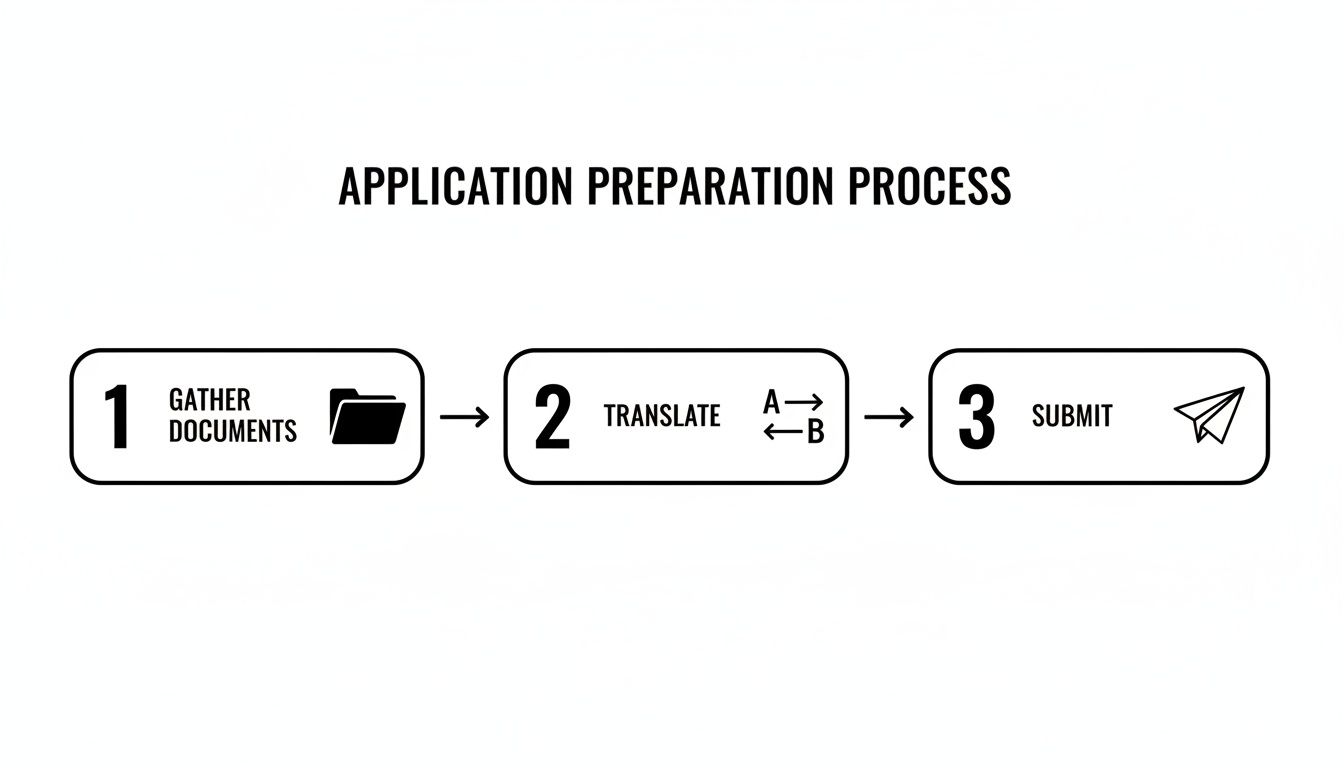
As you can see, success isn’t just about having the right documents. It’s about presenting them in the exact format required, which means certified translations and following official submission rules to the letter.
Once you get the green light, the consulate will call you back to place a temporary, four-month visa sticker in your passport. This sticker is your golden ticket. It allows you to legally enter Portugal and show up for your residency appointment with the Agency for Integration, Migration and Asylum (AIMA).
Your Arrival and AIMA Residency Appointment
With your visa in hand, it’s time to book that flight! The date for your AIMA appointment will either be pre-scheduled by the consulate, or you’ll need to book it yourself as soon as you arrive. This meeting is the final hurdle to formalizing your status as a legal resident of Portugal.
At the AIMA appointment, you’ll present the original documents you submitted back home, plus a few other items they might ask for. Officials will take your photo and fingerprints for your residency card, known as the Título de Residência.
This AIMA appointment is where your preparation truly comes full circle. Having every document perfectly organized—especially your compliant expat health insurance policy—shows you’re serious and ready for your new life. It makes for a smooth, stress-free final step.
After a successful meeting, your residency card will be mailed to your Portuguese address, usually within a few weeks. This card is your official proof of residency, valid for two years. It allows you to register for the national healthcare system (SNS) and travel freely throughout the Schengen Area. Once your D7 visa is approved and you’re ready to make the move, figuring out the logistics of seamless airport and city travel within Portugal will be key to settling in comfortably.
Comparing the D7 Visa and the Golden Visa
While the D7 visa is the go-to choice for most retirees, it’s worth taking a look at its high-net-worth cousin, the Golden Visa. Here’s a simple way to think about it: the D7 is for people who want to actually live in Portugal, supported by their existing passive income. On the other hand, the Golden Visa is for those who want to invest in Portugal, which in turn grants them residency with far fewer strings attached.
It’s important to know the landscape for the Golden Visa has changed quite a bit. It used to be famous for its real estate investment path, but that door was shut in late 2023. Today, the program is all about making significant capital investments into approved Portuguese funds or companies. This shift has made the distinction between these two visa routes clearer than ever.
Financial Requirements: A Head-to-Head Look
The financial gap between the D7 and the Golden Visa is enormous. To qualify for the D7, you just need to show a modest, stable passive income—currently around €10,440 per year for a single applicant. The goal is simply to prove you can support yourself comfortably without needing to work in Portugal.
The Golden Visa, however, is in a completely different league. It demands a massive upfront investment. The most common route now requires a minimum of €500,000 poured into a qualifying Portuguese investment or venture capital fund. This isn’t about your monthly income; it’s about making a large capital injection into the country’s economy.
Physical Residency: The Biggest Difference
This is where the decision becomes crystal clear for most applicants. The D7 visa is designed for full-time residents. To keep it, you’re expected to spend at least six consecutive months or eight non-consecutive months in Portugal each year. It’s for people who truly want to make Portugal home.
The Golden Visa, in contrast, offers incredible flexibility. Its physical residency requirement is famously low—you only need to be in the country for an average of just seven days per year. This makes it the perfect option for investors or retirees who want the perks of EU residency without the commitment to live in Portugal year-round.
The core question to ask yourself is: “Do I want to make Portugal my primary home, or do I want a high-value European foothold with minimal physical presence required?” Your answer will point you directly to the right visa.
D7 Visa vs Golden Visa: Which Is Right for You?
So, you have two very different paths to Portuguese residency. One is based on living there with a steady income, and the other is based on a significant investment with minimal stay requirements. This table breaks it all down.
| Feature | D7 (Passive Income) Visa | Golden Visa (Investment) |
|---|---|---|
| Primary Purpose | Full-time residency for retirees & passive income earners | Investment-based residency with minimal physical presence |
| Financial Requirement | Proof of stable passive income (approx. €10,440/year) | Minimum €500,000 investment into qualifying funds |
| Physical Stay Requirement | 6-8 months per year | Average of 7 days per year |
| Best For | Retirees who want to live in Portugal full-time | High-net-worth individuals seeking EU access & flexibility |
| Application Focus | Proving consistent income from pensions, rentals, investments, etc. | Proving the source and transfer of a large capital investment |
| Flexibility | Low; you are expected to be a tax resident and live in the country | High; you can maintain residency while living primarily elsewhere |
In the end, your personal goals will determine the best fit. If you’re dreaming of sipping coffee at a local pastelaria every morning, the D7 is your ticket. If you want a “Plan B” residency in Europe without uprooting your life, the Golden Visa is designed for you.
The Portugal Golden Visa program remains a powerful tool for wealthy investors. Even after the 2023 changes, it continues to attract applicants from the US, China, and Brazil, all looking to unlock EU residency with minimal hassle. Since it started in 2012, the program has issued over 42,000 permits to investors and their families. American interest, in particular, has surged, with US approvals jumping from 65 in 2019 to 216 in 2022 as more people seek global mobility. You can dive deeper into these Golden Visa statistics on globalcitizensolutions.com.
Ultimately, if your goal is to settle down and enjoy daily life in Portugal, the D7 is your path. If you are looking for an investment-based residency with the freedom to live elsewhere, the Golden Visa is the clear winner. For those considering a visa based on remote work, you might be interested in our guide on digital nomad visa requirements.
Common Questions About Retiring in Portugal
Alright, let’s get into the nitty-gritty. You’ve figured out the big picture, but now the practical questions start popping up. This is where we move from the broad strokes to the fine details that can genuinely make or break your visa application.
Believe me, many aspiring retirees get tripped up by the same few things, especially when it comes to expat medical insurance. It’s a non-negotiable part of the Portugal retirement visa requirements, and a simple mistake here is one of the most common reasons for rejection. Let’s clear the air and tackle the questions I hear all the time.
Clarifying Your Health Insurance Obligations
The number one source of application errors, hands down, is a misunderstanding of what Portuguese consulates actually want to see for health insurance. It’s not just about ticking a box; it’s about having the right kind of coverage.
-
Can I just use travel insurance for my D7 visa application?
Absolutely not. Please don’t make this mistake—it’s an instant dealbreaker. Portuguese consulates need to see a real, comprehensive health insurance policy that’s valid for at least one year. Your standard travel insurance is designed for short holidays, not for someone establishing residency. It simply doesn’t provide the robust, long-term coverage they require. You need a dedicated expat medical insurance plan. -
Is my US-based health insurance (like Medicare) good enough for the visa?
Almost certainly not. Your domestic insurance from back home, whether it’s Medicare in the US or another national plan, won’t cut it. These policies are designed to work within your home country’s healthcare system and don’t provide adequate coverage in Portugal or across the Schengen Area. You’ll need a proper international health plan built for expats that explicitly covers medical care, emergencies, and repatriation while you’re living abroad.
Life in Portugal After the Visa
Once you’ve got that visa stamped in your passport and you’ve landed in beautiful Portugal, a whole new set of questions will surface about daily life and what comes next.
A key point to remember: once you get your official residency permit, you can register with Portugal’s National Health Service (the SNS) and use the public healthcare system. Even so, a lot of expats choose to keep their private international health insurance. It gives them access to private clinics, helps them sidestep potential wait times, and offers peace of mind with rock-solid coverage for major medical events.
Another thing people worry about is the language. Do you need to speak Portuguese to get a retirement visa? For the initial D7 visa and residency permit, no, there isn’t a language test. But keep this in mind: if you eventually want to apply for permanent residency or citizenship after five years, you will need to prove you have a basic handle on the language (an A2 level).
For a bird’s-eye view of the entire journey from start to finish, this complete guide on how to retire in Portugal is an excellent resource.
Getting the health insurance piece right is a critical step in securing your retirement visa. At Expat Global Medical, we live and breathe this stuff. We provide compliant, comprehensive medical plans designed from the ground up to meet the strict requirements of Portuguese authorities. Let us take the guesswork out of it for you. Get your free quote today at https://expatglobalmedical.com.