For countless expats, private health insurance in Spain isn’t just a “nice-to-have”—it’s an absolute necessity. It’s often the key that unlocks your residency visa, but more than that, it’s your ticket to navigating the healthcare system smoothly, sidestepping long waits and potential language barriers common in a new country.
Why Private Health Insurance Is a Game-Changer for Expats in Spain
Spain is famous for its fantastic public healthcare system, the Sistema Nacional de Salud (SNS). It’s robust and reliable. But for expats, relying solely on the public system can feel a bit like taking a crowded city bus during rush hour—it’ll get you there eventually, but you might be in for a long, slow ride.
Private health insurance is more like having your own car. It gives you direct, speedy access to specialists and elective procedures on your own schedule. This layer of convenience and security is precisely why so many expats choose it.
The All-Important Expat Visa Requirement
For any expat coming from outside the EU, the decision is often made for you. To secure popular residency permits like the Non-Lucrative Visa or the Golden Visa, you must show proof of comprehensive private medical coverage.
This isn’t just a friendly suggestion; it’s a strict legal requirement. Your policy has to come from an insurer authorized to operate in Spain and offer coverage that’s on par with the public system, usually without any co-payments. This rule ensures new residents won’t strain the public system and have access to care from day one. In fact, failing to get a compliant plan is one of the top reasons expat visa applications get denied.
We break down the finer points in our detailed guide on public versus private healthcare for expats in Spain.
Growing Demand Means Faster Access for You
It isn’t just expats fueling the demand. The private health insurance market in Spain is booming. As of 2023, a staggering 12.4 million residents—nearly 26% of the population—held a private policy. That’s a huge leap from just 8.9 million a decade ago.
Why the surge? Many locals are also looking to bypass the growing wait times for specialist appointments and non-urgent surgeries in the public system. For an expat, this trend translates into some very real, practical benefits:
- See a Specialist, Fast: Need to see a dermatologist or a cardiologist? With private insurance, you’re often looking at an appointment in days or weeks, not months.
- Your Choice, Your Comfort: You get to pick your own doctor or hospital from a broad network. If you need to be hospitalized, you’ll often get a private room.
- No Language Barriers: Most private insurers have large networks of English-speaking doctors, clinics, and customer support staff, which makes a world of difference when you’re an expat.
When it comes down to it, private health insurance in Spain is about buying peace of mind. It’s the confidence of knowing you can get high-quality medical care quickly, in your own language, without getting tangled up in the red tape that can sometimes come with a public system.
To help you see the differences clearly, here’s a quick side-by-side comparison tailored for the expat experience.
Public vs Private Healthcare at a Glance for Expats
This table offers a quick comparison to help you understand the key differences between Spain’s public and private healthcare systems from an expat’s perspective.
| Feature | Public System (Sistema Nacional de Salud) | Private Health Insurance |
|---|---|---|
| Eligibility | Available to legal residents contributing to social security. | Available to any expat who purchases a policy. |
| Cost | Funded by social security taxes (no monthly premiums). | Monthly premiums based on age, health, and coverage. |
| Wait Times | Can be long for specialists and non-urgent procedures. | Significantly shorter wait times for appointments and surgeries. |
| Choice of Doctor | Assigned a primary care doctor; limited choice of specialists. | Freedom to choose any doctor or hospital within the network. |
| Language | Primarily Spanish-speaking providers. | Wide availability of English-speaking doctors and staff. |
| Hospital Stays | Shared rooms are common. | Private rooms are often standard. |
| Visa Compliance | Not accepted for non-EU residency applications. | Required for many expat visas (e.g., Non-Lucrative Visa). |
Ultimately, while the public system is excellent, private insurance provides the flexibility, speed, and comfort that many expats are looking for as they build their new life in Spain.
Navigating Spanish Residency and Visa Insurance Rules
For any expat moving to Spain from outside the European Union, sorting out private health insurance isn’t just a good idea—it’s often a non-negotiable legal hurdle. Spanish consulates are notoriously specific about the kind of medical coverage they’ll accept for residency visas, especially popular ones like the Non-Lucrative Visa.
Think of it as a quality-control check. The Spanish government needs to know that new expat residents can handle their medical needs without putting an immediate strain on the public healthcare system. This is precisely why a standard travel insurance policy, which only covers short-term emergencies, is a surefire way to get your visa application rejected.
The Four Pillars of a Visa-Compliant Expat Policy
To get your visa application stamped “approved,” your insurance plan has to meet four critical benchmarks. If you miss even one, you’re looking at frustrating delays or an outright denial.
Your policy absolutely must be:
- Fully Comprehensive: It needs to provide coverage that’s at least equivalent to Spain’s public Sistema Nacional de Salud. This means everything from GP visits and specialist appointments to hospital stays and major surgery.
- Zero Co-payments (Sin Copagos): The plan can’t require you to pay a fee every time you see a doctor or use a service. It must be a ‘sin copagos’ policy, where the insurer foots 100% of the bill for approved treatments.
- From an Authorized Insurer: The insurance company has to be legally authorized to operate in Spain. This is a crucial detail that knocks many foreign or generic international plans out of the running.
- Active for the Full Visa Period: The policy must cover you for the entire length of your initial residency, which is typically one full year. You’ll need to pay the annual premium upfront and get a certificate to prove it.
This decision tree gives you a quick visual of the paths expats usually take when weighing their healthcare options.
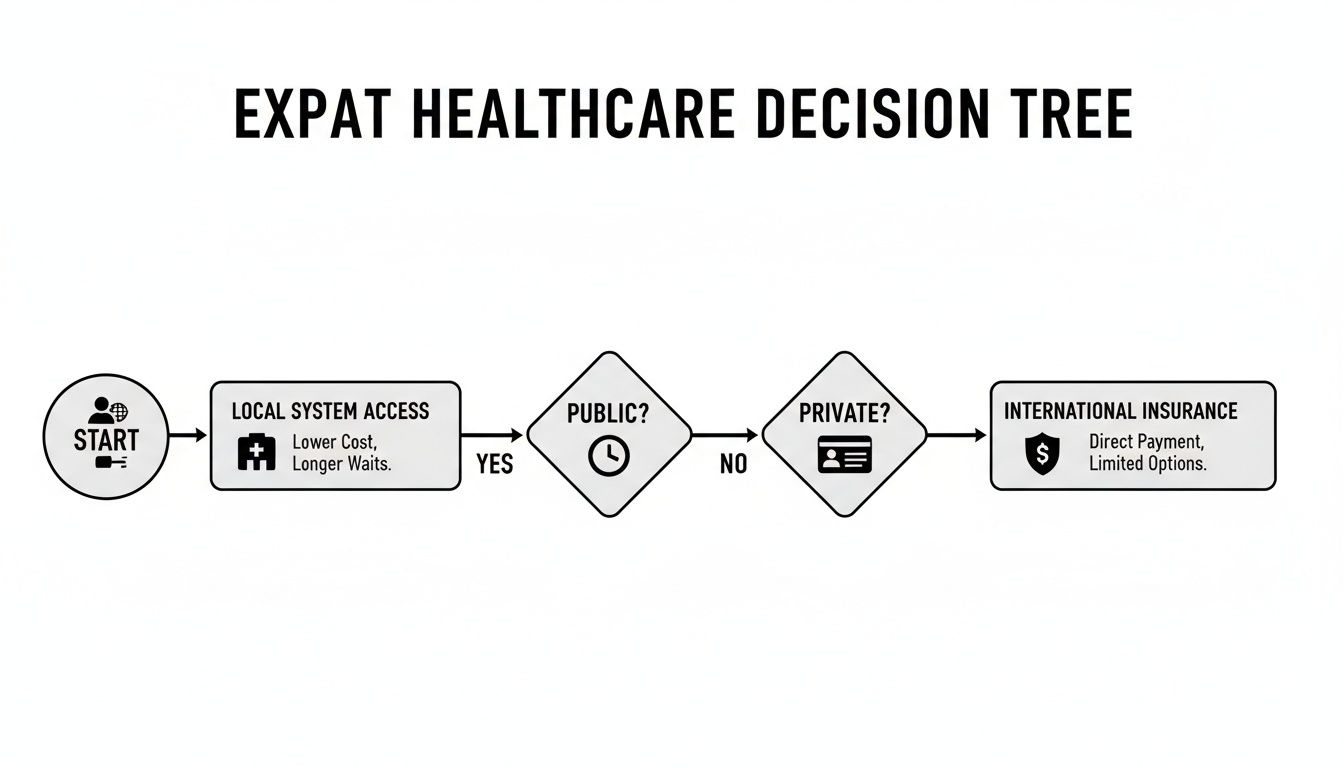
As you can see, for many would-be expat residents, the visa requirement funnels them directly toward a very specific type of private plan right from the start.
Why Your Travel Insurance Just Won’t Cut It
It’s a common—and very costly—mistake for expats to think a high-limit travel insurance policy will pass muster with the consulate. It won’t. Travel insurance is built for temporary trips and unforeseen emergencies, not the routine, day-to-day healthcare needs of someone who actually lives in the country.
The core difference is intent. Travel insurance covers you as a temporary visitor. Expat residency insurance proves you’re prepared to live in Spain with comprehensive, long-term medical support. The Spanish consulate needs to see the latter.
This is why getting the right private health insurance in Spain from day one is so critical for expats. You can learn more about finding the perfect fit by exploring our complete overview of medical insurance options in Spain. By choosing a plan designed specifically for the residency process, you give the consulate exactly what they need to see, paving the way for a much smoother start to your new expat life.
Breaking Down the Costs of Expat Health Insurance
Alright, let’s get down to brass tacks: what’s private health insurance really going to cost you as an expat in Spain? Budgeting for your new life abroad means getting a firm grip on the numbers, and thankfully, insurance pricing isn’t just a random figure pulled out of a hat. It’s a calculated cost based on a few key things about you and the plan you choose.

Think of your insurance premium like ordering a new car. There’s a base price for the standard model, but the final cost changes with every option you add—a bigger engine, leather seats, a sunroof. Your expat health insurance works in a very similar way.
Core Factors That Drive Your Premium
Insurers in Spain all look at the same handful of criteria to figure out what you’ll pay each month. Your final quote will almost always boil down to a mix of these elements.
- Age: This is the single biggest driver of your premium. As we get older, the statistical chance of needing medical care goes up, so premiums rise to match. A 30-year-old expat will pay a lot less than a 65-year-old for the exact same policy.
- Level of Coverage: A basic plan that covers the essentials will naturally be cheaper than a top-tier plan loaded with extras like dental care, pharmacy reimbursements, and worldwide coverage. The more features you bolt on, the higher the monthly price.
- Pre-existing Conditions: You must declare any health issues you already have when you apply. An insurer might respond by slightly increasing your premium, excluding that specific condition from coverage, or in some cases, declining the application. Being upfront here is absolutely crucial.
- Co-payments (Copagos): This choice makes a huge difference. Plans without co-payments (sin copagos) come with a higher monthly premium, but you pay zero when you visit a doctor. Plans with co-payments (con copagos) have a lower monthly bill, but you’ll pay a small, fixed fee (say, €5-€15) for each appointment or service.
It’s also worth pointing out that Spain’s private healthcare market is a major force in the economy. It’s projected to grow from USD 11.7 billion in 2025 to nearly USD 18 billion by 2033. This isn’t just an abstract number; a competitive market means more choices and better pricing for expats. You can see more on this in a detailed analysis of the Spanish healthcare insurance market.
What to Expect: Monthly Cost Examples for Expats
To give you a clearer picture, here are some realistic monthly premium ranges for different types of expats. These estimates are for a comprehensive, sin copago plan—the kind you’d need for a visa application.
| Expat Profile | Typical Age Range | Estimated Monthly Premium |
|---|---|---|
| Young Digital Nomad | 25-35 | €45 – €65 |
| Mid-Career Professional | 40-50 | €70 – €95 |
| Expat Family of Four (2 adults, 2 kids) | Adults 40s, Kids <18 | €200 – €280 (total) |
| Retired Expat Couple | 65-75 | €150 – €250 (per person) |
As you can tell, age is the elephant in the room. A family’s total bill might look high, but the per-person cost for children is usually quite low, which helps balance it out. For a closer look at how these numbers are calculated globally, check out our guide on understanding expat health insurance costs.
Key Takeaway: While plans for older expats are certainly more expensive, they still offer fantastic value, especially when compared to similar private coverage in places like the United States. The goal is to find that perfect balance between solid coverage and a monthly payment you’re comfortable with.
At the end of the day, the only way to know your exact cost is to get a personalized quote. But by understanding what drives the price, you can tweak your coverage options to land on a private health insurance Spain policy that gives you real value without breaking the bank.
How to Choose the Right Health Plan and Provider
Picking the right private health insurance in Spain can feel like you’re trying to solve a puzzle. You’ve got a dozen different plans and providers all shouting for your attention, but it’s not as complicated as it looks. Once you know what the key pieces are, you can put together the perfect picture for your expat needs.
Here’s your playbook for making a smart, informed decision that protects both your health and your wallet.

The first big choice you’ll have to make revolves around the co-payment structure. This is a fundamental decision that directly shapes what you pay each month versus what you’ll pay each time you see a doctor.
The Great Co-Payment Debate: Con Copago vs. Sin Copago
In Spain, you’ll see two terms pop up constantly: ‘con copago’ (with co-payment) and ‘sin copago’ (without co-payment). Think of it like a seesaw—when your monthly premium is low, your out-of-pocket costs at the clinic are a bit higher, and vice versa.
-
Sin Copago (No Co-payment): This is your all-access pass. You pay a higher, fixed premium each month, but every time you go to the doctor, get a lab test, or have a covered procedure, you pay €0. Nothing. This is the mandatory choice for most expat residency visa applications because the Spanish government wants proof that you won’t have any financial hurdles to getting medical care.
-
Con Copago (With Co-payment): This is more of a pay-as-you-go model. Your monthly premium is significantly lower, but you’ll pay a small, fixed fee for each service. This could be €5 for a GP visit or €15 to see a specialist. It’s a fantastic, budget-friendly option for expats who are already residents, are generally in good health, and don’t expect to be at the clinic every other week.
So, how do you choose? If you need a visa, the government has already decided for you: it’s sin copago all the way. But if you’re an established expat resident looking to keep monthly costs down, a con copago plan could easily save you hundreds of euros a year.
Evaluating the Provider Network or ‘Cuadro Médico’
Once you’ve settled on a co-payment structure, your next mission is to check out the insurer’s network of doctors and hospitals, known in Spanish as the ‘cuadro médico’. A policy is only as good as the doctors you can actually access with it.
Don’t just assume a big-name insurer has you covered everywhere. Spain’s geography is incredibly varied. A provider with a massive network in Madrid might have spotty coverage in a smaller coastal town in Andalusia.
A vast cuadro médico is your safety net. Before you sign anything, jump on the insurer’s website and use their online directory. Search for doctors, specialists, and hospitals in your specific town or city. Make sure there are convenient, well-regarded options nearby—especially English-speaking providers if that’s a priority for you as an expat.
What to Look for in an Expat Health Insurance Plan
Shopping for insurance can feel overwhelming, but it gets a lot easier when you know exactly what to compare. Use the table below as a checklist to evaluate the most critical parts of any policy you’re considering.
| Feature | What to Look For | Why It Matters for Expats |
|---|---|---|
| Visa Compliance | “Sin copago” (no co-payment), no deductibles, full hospitalization, and repatriation coverage. | Spanish consulates have strict, non-negotiable requirements. Your expat visa application will be rejected if the plan doesn’t meet these criteria. |
| Provider Network | Check the cuadro médico (network directory) for doctors, specialists, and hospitals in your specific town or region. | A great plan is useless if the best doctors are a two-hour drive away. You need convenient, quality care where you live. |
| Waiting Periods | Look for plans with waived carencias (waiting periods), especially for visa purposes. | Many standard plans make you wait months for certain services. A visa-compliant plan often removes these, giving you full coverage from day one. |
| Repatriation Rider | Explicit coverage for medical repatriation (transport to your home country) and repatriation of remains. | This is a mandatory requirement for most expat visas and provides crucial financial protection for your family in a worst-case scenario. |
| Dental Coverage | Basic dental (cleanings, extractions) is often included. Comprehensive coverage (root canals, orthodontics) is usually a paid add-on. | Public healthcare in Spain doesn’t cover dental. A good private plan can save you a lot of money on everything from check-ups to major work. |
| English-Speaking Support | 24/7 customer service helplines and in-network doctors who speak English. | Navigating healthcare in another language during a medical emergency is incredibly stressful. This feature is a lifeline for many expats. |
By focusing on these key areas, you can cut through the marketing noise and find a plan that genuinely works for your life in Spain.
The Big Players and the Expat Broker Advantage
As you search, you’ll see a few major national providers who dominate the Spanish market. Companies like Sanitas, Adeslas, DKV, and Asisa are household names here, holding a combined market share of over 70%. They all offer a solid range of plans built for different expat needs and budgets.
While you could approach these companies directly, many expats find it much easier to work with a specialized insurance broker. A good broker isn’t loyal to any single insurer. Their job is to be your expert guide, giving you unbiased advice based on your unique expat situation.
A top-notch expat broker will:
- Do the Shopping for You: They do the heavy lifting, comparing the best options from multiple insurers that fit your visa status, health needs, and budget.
- Navigate the Fine Print: They live and breathe policy documents, so they can quickly flag tricky waiting periods (carencias) or exclusions you might miss on your own.
- Be Your Advocate: From getting you signed up to helping with claims, they provide English-language support and can step in to help resolve any issues that come up.
The best part? Using a broker costs you nothing extra—they get paid by the insurance company. But their expertise can save you a huge amount of time, money, and stress, ensuring you get the right private health insurance in Spain from day one.
Breaking Down Your Coverage: The Essentials and the Upgrades
When you see the term “comprehensive coverage” thrown around for private health insurance in Spain, it’s not just marketing fluff. For any expat applying for a visa, this is a non-negotiable requirement. It means your policy has to be just as solid as the public system, covering you completely from day one. Think of this as your healthcare foundation in Spain.
At its core, a good comprehensive plan is designed to step in for pretty much any medical issue you could run into. It’s all built on a few key pillars that give you a solid baseline of protection.
What Comes Standard in a Comprehensive Expat Plan
This is the stuff that should be included right out of the box. Any quality plan, especially one that needs to pass muster for a residency application, will have these services as a bare minimum.
You can almost always count on your core coverage to include:
- Primary Care and Family Medicine: This is your go-to general practitioner (GP) for check-ups, when you get sick, or for an initial diagnosis. It’s your first port of call.
- Specialist Consultations: Here’s a huge perk over the public system. You can go directly to a cardiologist, dermatologist, or gynecologist without waiting for a referral from your GP.
- Hospitalization and Surgery: This covers the big stuff. If you need to be admitted to a hospital, your policy will handle the costs for the surgery, the doctors’ fees, anesthesia, and even a private room.
- Diagnostic Tests and Procedures: From simple blood work and X-rays to more complex imaging like MRIs and CT scans, all the tests needed to figure out what’s going on are covered.
- Emergency Services: Whether you need to visit an urgent care clinic (urgencias) or call an ambulance, your plan has your back in a crisis.
These elements are the backbone of your policy. They ensure that whether you’re dealing with a minor bug or a major medical event, you’ve got the support you need inside Spain.
Here’s how that plays out in real life: Let’s say you start getting persistent back pain. With your private plan, you book an appointment directly with an orthopedic specialist. They order an MRI, pinpoint the problem, and schedule a minor procedure—all happening within a few weeks and completely covered by your insurance.
Smart Add-Ons for an Expat Lifestyle
While the core coverage is fantastic for life within Spain, most expats don’t stay put. You might be hopping over to other European countries for weekend trips, flying back home to see family, or even working remotely from another spot for a while. This is where standard Spanish policies can leave you exposed, and where a few key add-ons become absolutely essential.
Think of these riders as powerful upgrades for your policy, built specifically to protect a more global expat lifestyle.
The Most Valuable Add-Ons for Expats
Let’s dig into the three most important extras that can turn a decent Spanish health plan into an indispensable tool for any expat.
-
Worldwide Travel or International Coverage: A basic Spanish plan typically covers you for emergencies abroad for up to 90 days, but with a pretty low reimbursement cap—maybe €12,000-€20,000. For any expat who travels regularly, that’s just not going to cut it. An international coverage add-on extends your full benefits across the globe. This is a lifesaver if you need serious medical care while visiting a country with sky-high healthcare costs, like the United States.
-
Dental Insurance (Seguro Dental): This is a big one. Spain’s public system offers almost zero dental coverage, and most standard private plans only cover the basics, like an annual cleaning or a simple extraction. A dedicated dental rider is usually a bargain at €10-€20 per month and gives you deep discounts or full coverage on expensive work like root canals, crowns, and even orthodontics. When you consider a single root canal can set you back over €300, this add-on pays for itself in a hurry.
-
Medical Repatriation and Evacuation: For visa applicants, this is often a mandatory add-on—and for good reason. Repatriation covers the eye-watering cost of flying you back to your home country for medical care if it becomes necessary. Imagine you have a serious accident in Spain and need long-term care closer to your family in the UK or US. Without this rider, a medically-equipped flight could easily top €50,000. It’s a tiny price to pay for that level of security.
By choosing these add-ons wisely, you’re not just getting a policy that works for your life in Spain—you’re building one that works for your life as a global expat citizen.
Your Step-By-Step Guide to Enrollment and Use
You’ve compared the plans, checked the networks, and picked the perfect policy. So, what happens next? Getting your private health insurance in Spain up and running is thankfully a pretty straightforward process. This is the final step that turns your policy from a piece of paper into a practical tool for your new life in Spain.
The enrollment itself is designed to be simple, especially if you’re an expat working with a broker who can guide you. Once you’ve submitted your application, the insurance provider will review your details and health questionnaire before issuing your policy documents. Approval is usually quick, often taking just a few days.
Getting Your Policy Started
To apply for your chosen plan, you’ll need to pull together a few key documents. Having these ready from the get-go will make everything go much smoother.
- Identification: A clear copy of your passport is a must. If you already have one, you’ll also need your Spanish Foreigner’s Identity Number (Número de Identidad de Extranjero or NIE).
- Spanish Bank Account: Insurers need an IBAN from a Spanish bank account to set up the direct debit for your monthly or annual premium payments.
- Health Questionnaire: You’ll have to fill out a cuestionario de salud, which is a standard form where you disclose your medical history and any pre-existing conditions. It’s absolutely crucial to be honest here to avoid issues later.
Once you get the green light, you’ll receive your policy certificate—the golden ticket for your visa or residency application—and your physical insurance card will pop through your letterbox shortly after.
Using Your Insurance From Day One
Think of your new insurance card as your key to the private healthcare system. Using it is surprisingly easy. Most insurers have powerful apps and online portals that act as a command center for all your healthcare needs.
Here’s how a typical visit to the doctor works:
- Find a Doctor: Just open your insurer’s app or website and use the cuadro médico (their network directory) to search for a specialist in your area. You can filter by language, specialty, and location to find the perfect fit.
- Book an Appointment: Call the clinic directly to schedule your visit. All you need to do is tell them which insurer you’re with (like Sanitas or Adeslas) and give them your policy number.
- Show Your Card: When you arrive, simply present your insurance card at reception. If you have a sin copago plan, that’s it—there’s absolutely nothing to pay.
For bigger things like non-emergency surgery, your doctor will almost always need to get pre-authorization from the insurer. This is a standard check where the hospital confirms with the insurance company that the treatment is covered. The good news? Your doctor’s office usually handles all the paperwork for you.
If you opted for a reimbursement (reembolso) plan and decide to see a specialist outside the network, the process is a little different. You’ll pay the doctor’s fee upfront, then send the invoice (factura) and a claim form to your insurer. They’ll then deposit the covered amount right back into your bank account, usually within a few weeks.
Got Questions About Expat Health Insurance? We’ve Got Answers.
When you’re sorting out your move to Spain, the world of private health insurance can feel like a maze. Let’s clear up some of the most common questions that pop up for expats, so you can make a smart choice for your new life abroad.
Can I Just Use My International Health Insurance For A Spanish Visa?
It’s a tempting shortcut, but it’s risky and almost always a bad idea for an expat visa application. For an international policy to even stand a chance, the insurer must be officially recognized and authorized to operate in Spain—a hurdle many global providers don’t clear.
On top of that, the plan has to meet Spain’s strict visa requirements to a T. This means offering coverage that’s just as good as the public system and, crucially, having absolutely no co-payments (sin copago). Most standard travel plans or even some beefy global health policies fail on these points. To avoid a guaranteed visa rejection, your safest bet is to get a compliant plan directly from a trusted Spanish provider.
How Do Spanish Insurers Handle Pre-Existing Conditions?
This is handled on a case-by-case basis, so there’s no single answer. When you apply, you’ll fill out a detailed health questionnaire known as a ‘cuestionario de salud’. Your honesty here is non-negotiable.
Based on what you disclose, the insurer might:
- Offer you full coverage, maybe with a slightly higher monthly premium.
- Cover you for everything except for your specific pre-existing condition.
- Apply a longer waiting period (carencia) before you can use services related to that condition.
This is where an experienced expat insurance broker becomes your best ally. They know which providers are more flexible and can help match your health profile to an insurer that’s more likely to give you the green light.
What’s The Real Difference Between ‘Con Copago’ and ‘Sin Copago’?
These two little phrases make a huge difference in how you pay for healthcare and are a critical part of any policy.
‘Sin copago’ means “without co-payment.” You’ll pay a higher monthly premium for these plans, but when you see a doctor or get a test, you pay absolutely nothing out of pocket. This is the type of plan that is mandatory for most Spanish residency and visa applications.
On the flip side, ‘con copago’ means “with co-payment.” These policies have lower monthly premiums, but you’ll pay a small, fixed fee (think €5-€15) each time you use a service. For expats who are already residents and don’t need a visa-compliant plan, this can be a fantastic, budget-friendly option, especially if you’re in good health.
Ready to stop guessing and find a plan that actually fits your expat needs? The team at Expat Global Medical lives and breathes this stuff. They specialize in helping expats cut through the confusion to find reliable, affordable coverage in Spain. Get your free, no-obligation quote today and feel confident about your healthcare from day one. Learn more and get started at https://expatglobalmedical.com.