Welcome to the Land of Smiles. If you’re moving to Thailand, one of the first things to sort out is your health insurance. Many expats figure their policy from back home or a simple travel plan will do the trick, but that’s a huge—and potentially very expensive—misconception. For anyone planning to live here long-term, you absolutely need proper expat medical insurance.
Why Your Home Insurance Just Won’t Cut It in Thailand
Living in Thailand is a dream, but you have to shift your thinking, especially when it comes to healthcare. Relying on your old domestic policy or a basic travel plan is a bit like trying to use a city map to navigate the jungle—it’s the wrong tool for the job and won’t get you very far.
Think of it this way: a travel policy is built for short-term emergencies. It’s perfect for a broken arm from a scooter mishap or a nasty bout of food poisoning during a two-week holiday. Its main job is to patch you up and, if things get serious, fly you back home. It was never designed to handle routine check-ups, manage a chronic condition, or cover major surgery while you’re living in Thailand as an expat.
The Big Gap Between Tourist Care and Expat Health
This is where the lines get drawn for expats. Your insurance from the U.S., the UK, or anywhere else almost certainly has geographic limits, with a network of doctors and hospitals that doesn’t reach Southeast Asia. Trying to use it here usually means paying for everything yourself upfront and then wrestling with a mountain of paperwork for a reimbursement claim that often gets denied. You can learn more about this in our deep dive into why U.S. health insurance doesn’t work abroad.
The whole point of expat medical insurance is to fill that void. It bridges the gap between temporary, emergency-only travel coverage and a domestic plan that’s useless overseas, giving you real, comprehensive healthcare access in your new home country.
To quickly see how these insurance types stack up for an expat living in Thailand, here’s a simple breakdown.
Expat Insurance Options in Thailand at a Glance
This table gives a bird’s-eye view of the most common insurance types you’ll encounter. It highlights what each is good for and, more importantly, where they fall short for a long-term resident.
| Insurance Type | Best For | Key Limitation for Expats |
|---|---|---|
| Travel Insurance | Short trips (under 90 days), vacations, and covering trip-related mishaps. | Covers emergencies only; no routine care, pre-existing conditions, or long-term needs. Not suitable for visas. |
| Home Country Insurance | Healthcare within your home country’s borders. | Network is geographically restricted and rarely covers care in Thailand, leading to out-of-pocket costs. |
| Local Thai Insurance | Basic, in-country coverage that meets minimum visa requirements. | Coverage is often limited to Thailand, with lower benefit caps and no international evacuation. |
| Expat Medical Insurance | Long-term residents, retirees, and digital nomads living abroad for 6+ months. | Can be more expensive than basic plans, but it’s the only truly comprehensive solution for expats. |
As you can see, for any expat serious about building a life here, a dedicated expat plan is the only option that makes sense.
Getting Access to Thailand’s World-Class Hospitals
Thailand is famous for its incredible hospitals. Places like Bumrungrad International and the Bangkok Hospital network offer care that rivals the best facilities in the West. But this level of quality isn’t cheap, and it’s certainly not covered by a basic travel plan. Without the right Thailand medical insurance, an expat could find themselves in a local public hospital, navigating language barriers and long waits.
A solid expat medical plan is your ticket to this top-tier system. It gives you:
- Direct Billing: The insurance company pays the hospital directly. This is a huge deal, saving you from having to front thousands of dollars for treatment.
- Real Coverage: Protection for everything an expat actually needs, from a simple doctor’s visit to major surgery or cancer care.
- Peace of Mind: The freedom to enjoy your life in Thailand, knowing your health and your savings are secure, no matter what happens.
At the end of the day, getting a proper expat health plan isn’t just about ticking a box for your visa. It’s a cornerstone of building a safe, secure, and sustainable life as an expat in your new home.
Decoding Your Expat Medical Insurance Options
So, you’re planning to make Thailand your long-term home. Fantastic choice. Now comes a decision that feels a lot like choosing between a local city scooter and a highway-ready car. Both get you from A to B, but they’re built for completely different journeys.
That’s the fundamental difference between a local Thai health plan and a dedicated international thailand medical insurance policy designed for expats.
A local Thai policy is your scooter. It’s often affordable, simple to arrange, and great for zipping around town to handle minor issues—think a quick doctor’s visit for a cold or a simple prescription refill. The catch? Its coverage limits are usually quite low, and its protection vanishes the moment you step outside of Thailand.
An international expat medical plan, on the other hand, is your reliable car. It’s built for the long haul. It offers serious, robust protection for major life events like surgery or cancer treatment, and its coverage travels with you, whether you’re visiting family back home or exploring neighboring countries.
This little flowchart can help you visualize which path makes the most sense for your expat life in Thailand.
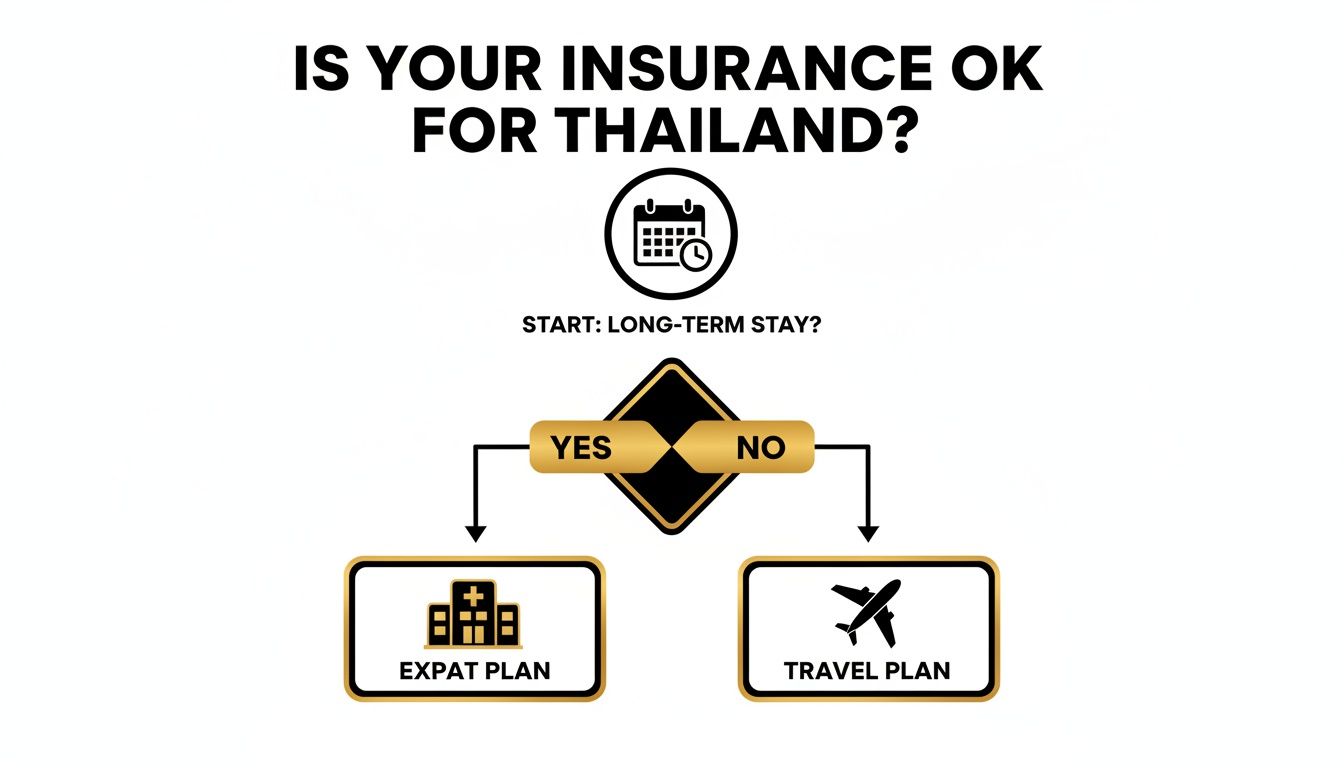
The main takeaway here is pretty clear: how long you plan to stay is the biggest factor in your decision. For anyone setting up a life here as an expat, the compass points firmly toward an expat-focused plan.
Key Differences Expats Must Understand
The gap between these two types of plans becomes glaringly obvious when you need care the most. While a local plan might feel perfectly adequate for everyday sniffles, its limitations can leave an expat dangerously exposed during a real medical crisis.
Here’s a breakdown of what really separates them:
- Geographical Scope: A local Thai plan works only within Thailand’s borders. An international plan offers worldwide or worldwide-excluding-USA coverage, which means you’re still protected on trips back home or during regional travel—a crucial feature for expats.
- Coverage Limits: Local policies often have caps that won’t come close to covering the full cost of a catastrophic event, which can easily soar into the hundreds of thousands of dollars. International plans offer much higher limits, often $1,000,000 or more, giving you genuine financial security.
- Direct Billing Networks: Top-tier international providers like Cigna, VUMI, and IMG have extensive direct billing agreements with Thailand’s best private hospitals. This is huge—it means you won’t have to front massive bills out-of-pocket and wait for reimbursement.
The need for this kind of solid coverage is becoming more apparent as the market evolves. The administrative side of Thailand’s insurance industry is booming, valued at USD 1.54 billion in 2023 and projected to hit USD 2.61 billion by 2030. This growth is fueled by rising medical costs and more people getting insured, highlighting just how essential it is to have a plan that can keep up. You can discover more insights about the Thai insurance TPA market and its effect on healthcare expenses.
Pre-Existing Conditions and Long-Term Care
Here’s another deal-breaker for many expats: how plans handle pre-existing conditions. Local Thai plans are notoriously strict and will often flat-out exclude any health issues you had before you signed up. For many retirees or any expat with a chronic condition, that’s simply a non-starter.
International expat insurance providers, however, are built specifically for the global citizen. They usually have pathways to cover pre-existing conditions—sometimes after a waiting period or for a slightly higher premium—so you get continuous, reliable care.
Think of it like this: a local plan might see a history of high blood pressure and reject the application. An international plan is far more likely to work with you to create a policy that manages it. For any expat planning to live, work, or retire in Thailand for the long term, that flexibility is everything.
Ultimately, choosing the right plan isn’t about saving a little money today. It’s about safeguarding your health and your finances for years to come.
Meeting Thailand Visa and Retirement Requirements
Trying to figure out Thai immigration rules can feel like putting together a complex puzzle. One of the most important pieces of that puzzle for an expat? The right thailand medical insurance. If you’re planning to stay long-term, especially as a retiree or a professional, a valid insurance policy isn’t just a good idea—it’s a strict, non-negotiable requirement for getting your visa approved.
Think of your insurance policy as your official ticket into the country. Without the correct coverage documented in the proper format, your application will almost certainly face delays or an outright rejection. Thai authorities put these rules in place for a good reason: to make sure expats don’t become a financial burden on the public healthcare system if a medical emergency strikes.
The Rules for Retirement Visas (Non-Immigrant O-A)
For expat retirees over 50, the Non-Immigrant O-A visa is one of the most popular routes to living in Thailand. To get one, you have to meet some very specific insurance mandates laid out by Thai immigration.
The main requirement is a policy with a minimum coverage of THB 3,000,000 (which is roughly USD $100,000). But it’s not just about the total number; the coverage needs to be broken down in a very specific way to pass muster.
- Inpatient Coverage: You need at least THB 3,000,000 for this. This is what covers your costs if you’re admitted to a hospital for surgery, treatment, or an overnight stay.
- Outpatient Coverage: Your plan must also include a minimum of THB 40,000 for outpatient care. This is for things like doctor’s visits, prescription drugs, and lab tests that don’t require a hospital stay.
It’s absolutely critical that your policy documents explicitly list these coverage amounts. A generic travel insurance plan from back home simply won’t cut it.
One of the biggest pitfalls for expat applicants is not getting the right paperwork. Your insurance provider must give you an official, standardized “Foreign Insurance Certificate.” This document is designed specifically for the visa application and confirms your policy meets all of Thailand’s immigration requirements. Submitting a simple policy summary is a common mistake that leads to an instant rejection.
Requirements for the Long-Term Resident (LTR) Visa
The LTR visa is a newer option designed to attract high-potential foreigners, like wealthy global citizens, affluent pensioners, and highly skilled professionals. Because it’s a more prestigious visa for expats, the insurance requirements are even more stringent.
Applicants for the LTR visa must have a health insurance policy with a minimum coverage of USD $50,000. As an alternative, you can show proof of a social security benefit that covers medical treatment in Thailand or hold a cash deposit of at least USD $100,000.
For most expats, getting a qualifying insurance plan is the most direct path. The policy has to come from a recognized provider, and just like with the O-A visa, you’ll need the correct documentation to prove your coverage is valid. Our guide on how to retire overseas offers more practical insights into preparing for these kinds of financial and logistical steps.
Choosing a Compliant Insurance Plan
Thai immigration won’t accept just any insurance policy. They have a strong preference for plans from approved local providers or specific international insurers who know the visa requirements inside and out. When you’re picking a thailand medical insurance plan for your visa, make sure it is:
- Issued by a reputable insurer: Providers like Cigna, IMG, and VUMI are experienced in issuing the correct documentation needed for Thai visa applications for expats.
- Clearly documented: The policy must explicitly state the inpatient and outpatient coverage amounts in either THB or USD, perfectly matching the visa’s requirements.
- Renewable: Your plan should be renewable each year to support your continued legal stay in Thailand as an expat.
Getting this step right from the start saves you a massive headache during the relocation process. It lets you focus less on paperwork and more on the exciting parts of starting your new life in the Land of Smiles.
The Non-Negotiables: Must-Have Coverage for Expats in Thailand
Picking a thailand medical insurance plan is a bit like packing a parachute. You need to be absolutely sure it has all the essential components long before you ever need it. For any expat living in Thailand, this means looking far beyond the bare-bones visa requirements to build a policy that offers real protection against everything from minor mishaps to life-altering emergencies.

Let’s be clear: not all insurance plans are created equal. A policy that looks good on paper might be riddled with critical gaps that only become obvious when you’re staring at a massive hospital bill. To avoid that nightmare scenario, you have to know the non-negotiable features that form the bedrock of any solid expat health plan.
Core Inpatient and Outpatient Benefits
The first pillar of any good policy is strong coverage for both inpatient and outpatient care. Think of them as two sides of the same coin—you absolutely need both for your health and financial well-being as an expat.
-
Inpatient Coverage: This is for the big stuff requiring a hospital admission. It pays for your room, surgery, intensive care, medications given in the hospital, and other major costs. A motorbike accident or a bad case of dengue fever would fall squarely into this category.
-
Outpatient Coverage: This covers pretty much everything else—all the medical care that doesn’t require an overnight stay. We’re talking about visits to your local doctor or a specialist, diagnostic tests like X-rays or blood work, and prescription medications you pick up from the pharmacy.
A common mistake is trying to save a few bucks by skimping on outpatient benefits. This can backfire spectacularly, as frequent doctor visits or the need for ongoing medication can drain your bank account faster than you’d think.
High Coverage Limits for When Things Go Seriously Wrong
While Thailand’s top hospitals offer world-class care, that quality comes with a price tag to match. A serious illness or accident can easily generate bills that run into the hundreds of thousands of dollars. This is where your policy’s overall coverage limit becomes mission-critical.
A low coverage limit is a false economy. A plan covering up to $100,000 might tick a box for your visa, but it’s dangerously inadequate for a true medical catastrophe. For genuine peace of mind, expats should be looking for plans with an annual limit of at least $1,000,000.
Think of this high limit as a financial firewall. It ensures that a single major health crisis doesn’t wipe out your life savings, allowing you to focus on what really matters: your recovery.
Medical Evacuation and Repatriation: Your Ultimate Safety Net
This might be the most critical—and most frequently overlooked—feature for any expat. Medical evacuation and repatriation coverage is your ultimate safety net, providing two services you can’t live without:
-
Medical Evacuation: If you get seriously hurt or sick in a remote part of Thailand where local clinics can’t handle it, this benefit covers the cost of getting you to a top-tier hospital, usually in Bangkok or Chiang Mai.
-
Repatriation: In the absolute worst-case scenario, this covers the cost of flying you back to your home country for treatment, often with a full medical team on board. This provides immense comfort, letting you recover with your family and support system nearby.
Without this coverage, an emergency evacuation can cost tens of thousands of dollars out of pocket. It’s a non-negotiable for anyone living in Thailand, especially if you venture outside the major cities.
To make sure you’re not missing anything, here’s a quick checklist of the essential features every robust expat plan should have. Use this as a guide when comparing policies.
Essential Features for Your Expat Insurance Plan
A checklist of critical coverage components to ensure you are fully protected while living in Thailand.
| Coverage Feature | Why It’s Critical for Expats | Recommended Minimum |
|---|---|---|
| Inpatient Hospitalization | Covers major costs like surgery, ICU, and room fees during a hospital stay. | Fully Covered |
| Outpatient Care | Pays for doctor visits, specialists, tests, and prescriptions without hospital admission. | Minimum $15,000 USD/year |
| High Annual Limit | Protects you from catastrophic medical bills that can lead to financial ruin. | $1,000,000 USD |
| Medical Evacuation | Transports you to the nearest top-tier hospital if local care is inadequate. | $500,000 USD |
| Repatriation | Flies you back to your home country for treatment in severe cases. | Fully Covered |
| 24/7 Emergency Assistance | Provides immediate support and coordination during a medical crisis. | Included |
This table lays out the foundational elements of a policy that provides real security, not just visa compliance.
Additional Protections to Consider
Beyond these core components, a truly comprehensive plan will offer optional benefits to build a policy that fits your life as an expat perfectly.
- Chronic Condition Management: If you have an ongoing health issue like diabetes or hypertension, this ensures your routine care and medications are consistently covered.
- Maternity Benefits: Essential if you’re planning to start or grow your family in Thailand. These plans cover prenatal care, delivery, and postnatal check-ups.
- Dental and Vision: Usually available as add-ons, these riders can save you a significant amount of money on everything from routine cleanings to major dental work and new glasses.
By making sure your thailand medical insurance includes these key features, you move beyond just meeting requirements and secure genuine, practical protection. It’s what allows you to fully embrace your life in Thailand, confident that you’re ready for whatever comes your way.
Understanding the Cost of Thailand Medical Insurance
When you’re budgeting for your new life in Thailand, figuring out your health insurance cost is a top priority. There’s no single price tag for a solid Thailand medical insurance plan; the final number is a personalized calculation based on who you are as an expat and what you need.
Think of it like building a custom suit. Your age, the level of coverage you want, and how much you’re willing to pay out-of-pocket are all measurements that tailor the final fit—and the price. A 30-year-old digital nomad will naturally pay less than a 65-year-old retiree, and a plan that only covers Asia will be much lighter on the wallet than one with global reach.
Key Factors That Shape Your Premium
Your insurance premium really just comes down to the level of risk the insurer is taking on. The variables that determine your final cost are pretty logical. Once you get a handle on them, you can start to piece together a plan that protects your health without wrecking your budget.
Here’s what the insurers are looking at:
- Your Age: This is the big one. As we get older, the statistical likelihood of needing medical care goes up, and so do the premiums.
- Coverage Level: This is a simple trade-off. A plan with a massive $5,000,000 annual limit will cost more than one with a $1,000,000 limit. The same goes for adding comprehensive outpatient care, dental, or maternity benefits—more coverage means a higher price.
- Deductible Choice: Your deductible is what you agree to pay yourself before the insurance kicks in. Choosing a higher deductible (say, $5,000 instead of $1,000) is one of the quickest ways to bring down your monthly premium.
- Geographic Scope: A policy that covers you everywhere—including the notoriously expensive US healthcare system—is going to be the priciest option. Simply opting for a “Worldwide excluding USA” plan can unlock major savings while still giving you fantastic global protection.
- Pre-Existing Conditions: If you’re managing any ongoing health issues, an insurer might cover them with a premium surcharge or after a waiting period, both of which will affect the overall cost.
Practical Ways to Manage Your Insurance Costs
You have more control over your insurance costs than you might think. By being strategic, you can lock in excellent protection without overstretching your finances. For a much deeper dive into the numbers, check out our complete guide on international health insurance costs.
One of the biggest reasons to budget smart is that healthcare isn’t getting any cheaper. Health insurance premiums in Thailand are expected to jump by nearly 10% and keep climbing, thanks to medical inflation that’s growing faster than the general economy. This trend makes finding a sustainable, long-term plan more critical than ever. You can read more about the factors driving Thai insurance premium hikes and why it’s a hot topic for expats.
Choosing a higher deductible is like telling your car insurance company you’ll handle the small fender benders yourself. You only need them for the big, expensive accidents. This lowers their risk profile for you, and they reward you with a lower premium.
By carefully balancing these elements—your age, coverage limits, deductible, and where you need protection—you can build a Thailand medical insurance plan that genuinely delivers peace of mind. The goal isn’t just to find the cheapest policy, but to secure the smartest, most sustainable value for your health and financial future in the Land of Smiles.
How to Secure Your Ideal Expat Insurance Plan

Alright, you’ve done the research. Now it’s time to take action. This is the final, most important step in protecting your health and finances in Thailand, and thankfully, it doesn’t have to be a headache. With a clear roadmap, you can confidently move from just looking at plans to actually locking in the one that fits your life here.
It all starts with a quick, honest self-assessment. Think about your personal health, your lifestyle, and what your future in Thailand looks like. Are you a retiree who needs solid coverage for potential chronic conditions? Or maybe you’re a digital nomad who just wants protection against a catastrophic event. Getting this clear in your own head is the key to knowing what an “ideal” plan even means for you as an expat.
Your Action Plan for Getting Covered
Once you have a good idea of what you need, the rest of the process is just a series of straightforward steps. Get your documents in order, compare your options methodically, and you’ll make a decision you feel good about.
- Assess Your Needs: Be honest about your health history, especially any pre-existing conditions. Also, consider your expat lifestyle—do you travel outside of Thailand often or enjoy adventure sports that might need special coverage?
- Gather Your Documents: Get your passport, visa details, and a quick summary of your medical history together. Having this handy will make the application process much smoother.
- Compare Quotes from Trusted Providers: Don’t just look at the monthly price. Compare the actual benefits and coverage limits from established international insurers like Cigna, VUMI, and IMG.
The Advantage of Working with a Specialist Broker
You absolutely do not have to do this alone. Partnering with a specialist insurance broker who lives and breathes the expat market can be a total game-changer. Think of them as your expert guide—they know the fine print, the gotchas, and the hidden gems in different policies, and they can pinpoint the one that offers the best real-world value for you as an expat.
A good broker helps you compare apples to apples, translates the confusing jargon, and holds your hand through the application. Their expertise is especially valuable if you have pre-existing conditions that need careful negotiation.
An experienced broker is your personal advocate. They translate your needs into the language of insurance, ensuring you’re not just buying a policy, but investing in a real safety net designed for your life as an expat in Thailand.
The insurance market here is growing and getting more complex. Thailand’s overall insurance sector is expected to grow at a 4.4% CAGR, expanding from THB 660.4 billion (USD 19.2 billion). While a mature market is great, it also means there’s a lot of noise. Expert guidance helps you cut through it to find truly high-quality, high-limit protection. You can learn more about Thailand’s insurance sector roadmap to see how things are evolving.
Final Checklist for Choosing Your Plan
Before you sign anything, do one last run-through with this checklist. Make sure the policy ticks all the boxes.
- Visa Compliance: Does it meet the minimum health insurance requirements for your specific Thai visa?
- Coverage Limits: Is the annual limit at least $1,000,000? This is what provides true protection from a medical catastrophe.
- Direct Billing: Does the insurer have a strong direct billing network with top Thai hospitals like Bumrungrad or Bangkok Hospital?
- Evacuation & Repatriation: Is this critical expat safety net included in the plan? Don’t skip it.
- Clear Exclusions: Do you understand exactly what the policy does not cover? No surprises later.
Follow these steps, and securing your health and peace of mind becomes a clear, achievable goal. The next logical step? Get a personalized quote and see exactly what your ideal coverage will look like in black and white.
Frequently Asked Questions
When you’re sorting out medical insurance in Thailand, a lot of questions come up. To help you cross the finish line with confidence, we’ve put together some straight-talking answers to the queries we hear most often from expats. Think of this as the final check to clear up any lingering doubts.
Can I Use Travel Insurance for a Long-Stay Visa in Thailand?
In a word, no. Thai immigration officials are incredibly specific about what they’ll accept for long-stay visas, like the Retirement (O-A) or the Long-Term Resident (LTR) visa. They require a proper, long-term health insurance policy that hits specific minimums for both hospital stays and regular doctor visits.
Travel insurance is designed for short holidays and unexpected emergencies. It almost never meets the coverage amounts or provides the official paperwork, such as the Foreign Insurance Certificate, that immigration needs to see before they’ll stamp your visa. Trying to use it is a guaranteed way for an expat to get their application rejected.
Are Pre-Existing Conditions Covered by Expat Medical Insurance?
This is the big one for many expats, and the answer really comes down to the insurer and your personal health history. A lot of the basic, local Thai plans will simply refuse to cover any pre-existing conditions, full stop. However, the good international insurance providers are usually much more accommodating.
Top-tier insurers often have plans that can cover these conditions, though sometimes it might be after a waiting period or for a slightly higher premium. The absolute most important thing you can do is be 100% honest and declare everything on your application. That transparency is what makes your coverage solid when you actually need to use it.
“This is where a specialist broker really earns their keep. They know the ins and outs of pre-existing conditions and can connect you with an insurer who is known for offering fair terms. It can be the difference between a flat-out rejection and getting an approved policy.”
Do I Need Insurance That Covers Me Outside of Thailand?
For nearly every expat, the answer is a definite yes. One of the single biggest advantages of a dedicated international medical plan is that it travels with you. This is a feature you just won’t find in local Thai policies.
Whether you’re popping over to Vietnam for a weekend, flying home to see family, or traveling for work, a real expat plan means you never have a gap in your medical protection. That global safety net is a huge part of the peace of mind you’re paying for.
What Is the Difference Between Inpatient and Outpatient Coverage?
Getting your head around this is fundamental to judging any thailand medical insurance policy. These two types of coverage handle completely different medical situations.
-
Inpatient Coverage: This kicks in whenever you are formally admitted to a hospital. It’s for the big-ticket items: think surgery, your hospital room, intensive care, and all the medications you’re given during your stay.
-
Outpatient Coverage: This is for everything else—all the medical care that doesn’t require you to be admitted. This includes your everyday stuff like visiting a doctor or specialist, getting diagnostic tests like an X-ray or blood work, and picking up prescription medicine from the pharmacy.
A truly comprehensive expat plan needs to have strong benefits for both. One without the other leaves you exposed.
Working through these details is the final step toward securing your health and well-being in the Land of Smiles. At Expat Global Medical, our specialists are here to give you clear answers and help you pinpoint a plan that’s a perfect fit.