Moving to Mexico is an incredible adventure, full of vibrant culture and new experiences. But making a smart plan for your health is just as crucial as packing your bags. Expat medical insurance isn’t just a “nice-to-have”; it’s the foundation for a secure, worry-free life abroad, making sure a sudden illness doesn’t turn into a financial catastrophe.
Securing Your Health And Peace Of Mind In Mexico
Picture this: you’ve finally settled into the beautiful, cobblestone streets of San Miguel de Allende. As a retiree or long-term resident realizing a lifelong dream, it’s easy to feel invincible in your new paradise. Many expats get swept up in the excitement and figure they can just “wing it” with healthcare. This is a common and dangerous mistake.
The hard truth is that your health plan from back home becomes practically useless the moment you cross the border. This is a critical point many newcomers miss—your domestic insurance, like U.S. Medicare, offers virtually zero coverage in Mexico. A simple accident or unexpected illness can quickly become a financial nightmare, shattering your dream life abroad.
The Myth Of Relying On Home Coverage
Assuming your existing health insurance will protect you is probably the biggest gamble you can take. Private hospitals in Mexico, which deliver the highest standard of care, demand payment upfront or solid proof of valid insurance. Without it, you could be looking at bills climbing into the tens of thousands of dollars for a single hospital stay.
The crucial takeaway is that preparing for your health is just as important as packing your bags. Proper expat medical insurance is what allows you to fully embrace your new life with confidence, knowing you are protected against the unexpected.
This becomes even more important as you start exploring. For those planning excursions to places like this wonderful guide to Queretaro, Mexico, having comprehensive health coverage is non-negotiable, especially when you venture away from the big city medical centers.
To help you understand what’s truly essential, here’s a quick look at what different types of expats should be thinking about when it comes to their health coverage in Mexico.
Expat Health Coverage Needs At A Glance
| Expat Profile | Primary Insurance Goal | Essential Policy Feature | Common Oversight |
|---|---|---|---|
| Retiree | Comprehensive long-term care & pre-existing condition management. | Guaranteed renewability, regardless of age or health changes. | Assuming Medicare provides any coverage abroad (it doesn’t). |
| Digital Nomad | Flexible, multi-country coverage for an unpredictable lifestyle. | Global network of hospitals with direct billing options. | Buying short-term travel plans back-to-back instead of a proper annual plan. |
| Expat Family | Coverage for routine care, wellness, and potential emergencies. | Inpatient/outpatient benefits, plus maternity & dependent add-ons. | Underestimating the cost of pediatric care or routine check-ups. |
| “Snowbird” | Seamless coverage for several months a year spent in Mexico. | A plan that covers the specific duration without gaps. | Forgetting to include medical evacuation back to their home country. |
This table is just a starting point, but it highlights how different lifestyles require different approaches to health security. No matter your situation, going without a dedicated expat medical insurance plan is a risk not worth taking.
The Financial Reality Of Healthcare In Mexico
Understanding the potential costs is the key to seeing the true value of proper expat medical insurance. A serious medical event isn’t just a health scare—it’s a major financial event. The numbers don’t lie.
For example, experts strongly recommend an expat policy with at least $50,000 in emergency medical coverage and $100,000 for medical evacuation to protect yourself from crippling debt. Without a solid insurance plan, a single hospital stay could easily run you $10,000 or more. Relying on luck just isn’t a strategy for a long-term resident.
Expat Medical Insurance vs. Short-Term Travel Plans
When you’re mapping out your new life in Mexico, it’s easy to assume all insurance is basically the same. That’s a dangerous mistake for an expat. The difference between a short-term travel policy and a long-term expat medical plan is huge, and picking the wrong one can leave you in a serious bind. The right choice isn’t about where you’re going, but how you plan to live there.
Think of it like this: a travel insurance policy is the spare tire in your trunk. It’s an absolute lifesaver for short-term emergencies—perfect for that two-week vacation or a month-long trip. Its whole job is to deal with an unexpected crisis, like a sudden injury from a fall or a last-minute flight cancellation. It patches you up and gets you back on your way.
On the other hand, an expat medical insurance plan is your comprehensive, everyday auto policy. It’s built for the long haul. This is the plan designed to be your primary healthcare coverage while you’re actually living in Mexico. It handles everything from routine check-ups and prescriptions to managing chronic conditions and even major surgeries.
When A Spare Tire Isn’t Enough for Residency
Trying to use a travel policy for a long-term move is a massive gamble. These plans simply aren’t built for residency. They almost always exclude routine care and wellness visits, and they have strict limits on how long you can even be out of your home country. After a certain point, often 90 to 180 days, the policy can just become void, leaving you with zero coverage.
Worse yet, travel policies are designed to stabilize you and ship you home. If you get seriously ill, their goal isn’t to manage your ongoing care in Mexico—it’s to get you well enough to be repatriated. For anyone who calls Mexico their new home, that’s a completely broken approach to healthcare. You can dive deeper into this crucial difference by reading our in-depth comparison of expat medical insurance vs. travel insurance.
This decision tree gives you a quick visual of why your insurance from back home isn’t going to cut it, either.
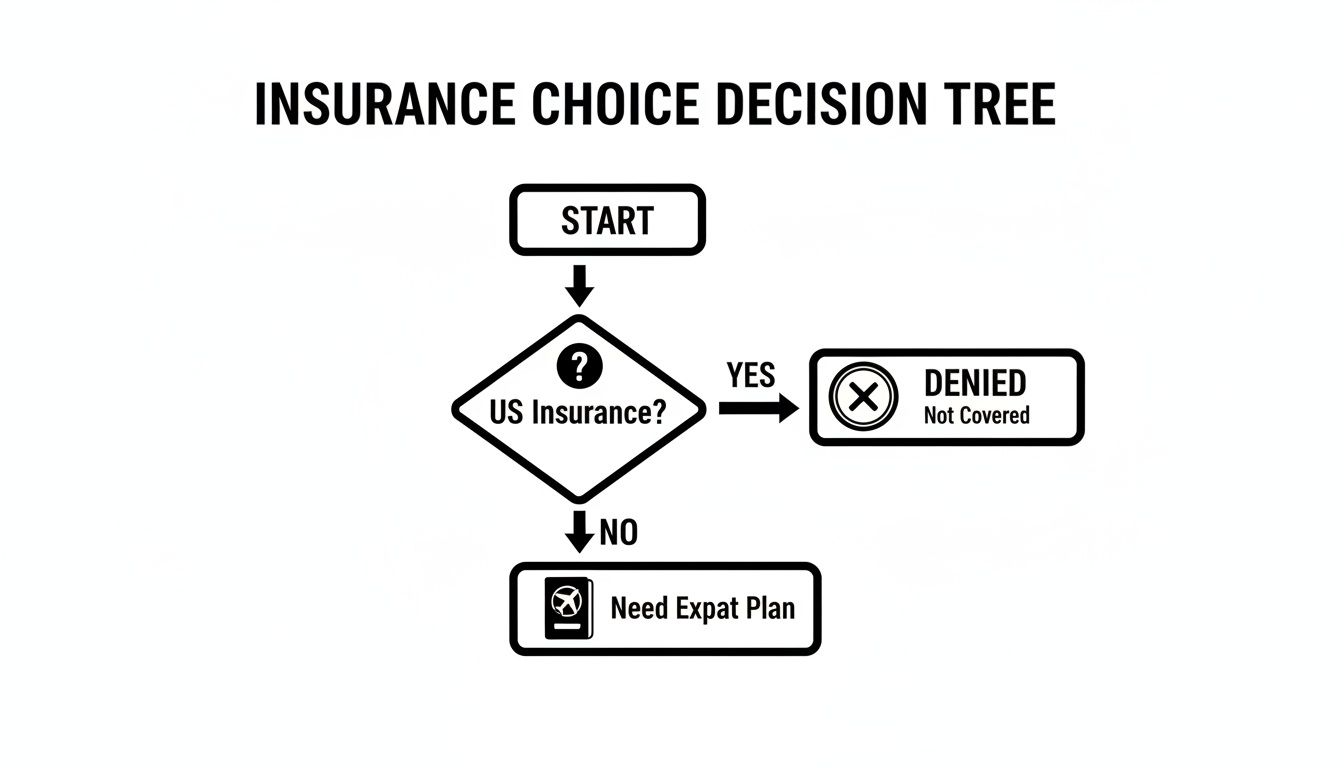
As the chart makes clear, your standard U.S. insurance won’t follow you abroad. That makes a dedicated expat medical insurance plan a necessity, not a luxury.
Matching Your Plan To Your Expat Lifestyle
Choosing the right type of travel health insurance in Mexico starts with being honest about your plans. Your lifestyle dictates what you need, and getting it wrong can be financially devastating.
Here’s a simple way to break it down:
- Short-Term Visitor (Under 6 months): Are you a “snowbird” escaping the cold or a tourist on an extended holiday? A solid travel insurance policy will probably do the trick. It’s designed to cover emergencies and unexpected medical issues during your temporary stay.
- Long-Term Resident (6+ months): If you’re moving to Mexico to live, work, or retire, an annual expat medical plan is non-negotiable. It’s the only way to get real coverage for both emergencies and day-to-day healthcare.
- Digital Nomad (Variable Stays): For those with a more fluid lifestyle, an annual expat plan with global coverage is the smart move. It gives you continuous protection as you move between Mexico and other countries, so you never have to worry about dangerous gaps in your coverage.
Ultimately, your insurance needs to reflect your reality. A temporary visitor needs a temporary solution. But if you’re making a life in Mexico, you need a plan that’s just as committed as you are. Using a travel policy long-term is like trying to drive cross-country on a spare tire—it just wasn’t built for the journey.
Core Coverage For Your Expat Medical Insurance
When you’re setting up a new life in Mexico, your health insurance can’t just be a flimsy safety net—it needs to be a solid foundation. A proper expat medical plan is more than a simple checklist of benefits; it’s a framework of protection that supports you through routine check-ups and unexpected crises alike. Knowing the “why” behind each core component is the key to picking a plan that truly has your back.
At its heart, every robust expat plan rests on two main pillars: inpatient and outpatient care. Think of inpatient care as coverage for any time you need an overnight hospital stay. This covers the big stuff—surgeries, serious illnesses, or accidents that require intensive monitoring and treatment within a hospital.
Outpatient care, on the other hand, covers everything else. These are the medical services that don’t require you to be admitted: visiting a specialist for a consultation, getting lab work or an MRI done, or heading to a physical therapist. A quality expat plan gives you easy access to both, so you’re covered whether you’re dealing with a complex procedure or just a routine visit.
The Lifeline Of Medical Evacuation
While inpatient and outpatient coverage form the core of your plan, there’s one feature that is absolutely non-negotiable for expats in Mexico: emergency medical evacuation. This is your lifeline if you have a serious medical event in a place that doesn’t have the specialized facilities to treat you. Mexico has excellent hospitals, but they are mostly concentrated in major cities like Mexico City, Guadalajara, and Monterrey.
Imagine you’re living in a beautiful coastal town like Sayulita and suffer a major heart attack. The local clinic might be able to stabilize you, but they can’t perform the complex surgery needed to save your life. Medical evacuation is what pays for the air ambulance to get you to a top-tier private hospital in Mexico City. Without it, you’d be staring at a bill that could easily top $100,000—a devastating cost that could stand between you and essential care.
For anyone living outside a major metropolitan area, medical evacuation isn’t a luxury add-on; it’s a fundamental part of your health security. It bridges the gap between where you are and the best possible medical outcome.
Navigating Pre-Existing Conditions And Prescriptions
One of the trickiest—and most important—parts of choosing a long-term expat medical insurance plan is figuring out how a policy handles pre-existing conditions. This is any health issue you had before your insurance kicked in. Full transparency on your application is absolutely crucial here. Many high-quality expat plans will cover these conditions, sometimes after a waiting period or with a higher premium, but failing to disclose them can get your claim denied right when you need help the most.
Likewise, you need to dig into the details of your prescription drug coverage. A good plan should offer solid benefits for any maintenance medications you rely on. Always check the policy’s formulary (the list of covered drugs) and reimbursement limits to make sure it aligns with your ongoing health needs. This empowers you to manage your well-being without constant financial stress.
The demand for this kind of detailed, comprehensive coverage is on the rise. In fact, the travel insurance market in Mexico is projected to nearly double from USD 650.21 million to USD 1,192.11 million by 2033. While short-term policies still make up a big chunk of the market, the growing number of long-term residents is driving the need for real expat plans that offer more than just basic emergency benefits. You can discover more insights about this trend and what it means for expats living in Mexico.
Understanding The Cost Of Expat Health Insurance
When you’re mapping out your budget for life in Mexico, the cost of your expat medical insurance is a huge piece of the puzzle. It’s not a one-size-fits-all product; your premium is shaped entirely by your personal situation and the kind of protection you choose. Knowing what drives these costs gives you the power to find a plan that’s both rock-solid and affordable.
Think of it like buying a car. The base model gets you safely from point A to point B, but adding a bigger engine, leather seats, or an advanced navigation system will change the final sticker price. Your insurance premium works the same way—it’s a direct reflection of the coverage you build and the risk profile you represent to the insurer.
Key Factors That Shape Your Premium
Four main variables will have the biggest say in your monthly cost. Each one is a lever you can pull to strike the right balance between bulletproof coverage and your budget. Getting a handle on how these work is the first step toward making a smart investment in your health.
- Your Age: This is the most straightforward factor of them all. As we get older, the statistical likelihood of needing medical care goes up, and premiums reflect that reality. A plan for a 30-year-old will almost always be cheaper than the exact same plan for a 65-year-old.
- The Deductible: This is the amount you pay out-of-pocket before your insurance company steps in. Opting for a higher deductible will dramatically lower your monthly premium, making it a powerful tool for managing costs. This is a fantastic strategy if your goal is to secure strong catastrophic coverage while handling smaller, routine expenses yourself.
- The Policy Maximum: This is the total ceiling on what the insurer will pay out over the policy term (usually per year). A plan with a $1,000,000 limit will cost less than one with a $5,000,000 limit. While higher limits offer more peace of mind, a lower maximum can be a practical way to cut costs if you’re mainly focused on emergency protection.
- U.S. Coverage: This is the big one. Adding coverage for medical care inside the United States can easily double your premium, if not more. This is purely because of the sky-high cost of healthcare in the U.S. If you don’t plan on spending much time there, excluding U.S. coverage is the single most effective way to lower your premium. You can always grab a separate short-term travel policy for quick visits home.
Choosing your deductible is a strategic decision. A higher deductible means a lower premium, effectively letting you self-insure for minor costs while protecting you from financially devastating major medical events.
Sample Monthly Premiums For Expat Insurance In Mexico
To bring these ideas to life, let’s look at some real-world cost estimates. These numbers are just examples—they can vary by carrier and specific benefits—but they’ll give you a realistic idea of what different expats might pay for their health insurance in Mexico. For a deeper dive, check out our complete guide on international health insurance costs.
Here are some illustrative cost estimates based on different applicant profiles and coverage levels to help you budget.
Sample Monthly Premiums For Expat Insurance In Mexico
| Applicant Profile | Low-Deductible Plan (Comprehensive) | High-Dectible Plan (Catastrophic) | Key Cost Factor |
|---|---|---|---|
| Digital Nomad (30s) | $150 – $250 / month | $80 – $140 / month | Youth and good health keep premiums low. |
| Retired Couple (60s) | $900 – $1,500 / month | $500 – $850 / month | Age is the primary driver of higher costs. |
| Young Family (2 Adults, 2 Kids) | $600 – $950 / month | $350 – $550 / month | Dependent children add to the premium but less than adults. |
As you can see, the difference between a low-deductible plan (say, $1,000) and a high-deductible one ($10,000) is massive. The right choice really comes down to your personal financial situation and how much risk you’re comfortable with.
Ultimately, your expat health insurance is an investment in your well-being. Understanding the costs is the first step to making a decision you can feel confident about.
Finding And Applying For The Right Plan
Once you’ve figured out what kind of coverage you need, the next step is actually getting a policy in your hands. Finding and applying for expat medical insurance in Mexico can feel like a huge task, but if you break it down into a simple roadmap, it’s completely manageable. The goal here is to go from doing your homework to having your policy documents ready, feeling totally confident in your choice.
It’s a bit like assembling a piece of furniture. You wouldn’t just start grabbing screws and panels at random; you’d follow the instructions, step-by-step, to make sure you end up with something sturdy. Securing your health coverage is no different—a logical process ensures you build a plan that won’t fall apart when you need it most.
Preparing Your Application
Before you start filling out forms, it pays to get your documents in order. This isn’t anything too complicated, but having everything ready beforehand will make the entire process a whole lot smoother. Think of it as your pre-flight checklist.
You’ll generally need to have these items ready to go:
- Personal Identification: A clear, scanned copy of your passport is the standard for verifying who you are.
- Proof of Address: This could be a utility bill or a bank statement. Don’t worry if it’s from your home country; that usually works just fine.
- Payment Information: You’ll need a credit card or bank details to set up your premium payments.
- Medical History: Be ready to provide honest, detailed information about your health, including any past treatments or medications you’re currently taking.
The single most critical part of this whole process is the medical questionnaire. This is where you lay out your entire health history for the insurer.
Complete honesty on your medical questionnaire is non-negotiable. Hiding information about pre-existing conditions is one of the fastest ways to get a future claim denied, which could even void your policy right when you’re counting on it.
The Underwriting And Approval Process
After you hit ‘submit’ on your application, it heads into underwriting. This is simply the stage where the insurance company’s team reviews your health information and overall risk profile to figure out if they can cover you and what your final premium will be.
Don’t be surprised if the underwriting team comes back with a few follow-up questions or asks for records from your doctor. This is a perfectly normal part of the process; they’re just making sure they have a complete and accurate picture of your health.
Once their review is done, you’ll get an official offer. This document will lay out your final premium, any specific exclusions (like a temporary waiting period for a pre-existing condition), and the full terms of your coverage. Make sure you read this document carefully before you make that first payment to activate the policy.
The Advantage Of Working With A Specialist Broker
Trying to navigate all of this on your own can be confusing, to say the least. This is where partnering with a specialist broker, like us here at Expat Global Medical, becomes a game-changer. A good broker is your advocate and guide, helping you find the right expat medical insurance in Mexico without any of the guesswork.
An experienced broker can:
- Compare Top Carriers: Instead of you spending hours researching dozens of plans, a broker brings the best options from leading global insurers directly to you, tailored to your needs.
- Clarify The Fine Print: They can translate the complex policy jargon, explaining everything from how your deductible works to the nitty-gritty details of medical evacuation coverage.
- Advocate On Your Behalf: If the underwriters have questions, your broker can step in to provide the necessary context, ensuring your application gets a fair and accurate review.
Ultimately, working with a broker simplifies the entire journey. It turns a potentially confusing and stressful task into a clear, manageable checklist for securing your health and peace of mind in Mexico.
How To Handle A Medical Emergency In Mexico
When a health crisis hits you in a foreign country, the last thing you want is to panic. Having a clear, straightforward plan is your best asset, turning what could be a terrifying experience into a situation you can actually manage. Knowing the right steps to take during a medical emergency in Mexico is key to getting the best care, fast.
The first few moments are absolutely critical. Before you do anything else, your first call should be to the 24/7 emergency assistance number from your insurance company. This number is your lifeline. Seriously, save it in your phone and maybe even write it down somewhere easy to find. The team on the other end is trained for these exact situations and will immediately start coordinating your care.
Taking The First Critical Steps
Once you’ve got your insurer on the line, their team will point you toward an appropriate, in-network private hospital. This is a crucial detail. While Mexico has a public healthcare system, the top-tier care—and the facilities that work with international insurance—are in the private system. Your insurance partner can tell you exactly which hospitals are in their network, which helps you avoid a massive, unexpected bill.
But their role goes way beyond just suggesting a hospital. The assistance team will:
- Coordinate with the hospital: They’ll talk to the administrative and medical staff to get your admission sorted out.
- Provide translation services: If you’re struggling with a language barrier, they can step in and make sure everyone understands each other.
- Arrange for direct billing: In many cases, they can set up a “guarantee of payment” directly with the hospital. This means you won’t have to max out your credit cards to pay for thousands of dollars upfront.
Think of a responsive insurance partner as your personal logistics expert. They handle all the complicated administrative and financial stuff, letting you and your family focus on what really matters: your health and recovery.
The Power Of A Good Insurance Partner
Let’s play out a scenario. An expat retiree takes a bad fall while exploring a small town just outside of Puerto Vallarta. The local clinic can patch them up, but they don’t have the orthopedic specialists or surgical suites needed for a complex fracture. Panic starts creeping in.
With a quality expat medical plan, however, the whole process is different. One call to their 24/7 hotline sets a real plan in motion. The insurer confirms that the best move is an ambulance transfer to a top private hospital in Puerto Vallarta. They arrange the guarantee of payment, so there are no financial roadblocks when the ambulance arrives. If the injury was even more severe and required a higher level of care, this is where medical evacuation coverage would kick in.
This kind of coordinated, calm response is the real value of solid expat medical insurance in Mexico. In a crisis, your policy is more than just a piece of paper; it’s an active support system. For anyone wondering what happens in the most extreme situations, it’s also worth understanding how emergency air evacuation insurance works as part of a comprehensive plan. It’s the ultimate safety net, making sure you get to the right facility, no matter where you are.
Common Questions About Expat Health Insurance In Mexico
Even with the best planning, it’s natural to have questions when you’re choosing something as important as health insurance. Let’s tackle some of the most common things expats ask about medical coverage in Mexico, so you can move forward with total confidence.
Think of this as a quick-reference guide to reinforce what we’ve covered and make sure you’re fully prepared.
Can I Just Rely On Mexico’s Public Healthcare System (IMSS)?
While expats with legal residency can enroll in the IMSS public healthcare system, it’s rarely a good idea to use it as your only safety net. Honestly, the system is known for long wait times, frequent resource shortages, and a standard of care that might not be what you’re used to back home.
Most expats find that a private medical insurance plan is the way to go. It opens the door to Mexico’s fantastic network of private hospitals and clinics, where you’ll get faster, higher-quality care. A solid expat plan is your ticket to this much better level of service.
Why Is Medical Evacuation Coverage So Important?
Medical evacuation is one of those things you hope you never need, but you’ll be incredibly glad you have it if you do. It covers the astronomical cost of getting you to a hospital that can actually treat your specific condition—whether that’s in another Mexican city or even back in your home country. This is a huge deal in Mexico, where many of the most beautiful places to live are hours away from specialized medical centers.
An air ambulance flight can easily top $100,000. Without evacuation coverage, a serious accident or illness could turn into a financial nightmare, or worse, keep you from getting life-saving care when every second counts.
Should My Expat Plan Include Coverage In The USA?
This really comes down to your personal travel plans. If you see yourself heading back to the U.S. frequently and want to be covered for medical care while you’re there, then you’ll want to choose a plan that includes it. Just be prepared—adding U.S. coverage will significantly bump up your premium because of how expensive healthcare is there.
For most expats who only take short, occasional trips home, there’s a more wallet-friendly approach. Buying a separate, short-term travel policy just for those specific visits is often the smarter move. That way, you’re not paying a high annual premium for coverage you barely use. For expats, understanding how insurance process outsourcing might impact their plan administration can also be insightful when navigating common questions about coverage details and claims handling across borders.
Figuring out expat medical insurance in Mexico is a lot less complicated when you have an expert in your corner. Expat Global Medical offers personalized quotes from the best carriers out there, making sure you find a plan that fits your life and your budget perfectly. Protect your new adventure in Mexico by visiting https://expatglobalmedical.com to get your free quote today.