
Expat medical insurance with medical evacuation is a lifeline. It’s a specific kind of policy designed to cover the astronomical cost of getting you to a proper medical facility if you’re hit with a serious illness or injury while living abroad. For expats in countries where local healthcare may not meet the standards you rely on, this coverage is a critical safety net. It’s your guarantee that you can get life-saving care without facing financial ruin.
Think of it this way: it’s for emergencies that are way beyond a simple trip to the doctor.
What Medical Evacuation Insurance Means For Expats
When you make a life for yourself overseas, your relationship with healthcare completely changes. You’re not just a tourist on a two-week vacation anymore; you’re building a life in a new country, and that includes navigating its medical system. This is where the difference between a standard travel policy and a robust expat medical insurance plan becomes crystal clear.
A basic travel policy is built for short trips and minor hiccups. A comprehensive expat medical plan, on the other hand, is designed for the long haul. Medical evacuation coverage is the heart of this protection, acting as your emergency bridge from an under-equipped local clinic to a world-class hospital.
More Than Just A Ride To The Hospital
It’s easy to hear “evacuation” and just think of a local ambulance ride. That couldn’t be further from the truth. In reality, it’s a highly complex logistical operation, often involving a private air ambulance staffed with a medical crew, all coordinated across international borders.
Let’s paint a picture. Say you’re an expat who retired to a quiet beach town in Mexico. Suddenly, you have a major heart attack. The local clinic can get you stable, but they don’t have the cardiac specialists or the surgical equipment you desperately need. This is the exact moment medical evacuation coverage kicks in.
A dedicated team jumps into action, arranging your transport—by ground or air—to the nearest hospital that can give you the advanced care you need. That could be in a major city in Mexico or in another country entirely.
This isn’t just about booking a flight. The coordination involves:
- Translating your medical records for the new doctors.
- Handling all the airport landing fees and customs clearances.
- Ensuring you have continuous medical supervision during the entire journey.
- Keeping your family back home in the loop.
These are the kinds of overwhelming tasks that are nearly impossible to manage yourself during a crisis, especially when you’re dealing with language barriers and unfamiliar hospital rules. You can find more details in our guide that explains international travel insurance coverage in depth.
Why Standard Travel Insurance Falls Short For Expats
Standard travel insurance is great for tourists, but for digital nomads, retirees, or anyone on a long-term corporate assignment, the risks are fundamentally different. Your “home base” might be a country with developing infrastructure, which makes getting specialized medical care a real worry.
This table breaks down why a standard plan often doesn’t cut it for the expat lifestyle.
Standard Travel Medical vs Expat Medical Evacuation Coverage
| Feature | Standard Travel Medical Insurance | Expat Insurance with Medical Evacuation |
|---|---|---|
| Primary Focus | Short-term emergencies, trip cancellation | Long-term, comprehensive health & emergency transport |
| Coverage Limits | Lower (often $50,000 – $100,000) | High (typically $1 million or more) |
| Ideal User | Tourists on vacation (weeks) | Expats, digital nomads, retirees (months/years) |
| Coordination | Basic assistance, may require self-coordination | Full logistical management by a dedicated team |
| Scope of Transport | Usually to the “nearest adequate facility” | Transport to a center of excellence, or repatriation |
As you can see, expat medical insurance with evacuation is built for the realities of living abroad. It provides much higher coverage limits—often up to $1 million or more—which reflects the staggering potential cost of an international medevac flight. These flights can easily top $200,000.
Beyond just the insurance policy itself, learning how to prepare for international travel in general can calm a lot of the anxieties that come with moving abroad. Ultimately, this coverage delivers true peace of mind, ensuring that no matter where your global journey takes you, you’re never really that far from the best medical care possible.
The True Cost of a Medical Emergency Abroad
Ever find yourself wondering if you really need robust medical evacuation coverage as an expat? The question answers itself the moment you look at the real-world costs of a medical crisis far from home. We’re not talking about small bumps and bruises; we’re talking about situations that can financially cripple you without the right safety net.
An emergency doesn’t care about your plans. A sudden accident or a severe illness in a country with shaky medical infrastructure can set off a chain reaction of jaw-dropping expenses. And the single biggest line item on that bill? The evacuation itself. Hint: it’s nothing like booking a commercial flight.
Breaking Down the Bill
Think of an air ambulance as a flying intensive care unit. It’s kitted out with specialized medical staff, life-support equipment, and the ability to land at smaller airfields to get you out of remote spots. That level of critical care, unfortunately, comes with a shocking price tag.
Let’s get real with the numbers:
- Short-Haul Evacuation: A flight from the Caribbean to Miami can easily run from $20,000 to $50,000.
- Transatlantic Evacuation: Need to get a patient from Europe to the United States? That often tops $100,000.
- Remote Location Evacuation: Transport from a far-flung part of Asia or Africa could soar past $250,000.
These figures aren’t just scare tactics. As more Americans live and work abroad, the need for this kind of protection has skyrocketed. In 2024, spending on travel insurance surged 46% from 2019 levels, hitting $5.56 billion as expatriates and travelers began to prioritize coverage against emergencies. This trend shows a growing awareness of how vulnerable you can be in foreign healthcare systems, especially as claims for emergency medical transport keep climbing. For more on this, you can check out insights on rising travel insurance statistics.
It’s a sobering reality: a single medical event can generate a bill larger than the value of your home. This is precisely why expat medical insurance with medical evacuation is non-negotiable for anyone living an expat lifestyle.
Factors That Drive Up Evacuation Costs
The final bill for a medical evacuation isn’t pulled out of thin air. Several key factors determine the expense, which is why high coverage limits are so essential for true peace of mind. Your location as an expat is a huge driver; getting you out of a remote jungle or a small island is always going to cost more than an evacuation from a major European city simply because of the complex logistics involved.
The severity of your medical condition also plays a massive role. A patient needing a full critical care team and specialized in-flight equipment will face a much higher cost than someone stable enough to fly with a medical escort on a commercial flight. Even the type of aircraft required and the landing fees at various airports all add up.
The complexity of these expenses is why your standard health insurance plan back home will almost certainly fall short. They just aren’t designed to handle the intricate coordination of international medical transport. If you’re curious about how these massive bills get paid, you might be interested in our article on how travel medical insurance saves travelers thousands on hospital bills abroad.
Providers like Expat Global Medical are built to handle these catastrophic costs. By partnering with world-class carriers, they offer plans with emergency assistance and transportation coverage of up to $1 million. This level of protection is specifically designed to absorb the immense financial shock of a worst-case scenario, ensuring your focus stays on getting better—not on a life-altering debt.
How a Medical Evacuation Actually Unfolds
When a serious medical crisis hits you far from home, the first few moments are a blur of confusion and fear. This is the exact point where your expat medical insurance with evacuation stops being a document and becomes a critical, life-saving service. It’s a highly coordinated operation, run by seasoned experts, designed to get you from the point of crisis to a center of medical excellence as safely and efficiently as humanly possible.
Let’s imagine an expat—we’ll call her Sarah—who is teaching in a small, rural town in Southeast Asia. During a weekend hike, she takes a bad fall, resulting in multiple fractures and suspected internal injuries. The local clinic is small, and it’s immediately clear they lack the surgeons and advanced imaging equipment she desperately needs.
This is the moment the evacuation process kicks into gear.
The Critical First Call
The first and most important step is always the same: contact the 24/7 emergency assistance number provided by your insurer. This single phone call sets a powerful chain of events in motion. Sarah, or someone with her, makes the call, gives her policy details, and explains the emergency.
From that moment on, a dedicated case manager and a team of medical professionals take the lead. Their first action is to contact the local clinic where Sarah is, speaking directly with her attending physician to get a firsthand account of her condition.
Assessment and Decision
The insurer’s medical team—often staffed with doctors and nurses experienced in international transport—quickly assesses the situation. They review Sarah’s injuries, evaluate the local clinic’s capabilities, and consider the doctor’s recommendations.
Their goal is to answer one vital question: can the local hospital provide the necessary standard of care?
If they determine the facility is inadequate, as it is for Sarah’s complex injuries, the decision to evacuate is made. This isn’t a casual choice; it’s based on strict medical necessity. The team’s absolute priority is moving the patient to the nearest medical facility that can properly manage their condition.
This visual shows how the stages of an emergency break down, from the initial crisis to the life-saving evacuation and aftercare.
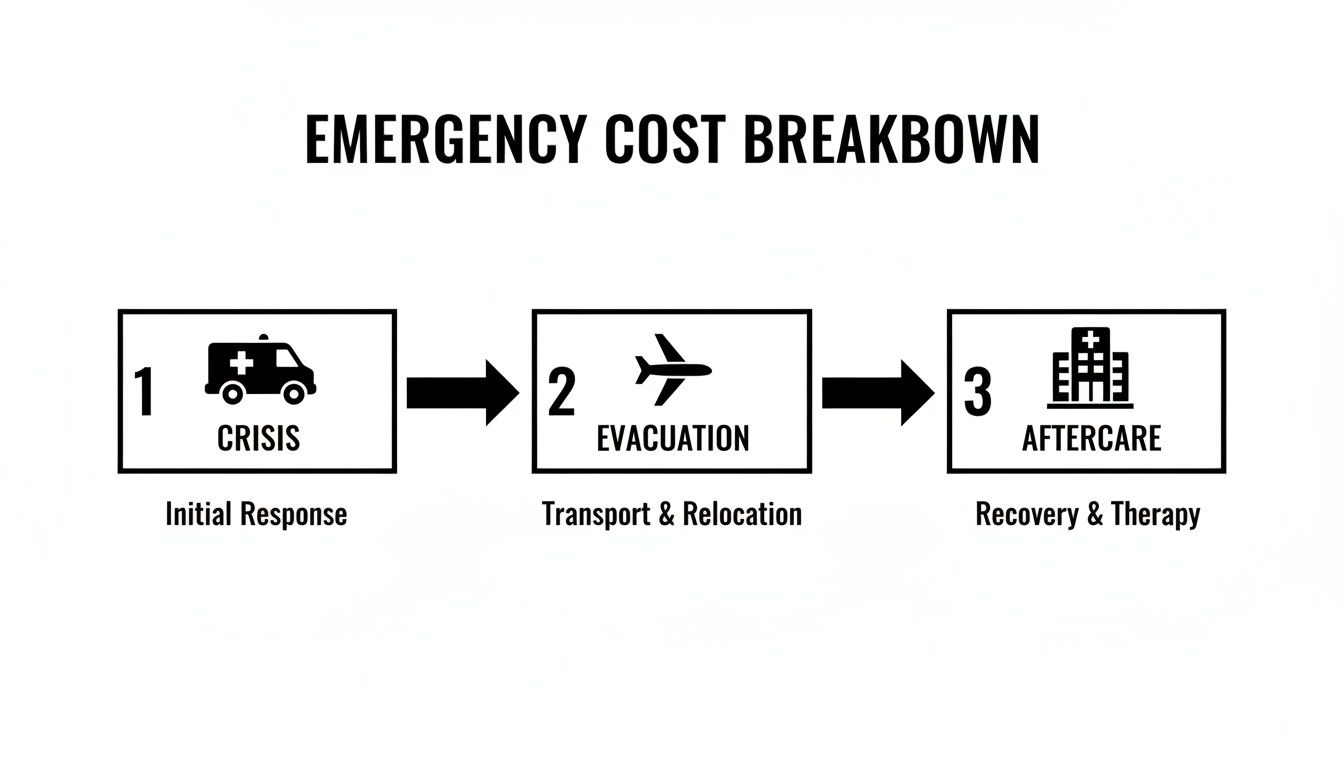
As the infographic shows, the evacuation itself is a distinct, logistically intense step that bridges the gap between the initial emergency response and definitive hospital treatment.
Coordinating the Complex Logistics
Once the green light is given for evacuation, the logistics team takes over what can only be described as an incredibly complex puzzle. This is far beyond what any individual expat could hope to manage during a crisis.
The coordination process is a whirlwind of activity:
- Arranging Transportation: Depending on the patient’s stability and location, this could mean a ground ambulance, a commercial flight with a medical escort, or a fully equipped private air ambulance. For Sarah, given her severe injuries, an air ambulance is the only safe option.
- Medical Crew Assembly: A specialized medical team, including a flight nurse and a paramedic, is assigned to accompany Sarah every step of the way, providing continuous care during transport.
- Clearing Red Tape: The team handles all the bureaucratic nightmares, like arranging flight plans, securing landing permits, and navigating customs and immigration for both the patient and the medical crew.
- Hospital Coordination: A bed is secured at the destination hospital. All of Sarah’s medical records are translated and transferred ahead of time so the new medical team is fully prepared for her arrival.
This entire operation is a masterclass in crisis management and underscores why you simply cannot coordinate your own medical evacuation. The expertise, global network, and resources required are immense. To get a better sense of the transport itself, you can learn more about travel medical air evacuation options and what goes into them.
Evacuation Versus Repatriation
It’s really important for expats to understand the difference between two key terms: medical evacuation and medical repatriation. They are not the same thing.
Medical Evacuation is the transport of a patient to the nearest adequate medical facility. The entire goal is immediate, life-saving treatment.
In contrast, Medical Repatriation is the transport of a patient back to their home country for continued care, but only once they are stable enough to travel the long distance. While many expat plans include this benefit, the initial emergency response is almost always an evacuation to the closest appropriate hospital.
For Sarah, this likely means being flown to a major hospital in Bangkok, not all the way back home. From that first frantic call to her arrival at a state-of-the-art facility, the process is seamless, professional, and focused entirely on one thing: her well-being.
Choosing the Right Expat Medical Insurance Plan
Picking the right expat medical insurance with medical evacuation isn’t like choosing a flight or a hotel. For an expat, this decision is a foundational piece of your life abroad—one that directly shapes your health, safety, and financial future. A one-size-fits-all plan just won’t cut it when your life is spread across borders.
Think about it: the needs of a retiree enjoying the quiet coasts of Portugal are worlds apart from a digital nomad bouncing between cafes in Thailand or a corporate executive stationed in Dubai. Every expat lifestyle brings its own unique risks and different levels of access to quality medical care. The real key is to look beyond the monthly premium and dig into the policy details to find a plan that delivers genuine, practical protection.
Decoding the Fine Print: What to Look For
Before you sign on the dotted line, you have to get comfortable reading the fine print. Insurers use very specific language to define what’s covered and what’s not, and understanding these terms is your first step to making a smart choice. Missing a single clause could be the difference between total protection and a denied claim right when you need it most.
Here are the absolute must-check items in any expat medical policy:
- Coverage Limits: What’s the maximum amount the policy will pay for an evacuation? You should be looking for plans with high limits, ideally in the $500,000 to $1 million range, or even higher.
- Definition of ‘Medical Necessity’: Who gets to decide if an evacuation is actually necessary? Most insurers give themselves the final say, so you need to understand their criteria.
- Pre-existing Conditions: How does the plan handle an emergency related to a health issue you already have? Some policies have frustrating waiting periods or exclude them entirely.
- Geographic Exclusions: Are you covered in your country of residence and any other places you plan to visit? Some plans won’t cover you in regions they deem high-risk or politically unstable.
Your Expat Lifestyle Dictates Your Needs
The best plan is the one that feels like it was made for your life. A retiree in a developed European nation might be most concerned with coverage for age-related conditions. A young digital nomad exploring remote corners of the globe, on the other hand, needs a plan that includes adventure sports and has a massive network of clinics.
Let these expat scenarios paint a picture:
- The Retiree in a Remote Town: If the nearest major hospital is hours away, your plan absolutely must be top-notch at coordinating evacuations from less accessible spots.
- The Digital Nomad Adventurer: If scuba diving or mountain trekking are on your agenda, your policy needs to explicitly cover those activities. No assumptions.
- The Expat with a Family: Your coverage must be solid enough for everyone, including benefits like flying a family member out to be with you during an evacuation.
Your insurance plan should be a reflection of your life. It needs to account for where you live, what you do, and who you are responsible for, ensuring there are no gaps when you need protection the most.
The financial stakes have never been higher. With the soaring costs of medical evacuations, insurers have started offering much more robust coverage. A recent analysis pointed out that plans offering $250,000 to $1 million per person in emergency transport are now becoming the norm. This is a direct response to the staggering bills we’ve seen in recent years, especially for expats and digital nomads who can’t rely on local care.
This trend is a big reason why the global travel medical insurance market, valued at $5.24 billion in 2024, is projected to nearly double by 2034.
A Practical Checklist for Making Your Choice
Feeling a bit overwhelmed by the options? Just use this straightforward checklist to compare policies and make sure you’re asking the right questions. Before you decide, it’s a good idea to explore the full range of travel insurance options out there to see how medical evacuation fits into the bigger picture.
- Verify the Evacuation Limit: Is it at least $500,000? For true peace of mind, aim for $1 million or unlimited coverage.
- Check Repatriation Options: Does the plan only get you to the nearest suitable facility, or will it cover transport back to your home country once you’re stable? This is a huge distinction for expats.
- Review the Assistance Provider: Who is actually managing the evacuation on the ground? Look for companies with a proven global network and 24/7 access to expert medical staff.
- Confirm Pre-existing Condition Clauses: Are you crystal clear on the waiting periods and exactly what is (and isn’t) covered?
- Ask About “Bedside Visit” Coverage: If you’re hospitalized, will the policy pay for a family member’s flight to come and be with you? This can make a world of difference.
By taking a methodical approach, you can choose a plan that acts as a true lifeline, protecting your health and your finances no matter where your expat journey leads.
Real-World Scenarios Where Evacuation Was a Lifeline

The true value of expat medical insurance with medical evacuation isn’t buried in policy documents; it’s proven in the chaos of a real crisis. For expats, these aren’t just abstract what-ifs but tangible risks that come with living a global life. The stories of those who’ve needed this lifeline show just how fast a manageable situation can spiral into a catastrophe without the right plan.
These scenarios aren’t just theory. They show how a solid plan can turn a potential disaster into a managed emergency, highlighting the huge difference between simply having insurance and having a partner ready to pull off a complex rescue mission when it matters most.
The Retiree in a Remote Paradise
Take David, a U.S. retiree living his dream in a small coastal town in Mexico. One morning, he has a stroke. The local clinic is staffed by caring people, but they’re set up for basic first aid, not the urgent neurological care he needs to prevent permanent damage.
Panic sets in. But one call to their expat medical insurance provider changes everything. Within hours, a medical team reviews his case, confirms the local facility is inadequate, and dispatches an air ambulance. David is flown to a major neurological center, where he gets the critical treatment that saves not just his life, but his quality of life.
The Digital Nomad’s Unexpected Detour
Now picture Chloe, a young digital nomad working from a beautiful island in Thailand. A bad scooter accident leaves her with severe internal injuries. The tiny island hospital simply can’t handle major trauma surgery, and every hour that ticks by is another hour of risk.
Her evacuation plan kicks into high gear. A logistics team coordinates a multi-stage transport—first by speedboat to the mainland, then by a medically-staffed flight to a top-tier hospital in Bangkok. They solved a massive puzzle involving language barriers, multiple types of transport, and urgent medical needs, letting Chloe’s family focus only on her recovery.
These aren’t just stories; they’re proof of why a catastrophic plan is so essential for expats. Without it, David and Chloe would have faced not only terrible medical outcomes but also financial ruin from evacuation costs that can easily top $200,000.
When Political Stability Vanishes
An expat family living in a country hit by sudden civil unrest faces a different kind of crisis. The father, an engineer on assignment, has a heart attack just as local hospitals become overwhelmed and unsafe. The emergency isn’t just medical; it’s geopolitical.
Their insurance provider’s assistance team navigates the volatile environment. They arrange secure ground transport to a private airfield, bypassing the chaos. A fully equipped medical jet flies the entire family to a hospital in a stable, neighboring country. This shows that a trigger for evacuation isn’t always a lack of equipment—sometimes, it’s the complete collapse of the world around you.
The demand for this level of protection is exploding. The medical travel insurance market swelled to $30.59 billion in 2024, a figure driven by the $1.4 trillion generated by international tourism and a sharp new awareness of health risks abroad. With 86.97 million people covered by U.S. plans alone, it’s clear that expats and global employers are no longer willing to gamble. You can read more about the growth of the medical travel insurance market.
All these stories share one thing: when the worst happened far from home, a comprehensive medical evacuation plan was the lifeline that opened the door to critical care, protected their savings, and ultimately, saved a life.
Answering Your Final Medical Evacuation Questions
Even after digging into the costs, coordination, and real-world scenarios, a few key questions always seem to pop up for expats. For anyone living or working abroad, getting these final details right is what separates true peace of mind from lingering anxiety.
Let’s clear up that last bit of confusion. Think of this as the final check-in before you commit to an expat plan. We’ll tackle whether your old domestic insurance has any role in your new life, hammer home the critical difference between evacuation and repatriation one last time, and unpack the tricky topic of pre-existing conditions. The goal here is to leave you feeling completely confident about the protection you’re putting in place.
Does My Domestic Health Insurance Cover Me Abroad?
This is easily one of the most common—and dangerous—assumptions expats make. For almost everyone living abroad long-term, the answer is a hard no.
Your health insurance from back home is built to operate within a specific country’s network of doctors, clinics, and hospitals. As soon as you move overseas, you’re almost always considered “out of network” for everything.
While a handful of premium domestic plans might offer a tiny sliver of coverage for a dire international emergency, it’s never enough. They simply weren’t designed to handle the staggering costs or the complex logistics of a medical evacuation, which can spiral past $200,000 without breaking a sweat. Relying on your home plan is a massive financial gamble.
A dedicated expat medical plan isn’t a supplement; it’s your primary insurance. It’s built for the global stage, giving you access to international medical networks and the kind of robust emergency transport benefits that domestic plans just can’t touch.
Evacuation vs. Repatriation: One Last Look
We’ve touched on this before, but the distinction is so vital for expats it’s worth cementing in your mind. Getting this wrong can lead to serious disappointment during an already stressful crisis.
-
Medical Evacuation: This is about one thing: getting you to the nearest adequate medical facility that can handle your life-threatening situation. The mission is purely about immediate, life-saving care, no matter where that hospital is located. It could be in a neighboring country or a major city a few hours away.
-
Medical Repatriation: This is the trip back to your home country for ongoing treatment or recovery. The key detail? It only happens after you are medically stable and cleared for a long-distance journey.
If you have a medical crisis in a remote part of Southeast Asia, the immediate response will be an evacuation to a top-tier hospital in Bangkok or Singapore, not a 20-hour flight back home. The best expat plans cover both, but in a true emergency, evacuation is always priority number one.
How Are Pre-Existing Conditions Handled in an Emergency?
This is a huge point of concern for many expats, especially retirees or those with chronic health issues. How a policy treats pre-existing conditions can vary dramatically, which makes reading the fine print absolutely essential.
Generally, expat plans will approach this in one of three ways:
- Total Exclusion: Many basic, short-term, or budget-oriented plans will flat-out refuse to cover any emergency that stems from a condition you had before your coverage started.
- A Waiting Period: A more common approach is for a policy to cover pre-existing conditions, but only after a “waiting period” (often 6-12 months) has passed where you’ve had no symptoms, treatment, or medical advice for that specific condition.
- Full Coverage (with Underwriting): The most comprehensive expat plans will cover pre-existing conditions from day one, as long as you disclose them fully during the application process. Your premium might be a bit higher, but it buys you the most reliable protection.
The golden rule for expats is to be 100% transparent about your medical history when you apply. Hiding a condition is the surest way to get a claim denied right when you need that coverage the most.
How Much Evacuation Coverage Do I Really Need?
It’s always tempting to go for the plan with the lower premium, but skimping on your medical evacuation limit is a terrible place to cut corners as an expat. The costs—for the air ambulance, the specialized medical crew, international landing fees, and ground coordination—are simply astronomical.
Here’s a quick guide to help you gauge what makes sense for your expat situation:
| Coverage Level | Recommended For | Why It Makes Sense |
|---|---|---|
| $500,000 | Expats in regions with excellent nearby medical infrastructure (e.g., Western Europe). | This is the absolute floor. It should be enough for most short-range, regional evacuations. |
| $1,000,000 | The vast majority of expats, from digital nomads to families in developing nations. | This provides a powerful safety net for more complicated or longer-distance rescues. |
| Unlimited | Expats in extremely remote areas or anyone who wants the ultimate peace of mind. | This guarantees that no matter how complex or expensive the situation gets, you’re covered. |
When you consider that even a “straightforward” evacuation can easily hit six figures, a coverage limit of at least $1 million is the smartest and safest bet for most expats. It’s the difference between a medical crisis and a lifelong financial catastrophe.
Ready to secure the peace of mind you deserve for your life abroad? The experts at Expat Global Medical have been helping expats find the right coverage since 1992. Get a personalized quote and explore plans designed for your unique journey. Protect your health and your future today.