Let’s be honest: searching for the best international medical insurance isn’t about finding a single, universally “best” plan. It’s about finding the plan that fits your expat life. The right choice hinges entirely on where you’re moving, who you’re with, and your personal health needs. A truly great plan for an expatriate strikes the perfect balance between solid coverage, a reliable network of doctors, and a price that fits your budget.
What Is the Best Expat Medical Insurance
Defining the “best” expat medical insurance is a deeply personal exercise. This isn’t a one-size-fits-all situation; the right plan has to mirror the actual realities of your life abroad. A young digital nomad hopping between co-working spaces in Southeast Asia has completely different needs than a family of four moving to Europe for a corporate job.
So, the first thing to do is stop looking for a single “best” plan and start figuring out what’s best for you as an expat. That process kicks off with a clear-eyed look at your own circumstances and deciding what coverage features are non-negotiable. For instance, a retiree settling down in Mexico will probably put robust coverage for chronic conditions at the top of their list, while a globetrotting executive needs a plan with a massive worldwide network to handle frequent travel.
Matching Your Expat Profile to Your Plan
Figuring out your “expat profile” is the real key to finding the right insurance. Are you a solo adventurer, part of a growing family, or a professional on a long-term assignment? Each of these profiles comes with its own set of priorities, which helps separate the essential features from the nice-to-haves.
A family plan, for example, absolutely needs strong maternity benefits and wellness coverage, including routine check-ups for the kids. A digital nomad’s policy, on the other hand, must have top-notch emergency evacuation and repatriation benefits—you need a way to get to a quality hospital, even if you’re working from a remote corner of the world.
The smartest way to look at expat medical insurance is not as an expense, but as a critical part of your financial and personal security strategy. The right plan protects both your health and your savings from the shock of an unexpected medical crisis.
To help you get started, we’ve put together a table that breaks down common expat profiles and their typical insurance priorities. Use it to zero in on what should be at the top of your checklist as you compare options.
Expat Profiles and Key Insurance Priorities
This table outlines the most critical insurance features for different types of expatriates to help you quickly pinpoint your primary needs.
| Expat Profile | Primary Coverage Priority | Essential Plan Feature | Common Plan Focus |
|---|---|---|---|
| Digital Nomad | Emergency and Accident Care | High-Limit Medical Evacuation | Flexible, worldwide coverage excluding the USA |
| Expat Family | Comprehensive Health and Wellness | Maternity & Dependent Coverage | In-network pediatricians and wellness benefits |
| Retiree Abroad | Chronic Condition Management | Pre-existing Condition Coverage | Strong local network and prescription drug benefits |
| Corporate Assignee | Seamless Global Access | Direct Billing Network | Worldwide coverage including the home country |
This framework gives you a solid starting point, helping you cut through the noise and focus on what truly matters for your specific situation as an expat.
Decoding the Core Features of Expat Health Plans

When you’re shopping for expat medical insurance, it’s easy to get fixated on the monthly premium. But the real worth of a plan is buried in the details—the fine print that separates true security from a false sense of it. This isn’t just about understanding industry jargon; it’s about knowing exactly how your policy will kick in when you actually need it.
Getting a handle on these core components is what empowers you to compare plans like an expert. You’ll start to see why one plan might cost a little more but deliver far better protection for your unique situation. Let’s pull back the curtain on the essential building blocks of any solid expat health plan.
Geographic Area of Coverage
One of the first things you’ll decide is where you need coverage. Expat health plans aren’t automatically global. They’re built with specific geographic boundaries, a factor that has a huge impact on what you’ll pay.
Most insurers give you two primary choices:
- Worldwide Coverage: This is the whole enchilada—access to healthcare anywhere on the planet, including high-cost countries.
- Worldwide Coverage Excluding the USA: A very popular and more budget-friendly option for expats who don’t plan on seeking medical care in the United States. Since U.S. healthcare is notoriously the most expensive in the world, simply excluding it can slash your premium by 30-50%.
Think of this choice as a strategic one. If you’re a U.S. citizen who plans on visiting home, you’ll want to make sure your plan includes at least limited coverage for trips back.
Benefit Limits and Deductibles
The financial nuts and bolts of your plan will determine your potential out-of-pocket spending. The annual benefit limit is the absolute maximum an insurer will pay for your medical care in a policy year. A $1 million limit might sound like a fortune, but a major medical crisis—like a complicated surgery or a long hospital stay—can burn through that surprisingly fast in certain countries.
Then there’s your deductible, which is what you have to pay yourself before the insurance company starts chipping in. Higher deductibles usually mean lower monthly premiums, but you’re taking on more of the initial financial risk. On the flip side, a lower deductible means higher premiums but less to pay out-of-pocket when you need care. It’s all about finding that sweet spot between your budget and your comfort level with risk.
One of the most critical, yet often overlooked, features is Emergency Medical Evacuation. If you have a serious accident or fall ill somewhere without adequate medical facilities, this benefit covers the cost of getting you to the nearest top-tier hospital. An air ambulance can easily top $100,000, making this coverage a non-negotiable financial lifeline for any expat.
Provider Networks and Payment Methods
How you actually get and pay for your healthcare is a huge practical detail for life abroad. Insurers manage this through provider networks and different payment systems. Understanding the difference is key to a hassle-free experience.
Here’s the typical breakdown:
- Direct Billing Network: This is the most convenient setup. The insurer has agreements with specific hospitals and clinics to pay them directly for your covered care. You just show your insurance card, and the money stuff is handled behind the scenes.
- Reimbursement (Pay and Claim): With this model, you pay for medical services upfront and then file a claim with your receipts to get your money back from the insurer. While it gives you the freedom to see any licensed doctor, it means you need to have the cash on hand and be ready to handle some paperwork.
When you’re comparing plans, always look into the size and quality of the insurer’s direct billing network in your new home country. A strong network makes an expat’s life so much easier and reduces financial stress when you’re already dealing with a medical issue.
Keep in mind that handling claims across borders can bring its own headaches, like language barriers. In these cases, using professional medical document translation services can be a lifesaver, ensuring your claims get processed correctly and without unnecessary delays.
Why Global Healthcare Trends Should Matter to Expats
Picking the right expat medical insurance isn’t just about you—it’s about understanding the world you’re stepping into. Big shifts are happening in global healthcare, from skyrocketing medical costs to more people living abroad than ever before. These trends directly shape the insurance plans on the market and explain why certain features are now non-negotiable for expats.
Getting a handle on these bigger forces gives you crucial context for your decision. It makes it clear why a solid, specialized expat plan isn’t just a travel add-on but a real investment in your financial stability. As global mobility becomes the new normal, the insurance industry is hustling to keep up with the long-term health needs of people living borderless lives.
The Rising Tide of Global Medical Costs
Let’s be blunt: healthcare is getting more expensive everywhere. This trend is a major driver behind insurance premiums and the amount of coverage you actually need. Medical inflation consistently outpaces regular inflation, pushed by new technologies, breakthrough treatments, and a growing demand for top-tier care in popular expat hubs like Dubai, Singapore, and across Europe.
This steady climb means an unexpected medical issue could be financially catastrophic without the right safety net. A plan with a low coverage limit that seemed fine a few years ago might leave you dangerously exposed today, facing huge out-of-pocket bills for even a routine procedure.
Modern expat health plans are designed with high benefit limits—often $1 million or more—for a reason. It’s not an upsell; it’s a direct response to the real-world cost of quality medical care abroad and the risk of inflation.
A World on the Move: The Boom in the Expat Population
The number of people living and working outside their home country has exploded, creating a huge demand for flexible, border-agnostic healthcare solutions. This isn’t just a niche market anymore; it’s a massive force transforming the insurance sector into a cornerstone of the global economy.
The global health insurance market has swelled into a multi-trillion-dollar industry, fueling demand for international plans that fill the gaps left by national systems. Industry experts peg the market’s value at somewhere between USD $1.8–$2.3 trillion in 2024–2025, and it’s projected to hit USD $3.6–$4.5 trillion by the early 2030s. North America holds a huge piece of this pie, thanks to high healthcare spending that drives demand for portable plans among U.S. citizens living abroad. You can dig deeper into these market dynamics with reports from sources like Fortune Business Insights.
This growth is great news for you as an expat. It translates to more competition, better innovation, and a wider variety of plans built specifically for the realities of a global lifestyle.
How Insurers Are Stepping Up for Expats
Insurers have gotten the message. They’re moving away from generic, one-size-fits-all policies and creating smarter plans that solve the real problems faced by modern expats, digital nomads, and global families.
You can see this evolution in a few key areas:
- Comprehensive Wellness Benefits: Plans are no longer just for emergencies. They now regularly cover routine check-ups, vaccinations, and preventive screenings, reflecting a shift toward maintaining long-term health while living abroad.
- Mental Health Support: Insurers recognize the unique pressures of expat life. Top-tier plans now offer solid coverage for mental and behavioral health, including therapy and counseling.
- Telehealth Services: Virtual doctor visits have become a standard feature. For an expat on the move, getting immediate medical advice from anywhere in the world is a game-changer.
At the end of the day, these global trends all point to one critical fact: your domestic health plan was never built for a life abroad. The best expat medical insurance is a specialized tool for a borderless world, giving you the financial protection and access to care you need to live confidently, no matter where you decide to call home.
Comparing Top Insurance Plans for Different Expat Lifestyles
Choosing the best expat medical insurance really comes down to looking at real-world situations. A generic list of features is a starting point, but the true test of a plan is how it performs for your specific lifestyle. What works for a digital nomad bouncing between cafes in Asia is worlds apart from what a family needs when putting down roots in Europe.
This section is all about breaking down how to compare leading expat insurance plans based on who you are and where you’re going. By looking at these trade-offs through practical examples, you can start to see how different plans hold up under pressure and make a much smarter decision for your life abroad.
The global health insurance market is booming, which shows just how many expats are living and working internationally and need solid coverage.
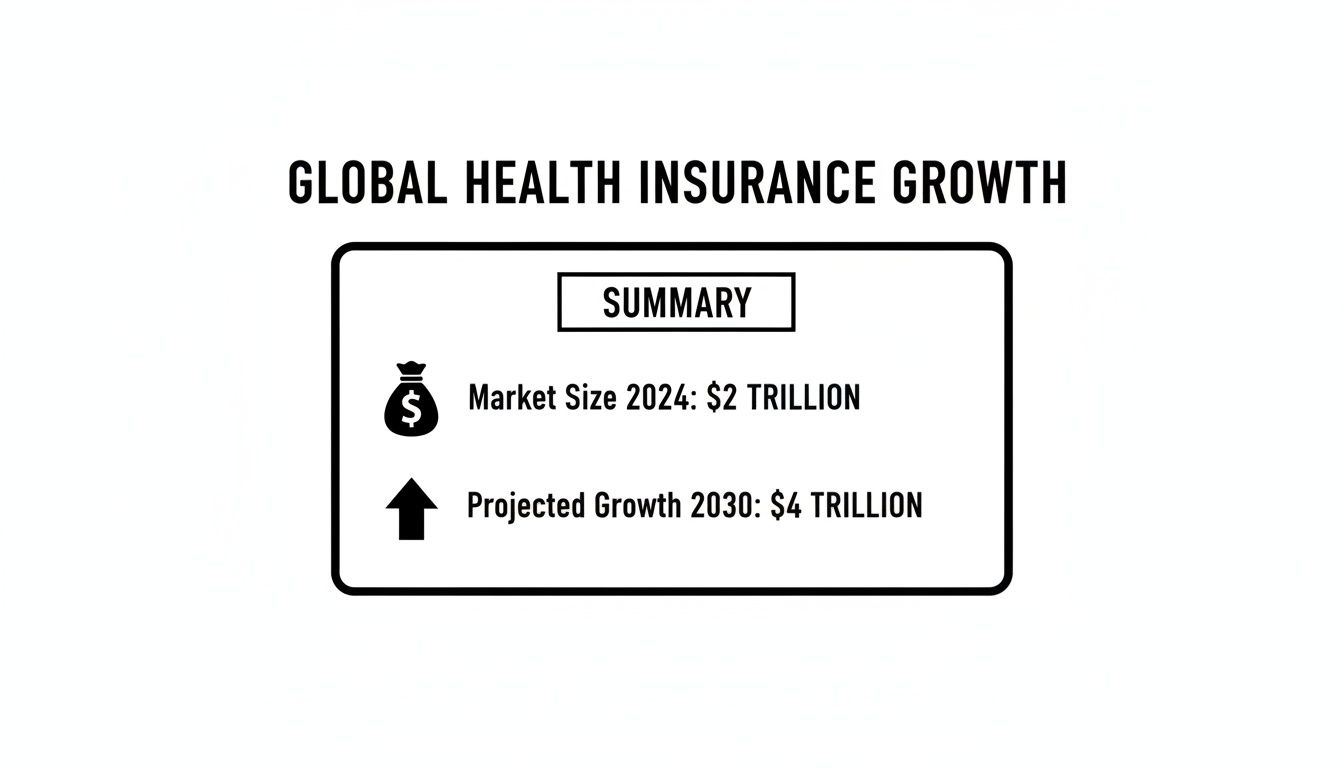
This projection to a $4 trillion market by 2030 highlights how critical the right insurance is for securing your health and finances while you’re living away from home.
The Digital Nomad In Southeast Asia
Let’s start with a classic expat scenario: “Alex,” a solo digital nomad who splits time between Chiang Mai, Thailand, and Bali, Indonesia. Alex’s income isn’t always predictable, so budget is a huge factor. Even more important, their lifestyle includes scooter rentals and working from places that might be a long way from a major hospital.
For Alex, the priorities are crystal clear:
- Emergency Medical Evacuation: This is non-negotiable. If Alex has a serious accident in a remote part of Bali, they need a plan that covers the astronomical cost of an air ambulance to a top-tier hospital in Singapore or Bangkok.
- Affordable Premiums: To keep monthly costs down, Alex can choose a plan with a higher deductible. Critically, excluding coverage in the USA can slash premiums by up to 50%.
- Global Flexibility: The plan has to offer seamless coverage across multiple countries without forcing them to buy a new policy every time they move.
In this case, a provider like GeoBlue’s Xplorer Essential plan is a strong contender. It delivers comprehensive worldwide coverage (excluding the U.S.) and has a reputation for robust emergency services. The focus here is less on routine check-ups and more on catastrophic coverage that protects against financially devastating events.
The Expat Family In Europe
Now, let’s picture the “Smith family,” moving from the U.S. to Berlin for a long-term corporate job. They have two young kids and are thinking about having a third. Their priorities are all about stability, comprehensive care, and convenience.
The Smith family’s insurance needs are completely different from Alex’s:
- Robust Maternity and Newborn Care: This is at the top of their list. They need a plan with a short or non-existent waiting period for maternity benefits and full coverage for prenatal, delivery, and postnatal care.
- Comprehensive Wellness Benefits: With kids, routine pediatric check-ups, vaccinations, and dental and vision care are essential for managing long-term health.
- Strong Direct Billing Network: Frequent doctor visits are a given. A plan with a massive network of direct-billing clinics in Germany is a lifesaver, as it removes the headache of paying upfront and waiting for reimbursement.
For the Smiths, a premium plan like Cigna Global’s Gold or Platinum tier makes perfect sense. While it costs more, it provides the broad, day-to-day coverage a growing expat family needs. The higher premium is a trade-off they’re willing to make for peace of mind.
The key differentiator isn’t just the list of benefits, but how those benefits align with your life stage and location. A digital nomad’s “best” plan is a family’s inadequate one, and vice versa.
To properly weigh your options, a detailed side-by-side analysis is invaluable. For a deeper dive, our international health insurance comparison tool allows you to filter plans based on your specific needs and see how leading providers stack up.
Scenario-Based Comparison of Leading Expat Plans
To make this even clearer, let’s put two major providers head-to-head to see how they perform for different needs. This table breaks down how key features align with specific expat profiles and destinations.
| Key Feature | Provider A (e.g., Cigna Global) | Provider B (e.g., GeoBlue Xplorer) | Recommended For… |
|---|---|---|---|
| Wellness & Routine Care | Excellent, with broad coverage for check-ups, dental, and vision in higher-tier plans. | More focused on essential and emergency care; wellness is often an optional add-on. | Cigna: Expat families and long-term residents who need predictable, comprehensive healthcare. |
| Emergency Evacuation | Strong, with global assistance, but may be part of a broader benefits package. | A core strength, with a focus on a high-quality global network for urgent situations. | GeoBlue: Digital nomads, adventurers, and expats in remote locations where local care is limited. |
| Maternity Coverage | A key feature of Gold and Platinum plans, often with shorter waiting periods. | Available as an optional rider, typically with a standard 10-12 month waiting period. | Cigna: Expats planning to start or grow their family abroad in the near future. |
| Cost Structure | Higher premiums for comprehensive benefits, offering lower out-of-pocket costs for frequent use. | Lower premiums, especially for “excluding USA” plans, balanced with higher deductibles. | GeoBlue: Budget-conscious expats who prioritize catastrophic coverage over routine care. |
Ultimately, finding the right expat medical insurance is a matching game. It requires an honest look at your lifestyle, health needs, and what you’re comfortable spending. By using these scenarios as a guide, you can move past generic feature lists and find the plan that truly gives you security for your adventure abroad.
The Financial Risks of Inadequate Expat Insurance

Moving abroad is one of life’s great adventures, but it comes with a massive blind spot that too many expats ignore: the staggering financial fallout of a medical emergency. Trying to get by with a basic travel policy—or worse, no coverage at all—isn’t just a risk. It’s a gamble with your entire financial future. The best expat medical insurance isn’t just another document; it’s one of the most important asset protection tools you can have.
Without a proper expat health plan, every single dollar of your medical care comes directly out of your pocket. In many countries, you’ll be asked to pay enormous sums upfront just to be admitted for treatment. This can wipe out your savings in a matter of days, force you into debt, or even mean selling assets back home to cover one hospital bill.
Catastrophic Costs Are a Real-World Threat for Expats
“Catastrophic” isn’t hyperbole. In many popular expat destinations, the cost of quality private healthcare can easily match or even blow past what you’d pay in the United States. A sudden accident or unexpected illness can set off a chain reaction of expenses that spiral out of control with terrifying speed.
Just look at these real-world estimates for common medical events, which can swing wildly depending on the country and severity:
- Emergency Appendectomy: What seems like a routine surgery can run anywhere from $15,000 to $40,000 in a private hospital in Western Europe or parts of Southeast Asia.
- Complex Fracture Surgery: A bad fall or an accident that requires surgery and a few nights in the hospital can easily hit $50,000 to $80,000.
- Heart Attack Treatment: Emergency cardiac care, including life-saving intervention and an ICU stay, can rack up bills well over $100,000.
- Medical Evacuation: If you’re in a location that can’t handle your emergency and need an air ambulance, the price tag ranges from $25,000 to over $200,000, based on the distance and level of medical support needed.
These numbers paint a very clear picture: a single health crisis can have life-altering financial consequences if you don’t have the right insurance. This is exactly why a comprehensive plan is non-negotiable for expats. To see how these factors affect your premium, check out our detailed guide to expat health insurance costs.
The Hidden Danger of Medical Inflation for Expats
Beyond the sticker shock of a huge hospital bill, there’s another financial risk that works more quietly but is just as dangerous: medical inflation. Around the world, the cost of healthcare services, new technologies, and medications consistently rises much faster than the general rate of inflation. For an expat, this means a policy that seemed adequate a few years ago might leave you dangerously exposed today.
The core purpose of high-limit expat medical insurance is to transfer the immense financial risk from your family’s shoulders to the insurer. It acts as a firewall between a medical crisis and your long-term financial stability, ensuring you can access care without risking bankruptcy.
The out-of-pocket exposure for a serious illness or injury abroad can be financially devastating. In high-quality private hospitals across popular expat hubs in Asia and Latin America, a single complex hospitalization or emergency evacuation can easily cost tens, if not hundreds, of thousands of U.S. dollars. This is why policies with high benefit limits and robust evacuation coverage are so widely recommended for the expat community.
Industry analysis consistently shows that health insurance remains a fast-growing sector, with insurers pricing plans to account for rising medical inflation, which often runs two to three times higher than general inflation. This reality drives up premiums, but it also reinforces the need for plans with broad limits to cap your catastrophic liability.
Ultimately, thinking of international medical insurance as just another travel expense is a critical mistake. It is an essential part of your financial planning as an expat, built to safeguard your savings, your investments, and your peace of mind. Without it, you’re not just risking your health—you’re risking everything you’ve worked so hard to build.
How to Select and Secure Your Ideal Expat Plan
After you’ve compared a few plans and figured out what matters most to you, it’s time to turn that research into reality. Securing the best international medical insurance for your expat life can feel like the final, toughest hurdle, but a clear process makes a world of difference.
You could go straight to an insurer, but that often leaves you trying to decipher complex policy documents all on your own. Frankly, it’s not the most efficient way to get things done.
A much better approach is to work with a specialist expat insurance broker. An experienced broker is your advocate, someone who navigates the market for you. They already know the ins and outs of the top-tier carriers and can quickly zero in on the options that actually make sense for your life abroad and your budget.
The Value of Expert Guidance for Expats
Think of a broker as a professional advisor for your global health. Their job isn’t just to sell you a policy; it’s to help you build a personalized safety net that you can actually rely on.
This is what that expert guidance looks like in practice:
- Customized Plan Comparison: Brokers give you side-by-side quotes from multiple insurers, but more importantly, they translate the fine print into practical terms so you can see the real-world trade-offs for your expat situation.
- Application Support: They help you through the underwriting process, making sure your application is accurate and complete. This is absolutely critical if you have pre-existing conditions to declare.
- Long-Term Advocacy: If you ever need to file a complicated claim or, in a worst-case scenario, require an emergency evacuation, your broker is there to help you deal with the insurer and cut through the red tape.
Securing your plan isn’t just a transaction; it’s the final step in protecting your health and finances abroad. Expert guidance ensures your choice delivers true peace of mind, not just a policy number.
Your Actionable Steps to Enrollment
With the right support, the process of getting your ideal plan is surprisingly straightforward. It usually starts with a consultation to go over your needs as an expat, which is then followed by a set of tailored quotes.
Once you’ve picked a plan, the broker will guide you through the enrollment and make sure your coverage is active and ready to go before your move.
Ultimately, leaning on professional advice just simplifies the whole journey. It takes the guesswork out of the equation and empowers you to make a confident decision, securing a plan that protects your well-being no matter where your expat adventure takes you.
Your Top Expat Insurance Questions Answered
When you’re sorting out life abroad, insurance questions are bound to pop up. It’s a complex world, but it doesn’t have to be confusing. Here are some straightforward answers to the questions we hear most often from expats just like you.
Can I Get Coverage for Pre-existing Conditions as an Expat?
Yes, you can, but the “how” is what really matters. Every insurer handles this differently, and it’s a critical detail to get right.
Some providers will offer full coverage for a pre-existing condition, but only after a waiting period—think anywhere from 6 to 24 months. Others might be willing to cover you immediately but will add a surcharge to your premium to account for the higher risk. In other situations, an insurer might just place an exclusion on that specific condition, meaning they won’t pay for any treatments related to it.
The most important thing? Be completely transparent about your medical history from day one. Hiding something might seem like a way to get a lower premium, but it’s a surefire way to have a claim denied when you need it most.
Does My Expat Plan Cover Me in My Home Country?
Most expat health plans do include some coverage for when you go back home, but it’s not a free-for-all. This benefit is designed for short, temporary visits—not for you to move back and use it as your primary insurance.
Typically, a policy might cover you back home for up to 90 days per year. You absolutely need to check this detail in your policy, because staying longer could mean you’re completely uninsured for that part of your trip.
What Is the Difference Between Travel and Expat Insurance?
This is probably the most common—and most critical—question we get. Getting this wrong can be a costly mistake for an expat.
Travel insurance is a short-term solution for trips. It’s built for emergencies, like a sudden accident on vacation, a canceled flight, or lost luggage. It was never intended to cover routine medical care.
Expat medical insurance is your long-term, comprehensive health plan for living abroad. It’s designed to act just like the health insurance you’d have at home, covering everything from emergency surgery and cancer treatment to your annual physicals and managing chronic conditions. Think of it as your real, everyday healthcare for a global life.
Finding the right plan isn’t about picking the cheapest option; it’s about matching your unique expat life with the right provider. At Expat Global Medical, our specialists live and breathe this stuff. We can help you compare top-tier plans and lock in coverage that protects both your health and your wallet, no matter where in the world you decide to call home.
Ready to get started? Get your free, personalized quote today!.