Showing up in Vietnam ready for a new chapter, only to find your health insurance from back home is basically worthless, is a tough pill…
Showing up in Vietnam ready for a new chapter, only to find your health insurance from back home is basically worthless, is a tough pill for many expats to swallow. The hard truth is that standard domestic plans are almost never recognized here. This makes a specialized expat medical insurance vietnam policy your single most important tool for financial and medical security.
Why Your Old Health Insurance Is a Liability in Vietnam
Trying to use your domestic health insurance in Vietnam is a bit like trying to pay for your pho with a currency the street vendor doesn’t accept. Sure, the money in your hand has value somewhere else, but it’s not useful here. In the same way, your insurance card from the U.S., UK, or Australia means very little to a Vietnamese hospital, which almost always requires foreigners to pay cash upfront.
This gap creates a huge financial risk. Without the right coverage, you are on the hook for the full cost of everything, from a minor tumble on a scooter to a serious medical emergency. This is exactly why a dedicated expat medical plan isn’t a luxury; it’s essential for anyone living abroad.
The Critical Gaps in Domestic Coverage
Your old insurance policy was designed for your home country’s healthcare system, period. It wasn’t built for the realities of life in Vietnam, leaving you exposed to several major blind spots that only an expat-focused plan can properly cover.
Some of the biggest problems with trying to use a domestic plan abroad include:
- No Direct Billing: Vietnamese hospitals don’t have direct billing arrangements with most foreign insurers. This means you’ll be forced to pay the entire medical bill out-of-pocket and then dive into the complicated, often frustrating process of trying to get reimbursed later.
- Poor Emergency Evacuation Coverage: Your home plan is highly unlikely to cover the shocking cost of a medical evacuation from a rural province to a major city like Ho Chi Minh City. Repatriation back to your home country is even less likely to be covered and can easily cost over $100,000.
- Restrictive Networks: Your policy’s network of “approved” doctors is back home. Every single hospital and clinic in Vietnam will be considered “out-of-network,” which usually means your claims will be denied or your coverage will be drastically reduced.
Even Vietnam itself understands the importance of feeling medically secure. By 2020, the government successfully enrolled over 90% of its population in a national health insurance program. This move directly boosted public confidence and economic stability, proving there’s a clear link between having solid protection and being able to live freely and without worry.
Before we go further, it’s worth highlighting the stark differences between what you’re used to and what you need now.
Comparing Domestic Insurance vs Expat Medical Coverage
This table breaks down the critical gaps between a typical health plan from your home country and the specialized coverage essential for living safely and securely in Vietnam.
| Coverage Feature | Typical Home Country Insurance | Essential Expat Medical Insurance |
|---|---|---|
| Direct Billing in Vietnam | Almost never available; you pay first. | Widely available at international clinics/hospitals. |
| Medical Evacuation | Rarely covered, or has very low limits. | A core benefit, often with $1,000,000+ in coverage. |
| Provider Network | Limited to your home country. | Global network of doctors and hospitals. |
| International Claims | Complicated reimbursement process. | Streamlined, with multilingual 24/7 support. |
| Repatriation of Remains | Usually not included. | A standard, essential inclusion. |
| Political Evacuation | Not covered at all. | Often included for unexpected civil unrest. |
As you can see, the two types of plans are built for completely different worlds. The structure, rules, and benefits of domestic plans just don’t translate to life abroad.
For a more detailed look at these shortcomings, check out our guide on why U.S. health insurance doesn’t work abroad. An expat plan is designed from the ground up to handle these international challenges, giving you real, functional protection right when you need it most.
Choosing the Right Expat Insurance for Your Life in Vietnam
Picking the right insurance plan for your new life in Vietnam is a bit like packing a toolbox. You wouldn’t bring just a single screwdriver for a major renovation, right? In the same way, the simple travel policy you bought for a week-long beach holiday just won’t cut it for a year-long stay as an expat.
Each type of plan is built for a specific purpose. For expats, retirees, and digital nomads, getting this choice right is one of the most critical decisions you’ll make. It’s not just about ticking a box; it’s about making sure your coverage truly matches your lifestyle and how long you plan to call Vietnam home.
Decoding Your Expat Insurance Options
The world of expat medical insurance vietnam can feel a little overwhelming at first, but your options really boil down to three main categories. Think of them as levels of protection, moving from temporary, emergency-only cover to comprehensive, long-term health management.
- Short-Term Travel Medical Plans: These are perfect for those initial scouting trips or short stints of up to a few months. They are built to handle unexpected medical emergencies—a sudden illness or, heaven forbid, a scooter accident—but they won’t cover routine check-ups. This is your emergency-only toolkit.
- Annual Multi-Trip Policies: If you find yourself flying in and out of Vietnam often but aren’t living there full-time, this is a fantastic, convenient option. It covers you for multiple international trips over a year (usually up to 30, 45, or 90 days per trip), so you don’t have the hassle of buying a new policy every single time.
- Long-Term Expat Health Insurance: For anyone planning to live in Vietnam for six months or more, this is the real deal. It’s not just travel insurance; it’s proper health insurance, much like what you’d have back home. It covers the big emergencies and the day-to-day stuff like doctor visits, specialist appointments, and wellness checks. This is the complete toolbox, designed for real life abroad.
This quick visual breaks down how a typical expat plan works on the ground in Vietnam, showing the two main ways you’ll access care.
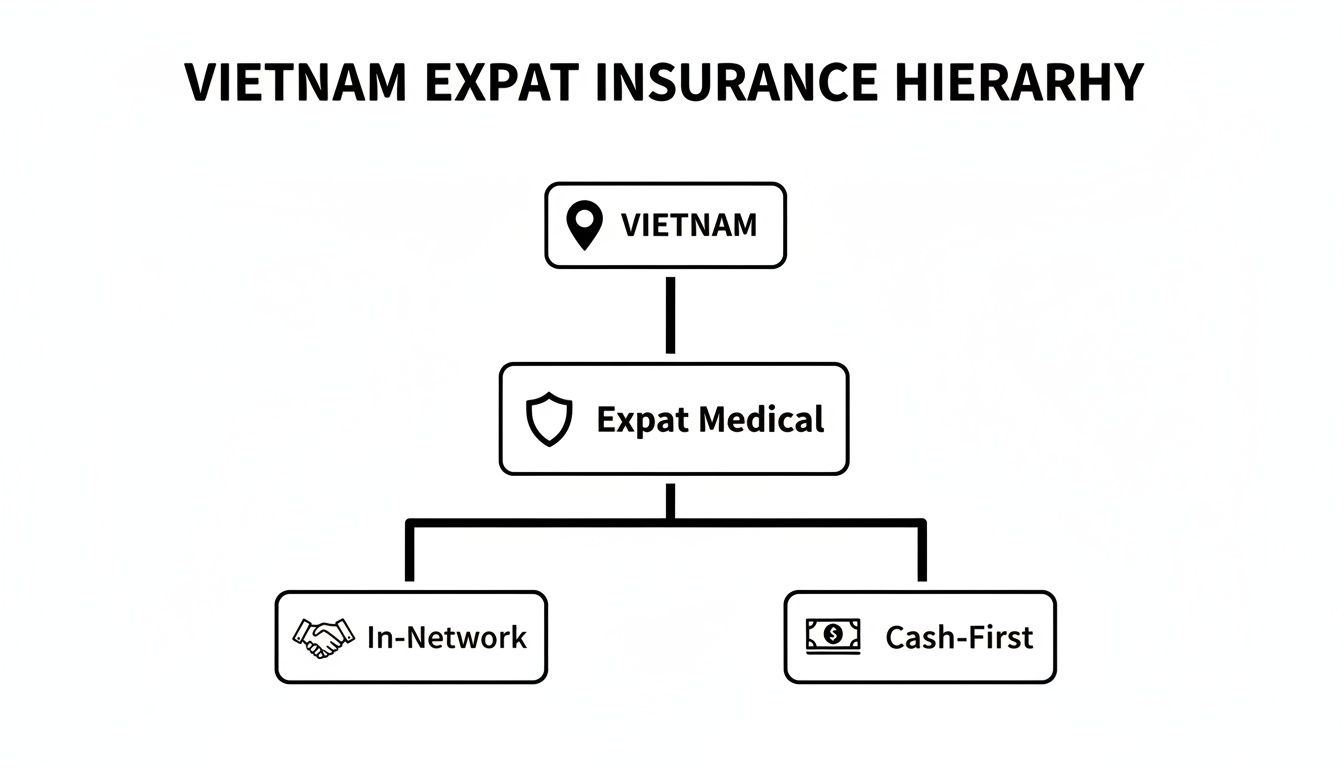
As you can see, your policy will either let you use direct “in-network” billing at major international hospitals or have you pay “cash-first” at smaller clinics and get reimbursed later.
Must-Have Coverage for Expat Peace of Mind
When you start looking at long-term expat plans, the jargon can get thick. Let’s cut through the noise and focus on what actually matters for your protection. A good policy should feel less like a gamble and more like a sturdy safety net, always there when you need it.
First and foremost, your plan needs solid coverage for both inpatient and outpatient care. Inpatient care is any treatment that requires you to be formally admitted to a hospital, like for surgery or a serious illness. Outpatient care is everything else—a visit to your family doctor, seeing a specialist, getting lab tests, or picking up prescriptions.
A high overall coverage limit is non-negotiable for anyone living in Vietnam. It’s tempting to go for a cheaper plan with a lower limit, but one serious medical event can wipe that out in a heartbeat. We recommend a minimum coverage limit of $250,000 as a safe starting point, though many expats choose $500,000 or more for genuine financial security.
Aligning Your Plan with Your Expat Lifestyle
At the end of the day, the “best” insurance plan is the one that fits your specific life in Vietnam. A digital nomad hopping between cafes in Da Nang has very different needs from a retiree settling into a quiet life in Hoi An.
Think about your daily routines, your medical history, and where you’ll be living. If you’re in a big city like Ho Chi Minh City, you’ll have great access to international hospitals with direct billing networks. But if you’re setting up in a more rural spot, a plan with a dead-simple reimbursement process is going to be your best friend. By considering these factors, you can find a policy that does more than just exist on paper—it genuinely protects your new life abroad.
Understanding Vietnam’s Healthcare Landscape for Expats
When you think about healthcare in Vietnam, picture a tale of two completely different worlds. This contrast is the single most important thing to grasp, as it directly shapes the kind of expat medical insurance Vietnam residents and long-term visitors absolutely must have. One world exists in the bustling hubs of Ho Chi Minh City and Hanoi, and the other unfolds across the vast, beautiful, but far less developed provinces.
In the big cities, you’ll find impressive, international-standard hospitals. Places like FV Hospital or Vinmec International Hospital offer a level of care that can rival what you’d expect back home, staffed with well-trained, often English-speaking doctors. For the expat community, these are the go-to facilities for everything from a routine check-up to complex surgery.
But the moment you venture outside these urban centers, the picture changes dramatically. Local and provincial clinics are set up for basic care. They’re perfectly fine for minor issues, but they simply don’t have the specialized equipment or staff to handle serious trauma or a complex medical crisis. This gap isn’t just a small detail; it’s the core reason why the right insurance plan is so critical for expats.

The Number One Risk for Expats: Road Accidents
Beyond the brick-and-mortar hospitals lies the biggest threat to foreigners in Vietnam: the roads. That iconic image of a chaotic, buzzing river of motorbikes is part of the country’s charm, but it’s also a serious danger. Traffic rules often feel more like gentle suggestions than hard laws, and accidents are startlingly common.
Even a minor-seeming incident—a low-speed scooter bump or a tumble in a busy intersection—can lead to nasty injuries. We’re talking broken bones, deep abrasions (the infamous “road rash”), and head trauma. The immediate medical bills can pile up fast, but the logistical nightmare of getting to the right kind of care is an even bigger worry for a long-term resident.
The reality is stark: road accidents are a leading cause of tourist fatalities in Vietnam. The chaotic dance of motorbikes makes every journey a high-stakes venture, yet this is where affordable insurance becomes a true lifeline. To give you an idea, Squaremouth.com notes that basic medical-only plans average just $3.08 per day, while more extensive coverage comes in around $9.58 for a typical month-long trip.
This isn’t just a risk for adventurous backpackers renting motorbikes. It applies to every expat. You could be a passenger in a Grab car, a pedestrian crossing the street, or a cyclist out for a ride in the countryside—the potential for an accident is always there.
Why Emergency Medical Evacuation is Non-Negotiable for Expats
This brings us to what is arguably the most critical feature your insurance policy must have: robust Emergency Medical Evacuation coverage. Too many people think this is only for extreme, movie-like scenarios, like being airlifted from a remote jungle. In Vietnam, its most common and vital use is for something far more ordinary.
Let’s walk through a scenario. You’re an expat living in a provincial town and have a road accident. The local clinic can clean your wounds and maybe set a simple fracture, but they can’t perform the surgery needed for a severe break. They don’t have an MRI machine to check for internal bleeding.
In this situation, “medical evacuation” isn’t about flying you out of the country. It’s about arranging and paying for a medically staffed ambulance to drive you several hours to a capable international hospital back in Ho Chi Minh City.
Without this coverage, you’re on the hook for coordinating and funding that transfer yourself, which is a terrifying and expensive prospect in the middle of a crisis. A private, medically-staffed ambulance can easily cost thousands of dollars.
Here’s what good evacuation coverage actually does for you:
- Coordination: The insurance company’s 24/7 assistance team handles all the logistics. They find a hospital with an available bed and arrange the ambulance and medical crew.
- Payment: They cover the high costs of the transfer, ensuring you get to the right facility without any financial delays.
- Peace of Mind: You get to focus on your health, knowing that experts are managing your safe transport to a place where you can be treated properly.
Ultimately, understanding this landscape shows that good insurance isn’t just about paying bills. It’s about ensuring you have a bridge to life-saving care when every second counts—closing that critical gap between where you might get hurt and where you can actually get healed.
What Medical Evacuation and Repatriation Really Mean for Expats
When you dig into the fine print of any quality expat medical plan, you’ll find two benefits that are absolutely vital, yet almost always misunderstood: Medical Evacuation and Repatriation.
Think of them as your personal medical life raft, ready to deploy in a crisis. While they might sound similar, they do two very different—and equally critical—jobs.
Getting the difference straight is crucial for anyone with expat medical insurance vietnam. The middle of a crisis is the worst possible time to find out you have the wrong kind of protection. And don’t think these benefits are just for extreme adventurers; they’re for everyday expats facing completely unexpected emergencies.
Medical Evacuation: The Crucial First Step
Medical Evacuation is all about getting you from a place with inadequate medical care to the nearest facility that can actually treat you properly. It’s a short-range rescue mission, and frankly, it’s a common scenario in Vietnam where the gap between rural clinics and major city hospitals is huge.
Imagine you’re in a scooter accident in a small town. The local clinic can patch up your scrapes, but they don’t have the surgeons or equipment for the complex surgery your broken leg needs. This is where medical evacuation coverage kicks in.
Your insurer’s assistance team coordinates and pays for a medically-equipped ambulance to get you to an international-standard hospital in Ho Chi Minh City or Hanoi. It’s the bridge that closes that healthcare gap, making sure you get the right care, right away.
Without this benefit, you’d be stuck trying to arrange and pay for that transfer yourself—a logistical and financial nightmare during an already terrifying time. A single, medically-staffed transfer can easily run into thousands of dollars out-of-pocket.
Repatriation: The Journey Home
Repatriation, on the other hand, is the long-haul journey. This benefit covers the staggering cost of transporting you all the way back to your home country for ongoing medical treatment, recovery, or just to be with your family. It’s usually triggered for severe conditions where a long recovery is expected.
Let’s go back to that same scooter accident. Say the injury requires months of specialized physical therapy. After you’re stabilized in a Vietnamese hospital, your policy’s repatriation benefit would arrange for a commercial flight with a medical escort to get you home safely.
This is where the costs become truly astronomical. Arranging an emergency medical flight, especially one needing a full air ambulance, can easily soar past $100,000. For most people, that’s a life-altering expense. Repatriation coverage protects you from that catastrophic financial blow so your focus can stay on healing, not on hospital bills.
Breaking Down the Costs and Coverage
It’s one thing to talk about these benefits in theory, but it’s another to see what they actually deliver in a real-world emergency. A robust expat policy provides more than just a flight; it’s a complete logistical safety net.
- 24/7 Assistance Team: Your first call is to a dedicated emergency line. This multilingual team immediately takes control, speaking with local doctors and arranging your transport.
- Transportation Logistics: They handle absolutely everything—from booking the ambulance or flight to making sure the right medical personnel and equipment are on board.
- Direct Payment: The insurer pays the providers directly. You aren’t hit with massive upfront bills during the crisis.
- Family Support: Many great plans even include benefits like flying a family member to your bedside if you’re hospitalized for a while.
Proper medical evacuation insurance is a non-negotiable cornerstone of any worthwhile expat plan. It delivers the ultimate peace of mind, turning a potential catastrophe into a managed event. No matter where your Vietnamese adventure takes you—from the mountains of Sapa to the beaches of Mui Ne—you have a lifeline back to world-class care.
How to Find an Affordable and Effective Expat Medical Plan
Finding high-quality expat medical insurance vietnam for your new life abroad doesn’t have to break the bank. The secret is knowing that your insurance premium isn’t some fixed, non-negotiable number. Think of it more like a set of sliders you can adjust to find that perfect sweet spot between rock-solid protection and a price that fits your budget.
Getting a plan is simpler than ever before, a reality reflected in Vietnam’s fast-growing insurance market. The sector has exploded, jumping from USD 88.40 million to a projected USD 221.23 million by 2033, fueled by a 10.73% compound annual growth rate. This boom is largely thanks to digital platforms that make buying a policy a straightforward process. You can dig into the numbers behind this market growth on imarcgroup.com.
The Key Levers That Control Your Premium
Imagine your insurance cost is controlled by three main levers. Once you understand how each one works, you can start customizing a plan that gives you exactly what you need without paying for extras you don’t.
- Your Age and Health: This is the one factor you can’t really change. As a general rule, premiums go up with age because the statistical risk of needing medical care increases. A healthy 28-year-old digital nomad will almost always pay less than a 65-year-old retiree.
- Your Deductible: This is simply the amount you agree to pay out-of-pocket before your insurance kicks in. Choosing a higher deductible—say, $1,000 instead of $250—is one of the most powerful ways to lower your monthly premium.
- Your Coverage Limit: This is the maximum amount your policy will pay out in total. While a massive limit sounds comforting, you can often find significant savings by opting for a $500,000 limit instead of a $2,000,000 one, which is still more than enough for the vast majority of medical situations.
By tweaking these elements—especially your deductible—you can effectively design your own price point. It’s a strategic trade-off where you take on a bit more manageable, upfront risk in exchange for lower, predictable monthly payments.
Sample Costs for Expat Medical Insurance
To make this more concrete, let’s look at some real-world estimates. The table below shows how different expat profiles and their coverage choices can influence what they pay each month.
These sample costs for different expat profiles can help you budget effectively for your essential medical coverage.
Estimated Monthly Premiums for Vietnam Expat Medical Insurance
| Expat Profile | Coverage Tier | Estimated Monthly Premium |
|---|---|---|
| Young Digital Nomad (Age 30) | Basic (High Deductible) | $80 – $120 |
| Expat Professional (Age 45) | Mid-Range (Moderate Deductible) | $180 – $250 |
| Retiree Couple (Age 65) | Comprehensive (Low Deductible) | $700 – $950+ (for two) |
As you can see, finding affordable international health insurance is completely achievable when you tailor the plan to your specific life and budget.
Aggregators vs. Specialist Brokers: Who Is Better for Expats?
When you start looking for a plan, you’ll run into two main options: using a big online aggregator or working with a specialist broker. While aggregators are great for getting a quick price check, they often miss the mark for expats with unique needs.
Think of an aggregator like a giant supermarket. It has tons of options on the shelves, but there’s no one there to help you read the fine print or tell you which product is actually the right fit for you.
A specialist broker, on the other hand, is more like a personal shopper. They take the time to understand your life in Vietnam, your health background, and your budget. They can then cut through the jargon, explain the tricky exclusions, and find you a plan from a reputable company that truly meets your needs. It’s the difference between just buying a policy and investing in real peace of mind for your life abroad.
Your Simple Steps to Getting Covered in Vietnam
Okay, turning all this information into a real, active policy is the final—and most important—step. You now have a solid grasp of Vietnam’s healthcare system, the potential risks, and the kinds of insurance that can protect you. The good news is that securing the right expat medical insurance Vietnam policy isn’t complicated when you break it down.
Think of this as your roadmap from figuring out what you need to actually being enrolled. It’s all about making a confident decision so you can start your expat life on the right foot, without any lingering worries.

Assess Your Personal Expat Needs
Before you even glance at a quote, you need to take stock of your own situation. This is like creating a blueprint for your perfect coverage. After all, a 30-year-old digital nomad zipping around Da Nang has completely different needs than a 65-year-old retiree settling into the quiet life in Hoi An.
Get honest about these key factors:
- Lifestyle: Are you a city person, or will you be living in a more rural area? Will you be riding a scooter every day or trekking through remote mountains? High-octane hobbies need specific add-ons to your policy.
- Health History: Be completely upfront about any pre-existing conditions. Full disclosure is non-negotiable; it’s the only way to get a plan that will actually cover you and avoid having a claim denied down the road.
- Location: Where will you be based? Living in Ho Chi Minh City, with its world-class international hospitals, might change your thinking on network and deductible options.
- Budget: Pinpoint a realistic monthly premium you can comfortably handle. This number will help you find that sweet spot between your deductible and your total coverage limits.
Request Quotes and Compare Your Options
Once you have your personal blueprint, it’s time to start gathering quotes. This is where working with a specialist broker really shines. Instead of filling out the same information on a dozen different insurer websites, you do it just once and get back several comparable options.
When you’re looking at different plans, don’t just focus on the price tag. Dig into the details. How does medical evacuation really work? What’s the process for getting reimbursed for out-of-network claims? Are there waiting periods for certain treatments? A slightly higher premium is often a small price to pay for excellent 24/7 support and a claims process that doesn’t give you a headache.
Finalize and Activate Your Policy
After you’ve picked the winner, the last leg of the journey is completing the application and underwriting process. This means submitting your personal details and filling out a health questionnaire. Be meticulous and accurate here to make sure your policy is rock-solid.
Once you get the green light, take the time to actually read your policy documents. Save the emergency contact numbers to your phone and make sure you understand exactly how to start a claim. With your policy active, you can dive into your new life in Vietnam with the confidence that your health and finances are properly protected.
Ready to get started? You can get a personalized, no-obligation quote from Expat Global Medical or schedule a consultation to walk through your specific needs with one of our expert advisors.
Your Top Questions About Vietnam Expat Insurance, Answered
Let’s be honest, figuring out the nuts and bolts of expat medical insurance can feel a bit overwhelming. But getting clear, straightforward answers is the only way to choose a plan with confidence. We’ll tackle some of the most common questions we hear from expats who are either planning their move or are already on the ground in Vietnam.
Does My Visa Type Affect My Expat Insurance Options?
In short, no. Whether you’re on a tourist e-visa, a business visa, or you hold a Temporary Residence Card (TRC), your specific visa document doesn’t stop you from buying insurance. What providers really care about is your intended length of stay and residency status, not the piece of paper itself.
The goal is to match the insurance to your life. A short-term travel medical insurance vietnam plan is the perfect tool for initial scouting trips. But for anyone setting up shop here long-term, a comprehensive annual expat policy isn’t just a good idea—it’s the right tool for the job.
How Is My Pre-Existing Condition Handled?
This is a huge one, and it trips up a lot of people. Your standard, off-the-shelf travel policy will almost certainly exclude pre-existing conditions. Full stop. However, proper long-term expat medical plans are a different beast entirely.
Many plans designed for expats can offer coverage for pre-existing conditions. This might look like covering the “acute onset” of a flare-up, or it could mean full coverage after a certain waiting period has passed. The golden rule here is to disclose every single condition when you apply. Hiding something is the fastest way to get a future claim denied.
This is where working with an experienced broker really pays off. We know which carriers and plans are built to accommodate specific health needs right from the start.
Can I Use My Expat Insurance at Any Hospital in Vietnam?
This all comes down to your plan’s network. Top-tier international insurers have spent years building direct-billing relationships with the best hospitals in cities like Ho Chi Minh City and Hanoi—think FV Hospital or Vinmec. This is the dream scenario: the hospital bills the insurer directly, and you avoid forking over a huge amount of cash upfront.
If you go to an out-of-network facility or a smaller local clinic, you will almost always have to pay for your treatment first. You’ll then gather your receipts and paperwork to submit a claim for reimbursement. Before you ever need care, it’s vital to check your insurer’s hospital directory and get a handle on the claims process for both in-network and out-of-network situations.
Navigating the world of international insurance is complex, but you don’t have to do it alone. The experts at Expat Global Medical are here to offer personalized advice, helping you compare plans to find the perfect fit for your life in Vietnam. Get a free, no-obligation quote today and take the first step toward securing your peace of mind.