Relying on your health insurance from back home while living abroad is a massive financial gamble. It might feel safe and familiar, but these plans are built for one country’s healthcare system. The moment you step outside that system, you’re often left with little to no coverage, facing potentially staggering medical bills if an emergency strikes. For any expat, a dedicated expat medical insurance policy isn’t just a good idea—it’s essential.
Why Your Domestic Health Plan Is a Risky Bet Abroad

It’s tempting to stick with what you know. But using your domestic health plan overseas is like taking a house key to another country and expecting it to unlock your new apartment. It just wasn’t made for that.
Domestic plans are built around specific networks of doctors and hospitals. The second you get care somewhere else, you’re considered “out-of-network.” In the insurance world, that’s a red flag for huge, unexpected costs.
Even if your plan agrees to cover a fraction of an emergency abroad, you’ll likely be on the hook for the rest of the bill. And forget about routine care—things like check-ups, specialist visits, or prescription refills are almost never included. This is why a proper expat medical insurance plan is so critical.
The Most Common—and Dangerous—Coverage Gaps
This isn’t just about high out-of-pocket costs; it’s about being left vulnerable when you need help the most. The limitations of domestic plans create some truly dangerous gaps in your safety net.
Here are the problems expats run into all the time:
- Outright Claim Denials: The most common scenario is painfully simple: your insurer just refuses to pay for any care you receive outside your home country.
- Paying Upfront in a Crisis: You’ll almost certainly have to pay the entire medical bill yourself—which can easily be tens of thousands of dollars—and then try to get a small piece of it reimbursed months later.
- No Lifeline for Medical Evacuation: If you have a serious accident in a remote area, your plan won’t touch the cost of an emergency airlift. That service alone can exceed $100,000.
Thinking your domestic plan has you covered abroad is one of the most expensive assumptions an expat can make. The reality is that these plans are geographically limited, leaving you dangerously exposed to both health and financial crises.
There’s a reason the global health insurance market is booming, with projected annual growth of around 6.7%. More and more people are realizing they need coverage built for a global life. This competition is great news, as it means better and more competitive options for people living and working abroad.
At the end of the day, your plan from back home simply isn’t designed for the realities of an expat lifestyle. For a deeper look at these limitations, especially for Americans, our guide explains in detail why U.S. health insurance doesn’t work abroad. Getting a handle on this is the first crucial step to protecting yourself.
Decoding The Different Types Of Global Health Plans
Once you realize your health plan from back home won’t cut it abroad, the next challenge is figuring out which type of global coverage you actually need. The world of health insurance when living abroad isn’t a one-size-fits-all situation; it’s more like choosing the right tool for the job. You wouldn’t use a hammer to turn a screw, and you definitely shouldn’t rely on a short-term policy for a long-term move.
Getting a handle on the basic differences between plan types is the single most important step you can take to protect both your health and your wallet. If you pick the wrong one, you could end up with massive coverage gaps, leaving you just as exposed as you were with your domestic plan.
Let’s break down the main options, with a special focus on expat medical insurance, so you can confidently match the right policy to your specific adventure.
Short-Term Travel Medical Insurance
Think of travel medical insurance as the first-aid kit you’d pack for a vacation or a short work assignment. Its main purpose is to shield you from sudden, unexpected medical disasters—like a broken leg from a skiing accident or a severe illness that lands you in the hospital. These plans are built for a specific timeframe, usually lasting anywhere from a few days up to a year.
They are a fantastic, budget-friendly choice for temporary trips. But their laser focus on emergencies means they simply aren’t designed for the day-to-day realities of an expat’s life.
Key features of travel medical insurance usually include:
- Emergency Medical and Accident Coverage: This is the heart of the policy, covering costs for injuries and illnesses that pop up out of the blue.
- Medical Evacuation: Most plans include coverage to transport you to the nearest capable hospital if the local facilities can’t handle your condition.
- Limited Scope: These policies almost never cover routine check-ups, preventative care, or pre-existing conditions.
This is the perfect plan for a digital nomad backpacking through Southeast Asia for six months or a student spending a semester abroad. It is not the right solution for someone moving their family to another country for the next few years. For that, you need expat medical insurance.
Long-Term Expat Medical Insurance
If travel insurance is a first-aid kit, then expat medical insurance is the fully-stocked doctor’s bag. This is the comprehensive, long-term solution built from the ground up for individuals and families living outside their home country for a year or more. It works a lot like the health insurance you’re used to back home, just with a global footprint.
These plans are designed for the real-life needs of an expatriate. They cover everything from emergency surgery to your annual physical, creating a solid safety net that lets you manage your health proactively, no matter where you are in the world.
A true expat medical plan is designed for living, not just visiting. It provides continuous, renewable coverage for both emergencies and routine healthcare, giving you peace of mind for the long haul.
This is the go-to choice for a family relocating for a multi-year work contract, a retiree settling down in Portugal, or anyone making a permanent move abroad. To really get into the nuts and bolts, our detailed guide on what global medical insurance is offers a much deeper look at these comprehensive plans.
Local Private Health Plans
A third option is to buy a local private health plan directly in your new country. This can be a decent strategy, especially if you plan on staying put in one country for the long haul and don’t expect to need medical care anywhere else. Local plans are often more affordable and are designed to work seamlessly with that country’s healthcare system.
But this approach comes with some serious strings attached. The biggest one is a total lack of portability—your coverage evaporates the second you cross the border. That makes it a poor fit for anyone who travels often for work or fun, or for those who might want the option to get treatment back in their home country. Plus, these plans are often only offered in the local language, which can turn understanding your benefits or filing a claim into a major headache.
Comparing Global Health Insurance Options
To make it even clearer, here’s a quick-glance table to help you see how these three main options stack up against each other. Think of this as your cheat sheet for matching the plan type to your lifestyle.
| Plan Type | Best For | Typical Coverage Duration | Key Limitation |
|---|---|---|---|
| Travel Medical Insurance | Short-term travelers, tourists, digital nomads on trips under a year | Days up to 1 year | Emergency-only; no routine care or pre-existing conditions |
| Expat Medical Insurance | Long-term residents, retirees, families living abroad for 1+ years | Annually renewable; designed for continuous coverage | Higher premium cost due to its comprehensive nature |
| Local Private Plan | Individuals staying indefinitely in one single country | Annually renewable within that country | Coverage stops at the border; no portability |
Ultimately, the right choice comes down to how long you’ll be abroad and what kind of healthcare access you need to feel secure. For short trips, travel insurance is a no-brainer. But for anyone truly building a life in a new country, a comprehensive expat medical insurance plan is the only option that provides true peace of mind.
The Must-Have Features In Every Expat Medical Policy
When you start comparing expat medical insurance plans, it’s easy to get fixated on the monthly premium. But a low price tag can be deceptive, often masking critical gaps in coverage that leave you exposed when you need it most. A genuinely solid policy isn’t defined by its cost, but by its core features—the non-negotiables that deliver real security.
Knowing what these essential benefits are helps you cut through the marketing fluff and evaluate plans based on their true value. From a simple doctor’s visit to a life-threatening emergency, these are the pillars of quality health insurance when living abroad. Let’s break down exactly what you should be looking for.
This decision tree is a great way to visualize which type of plan makes sense for your specific journey, whether it’s a short trip, a long-term move, or something in between.
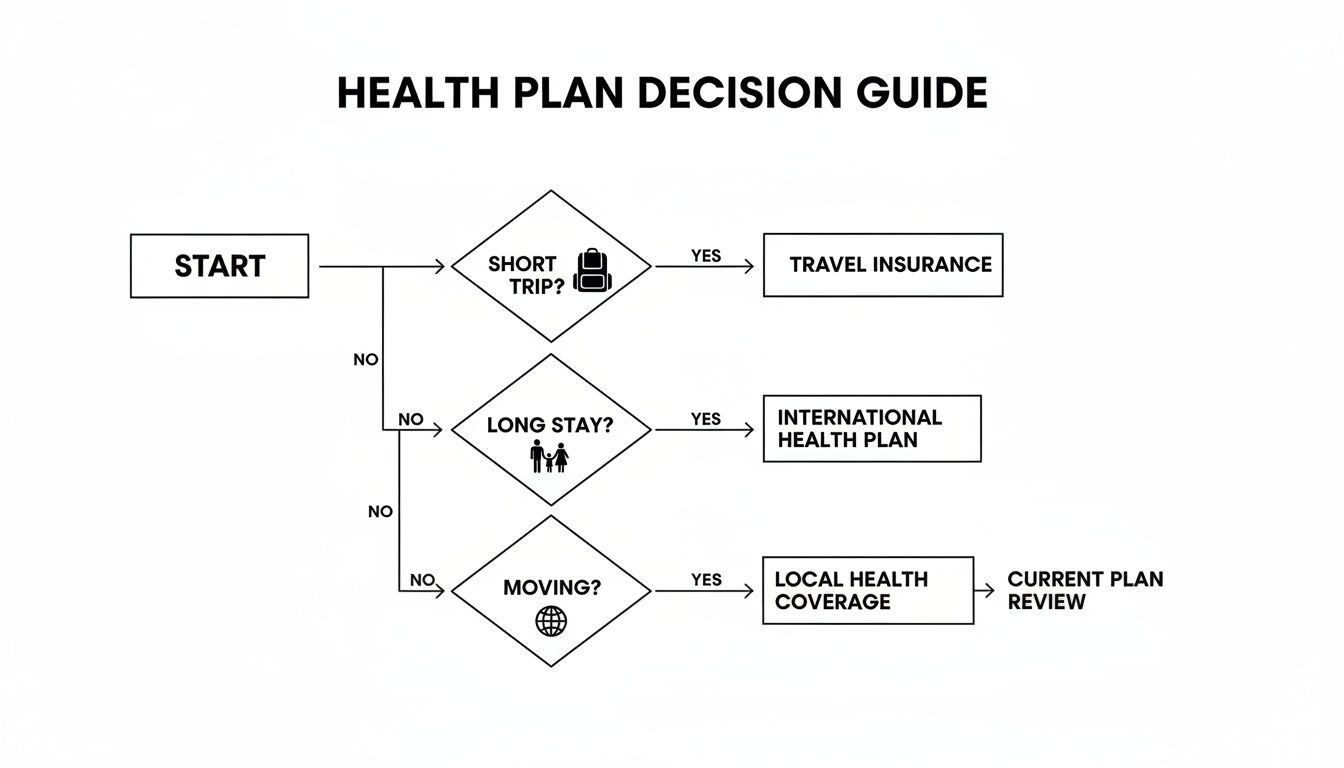
The main takeaway here is simple: the length and purpose of your time abroad are what should drive your insurance choice, pointing long-term residents squarely towards expat medical insurance.
Comprehensive Inpatient and Outpatient Care
At the absolute core of any decent expat medical plan is coverage for both inpatient (when you’re admitted to a hospital) and outpatient (when you’re not) services. You can think of them as two sides of the same coin. Without both, your coverage has a massive hole in it.
Inpatient care is for the big, scary, and expensive stuff. It covers things like:
- Overnight hospital stays for surgery or a serious illness
- Intensive care unit (ICU) services
- Surgeon’s fees and operating room charges
Outpatient care, on the other hand, covers everything else—all the medical services you get without being admitted. This is your day-to-day healthcare: routine check-ups, visits to specialists, diagnostic tests like X-rays and bloodwork, and prescription drugs. A plan that only covers hospitalization leaves you paying out-of-pocket for every single doctor’s visit.
Emergency Medical Evacuation: The Ultimate Lifeline
Picture this: you’re living in a gorgeous but remote village on the coast of Thailand. You have a serious accident, and while the local clinic can patch you up, they aren’t equipped for the complex surgery you urgently need. This is where emergency medical evacuation coverage becomes a literal lifesaver.
This feature covers the astronomical cost of transporting you from a place with inadequate medical facilities to the nearest hospital that can give you the right care. An emergency airlift can easily top $100,000—an expense that would be financially crippling for almost anyone.
Medical evacuation isn’t a luxury add-on; it’s an essential safeguard. It ensures that no matter where your adventure takes you, you have a clear path to high-quality medical treatment in a crisis.
When you’re looking at this benefit in an expat medical policy, pay close attention to the coverage limits and what the policy says will trigger an evacuation. This is one area where you absolutely cannot afford to cut corners.
Maternity Benefits For Growing Families
For any expats planning to start or grow their family while living abroad, strong maternity coverage is a must. The cost of having a baby varies wildly around the world, from a few thousand dollars in some countries to well over $50,000 in places like the United States. A good expat medical insurance policy will cover everything from prenatal check-ups and delivery to postnatal care for both mother and baby.
But there’s a huge catch you need to be aware of: waiting periods. Most insurers make you wait anywhere from 10 to 24 months before your maternity benefits kick in. This means you have to plan ahead and get the policy well before you even think about getting pregnant to ensure you’re covered.
Navigating Pre-Existing Conditions
A pre-existing condition is any health issue you had before your new insurance policy started—think diabetes, asthma, or a history of heart trouble. This is easily one of the trickiest parts of buying expat medical insurance, and how an insurer handles it is a make-or-break detail.
Generally, policies will take one of three routes:
- Full Coverage: This is the ideal outcome. The insurer agrees to cover your condition, though sometimes it means you’ll pay a higher premium.
- Exclusion: The company offers you a policy but carves out an exception, stating it will not pay for any costs related to your specific pre-existing condition.
- Denial: If the condition is seen as too high-risk, the insurer might just refuse to offer you a policy at all.
It is absolutely crucial to be 100% honest about your medical history on your application. Hiding a condition might seem tempting, but it can lead to your claims being denied or your entire policy being cancelled just when you need it most. Always, always read the fine print to understand exactly what is—and isn’t—covered.
How To Compare Expat Medical Insurance Plans Like A Pro
Picking the right expat medical plan can feel like you’re staring at a wall of options, with dozens of providers all claiming to be the best. To make a smart decision, you have to look past the monthly price tag and dig into what really gives a policy its value. A cheap plan with a lousy network or a claims process from the stone age can end up costing you a whole lot more when you actually need it.
This section will give you a clear framework to evaluate your options like someone who’s been through it before. We’ll break down the critical factors—from provider networks to the dreaded fine print—so you can find a plan that delivers genuine security and peace of mind for your life abroad.
Balancing Premiums and Deductibles
Think of your insurance costs like a seesaw. On one side, you have the premium—that’s the fixed amount you pay every month or year just to keep the lights on and your policy active. On the other side is your deductible, which is the amount you have to pay out of your own pocket before the insurance company starts picking up the tab.
These two numbers almost always work in opposite directions:
- A higher deductible usually means a lower monthly premium. You’re basically agreeing to take on more of the initial financial risk yourself in exchange for smaller, regular payments.
- A lower deductible almost always leads to a higher monthly premium. You pay more upfront in your premium so that your insurance kicks in much, much sooner.
There’s no magic formula here; it’s all about finding a balance that matches your budget and your health. A young, healthy digital nomad might be perfectly happy with a high-deductible plan to keep monthly costs down. A retiree managing a few chronic conditions, on the other hand, will probably sleep better with a low-deductible plan that offers more predictable expenses.
Evaluating The Provider Network
A plan’s provider network is simply the list of hospitals, clinics, and doctors that have a direct-billing agreement with the insurer. For an expat, this is a massive deal. When you get care inside the network, the hospital sends the bill straight to your insurance company. You just handle your part, like the deductible or co-pay, and walk away.
Without a strong direct-billing network, you’re stuck paying the entire medical bill upfront—we’re talking potentially thousands of dollars—and then chasing down your insurer for reimbursement. That can create a huge amount of financial stress and a mountain of paperwork.
A robust, easy-to-use direct-billing network isn’t just a nice-to-have feature. It’s a critical lifeline that protects your cash flow during a medical emergency. Always check the network in your specific city or region before you sign anything.
Understanding Policy Exclusions
Every single expat medical insurance policy has exclusions. These are the specific conditions, treatments, or situations that the plan will not cover, no matter what. Reading this “fine print” is absolutely essential to avoid a nasty surprise right when you need help the most.
Some of the usual suspects you’ll find on an exclusion list include:
- Treatment for pre-existing conditions that you didn’t disclose or that weren’t approved for coverage.
- Cosmetic surgery that isn’t medically necessary.
- Injuries you get while doing high-risk sports or activities (think scuba diving or rock climbing).
- Alternative therapies like acupuncture or chiropractic care, unless you’ve paid extra for that benefit.
Don’t just skim this part of the policy document. Really take the time to understand what isn’t covered so you can make an informed choice or find a plan that better fits your lifestyle. For a side-by-side analysis, our overseas health insurance comparison tool is a great way to see how different policies stack up.
Assessing The Claims Process and Portability
Finally, think about the real-world logistics of using your insurance. A clunky, difficult claims process can turn a stressful medical event into an absolute nightmare. Look for insurers with a modern, straightforward system, ideally one with an online portal or a mobile app that makes submitting claims easy.
Portability is another huge factor for anyone whose expat life might involve another move down the road. A good expat medical insurance plan should be able to pack its bags and move with you. Make sure the policy will cover you not just in your current country but also in other places you might end up. That kind of flexibility is the hallmark of a true global plan built for the reality of expat life.
As you budget, keep in mind that medical costs don’t stand still. Medical inflation is a serious challenge, with recent reports projecting global medical expenses will climb by over 10% each year—a rate that’s blowing past general economic growth. This trend will directly affect your future premiums and really drives home the importance of picking a plan with sustainable costs. You can discover more insights about these accelerating medical trends on oneworldcover.com.
How to Match an Expat Medical Insurance Plan to Your Real-World Needs

Insurance policies can feel abstract—a confusing mix of jargon about deductibles, networks, and exclusions. The best way to really grasp what health insurance when living abroad means is to see how it plays out for real people. By walking through a few common expat profiles, you can start to connect the dots between your own life and the features of a plan.
Let’s look at three different expats. Each one has a unique set of needs, priorities, and, ultimately, a different “best fit” insurance strategy. This should help you figure out what actually matters for your own journey.
Scenario 1: The Retiree in Portugal
Meet Eleanor, a 68-year-old moving to Portugal’s sunny Algarve region to enjoy her retirement. She’s in great health but manages hypertension with daily medication. Her biggest priority is simple: she wants reliable, easy access to quality care without the fear of massive bills eating into her fixed income.
For Eleanor, the right expat medical insurance strategy boils down to a few key things:
- Rock-Solid Pre-Existing Condition Coverage: This is an absolute dealbreaker. She needs a plan from an insurer that will fully cover her hypertension and any related care from the moment her policy starts.
- A Strong Local Network: Eleanor wants to find local doctors she can trust. A plan with an extensive direct-billing network in Portugal is huge for her, as it means she won’t have to pay out-of-pocket for routine visits or prescriptions.
- A Low Deductible: To keep her costs predictable, a lower deductible is worth the trade-off of a higher monthly premium. It’s all about peace of mind when you’re living on a retirement budget.
A comprehensive expat medical plan with a strong European network and clear coverage for her condition is the only sensible choice for Eleanor. A local Portuguese plan might look cheaper at first glance, but it wouldn’t let her get treatment back home, and simple travel insurance is completely out of the question.
Scenario 2: The Young Family in Singapore
Now, let’s picture Mark and Sarah. They’re moving to Singapore with their two young kids for Mark’s three-year corporate assignment. They know Singapore’s healthcare is top-notch but also incredibly expensive. Their main concern is getting comprehensive coverage for the whole family, including what might happen down the road.
Their ideal expat medical insurance plan needs to be built around family-first benefits:
- Maternity Coverage: They’re thinking about having another child, so a policy with a strong maternity benefit is a must. They’ll need to enroll at least 12-24 months before conceiving to get past the standard waiting period.
- Wellness and Pediatric Care: Coverage for routine check-ups, vaccinations for the kids, and those unexpected childhood illnesses is non-negotiable.
- High Coverage Limits: Given Singapore’s sky-high medical costs, a plan with a high annual limit (think over $1,000,000) provides a crucial safety net against a worst-case scenario.
A top-tier group plan through Mark’s employer would be perfect. If that’s not on the table, a premium family expat policy that includes robust maternity and wellness benefits is the way to go.
Choosing a plan isn’t just about protecting against emergencies; it’s about supporting your lifestyle and future plans. For a family, that means investing in coverage that grows with them.
Scenario 3: The Digital Nomad in Latin America
Finally, we have Leo, a 28-year-old freelance developer. He plans to spend the next year bouncing between Colombia, Peru, and Mexico. He’s healthy, active, and watching his budget closely. He isn’t worried about wellness check-ups but absolutely needs a safety net in case of a serious hiking accident or a sudden illness.
Leo’s needs are all about flexibility and emergency protection:
- Global Portability: His plan has to cover him seamlessly as he moves from one country to the next. No one wants to apply for a new policy every time they cross a border.
- An Emergency Focus: A plan that centers on hospitalization and medical evacuation is perfect for him. He’s fine paying for minor clinic visits out of his own pocket.
- A High Deductible: To keep his monthly premium as low as possible, Leo is comfortable taking on a higher deductible. He has enough savings to cover a few thousand dollars if a serious medical event happens.
For Leo, a classic expat medical insurance plan is the right fit, but one tailored to his lifestyle—with a high deductible and a worldwide coverage area that excludes expensive countries like the USA to keep costs down. This strategy gives him the essential catastrophic coverage he needs without derailing his budget.
Your Action Plan for Securing Expat Medical Insurance
Alright, you’ve got a solid grasp of the options out there. Now it’s time to put that knowledge to work. Securing the right health insurance when living abroad isn’t a shot in the dark; it’s a methodical process. The final, most crucial step is knowing exactly what to ask the providers you’re considering.
This goes way beyond just getting a price quote. You’re digging in to verify the quality of the coverage and the reliability of the company behind it. Arming yourself with the right questions now will save you from major headaches later.
Key Questions to Ask Every Insurer
Before you even think about signing on the dotted line, you need direct, clear answers to these questions. A provider that’s worth your time will be completely transparent and happy to explain the details.
- Direct Billing: “Can you show me the direct-billing hospital network in my specific city, and how does that process work in an emergency?”
- Claims Process: “What’s the average turnaround time for getting reimbursed for out-of-network claims, and what paperwork will I need to submit?”
- Pre-Existing Conditions: “What is your underwriting process for my specific pre-existing condition, and can I see the proposed policy wording in writing before I commit?”
- Renewals: “How are premium increases calculated at renewal time? What factors, other than my age and medical inflation, do you consider?”
Think of choosing a provider as starting a long-term partnership. Their answers here tell you everything about how supportive and dependable they’ll be when you actually need them. Don’t settle for vague responses.
Leveraging Expert Guidance
You don’t have to navigate this complicated market on your own. Teaming up with a specialist insurance broker gives you a huge advantage. A good broker works for you, not the insurance company, so they offer unbiased advice that fits your unique situation and budget. They can slice through the jargon and quickly compare plans from top-rated insurers, saving you a ton of time and stress.
International health insurance providers are essential partners for any expat. The best ones have exceptional financial strength—a critical factor ensuring they can actually pay claims without a fuss. Cigna Global, for example, holds an A rating from A.M. Best, which signals a strong capacity to meet its financial promises.
For those looking to build a truly global lifestyle, it helps to understand broader strategies like the 5 Flag Theory, which can offer valuable insights that go hand-in-hand with your health coverage planning.
Got Questions About Expat Medical Insurance? We’ve Got Answers.
Stepping into the world of international health insurance can feel a bit like learning a new language. To make things clearer, we’ve pulled together some of the most common questions expats ask, with straightforward answers to help you make sense of it all.
Can I Use My Expat Medical Insurance Back Home?
This is a big one for almost every expat. The short answer is: yes, but with limits. Most quality expat medical insurance plans will cover you for a certain period—think a few weeks or months a year—when you pop back to your home country.
This coverage is really designed for emergencies, like an unexpected illness or an accident while you’re visiting family. It’s not meant for planned check-ups or elective procedures. If you need solid medical cover in both your new country and your old one, you’ll want to look for a plan that specifically offers a “home country coverage” add-on.
How Do I Actually Make a Claim When I’m Overseas?
How you file a claim can make or break your experience with an insurer. The gold standard is direct billing. This is where the hospital or clinic sends the invoice straight to your insurance company. You just handle your deductible or copay, and that’s it. This seamless process is usually available within an insurer’s network of approved providers.
If you go outside that network, you’ll probably have to pay the bill yourself and then submit the receipts for reimbursement. A good, modern insurer will have a simple online portal or a slick mobile app to make this as painless as possible.
The smoothness of a claims process directly impacts your peace of mind during a stressful medical event. Always prioritize insurers known for efficient, user-friendly systems.
Even with the best plan, you might run into a snag. It’s always smart to understand your rights and options for dealing with denied health insurance claims just in case you ever face a dispute.
Are My Pre-Existing Conditions Covered?
Yes, they often can be, but you have to be upfront and choose your plan carefully. A pre-existing condition is any health issue you had before your insurance policy kicked in. When you apply, insurers will “underwrite” these conditions to figure out the risk.
From there, they have a few options:
- Cover the condition fully, though sometimes this means a higher premium.
- Apply a moratorium period, where they won’t cover that specific condition for a set time (often 24 months).
- Exclude the condition from your policy altogether.
Honesty is non-negotiable here. Hiding a condition can lead to a denied claim when you need help the most.
What’s the Difference Between Evacuation and Repatriation?
People often mix these up, but they cover two very different, and very serious, situations.
- Medical Evacuation: This is about getting you to proper medical care. If you’re in a place with inadequate medical facilities, this benefit transports you to the nearest center of medical excellence equipped to handle your condition.
- Repatriation of Remains: A much more somber benefit, this covers the logistical and financial burden of transporting a deceased person’s body back to their home country. It’s a complicated and costly process that no family wants to handle alone.
Finding the right health insurance when living abroad is one of the most important decisions you’ll make for your life overseas. At Expat Global Medical, our specialists are here to offer personalized advice and help you compare plans from the world’s top insurers. Get a free quote today and secure the protection you need for your global life.